Quick Answer: Is an Electric Wheelchair Van Right for You?
Yes — if you have reliable home Level 2 charging and drive under 200 miles per day, an electric wheelchair van built on a modern EV minivan platform (like the Chrysler Pacifica Hybrid PHEV or the fully electric Kia EV9 / Hyundai Ioniq 9 SUV-platform conversions) can save $1,500–$3,000 annually in fuel and maintenance versus a gas wheelchair van. However, fully electric dedicated wheelchair-accessible minivans remain limited in 2026. Most buyers convert a plug-in hybrid or battery-electric minivan/SUV through a mobility upfitter. Expect total costs of $65,000–$110,000 including the vehicle and conversion, with real-world range of 200–280 miles (BEV) or 32 miles electric-only + gas backup (PHEV).
The Electric Wheelchair Van Landscape in 2026
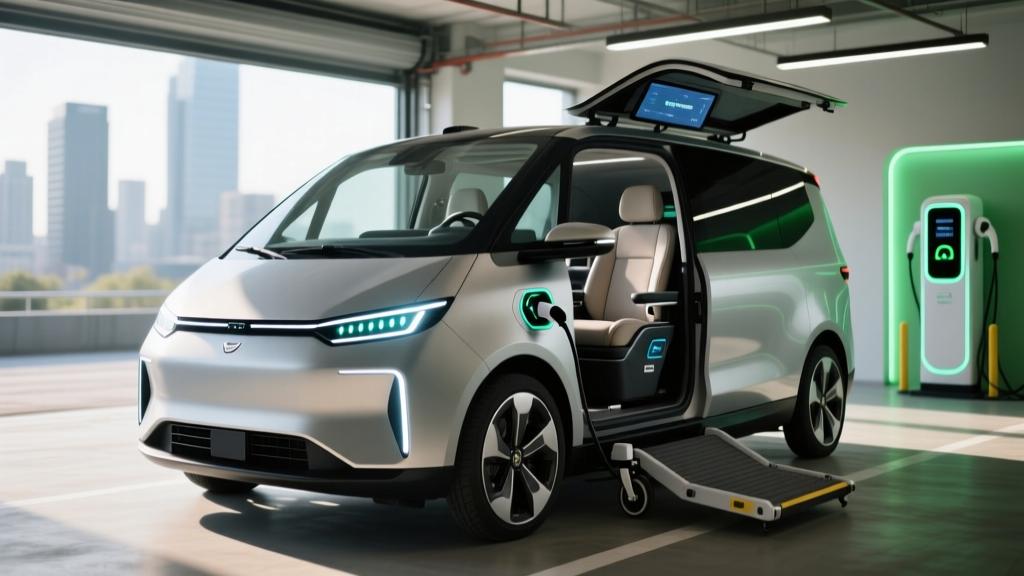
The wheelchair-accessible vehicle (WAV) market has been slow to electrify compared to mainstream passenger cars. The reason is structural: a wheelchair van conversion adds 400–800 lbs of equipment (ramp, lowered floor, reinforced suspension, tie-down systems), which directly reduces range and payload capacity on a battery-electric platform.
That said, the math is shifting. With gasoline averaging $3.40/gallon nationally in early 2026 and electricity at a national average of $0.16/kWh, the per-mile operating cost of an EV is roughly one-third that of a comparable gas minivan. For wheelchair users and caregivers who drive daily — to medical appointments, school, work, and therapy — those savings compound quickly.
The main platforms used for electric wheelchair van conversions in 2026 fall into two categories:
- Plug-in hybrid (PHEV): Chrysler Pacifica Hybrid — the longest-running WAV platform with electric-only capability
- Battery-electric (BEV): Emerging conversions based on large EV SUVs and minivans, though availability through certified mobility upfitters remains limited
Platform Comparison: PHEV vs. BEV for Wheelchair Conversions
| Attribute | Chrysler Pacifica Hybrid (PHEV) | Battery-Electric Minivan/SUV Platform | Gas Chrysler Pacifica (Baseline) |
|---|---|---|---|
| Powertrain | 3.6L V6 + 2-motor PHEV | Dual-motor AWD BEV (typical) | 3.6L V6 gas |
| EPA Electric-Only Range | 32 miles | 230–300 miles (pre-conversion) | N/A |
| Total Range (elec + gas) | ~430 miles combined | 200–260 miles (post-conversion est.) | ~450 miles |
| Battery Capacity | 16 kWh (usable ~13 kWh), NMC | 77–110 kWh usable, NMC/LFP | N/A |
| MPGe (electric mode) | 82 MPGe | 85–105 MPGe | 22 MPG combined |
| Gas MPG (after battery depleted) | 30 MPG combined | N/A | 22 MPG combined |
| Level 2 Charge Time (0–100%) | ~2 hours at 7.2 kW | 7–11 hours at 11 kW | N/A |
| DC Fast Charge (10–80%) | Not available | ~25–35 min at 150–250 kW peak | N/A |
| Vehicle Base MSRP (2026) | ~$51,000–$56,000 | $55,000–$75,000 (platform dependent) | ~$40,000–$50,000 |
| Wheelchair Conversion Cost | $20,000–$30,000 | $25,000–$40,000 (limited upfitters) | $20,000–$30,000 |
| Estimated Total Cost | $71,000–$86,000 | $80,000–$115,000 | $60,000–$80,000 |
| Federal Tax Credit (§30D) | Up to $7,500 (if eligible) | Up to $7,500 (if eligible) | None |
Key insight: The Pacifica Hybrid PHEV remains the most proven and widely supported platform for wheelchair conversions with electrification. Its 32-mile electric-only range covers most daily driving (medical visits, school runs, errands), and the gas engine eliminates range anxiety for longer trips. Full BEV conversions exist through specialty upfitters but carry higher cost, longer lead times, and range penalties from conversion weight.
Real Costs: Buying, Charging, and Maintaining an Electric Wheelchair Van
Understanding total cost of ownership (TCO) is critical. Wheelchair vans are major purchases, and the electrified premium must be justified by operating savings and quality-of-life benefits.
| Cost Category | Pacifica Hybrid PHEV WAV | Gas Pacifica WAV | Difference |
|---|---|---|---|
| Vehicle + Conversion Purchase | $78,000 (est. mid-trim) | $68,000 (est. mid-trim) | +$10,000 EV premium |
| Federal Tax Credit (§30D) | −$7,500 (if eligible) | $0 | −$7,500 savings |
| Net Purchase Cost | $70,500 | $68,000 | +$2,500 |
| Fuel/Electricity (12,000 mi/yr × 5 yr) | $4,200 (70% electric, 30% gas) | $11,100 (at $3.40/gal, 22 MPG) | −$6,900 savings |
| Maintenance (5 years) | $2,800 (fewer fluid changes, regen braking saves pads) | $4,500 | −$1,700 savings |
| Insurance (5 years) | $9,500 (EV surcharge ~8–12%) | $8,500 | +$1,000 |
| Home Charger Installation (Level 2) | $1,200–$2,500 (one-time) | $0 | +$1,850 avg |
| 5-Year Net Cost | $88,850 | $92,100 | −$3,250 EV savings |
The numbers show that the EV premium is largely recovered within 5 years through fuel and maintenance savings — and the gap widens further in years 6–10 as the gas vehicle requires more maintenance (transmission, exhaust, timing components) while the PHEV/BEV does not.
Charging Cost Breakdown
Charging the Pacifica Hybrid's 16 kWh battery from empty to full costs approximately:
- Home (national avg $0.16/kWh): ~$2.08 per full charge → $0.065/mile in electric mode
- Public Level 2 ($0.25–$0.49/kWh): ~$3.25–$6.38 per full charge
- Gas equivalent (at 22 MPG, $3.40/gal): ~$0.155/mile
For a BEV platform with a 100 kWh battery, home charging costs roughly $12.80 for a full charge, translating to ~$0.05/mile — a significant advantage for high-mileage drivers.
Tax Credits, Grants, and Financial Assistance
The financial picture for electric wheelchair vans involves layering multiple incentive programs:
Federal §30D Clean Vehicle Credit — Eligibility Requirements (2026)
- Credit amount: Up to $7,500 for new qualifying PHEVs and BEVs
- MSRP cap: Vans/minivans/SUVs must have MSRP ≤ $80,000 (before conversion)
- Income cap: Modified AGI ≤ $300,000 (joint), $225,000 (head of household), $150,000 (single)
- Battery sourcing: Critical minerals and battery component requirements apply — percentages increase annually through 2032. Check current-year rules at IRS.gov §30D
- Point-of-sale transfer: You can transfer the credit to the dealer at purchase, reducing your out-of-pocket cost immediately
- Important: The wheelchair conversion cost is added after the vehicle MSRP, so the $80,000 cap applies to the base vehicle only — confirm with your dealer and tax professional
Beyond the federal credit, several programs can reduce the effective cost:
- State mobility/adaptive equipment grants: Some states offer $1,000–$5,000 in additional incentives for adaptive vehicle modifications. Check your state's department of transportation or vocational rehabilitation agency.
- Veterans Affairs (VA): Eligible veterans can receive up to $26,000+ toward a wheelchair-accessible vehicle through the VA Automobile Adaptive Equipment (AAE) grant, which stacks with EV incentives.
- Medicaid waivers & vocational rehab: Some state Medicaid programs and vocational rehabilitation agencies provide partial funding for WAV purchases when tied to employment or medical necessity.
- Nonprofit grants: Organizations like the United Way, Easterseals, and the National Organization for Rare Disorders occasionally offer vehicle modification assistance.
Real-World Ownership: What First-Time Buyers Need to Know
Electrifying a wheelchair van introduces considerations that don't apply to a standard EV purchase. Here's what matters in practice:
Home Charging Is Nearly Essential
Public DC fast charging is unreliable in many areas and impractical for daily use with a wheelchair van. You need a Level 2 home charger (240V, 32–48 amps) for convenient overnight charging. Installation typically costs $1,200–$2,500 if your electrical panel has capacity. If you need a panel upgrade (100A → 200A), add $2,000–$4,000. Renters and those without garage access face a real barrier — plan accordingly.
Conversion Weight Kills Range
A full wheelchair conversion (lowered floor, ramp, reinforced suspension, power tie-downs) adds 400–800 lbs. On a BEV, this reduces range by roughly 8–15%. A platform rated at 280 miles EPA pre-conversion may deliver 230–250 miles post-conversion. In cold weather (below 32°F), expect an additional 20–30% range reduction, bringing real-world winter range to potentially 160–200 miles.
Cold Weather and Battery Performance
Lithium-ion batteries lose efficiency in cold temperatures. If you live in northern climates (Minnesota, Michigan, New England), plan for winter range that's 70–80% of the EPA sticker. A PHEV sidesteps this issue because the gas engine provides reliable range regardless of temperature.
Maintenance Advantages
Electric and plug-in-hybrid powertrains eliminate or reduce many maintenance items: no oil changes (BEV), fewer transmission issues, regenerative braking extends pad life to 100,000+ miles, and no exhaust system to corrode. For wheelchair users who depend on their vehicle daily and for whom a breakdown is more than an inconvenience, this reliability matters enormously.
Upfitter Availability
Not every mobility upfitter will work on EV platforms. The high-voltage battery and wiring harnesses require specialized training. Before purchasing any EV for conversion, confirm that a certified upfitter (BraunAbility, VMI, or a regional specialist) supports that specific platform. As of 2026, the Pacifica Hybrid has the widest upfitter support; full BEV platforms have limited but growing options.
| Myth | Fact |
|---|---|
| "EVs can't handle the weight of a wheelchair conversion" | Modern EV platforms are designed for heavy battery packs (1,000+ lbs). A 600-lb conversion is well within structural limits, though range decreases 8–15%. |
| "You'll be stranded with a dead battery" | A PHEV has a gas backup (430+ mile total range). BEV owners who charge at home overnight start every day with a full battery — the 'stranded' scenario applies mainly to unplanned long trips without route planning. |
| "Battery replacement will cost $20,000+" | Modern EV batteries are warrantied for 8 years/100,000 miles minimum (federal mandate). Real-world data shows most batteries retain 85–90% capacity at 150,000 miles. Full replacement is rare and costs $8,000–$16,000 depending on platform. |
| "The tax credit covers the conversion too" | The §30D credit applies to the base vehicle MSRP, not aftermarket conversions. Confirm eligibility with a tax professional — conversion costs are separate. |
| "Charging takes too long" | Home Level 2 charging happens overnight while you sleep — it takes zero active time. A PHEV charges fully in ~2 hours. The 'charging time' objection applies only to public DC fast charging on road trips. |
Decision Framework: Which Electric Wheelchair Van Is Right for You?
Choose Based on Your Situation
Choose a PHEV wheelchair van (Pacifica Hybrid) if:
- You drive 30–80 miles per day and can charge at home overnight
- You regularly take trips over 200 miles (gas backup eliminates planning stress)
- You live in a cold climate where BEV range loss is a concern
- You want the widest upfitter support and shortest conversion lead times
- Your budget is $70,000–$90,000 total (vehicle + conversion)
Choose a BEV wheelchair van platform if:
- You drive under 150 miles per day and have reliable home charging
- You want zero tailpipe emissions and the lowest per-mile operating cost (~$0.05/mile)
- You rarely take trips over 200 miles or are comfortable planning DC fast-charging stops
- You can budget $85,000–$115,000 and accept longer upfitter lead times
- You want minimal maintenance and plan to keep the vehicle 8+ years
Stick with a gas wheelchair van if:
- You cannot install a home charger (apartment, no garage, panel limitations)
- You regularly drive 300+ miles per day or live in a charging desert
- Your budget is under $65,000 total
- You need the maximum number of upfitter options and fastest delivery
Frequently Asked Questions
Can I get a fully electric wheelchair-accessible minivan in 2026?
Fully electric dedicated wheelchair minivans are not yet mass-produced by OEMs. However, mobility upfitters are beginning to convert BEV platforms (large electric SUVs and upcoming electric minivans) into wheelchair-accessible configurations. Availability is limited and lead times are longer than PHEV or gas options. The Chrysler Pacifica Hybrid PHEV remains the most accessible electrified WAV platform.
How much does a wheelchair van conversion cost on an EV?
Wheelchair conversions typically cost $20,000–$30,000 for a PHEV platform and $25,000–$40,000 for a BEV platform, depending on ramp type (side-entry vs. rear-entry), power vs. manual operation, and suspension modifications. BEV conversions cost more due to high-voltage system clearance requirements and limited upfitter experience.
Does the wheelchair conversion void the EV battery warranty?
A properly performed conversion by a certified mobility upfitter should not void the powertrain or battery warranty, but this depends on the manufacturer's terms. Always get warranty confirmation in writing from both the vehicle manufacturer and the upfitter before proceeding. Federal law (the Magnuson-Moss Warranty Act) protects consumers from blanket warranty voids due to aftermarket modifications unless the modification caused the specific failure.
How long does the battery last in an electric wheelchair van?
Federal law requires EV battery warranties of at least 8 years/100,000 miles (10 years/150,000 miles in CARB states like California). Real-world degradation data from fueleconomy.gov and fleet studies show most modern NMC and LFP batteries retain 85–92% of original capacity at 150,000 miles. The Pacifica Hybrid's 16 kWh battery has proven durable in taxi and fleet use.
Is an electric wheelchair van cheaper to insure?
Generally no — EVs carry an insurance surcharge of 8–15% due to higher repair costs (specialized parts, high-voltage safety protocols, and fewer qualified body shops). However, the fuel and maintenance savings typically outweigh the insurance premium increase. Get quotes from multiple insurers before purchasing; some companies (like Geico and Progressive) have narrowed the EV insurance gap.
Can the ramp and lift systems run off the EV's battery?
Most wheelchair ramp and lift systems draw from the vehicle's 12V auxiliary battery, not the high-voltage traction battery. The 12V system is charged by a DC-DC converter from the main battery, so range impact from ramp operation is negligible (a few watt-hours per cycle). Some upfitters offer direct high-voltage integration for powered securement systems, but this is uncommon.
What happens if the battery needs replacement out of warranty?
Out-of-warranty battery replacement for the Pacifica Hybrid costs approximately $6,000–$9,000 (smaller 16 kWh pack). For a full BEV platform with a 100 kWh pack, expect $10,000–$18,000. However, based on current degradation data from manufacturers and fleet operators tracked by sources like NHTSA and independent studies, most EV batteries outlast the vehicle's useful life. Complete failure before 200,000 miles is statistically uncommon.
Next Steps for Prospective Buyers
If you're considering an electric wheelchair van, take these steps in order:
- Confirm home charging feasibility: Get a quote from a licensed electrician for a Level 2 (240V/40–48A) installation. If you can't charge at home, a PHEV or gas vehicle is more practical.
- Contact certified mobility upfitters: Ask BraunAbility, VMI, or a regional specialist which EV/PHEV platforms they currently support and what lead times look like.
- Verify tax credit eligibility: Use the IRS tool at irs.gov to confirm the base vehicle qualifies for the §30D credit based on your income, the vehicle's MSRP, and current battery-sourcing rules.
- Layer your funding: Stack the federal credit with VA grants (if eligible), state incentives, and nonprofit assistance before finalizing your purchase.
- Test drive before converting: Drive the base vehicle in both electric and gas modes (PHEV) to confirm ride quality, entry height, and interior space meet your needs before committing to a $20,000+ conversion.
The electric wheelchair van market is still maturing, but for buyers with home charging and predictable daily routes, the fuel savings, reduced maintenance, and daily convenience of plugging in overnight make a compelling case — especially when layered incentives narrow the upfront cost gap.