The Quick Answer on Electric Vehicle Towing
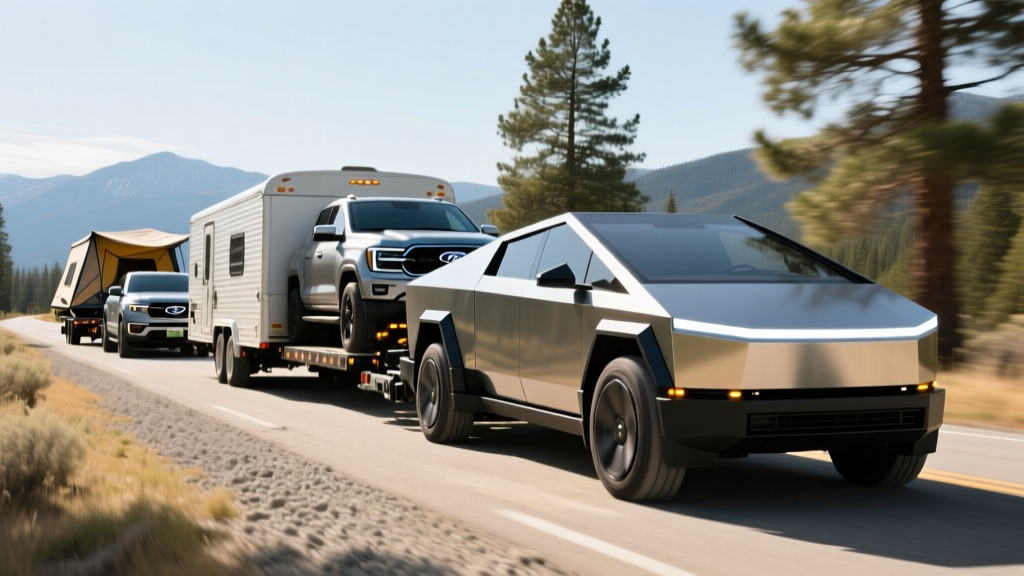
Electric vehicle towing is viable but comes with a massive efficiency penalty: expect to lose 40–60% of your EPA-rated range when pulling a loaded trailer. A Ford F-150 Lightning rated at 320 miles of range will realistically deliver 130–180 miles while towing a 5,000-lb camper. Towing also increases energy consumption from roughly 2.0–2.5 kWh/mile (unladen) to 3.5–5.0 kWh/mile under load, making long-distance trailer trips expensive and logistically complex on public DC fast chargers. EVs excel at local towing (boats to the lake, utility trailers around town) but remain challenging for cross-country hauling due to charging time and infrastructure gaps.
Why Towing Crushes EV Range: The Physics
Every vehicle — gas or electric — loses efficiency when towing. The difference is that EVs are far more sensitive to aerodynamic drag and weight because their energy storage (kWh) is finite and fixed, while a gas truck can simply carry a larger fuel tank or refuel in five minutes at any station.
Three factors dominate towing energy consumption:
- Aerodynamic drag — A boxy travel trailer creates a turbulent air wall behind the tow vehicle. At 65 mph, drag forces can triple compared to an unladen truck. This is the single largest range killer.
- Rolling resistance — Added tongue weight and trailer axle load increase tire deformation. Every 1,000 lbs of trailer weight adds roughly 0.2–0.4 kWh/mile in energy demand.
- Elevation changes — Climbing grades with a trailer demands sustained high-power output. A 6% grade at highway speed with a 7,000-lb combined weight can push consumption above 5.0 kWh/mile. Regenerative braking recovers some energy on descents, but typically only 15–25% of what was spent climbing.
For context, a 2026 Ford F-150 Lightning Extended Range carries a 131 kWh usable battery (Ford F-150 Lightning specs). Unladen, it averages about 2.1 kWh/mile, yielding its EPA rating of ~320 miles. Towing a 5,500-lb travel trailer at 65 mph, consumption climbs to roughly 3.8–4.2 kWh/mile, cutting effective range to 150–175 miles — and that's in mild weather on flat terrain.
EV vs. Gas Truck Towing: A Data-Driven Comparison
The table below compares a 2026 Ford F-150 Lightning Extended Range against a comparable gas-powered 2026 Ford F-150 with the 3.5L EcoBoost V6 and 36-gallon fuel tank, both towing a 5,500-lb travel trailer at highway speeds.
| Metric | F-150 Lightning (EV) | F-150 3.5L EcoBoost (Gas) |
|---|---|---|
| Max towing capacity | 10,000 lbs | 14,000 lbs |
| Energy/fuel capacity | 131 kWh battery | 36-gal tank (~1,188 kWh energy equiv.) |
| Consumption while towing | ~3.8–4.2 kWh/mi | ~8–10 MPG (~3.7–4.2 kWh/mi equiv.) |
| Real-world towing range | 130–175 miles | 280–360 miles |
| Refuel/recharge time | 30–50 min (10–80% at 150–250 kW DC) | 5–8 min at gas station |
| Energy/fuel cost per mile (towing) | $0.15–$0.38/mi (home vs. DCFC) | $0.35–$0.50/mi ($3.50/gal avg.) |
| Regen on descents | Yes — recovers 15–25% of climb energy | No — engine braking wastes energy as heat |
| Tongue weight limit | ~1,000 lbs (varies by config.) | ~1,400 lbs (varies by config.) |
Sources: fueleconomy.gov, Ford Motor Company spec sheets. Gas-equivalent kWh/mi calculated at 33.7 kWh/gallon (DOE standard).
The key takeaway: energy consumption while towing is nearly identical between EV and gas trucks (about 3.7–4.2 kWh per mile in equivalent terms). The gas truck wins on range and refill speed because liquid fuel carries vastly more energy per unit of weight and volume, and refueling infrastructure is ubiquitous. The EV wins on per-mile cost when charging at home and offers regenerative braking advantages in mountainous terrain.
Which 2026 EVs Can Actually Tow? Specs by Model
Not every EV is rated for towing. Many sedans and crossovers have zero or minimal tow ratings. Here are the top 2026 electric vehicles with meaningful towing capability:
| Model | Max Tow Rating | Battery (kWh usable) | EPA Range (unladen) | Est. Towing Range | Base MSRP |
|---|---|---|---|---|---|
| Ford F-150 Lightning Ext. Range | 10,000 lbs | 131 kWh (NMC) | 320 mi | 130–175 mi | $72,090 |
| Rivian R1T Dual-Motor Max Pack | 11,000 lbs | 149 kWh (NMC) | 410 mi | 180–230 mi | $92,000 |
| Chevrolet Silverado EV 4WT | 10,000 lbs | 200 kWh (NMC) | 440 mi | 200–250 mi | $75,000 (est.) |
| Tesla Cybertruck AWD | 11,000 lbs | 123 kWh (NMC) | 340 mi | 150–190 mi | $79,990 |
| Hyundai Ioniq 5 (w/ tow pkg) | 2,300 lbs | 84 kWh (NMC) | 305 mi | 160–200 mi | $52,500 |
| Kia EV9 GT-Line AWD | 5,000 lbs | 100 kWh (NMC) | 270 mi | 120–150 mi | $65,900 |
| GMC Hummer EV Pickup | 7,500 lbs | 212 kWh (NMC) | 350 mi | 170–210 mi | $104,500 |
Towing range estimates assume a mid-size travel trailer (4,000–5,500 lbs) at 65 mph in mild conditions. Actual range varies significantly with trailer aerodynamics, weight, terrain, and temperature. MSRP reflects base trims with tow packages where applicable. Check fueleconomy.gov for official EPA data.
The Real Cost of Towing with an EV
Towing doesn't just cut range — it reshapes your entire cost picture. Here's a breakdown of what a 500-mile round-trip towing a 5,000-lb trailer actually costs, comparing home-charged EV, DC-fast-charged EV, and gas truck scenarios:
| Cost Factor | EV (Home L2 Charging) | EV (DC Fast Charging) | Gas Truck (10 MPG towing) |
|---|---|---|---|
| Avg. consumption (towing) | 4.0 kWh/mi | 4.0 kWh/mi | 10 MPG |
| Total energy for 500 mi | 2,000 kWh | 2,000 kWh | 50 gallons |
| Cost per unit | $0.14/kWh (nat'l avg.) | $0.40/kWh (avg. DCFC) | $3.50/gal |
| Total energy cost | $280 | $800 | $175 |
| Number of stops | 0 (if home-only; impractical) | 3–4 stops (30–50 min each) | 2–3 stops (5–8 min each) |
| Extra time vs. solo drive | N/A | +2–3 hours | +15–25 minutes |
The math reveals an uncomfortable truth: towing on DC fast chargers is the most expensive way to travel by a wide margin. At $0.40/kWh and 4.0 kWh/mile, you're spending $1.60 per mile — roughly triple the gas truck cost. Home charging flips the equation: at $0.14/kWh, the EV costs $0.56/mile, beating gas on a per-mile basis. The catch is that a 500-mile trip requires multiple DC fast charging stops unless you're only towing locally.
Charging Logistics: The Hidden Challenge of EV Towing
Beyond cost, the physical act of charging while towing presents real-world complications that most buyers don't anticipate:
Pull-through charging is rare
Most DC fast charging stations are designed as pull-in/pull-back stalls. Arriving with a 25-foot trailer means either unhitching in the parking lot (time-consuming, requires a safe spot to park the trailer) or finding a station with pull-through lanes. Networks like Electrify America and Tesla Superchargers have begun adding pull-through stalls at select locations, but they remain a minority as of 2026. Apps like PlugShare and A Better Routeplanner now flag pull-through-capable stations — use them.
Charge speeds taper under load
After sustained highway towing, battery temperatures rise. Thermal management systems may limit peak charge rates to protect the pack. A truck that normally peaks at 250 kW may be capped at 150–175 kW during a towing stop, extending your 10–80% charge from ~20 minutes to 35–45 minutes. Preconditioning helps — activate it via the vehicle's navigation system 15–20 minutes before your planned stop.
Campground charging is limited
If you're towing to a campground, don't count on plugging in at your site. Most campgrounds offer 30A or 50A 240V outlets designed for RV house power, not EV charging. A 50A/240V outlet delivers roughly 9.6 kW — enough to add about 20–25 miles of range per hour to a large EV truck. An overnight 10-hour charge yields roughly 200–250 miles of (unladen) range, which may be sufficient for your return trip. Bring a mobile connector with the appropriate adapter, and always call the campground ahead to confirm outlet availability and amperage.
Common Electric Vehicle Towing Myths — Fact-Checked
| Myth | Fact |
|---|---|
| "EVs can't tow at all." | Modern EV trucks tow 7,500–11,000 lbs — competitive with many gas half-ton trucks. The F-150 Lightning is rated for 10,000 lbs; the Rivian R1T for 11,000 lbs. |
| "Regenerative braking makes towing safer." | Regen helps on descents but isn't a substitute for trailer brakes. Most states require independent trailer brakes above 1,500–3,000 lbs. Always use a proper brake controller. |
| "Towing will destroy the battery." | Towing increases cycle count and thermal stress, but modern liquid-cooled packs handle it within design margins. Expect slightly accelerated degradation (1–3% additional capacity loss over 100,000 miles) if you tow frequently, but not catastrophic damage. Battery warranties (typically 8 years/100,000 miles) still apply. |
| "You can't tow in cold weather." | You can, but the range penalty stacks: towing (–40–60%) plus cold weather (–15–30%) can cut range by 65–75% versus the EPA sticker. A 320-mile truck might deliver just 80–110 miles towing in 20°F weather. Plan accordingly. |
| "All EVs come with a hitch." | Many EVs require a factory or dealer-installed tow package. The Hyundai Ioniq 5, for example, needs an optional tow hitch and wiring harness. Confirm tow rating and equipment before purchase — it varies by trim. |
| "EVs get the §30D tax credit even with towing use." | The federal §30D clean vehicle credit applies to eligible new EVs regardless of towing use, but income caps ($150K single / $300K joint), MSRP caps ($80K for trucks/vans), and battery sourcing requirements apply. Some large EV trucks exceed the MSRP cap. Verify current-year rules with a tax professional. |
Decision Framework: Should You Tow with an EV?
Choose an EV for towing IF:
- Your towing is mostly local — boat launches, dump runs, utility trailers within a 60-mile radius of home. You charge at home overnight and rarely need public charging while hooked up.
- You have home Level 2 charging — A 240V/48A home charger (9.6–11.5 kW) is essential. Towing depletes the battery heavily; relying on Level 1 (120V) to recharge after a towing day would take 48–72 hours.
- You value torque and low-end pulling power — EVs deliver peak torque from 0 RPM. The F-150 Lightning's 775 lb-ft makes it feel effortless pulling away from stops and climbing grades, with no downshift hunting.
- You tow in mountainous terrain — Regenerative braking on descents recovers meaningful energy and reduces brake wear. A 6-mile downhill grade can recover 5–10 miles of range.
- You want to power accessories from the truck — V2L (vehicle-to-load) capability in the F-150 Lightning (Pro Power Onboard, up to 9.6 kW) and Rivian R1T lets you run campsite appliances, power tools, or trailer A/C directly from the battery.
Stick with a gas or diesel truck for towing IF:
- You regularly tow over 200 miles one-way — The charging logistics, time penalty, and DCFC cost make long-distance towing painful. A gas truck covers 300+ miles towing and refuels in minutes.
- You tow heavy fifth-wheel or large travel trailers (7,000+ lbs) — Range drops to 100–140 miles in most EV trucks at this weight. The Chevy Silverado EV's 200 kWh pack helps but adds significant cost.
- You lack reliable home charging — If you can't install a Level 2 charger at home, recharging a depleted battery after towing on public infrastructure is expensive and time-consuming.
- You tow in extreme cold frequently — The stacked penalties of cold + towing make range planning extremely difficult, and DCFC speeds slow further in freezing temperatures.
- You need maximum payload and tongue weight — Heavy-duty gas trucks (F-250/2500 class) still dominate for gooseneck and heavy fifth-wheel applications. No EV pickup currently offers a Class V hitch rating above 11,000 lbs.
What First-Time EV Towing Buyers Must Know
If you're considering an EV specifically for towing, build your purchase around these non-negotiable requirements:
- Install a 240V/60A home circuit before the truck arrives. A hardwired Level 2 charger delivering 11.5 kW is the minimum practical setup for towing use. Budget $1,200–$2,500 for the charger and electrician (more if your panel needs upgrading to 200A service).
- Buy the largest battery pack available. Towing exposes the limitations of small packs. The difference between a 100 kWh and 150 kWh pack is the difference between 110 and 170 miles of towing range — often the margin between comfortable and stressful.
- Invest in a weight-distribution hitch and trailer brake controller. EV trucks are heavy (6,000–9,500 lbs curb weight), which changes weight distribution dynamics. A proper WDH and integrated brake controller are essential for safety and stability.
- Plan routes with A Better Routeplanner or PlugShare. Filter for pull-through-capable chargers, check real-time charger status, and always have a backup charging plan. Assume 150 miles of real-world towing range as your planning baseline regardless of the EPA sticker.
- Factor in higher tire wear and insurance. EV trucks are heavy, and towing adds more stress to tires. Expect tire replacement every 25,000–35,000 miles under regular towing use. Insurance premiums for EV trucks average 15–25% higher than comparable gas trucks due to repair costs.
Frequently Asked Questions
Can I tow a travel trailer cross-country with an EV?
Technically yes, but it requires meticulous planning and significant time. A 2,000-mile trip towing a mid-size trailer will require 12–16 DC fast charging stops of 35–50 minutes each, adding 8–12 hours of charging time compared to the same trip in a gas truck. Energy costs on DCFC will likely exceed $600–$900 for the trip. Most EV owners who tow long-distance do so with segments of 150 miles or less between overnight stops where they can charge on Level 2.
Does towing void my EV battery warranty?
No. Towing within the manufacturer's rated capacity is a normal use case covered under standard battery warranties (typically 8 years/100,000 miles with a minimum 70% capacity retention threshold). However, if you consistently tow at maximum capacity in extreme heat and see accelerated degradation, the manufacturer may scrutinize your usage patterns. Document your towing habits and follow the owner's manual thermal management recommendations.
What's the best EV for towing a small boat or jet ski?
For lightweight towing (1,500–3,000 lbs), the Kia EV9 (5,000-lb rating) or Hyundai Ioniq 5 with tow package (2,300-lb rating) handle boat trailers easily with minimal range loss — expect 80–90% of normal range at these lighter loads. You don't need a full-size EV truck for a personal watercraft or aluminum fishing boat.
How does trailer aerodynamics affect EV towing range?
Enormously. A sleek, low-profile teardrop trailer may only reduce range by 25–35%, while a tall, boxy travel trailer with a flat front cap can cut range by 50–60%. If you're choosing a trailer specifically to tow with an EV, prioritize aerodynamic designs — rounded fronts, lower rooflines, and side skirts make a measurable difference in energy consumption at highway speeds.
Is a PHEV a better towing compromise than a full EV?
For frequent long-distance towing, a plug-in hybrid like the 2026 Toyota Tacoma i-FORCE MAX hybrid or a diesel truck may offer a better compromise. You get electric torque for local driving and a liquid-fuel range extender for long hauls. The trade-off: PHEVs have smaller batteries (10–20 kWh), so electric-only range is limited to 25–50 miles, and you still pay for oil changes and engine maintenance. If your towing is 80% local and 20% road-trip, a full EV with a rental gas truck for big trips may be more economical overall.