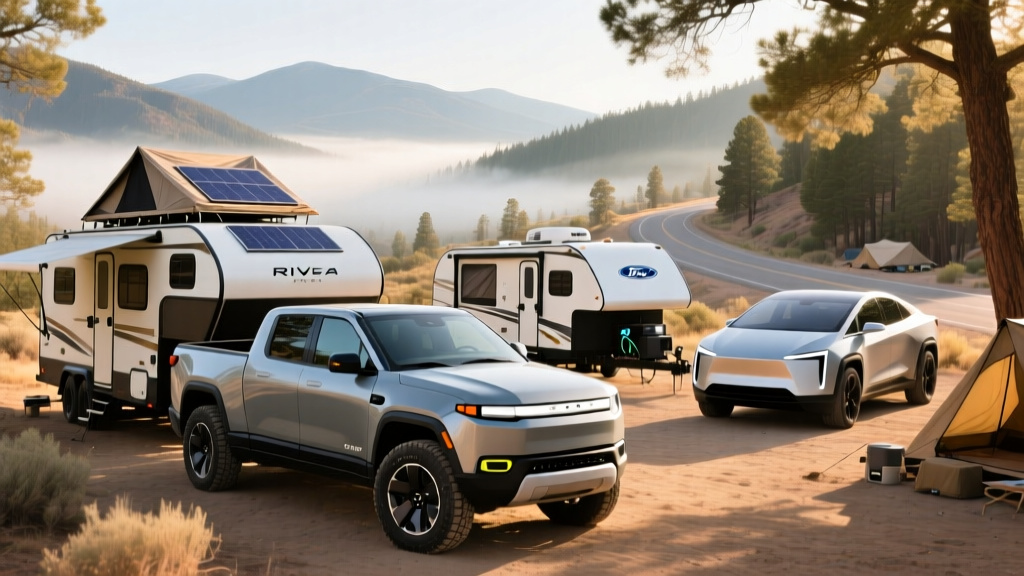
If you're considering an electric vehicle camper setup, here's the practical reality: current EV trucks and large SUVs can tow small-to-medium campers (1,500–4,000 lbs), but expect your real-world range to drop 40–55% from the EPA sticker when towing on the highway. A Ford F-150 Lightning rated for 320 miles EPA drops to roughly 140–170 miles while pulling a 3,500-lb travel trailer at 65 mph. Rivian R1S and R1T models hold up better with their larger battery packs, delivering 150–180 real-world towing miles. The viability of your EV camper adventure depends almost entirely on your route planning, charging access along your corridor, and willingness to stop every 2–2.5 hours on long hauls.
Quick Answer: Can an EV Tow a Camper?
Yes, with caveats. EV trucks (F-150 Lightning, Rivian R1T, Chevy Silverado EV) can tow 5,000–10,000 lbs and pull campers effectively, but towing cuts range nearly in half. Plan routes around DC fast chargers spaced 100–130 miles apart. For campers under 2,500 lbs (teardrops, pop-ups), most long-range EV SUVs work well. For 3,000+ lb travel trailers, stick with extended-range truck platforms and budget extra time for charging stops.
Which EVs Actually Work for Camper Towing?
Not every electric vehicle with a hitch rating makes a practical camper hauler. Battery capacity, charging speed, and thermal management under sustained load separate the viable options from the frustrating ones. Here's how the leading platforms stack up for 2026 model-year specs.
| Vehicle | Max Tow Rating | Battery (kWh usable) | EPA Range | Real-World Tow Range* | Peak DC Charge | 10–80% Time | Base MSRP |
|---|---|---|---|---|---|---|---|
| Ford F-150 Lightning Ext. Range | 10,000 lbs | 131 kWh (NMC) | 320 mi | 140–170 mi | 210 kW | ~34 min | $69,995 |
| Rivian R1T Dual Max Pack | 11,000 lbs | 149 kWh (NMC) | 420 mi | 180–220 mi | 220 kW | ~32 min | $87,900 |
| Chevy Silverado EV 4WT | 10,000 lbs | 200 kWh (NMC) | 440 mi | 200–240 mi | 350 kW | ~28 min | $74,800 |
| Rivian R1S Dual Max Pack | 7,700 lbs | 149 kWh (NMC) | 410 mi | 175–210 mi | 220 kW | ~32 min | $82,900 |
| Tesla Cybertruck AWD | 11,000 lbs | 123 kWh (NMC) | 340 mi | 150–180 mi | 250 kW | ~28 min | $79,990 |
*Real-world tow range estimated at 60–65 mph with a 3,000–4,000 lb travel trailer on flat terrain, 70°F. Cold weather (below 40°F) reduces these figures an additional 15–25%. Source: EPA estimates via fueleconomy.gov, manufacturer spec sheets, and independent towing tests.
The Range Reality: What Towing Actually Does to Your Battery
Towing is the single biggest range destroyer an EV can face — worse than cold weather, worse than high speed alone. Here's the physics: pulling a trailer increases aerodynamic drag substantially (the trailer creates a turbulent low-pressure wake behind the tow vehicle) and adds rolling resistance from 1,500–4,000+ additional pounds. Energy consumption jumps from a typical 2.0–2.5 kWh/mile (unladen highway) to 3.5–5.0 kWh/mile while towing, depending on trailer weight and frontal area.
Towing Range Math You Can Trust
Formula: Usable battery kWh ÷ towing consumption (kWh/mi) = real towing range
Example — F-150 Lightning Extended Range: 131 kWh usable ÷ 4.0 kWh/mi (3,500-lb trailer at 65 mph) = ~163 miles
Example — Silverado EV 4WT: 200 kWh usable ÷ 4.0 kWh/mi = ~250 miles (best-in-class for towing)
Always plan for 80% of calculated range to maintain a safety buffer and avoid charging above 90% SoC at DC fast chargers (where speeds taper dramatically).
The charge curve matters enormously on camping trips. Most EVs peak at their maximum kW rate only between 10–40% State of Charge, then taper progressively. The F-150 Lightning, for instance, peaks at 210 kW briefly but averages closer to 130–150 kW across the 10–80% session. That 34-minute 10–80% claim assumes optimal battery preconditioning — if you arrive at a charger cold (without the navigation system routing you there to warm the pack), add 5–10 minutes.
Electric Vehicle Camper vs. Gas Truck: Cost & Practicality Breakdown
How does an EV camper setup compare to pulling the same trailer with a gasoline or diesel truck? The answer depends heavily on your annual camping mileage, electricity rates, and whether you can charge at home.
| Category | F-150 Lightning (EV) | F-150 3.5L EcoBoost (Gas) |
|---|---|---|
| Purchase Price (base, before credit) | $69,995 | $54,995 |
| Federal Tax Credit (§30D) | –$0 to $7,500† | $0 |
| Home Charger Install (Level 2) | $1,200–$2,500 | $0 |
| 5-Year Fuel/Energy (towing miles) | $2,250–$3,600‡ | $6,750–$8,100‡ |
| 5-Year Fuel/Energy (non-towing) | $2,700–$4,050 | $7,500–$9,000 |
| 5-Year Maintenance | $1,500–$2,000 | $3,500–$5,000 |
| 5-Year Insurance (est.) | $9,000–$12,000 | $7,000–$9,500 |
| Estimated 5-Year Total | $86,645–$93,645 | $79,745–$86,595 |
† The IRS §30D credit requires meeting MSRP caps ($80,000 for trucks), buyer income limits ($300K joint / $150K single), and battery critical-mineral/sourcing requirements. Eligibility changes frequently — consult a tax professional and check current IRS guidance.
‡ EV energy cost assumes $0.14/kWh home charging and $0.45/kWh public DC fast charging mix. Gas assumes $3.50/gal and 12 MPG while towing, 20 MPG combined unladen. Source: fueleconomy.gov.
The EV wins on fuel and maintenance savings — roughly $8,000–$11,000 less over five years in energy and upkeep. But the higher purchase price, home charger installation, and typically higher insurance premiums narrow the gap substantially. If your camping trips are primarily within 150 miles of home (where you can leave and return on a single charge with a lighter trailer), the EV's daily-driving efficiency advantages compound. If you regularly tow 300+ miles to remote campgrounds with sparse charging infrastructure, the gas truck's range and refueling speed remain genuinely more practical.
Charging Infrastructure for Camping Routes
The viability of an electric vehicle camper trip lives or dies on charger availability along your route and at your destination. Here's what you need to plan for.
DC Fast Chargers on highways: Tesla Superchargers (now opening to NACS-equipped Ford, Rivian, and GM vehicles), Electrify America, and EVgo stations are increasingly common along major interstates. However, many chargers max out at 150 kW — fine for topping up, but you won't see peak charge rates. Plan stops at 350 kW-capable stations when possible to minimize downtime.
Campground charging: This remains the biggest gap. Most campgrounds offer 30-amp or 50-amp NEMA 14-50 outlets designed for RV hookups. With a portable Level 2 EV charger (like the Tesla Mobile Connector or Emporia Level 2), you can pull 7.2–11.5 kW from a 50-amp outlet — adding roughly 25–40 miles of range per hour. That's enough to fully recharge overnight for next-day driving, but it won't help if you arrive with a near-empty battery and need to leave quickly. Call campgrounds ahead to confirm outlet availability and amperage.
Destination charging strategy: The smartest EV camping approach is to charge to 80–90% at the last DC fast charger before your campground, then trickle-charge overnight on Level 2. This avoids the worst of the DC charge-curve taper (which slows dramatically above 80%) and means you wake up with a full pack for exploring.
| Level | Power (kW) | Miles Added/Hour (unladen) | Miles Added/Hour (towing) | Typical Source |
|---|---|---|---|---|
| Level 1 (120V) | 1.2–1.9 kW | 3–5 mi | 1.5–3 mi | Standard household outlet |
| Level 2 (240V, 32A) | 7.7 kW | 22–28 mi | 12–16 mi | Home charger / campground 30A |
| Level 2 (240V, 48A) | 11.5 kW | 32–40 mi | 18–24 mi | Home charger / campground 50A |
| DC Fast (150 kW) | 150 kW peak | ~500 mi/hr | ~280 mi/hr | Public highway stations |
| DC Fast (350 kW) | 350 kW peak | ~1,000+ mi/hr | ~550 mi/hr | Electrify America, newer stations |
What First-Time EV Camper Buyers Must Know
If this is your first time combining an electric vehicle with a camper, several non-obvious factors will shape your experience.
Hitch and payload ratings still matter. An EV's instant torque is excellent for accelerating with a trailer, but you must respect the Gross Combined Weight Rating (GCWR) and tongue-weight limits. Overloading stresses the drivetrain, suspension, and — critically — increases energy consumption even further. Weigh your loaded trailer at a CAT scale before your first trip.
Trailer brake controllers are essential. Any trailer over 1,500 lbs should have electric brakes, and your EV needs a compatible brake controller. The F-150 Lightning and Silverado EV have integrated trailer brake controllers; Rivian requires an aftermarket unit for some configurations. Regenerative braking alone cannot safely manage trailer momentum on downgrades.
Cold weather compounds the range penalty. If you camp in shoulder seasons or at altitude where temperatures drop below 40°F, expect an additional 15–25% range loss on top of the towing penalty. An F-150 Lightning that delivers 160 miles towing in summer may only manage 120–130 miles in 30°F weather. Battery preconditioning helps at DC chargers but doesn't recover driving range.
Tire pressure and trailer bearings. EVs are heavier than gas equivalents (the Lightning weighs ~6,200 lbs curb), which increases tire wear. Check pressures before every towing trip. And while this isn't EV-specific: repack your trailer wheel bearings annually — a seized bearing on a remote forest road is a trip-ender regardless of what's pulling it.
| Myth | Fact |
|---|---|
| "EVs can't tow — they'll run out of battery immediately." | EV trucks have 10,000–11,000 lb tow ratings and can pull campers 140–240 real-world miles per charge. Range drops significantly, but the capability is real. |
| "You can charge at any campground like an RV." | Most campgrounds have RV electrical hookups (30A/50A), which work for Level 2 EV charging with the right adapter — but not all sites allow it, and amperage varies. Always confirm ahead. |
| "Towing will destroy the battery." | Towing increases cycle count and thermal stress, but modern NMC packs with active liquid cooling handle sustained loads well. Battery degradation from occasional towing is minimal — expect 1–2% additional loss over 5 years compared to non-towing use. |
| "Solar panels on the trailer will keep the EV charged." | Trailer-mounted solar (typically 200–400W) generates 1–2 kWh per day — enough to power trailer appliances, not to meaningfully charge a 130+ kWh EV traction battery. Don't rely on this. |
| "Any EV with a hitch can tow a camper." | Many EVs have hitch ratings of 1,500–2,500 lbs (suitable for bike racks or very light teardrop trailers). For travel trailers over 3,000 lbs, you need a full-size EV truck or large SUV platform. |
Decision Framework: Is an Electric Vehicle Camper Setup Right for You?
Choose an EV Camper Setup If:
- Your camping destinations are within 150 miles of home, or along well-served interstate corridors with DC fast chargers every 80–100 miles
- You have home Level 2 charging (240V, 40A+ circuit) and can leave every trip at 100% SoC
- Your camper weighs under 4,000 lbs loaded (teardrop, pop-up, or light travel trailer)
- You already plan to buy an EV truck or large SUV for daily driving and want dual use
- You value the silent, fume-free campsite experience and the ability to power trailer appliances from the truck's battery (V2L/pro-power onboard)
- You're willing to add 30–60 minutes of charging time per 150 miles of towing on longer trips
Stick With a Gas/Diesel Truck for Camping If:
- You regularly tow 250+ miles to remote campgrounds with limited or no charging infrastructure
- Your loaded trailer exceeds 5,000 lbs (heavy travel trailers, fifth wheels)
- You camp extensively in cold weather (below 30°F) where range penalties compound
- You don't have reliable home charging access and would depend entirely on public infrastructure
- Your budget can't absorb the $15,000–$30,000 price premium of an EV truck over a comparable gas model
- You need to tow and return in a single day over 300+ mile round trips without extended stops
Consider a PHEV as a Middle Ground If:
- You want electric daily driving (30–50 miles EV range) but gas-powered towing flexibility for longer camping trips
- Your trailer is under 5,000 lbs and a PHEV SUV (like the Jeep Wrangler 4xe or Toyota Tacoma i-FORCE MAX hybrid) meets your tow rating
- You're not ready to commit to full EV infrastructure planning for remote camping
Real Ownership Costs Beyond the Sticker Price
Budgeting for an EV camper setup means accounting for costs that don't appear on the window sticker.
Home charging installation: A dedicated 240V/60A circuit with a hardwired Level 2 charger (ChargePoint Home Flex, Emporia VUE, or Ford Charge Station Pro) typically costs $1,200–$2,500 including electrician labor, permit, and equipment. If your electrical panel needs an upgrade from 100A to 200A service, add $1,500–$3,500. This is a one-time cost but a real barrier for some buyers. Always get a quote from a licensed electrician before committing to the vehicle.
Insurance premiums: EV trucks currently carry 15–30% higher insurance premiums than gas equivalents, driven by higher repair costs for battery and structural components. An F-150 Lightning might cost $1,800–$2,400/year to insure vs. $1,400–$1,900 for a gas F-150. Get quotes before purchasing — your mileage, location, and driving record will shift these numbers significantly.
Maintenance savings are real: No oil changes, no transmission fluid, no spark plugs, no exhaust system. Brake pad life extends significantly thanks to regenerative braking (many EV owners report 80,000+ miles on original pads). Budget for tire rotation, cabin air filters, washer fluid, and eventual tire replacement (EV-specific tires with low rolling resistance and high load ratings cost $250–$400 each for truck sizes).
Battery warranty coverage: Ford, Rivian, and GM provide 8-year/100,000-mile battery warranties with a capacity retention threshold of 70% (Ford) to 70–75% (Rivian, GM). If your battery degrades below the threshold within the warranty period, the manufacturer replaces or repairs it at no cost. For context, real-world data from Recurrent Auto shows most modern NMC packs retain 90–95% capacity at 100,000 miles under normal use. Towing accelerates degradation slightly but not dramatically.
Frequently Asked Questions
What's the best electric vehicle for pulling a small camper trailer?
For trailers under 3,000 lbs (teardrops, pop-ups, small Scamps), the Rivian R1S Max Pack or Ford F-150 Lightning Extended Range offer the best combination of tow rating, battery capacity, and charging infrastructure access. The R1S's 410-mile EPA range gives you roughly 175–210 real-world towing miles — enough for most regional camping trips with one charging stop.
Can I use my EV's battery to power my campsite?
Yes — this is one of the best EV camping features. The F-150 Lightning's Pro Power Onboard provides up to 9.6 kW of 120V/240V output, enough to run a microwave, coffee maker, lights, and charge devices simultaneously for days without depleting the pack meaningfully. Rivian offers a similar V2L (vehicle-to-load) feature via its camp kitchen accessory and built-in outlets. This eliminates the need for a noisy, fume-producing gas generator at your campsite.
Do I need a special charger adapter for campground outlets?
Most likely, yes. Campgrounds typically use NEMA 14-50 (50A, 240V) or TT-30 (30A, 120V) outlets. Your EV's portable Level 2 charger likely came with a NEMA 14-50 plug, which fits the 50A RV outlet directly. For TT-30 outlets (common at older campgrounds), you'll need a TT-30 to 14-50 adapter — but be aware that TT-30 is only 120V, limiting you to Level 1 speeds (~3–5 miles per hour of charging). Invest in a quality EV-rated adapter (not a generic RV adapter) to avoid overheating risks.
How much does it cost to charge an EV truck while towing on a road trip?
At public DC fast chargers averaging $0.40–$0.55/kWh, and with towing consumption around 4.0 kWh/mile, you're spending roughly $0.16–$0.22 per mile — or about $32–$44 to "refuel" every 200 miles. Compare this to a gas truck getting 10–12 MPG while towing at $3.50/gallon: $0.29–$0.35 per mile, or $58–$70 per 200 miles. The EV saves roughly 40–50% on energy costs even at public DC fast-charging prices, though the charging time adds 25–40 minutes per stop.
Will towing void my EV battery warranty?
No. Towing within the manufacturer's rated capacity is a normal, warrantied use case. Ford, Rivian, and GM do not exclude towing from their 8-year/100,000-mile battery warranties. However, consistently towing at maximum capacity in extreme heat without allowing the battery thermal management system to cool between sessions could accelerate degradation. Follow the manufacturer's towing guidelines and preconditioning recommendations.
Is a hybrid truck better than an EV for camping?
For remote camping trips beyond 250 miles from reliable charging, a hybrid like the Ford F-150 PowerBoost (3.5L V6 hybrid, 7.2 kW onboard generator, ~22 MPG towing) offers superior range flexibility. You sacrifice the silent campsite power advantage and daily-driving efficiency of the EV, but gain 500+ miles of towing range and 5-minute refueling. If your camping style is 80% local/short trips and 20% long hauls, the EV with careful planning works. If it's reversed, the hybrid is the more pragmatic choice.
Sources: EPA range and efficiency data from fueleconomy.gov; manufacturer towing specifications from Ford, Rivian, and GM press sites; IRS §30D tax credit rules from irs.gov; battery degradation data from Recurrent Auto.