The Quick Answer: Which Electric SUV for Families Is Right for You?
If you need three rows and over 300 miles of EPA range, the Kia EV9 (304 mi EPA, starts ~$54,900) and Rivian R1S Dual-Motor (352 mi EPA, starts ~$75,900) lead the 2026 pack. For a two-row family hauler with the best efficiency-per-dollar ratio, the Hyundai Ioniq 5 (311 mi EPA, starts ~$42,600) remains the benchmark. Plug-in hybrids like the Toyota Grand Highlander Hybrid MAX (34 MPG combined, ~$53,000) are the pragmatic fallback if you lack home charging or regularly tow over 3,500 lbs.
The right choice depends on three things: your daily mileage, whether you can install a Level 2 home charger, and your third-row/towing requirements. We'll break down each factor with hard numbers below.
Top Contenders Compared: Range, Charging, and Space
Family EV buyers care about three metrics above all: real-world range (not the EPA sticker alone), how quickly the battery recharges on road trips, and whether the cargo area actually fits a double stroller plus groceries. Here's how the leading 2026 models stack up.
| Model | EPA Range | Battery (kWh / Chemistry) | Peak DC Charge (kW) | 10–80% Time | 0–60 mph | Cargo (cu ft, seats folded) | Base MSRP |
|---|---|---|---|---|---|---|---|
| Kia EV9 Land AWD | 280 mi | 99.8 / NMC | 210 kW | ~24 min | 7.7 sec | 81.7 | $59,900 |
| Hyundai Ioniq 5 Limited AWD | 290 mi | 84.0 / NMC | 240 kW | ~18 min | 5.1 sec | 59.3 | $52,600 |
| Rivian R1S Dual-Motor Max | 352 mi | 149.0 / NMC | 220 kW | ~34 min | 4.5 sec | 88.2 | $83,900 |
| Tesla Model Y Long Range AWD | 320 mi | 78.4 / NMC | 250 kW | ~15 min | 4.8 sec | 72.1 | $48,990 |
| Volkswagen ID.4 Pro S AWD | 291 mi | 82.0 / NMC | 175 kW | ~28 min | 6.7 sec | 64.2 | $47,995 |
Real-world range reality check: EPA estimates assume moderate temperatures and mixed driving. On a 75-mph highway run in 30°F weather, expect a 20–30% reduction. The EV9 Land AWD rated at 280 mi EPA may deliver 195–220 mi in winter highway conditions. If your family road trips exceed 250 miles between stops, prioritize the R1S Max Pack or plan charging breaks with ABRP.
EV vs. Gas vs. Hybrid: What Families Actually Spend Over 5 Years
The sticker price of an electric SUV for families is typically $5,000–$15,000 higher than a comparable gas SUV, but the total cost of ownership (TCO) tells a different story — especially after factoring in the federal tax credit, fuel savings, and reduced maintenance.
| Cost Factor (5 yr / 75,000 mi) | Kia EV9 Land AWD | Kia Telluride SX (Gas) | Toyota Grand Highlander Hybrid MAX |
|---|---|---|---|
| Purchase Price (MSRP) | $59,900 | $48,500 | $53,075 |
| Federal Tax Credit (§30D) | −$3,750* | $0 | $0 |
| Fuel / Energy Cost | $4,125 (home L2 @ $0.14/kWh) | $10,500 (22 MPG @ $3.08/gal) | $6,375 (34 MPG @ $3.08/gal) |
| Maintenance | $1,200 | $3,500 | $3,200 |
| Insurance (avg) | $9,800 | $7,500 | $8,100 |
| Estimated Depreciation | $22,000 | $18,500 | $19,200 |
| Total 5-Year Cost | $93,275 | $88,500 | $90,950 |
| Cost per Mile | $0.62 | $0.59 | $0.61 |
*The EV9's §30D credit is partial ($3,750) because it meets critical-mineral requirements but not all battery-component sourcing thresholds. Verify current eligibility on IRS.gov. Income caps apply: $150K single / $300K joint MAGI.
The numbers reveal a near-parity scenario: the EV9's fuel savings (~$6,375 over five years vs. the gas Telluride) largely offset its higher purchase price and insurance premiums, but depreciation remains the wildcard. EVs have historically depreciated faster than gas counterparts, though the gap is narrowing as battery warranties and market confidence grow. Per fueleconomy.gov, electricity costs vary widely by state — if your utility charges above $0.20/kWh, the fuel-savings advantage shrinks considerably.
Home Charging Access: The Make-or-Break Factor
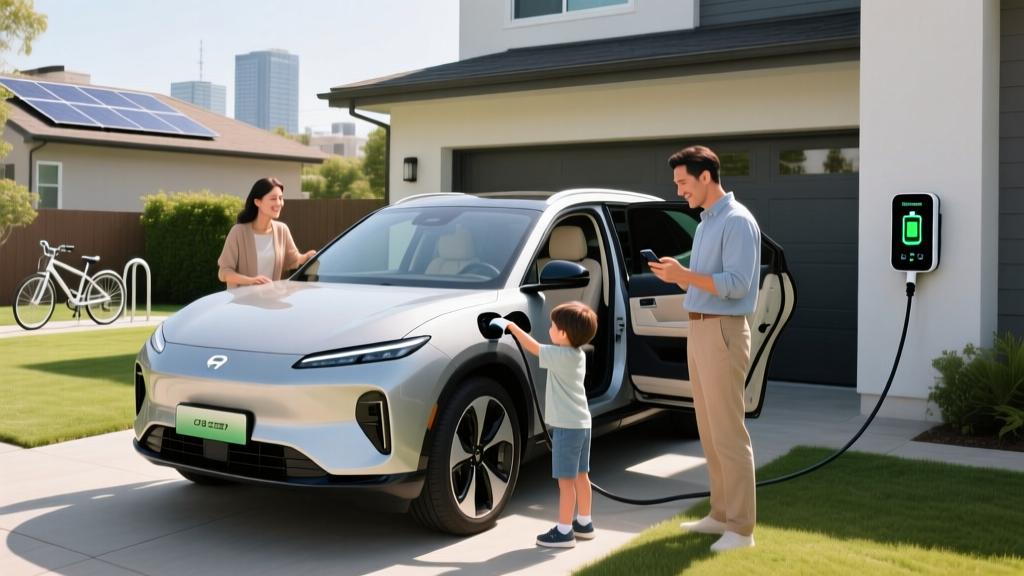
Owning an electric SUV for families is dramatically more convenient — and cheaper — if you can charge at home. Here's what installation actually looks like.
| Item | Typical Cost Range | Notes |
|---|---|---|
| Level 2 Charger (40A–48A, hardwired) | $400–$700 | Emporia Vue, ChargePoint Home Flex, Wallbox Pulsar Plus |
| Electrician Labor (240V/50A circuit) | $800–$2,500 | Depends on panel proximity and conduit run length |
| Electrical Panel Upgrade (if needed) | $1,500–$3,500 | Required if your panel is 100A or has no spare breaker slots |
| Permit & Inspection | $100–$400 | Varies by municipality |
| Total (best case) | $1,300–$2,200 | Panel has capacity, short conduit run |
| Total (worst case) | $3,500–$6,500 | Panel upgrade required, long wire run |
A typical Level 2 charger at 11.5 kW (48A) adds roughly 30–35 miles of range per hour for an EV9. That means an overnight charge (10 hours) replenishes about 300 miles — more than enough for daily family routines. If you live in an apartment or lack dedicated parking, public charging becomes your primary strategy, which adds cost ($0.35–$0.55/kWh at DC fast chargers) and time (20–40 minutes per session). Families without home charging should strongly consider a PHEV like the Grand Highlander Hybrid or wait until reliable workplace or neighborhood Level 2 infrastructure is confirmed.
Common Misconceptions About Family EVs — Fact-Checked
| Myth | Fact |
|---|---|
| "EV batteries need replacing every 5 years." | Modern NMC and LFP batteries are warrantied for 8 years/100,000 miles at 70%+ capacity retention. Real-world Recurrent data shows most packs retain 90%+ after 100K miles. |
| "You can't take an EV on road trips." | A Kia EV9 adds ~140 miles in 15 minutes at a 210 kW DC charger. Families on a 500-mile trip typically stop twice anyway for food and bathroom breaks. |
| "EVs are worse in cold weather." | Range drops 20–30% in sub-freezing temps, but preconditioning (warming the battery while plugged in) recovers most of the charging speed. Heat pumps, standard on the Ioniq 5 and EV9, reduce cabin-heating energy draw by ~30%. |
| "Electric SUVs can't tow." | The Rivian R1S tows 7,700 lbs; the EV9 tows 5,000 lbs. However, towing cuts range by 40–50%, so plan accordingly. |
| "The tax credit is $7,500 for every EV." | The §30D credit is up to $7,500 but depends on battery sourcing, MSRP caps ($80K for SUVs), and buyer income. Many vehicles qualify for $3,750 or $0. Always check IRS guidelines before purchasing. |
Decision Framework: Which Electric SUV for Families Fits Your Situation?
Choose the Kia EV9 if: You need three rows, want the most affordable 300-ish-mile electric family SUV, and can charge at home. Best for families who prioritize interior space and value over maximum range.
Choose the Rivian R1S if: Budget allows $80K+, you need serious off-road capability, 7,700-lb towing, or the Max Pack's 352-mile range for frequent long road trips through charging-sparse regions.
Choose the Hyundai Ioniq 5 if: You have two kids (or younger), don't need a third row, and want the fastest charging in the segment (10–80% in ~18 min) at a sub-$55K price point.
Choose the Tesla Model Y if: You want the Supercharger network's reliability, the lowest cost-per-mile efficiency (28 kWh/100mi), and strong cargo volume — but can accept the polarizing interior and no third row.
Choose a PHEV (Grand Highlander Hybrid) if: You lack home charging, regularly tow over 4,000 lbs, frequently drive in extreme cold (below 0°F), or want zero range-anxiety on 600-mile road trips without planning charger stops.
What First-Time EV Buyers Must Know Before Signing
If this is your family's first electric vehicle, these practical realities separate informed buyers from disappointed ones:
- Charging speed matters more than peak range. A vehicle that charges at 240 kW (Ioniq 5) spends significantly less time at DC fast chargers than one capped at 150 kW, even if both have 300-mile batteries. Look at 10–80% charge times, not just the EPA number.
- kW vs. kWh — know the difference. kW (kilowatts) is the rate of power delivery — how fast you charge. kWh (kilowatt-hours) is the battery's energy capacity — how far you can drive. A 99.8 kWh battery (EV9) charged at 210 kW is like filling a large tank through a wide hose.
- Insurance is typically 15–25% higher for EVs due to higher repair costs and parts pricing. Get quotes before committing.
- Tax credit at point of sale: As of 2026, you can transfer the §30D credit to the dealer for an immediate price reduction rather than waiting to claim it on your tax return. Confirm eligibility before signing.
- Battery degradation is slow and warrantied. Expect 5–10% capacity loss over 8 years. Federal law mandates a minimum 8-year/100,000-mile battery warranty for all EVs sold in the U.S.
- Winter driving requires planning. Precondition your EV while it's still plugged in. This warms the battery for optimal regen and charging speed and uses grid power rather than battery energy for cabin heat.
Frequently Asked Questions
Are electric SUVs safe for families in crashes?
Yes. The Tesla Model Y and Hyundai Ioniq 5 both earned IIHS Top Safety Pick+ ratings. EVs typically score well due to their low center of gravity (reducing rollover risk) and large front crumple zones (no engine block). Check specific ratings at IIHS.org and NHTSA.gov.
How much does it cost to charge an electric SUV at home per month?
Driving 1,000 miles/month in an EV9 (averaging 2.1 mi/kWh) requires ~476 kWh. At the U.S. average residential rate of $0.16/kWh, that's about $76/month — compared to ~$140/month for a gas Telluride at 22 MPG and $3.08/gallon. Your actual cost depends on your utility rate and whether your provider offers off-peak EV charging discounts.
Can I install a Level 2 charger in a garage with a 100-amp panel?
Possibly, but it depends on your panel's existing load. A 48A charger draws continuously and requires a 60A breaker. If your panel is already near capacity (common with electric dryers, ranges, and HVAC), an upgrade to 200A may be required — adding $1,500–$3,500. A licensed electrician can perform a load calculation to confirm.
Do electric SUVs qualify for the full $7,500 federal tax credit?
Rarely the full amount. Under current §30D rules, the credit is split: $3,750 for meeting critical-mineral sourcing requirements and $3,750 for battery-component manufacturing requirements. Many 2026 models qualify for one but not both. MSRP must be under $80,000 for SUVs, and buyer MAGI must not exceed $150K (single) or $300K (joint). Always verify on IRS.gov before purchase.
What happens if the battery fails outside the warranty period?
Full battery replacements range from $12,000–$22,000 depending on pack size. However, catastrophic failure after 100K miles is statistically rare. Most degradation is gradual — a battery at 85% State of Health still provides 85% of its original range. Module-level repairs (replacing individual cell groups rather than the full pack) are increasingly available for $3,000–$6,000.