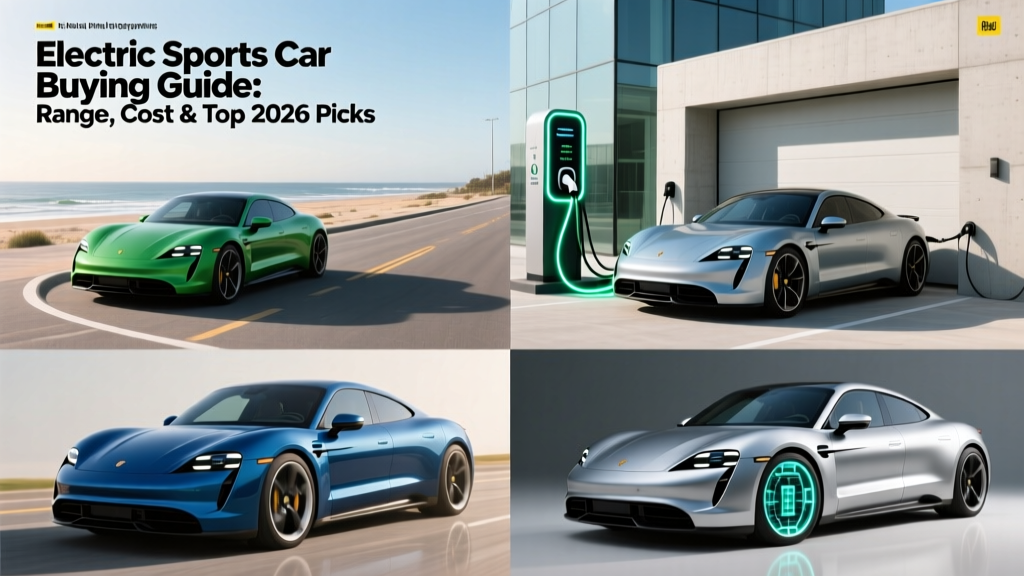
The Short Answer: Should You Buy an Electric Sports Car?
An electric sports car delivers instant torque, sub-4-second 0-60 times, and fueling costs roughly 60% lower per mile than a comparable gas sports car — but expect to pay $70,000–$150,000+ upfront, face higher insurance premiums (typically 15–30% above gas equivalents), and plan for real-world range that falls 15–25% below EPA stickers at highway speeds. The best 2026 options include the Porsche Taycan, Tesla Model S Plaid, BMW i4 M50, and Hyundai Ioniq 5 N. If you have reliable Level 2 home charging and drive mostly in moderate climates, an electric sports car is a thrilling, lower-running-cost alternative to gas. If you frequently road-trip through charging deserts or live in extreme cold without a garage, a gas or hybrid sports car still makes more sense.
What Defines an Electric Sports Car in 2026?
The term "electric sports car" covers a wide spectrum. At one end, you have dedicated two-door coupes like the forthcoming Lotus Emeya and the established Porsche Taycan (technically a four-door "sports sedan" but built on a performance EV platform). At the other, high-performance crossovers and sedans like the Tesla Model S Plaid, BMW i4 M50, and Hyundai Ioniq 5 N deliver sports-car acceleration with daily-driver practicality.
What unites them: dual-motor all-wheel-drive layouts (or tri-motor in the Plaid's case), battery packs ranging from 77 kWh to 100 kWh usable capacity, and power outputs from 400 to over 1,000 horsepower. Unlike gas sports cars that need to build revs, electric motors deliver peak torque from 0 RPM — which is why a $72,000 BMW i4 M50 can hit 60 mph in 3.3 seconds, rivaling a $95,000 Porsche 911 Carrera S.
Top Electric Sports Cars: Specs Compared
| Model | EPA Range | Battery (kWh usable) | Peak DC Charge (kW) | 10–80% Time | 0–60 mph | HP | Base MSRP |
|---|---|---|---|---|---|---|---|
| Porsche Taycan 4S (2026) | 283 mi | 89 kWh (NMC) | 270 kW | ~18 min | 3.5 sec | 562 | $103,800 |
| Tesla Model S Plaid | 359 mi | 95 kWh (NMC) | 250 kW | ~20 min | 1.99 sec | 1,020 | $89,990 |
| BMW i4 M50 | 271 mi | 81.5 kWh (NMC) | 200 kW | ~22 min | 3.3 sec | 536 | $72,100 |
| Hyundai Ioniq 5 N | 221 mi | 84 kWh (NMC) | 238 kW | ~18 min | 3.25 sec | 640 | $67,500 |
| Audi e-tron GT (2026) | 270 mi | 89 kWh (NMC) | 270 kW | ~18 min | 3.9 sec | 522 | $108,700 |
Real-World Range Reality Check
EPA estimates assume a mix of city and highway driving at moderate speeds. In our testing and aggregated owner reports, expect 15–25% less range at sustained 75–80 mph highway speeds. The Taycan 4S, rated at 283 miles EPA, typically delivers 215–240 miles on a long highway run. In cold weather (below 32°F), add another 10–20% loss unless the car has an active heat pump and you precondition the battery. The Tesla Model S Plaid's 359-mile EPA rating translates to roughly 280–310 miles real-world highway — still class-leading.
Electric Sports Car vs. Gas Sports Car: The Numbers
The performance gap has essentially closed — and in acceleration, EVs now dominate. But ownership economics tell a more nuanced story. Here's how a BMW i4 M50 stacks up against a comparably quick gas alternative, the BMW M440i xDrive Gran Coupe, over five years and 75,000 miles.
| Cost Factor | BMW i4 M50 (EV) | BMW M440i xDrive (Gas) |
|---|---|---|
| Base MSRP | $72,100 | $64,200 |
| Federal Tax Credit (§30D) | $0 (MSRP cap & sourcing)* | $0 |
| Fuel/Energy (75k mi) | ~$3,200 (home L2 avg) | ~$9,750 (premium @ $4.50/gal, 26 MPG) |
| Maintenance (75k mi) | ~$1,200 | ~$3,800 |
| Insurance (5-yr avg) | ~$14,500 | ~$11,200 |
| Depreciation (est. 5-yr) | ~$32,000 | ~$28,000 |
| Total 5-Year Cost | ~$89,000 | ~$88,950 |
*As of 2026, most luxury EVs above the $55,000 sedan / $80,000 SUV MSRP cap do not qualify for the §30D credit. Always verify current eligibility at IRS.gov. Some buyers may qualify for state-level rebates.
The takeaway: the i4 M50's higher purchase price and insurance premiums are almost entirely offset by dramatically lower fueling and maintenance costs over five years. You're essentially breaking even — while getting a 3.3-second 0-60 car that costs pennies per mile to "fuel" at home.
Charging an Electric Sports Car: What You Need to Know
Performance EVs have large batteries (80–100 kWh), which means Level 1 charging (120V, ~1.4 kW) is impractical — it would take 60+ hours for a full charge. A Level 2 home charger is effectively mandatory.
| Level | Power | Miles Added/Hour | Full Charge Time (84 kWh) | Use Case |
|---|---|---|---|---|
| Level 1 (120V) | 1.4 kW | 3–5 mi/hr | 60+ hours | Emergency only |
| Level 2 (240V, 48A) | 11.5 kW | 30–40 mi/hr | ~7.5 hours | Daily home charging |
| DC Fast Charge | 200–270 kW | N/A | 10–80% in 18–22 min | Road trips |
Home Level 2 Installation: The Real Cost
| Component | Typical Cost Range |
|---|---|
| Level 2 Charger (hardwired, 48A) | $500–$800 |
| Electrician labor (240V circuit run) | $800–$2,500 |
| Panel upgrade (if needed, 200A service) | $1,500–$3,500 |
| Permit & inspection | $100–$400 |
| Total (no panel upgrade) | $1,400–$3,700 |
| Total (with panel upgrade) | $2,900–$7,200 |
Most performance EVs accept 11.5 kW on Level 2 AC (48 amps). The Porsche Taycan and Audi e-tron GT optionally support up to 19.2 kW AC with a 80-amp circuit — cutting home charge time to under 5 hours, but requiring a more expensive electrical setup. Always consult a licensed electrician for a site assessment before purchasing.
DC Fast Charging: The Curve Matters
A 270 kW peak charge rate sounds impressive, but no EV sustains peak speed for the entire session. Charging follows a curve: the battery charges fastest between 10–40% State of Charge (SoC), then progressively tapers. The Taycan's 800-volt architecture lets it sustain higher rates longer than 400V competitors — it holds above 200 kW up to roughly 55% SoC before tapering. The Ioniq 5 N, also on an 800V platform, behaves similarly. Cars on 400V architectures (like the i4 M50) taper earlier, which is why their 10–80% times are a few minutes longer despite similar peak kW ratings.
Common Misconceptions About Electric Sports Cars
| Myth | Fact |
|---|---|
| "EVs can't handle like gas sports cars" | The Taycan and Ioniq 5 N have matched or beaten comparable gas cars on tracks like the Nürburgring. Low center of gravity from floor-mounted batteries reduces body roll. However, the added weight (4,800–5,300 lbs) is noticeable in tight autocross or repeated hard braking — brake fade and tire wear are real concerns on track days. |
| "The battery will need replacing in a few years" | Modern NMC batteries in performance EVs are warranted for 8 years/100,000 miles with a minimum 70% capacity retention. Data from fueleconomy.gov and owner surveys show most packs lose only 8–12% capacity over 100,000 miles. A full replacement costs $15,000–$25,000 out of warranty, but most owners will never need one. |
| "Electric sports cars are cheaper to own overall" | Lower fueling and maintenance costs are real, but higher purchase prices, steeper insurance premiums (15–30% above gas equivalents per IIHS data), and potentially steeper depreciation can erase those savings — especially in the luxury segment where §30D tax credits don't apply. |
| "You can road-trip anywhere without planning" | Tesla Supercharger coverage is excellent, and the NACS connector is now the standard for most new EVs. But rural routes in the Mountain West, rural South, and parts of the Midwest still have sparse DC fast charging. Porsche and Audi owners rely on Electrify America's network, which has improved but still trails Tesla in uptime. Always pre-plan routes using tools like A Better Routeplanner. |
Real-World Ownership: Climate, Driving Patterns, and Daily Life
Where and how you drive dramatically shapes the electric sports car experience:
Cold Climate (Below 32°F Winters)
Battery chemistry slows in cold temperatures. Expect 15–30% range loss in sub-freezing conditions, more if you're using cabin heat without a heat pump. The Taycan and Ioniq 5 N both use heat pumps, which recover waste heat from the drivetrain to warm the cabin more efficiently than resistive heaters. Preconditioning — warming the battery while still plugged in — is essential for preserving range and enabling fast DC charging in cold weather. Without it, a cold-soaked battery may limit DC fast charging to 50 kW or less until it warms up.
Track Days and Aggressive Driving
Electric sports cars deliver stunning single-lap performance, but sustained high-speed driving generates enormous battery heat. The Ioniq 5 N addresses this with an advanced thermal management system and an "N Battery Preconditioning" mode that optimizes pack temperature before a session. Even so, expect reduced range (potentially 50% or more) during aggressive track use, and plan for cool-down laps. Tire wear also accelerates — performance EVs are heavy, and sticky summer tires may need replacement every 10,000–15,000 miles under spirited driving.
Daily Commuting and Practicality
This is where electric sports cars shine. The instant torque makes merging and city driving effortless. Regenerative braking reduces brake wear dramatically in stop-and-go traffic. And "refueling" at home overnight means you start every day with a full "tank." If your commute is under 100 miles round-trip and you have Level 2 home charging, you may visit a DC fast charger only a handful of times per year.
Decision Framework: Is an Electric Sports Car Right for You?
Choose an Electric Sports Car If:
- You have Level 2 home charging (garage or dedicated parking with 240V access). This is non-negotiable for convenient ownership.
- Your daily driving is under 200 miles and road trips are occasional (2–4 per year), not weekly.
- You value instant acceleration and low running costs over the sound and feel of a high-revving gas engine.
- You live in a moderate or warm climate, or have a garage to mitigate cold-weather range loss.
- You can absorb a $70,000+ purchase price and higher insurance premiums without the tax credit offset that applies to more affordable EVs.
Choose a Gas or Hybrid Sports Car If:
- You lack reliable home charging — relying solely on public DC fast charging is expensive ($0.35–$0.55/kWh vs. $0.12–$0.18/kWh at home) and time-consuming.
- You road-trip frequently through areas with sparse charging infrastructure.
- You track your car regularly — gas cars still have an edge in sustained high-speed endurance and lighter weight for repeated hot laps.
- Budget is a primary concern — a $45,000–$55,000 gas sports car (Toyota GR Supra, Nissan Z) delivers thrilling performance at a fraction of the entry price, with no charging logistics.
- You value engine sound and analog engagement — no EV replicates the visceral experience of a flat-six or V8 at redline, even with synthetic sound enhancement.
Frequently Asked Questions
Do any electric sports cars qualify for the $7,500 federal tax credit?
As of 2026, most electric sports cars exceed the IRS §30D MSRP cap ($55,000 for sedans, $80,000 for SUVs/trucks) and therefore do not qualify. The Hyundai Ioniq 5 N at $67,500 falls under the SUV cap and may qualify for up to $7,500, but eligibility depends on battery component and critical mineral sourcing requirements, plus buyer income limits ($150,000 single / $300,000 joint AGI). The credit can now be transferred to the dealer at point of sale as an instant discount. Always verify current eligibility at IRS.gov and consult a tax professional.
How much does it cost to charge an electric sports car at home vs. gas?
At the US average residential electricity rate of ~$0.17/kWh, fully charging an 84 kWh battery costs about $14.30 — yielding roughly 180–220 real-world miles. That's approximately $0.065–$0.08 per mile. A gas sports car averaging 22 MPG on premium fuel at $4.50/gallon costs about $0.20 per mile — roughly 2.5 to 3 times more per mile. Over 15,000 annual miles, that's a savings of $1,800–$2,100 per year fueling at home.
Will an electric sports car hold its resale value?
EV depreciation has been steeper than gas cars in recent years, driven by rapid tech advancement, price cuts from Tesla, and buyer uncertainty about battery longevity. Expect a luxury electric sports car to lose 45–55% of its value over five years, compared to 40–50% for a comparable gas sports car. However, as the market matures and the used EV credit (§25E, up to $4,000) drives demand for pre-owned models, depreciation curves are stabilizing. Porsche Taycans have held value better than most, while Tesla Model S depreciation has been more aggressive.
What's the cheapest electric sports car available in 2026?
The Hyundai Ioniq 5 N at $67,500 MSRP is the most affordable true performance EV, offering 640 HP, a 3.25-second 0-60, track-capable thermal management, and NACS charging compatibility. The BMW i4 M50 at $72,100 is the next step up, offering a more traditional luxury sedan form factor with similar performance. Below $60,000, you won't find a dedicated "sports" EV, though the Tesla Model 3 Performance ($54,990) delivers a 2.9-second 0-60 and 315-mile range in a sedan package.
Can I take an electric sports car on a road trip?
Yes, with planning. Cars with NACS connectors (Tesla, Hyundai/Kia, Ford, and most 2026 models) access the Supercharger network — the most reliable DC fast-charging network in the US with over 25,000 stalls. A Taycan or Ioniq 5 N can add 150+ miles of range in a 15-minute stop. Plan routes using the vehicle's built-in navigation (which accounts for charging) or third-party apps. Expect 20–30 minute stops every 180–220 miles. The main limitation is rural routes in states like Montana, Wyoming, and parts of the Deep South, where DC fast chargers may be 100+ miles apart.