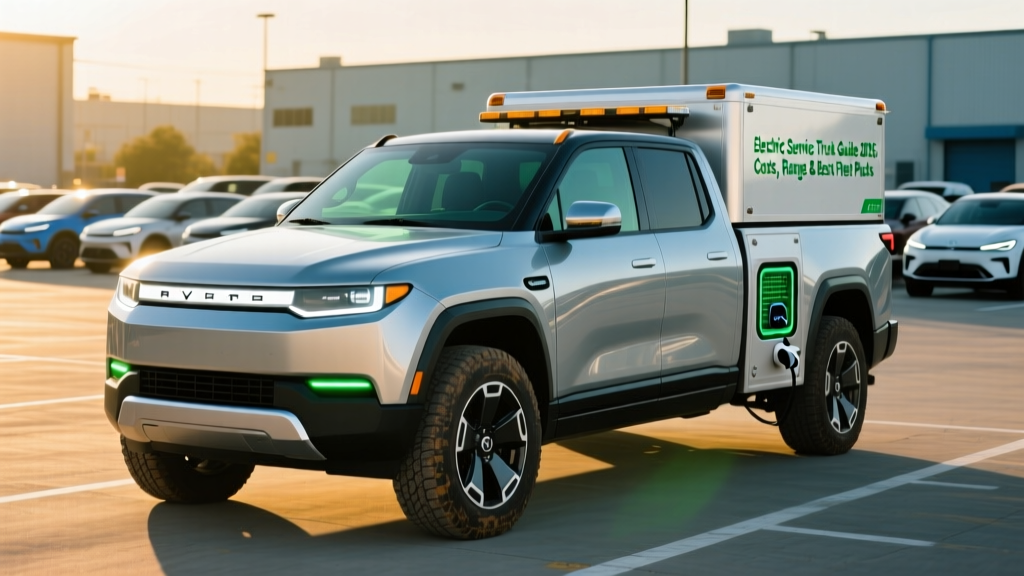
Is an electric service truck worth it in 2026? For fleet operators and tradespeople running predictable daily routes under 150 miles with depot or home charging access, yes — the total cost of ownership undercuts comparable gas trucks by $8,000–$15,000 over five years, driven by fuel savings and near-zero drivetrain maintenance. For long-haul or remote job sites without reliable charging infrastructure, a gas or hybrid truck remains the pragmatic choice. Current leading models include the Ford F-150 Lightning, Chevrolet Silverado EV, and Ram 1500 REV, with base MSRPs ranging from roughly $55,000 to $75,000 before federal and state incentives.
The Electric Service Truck Landscape in 2026
The commercial electric pickup segment has matured past early-adopter growing pains. Ford's F-150 Lightning has accumulated billions of real-world fleet miles, GM's Ultium-based Silverado EV has resolved its initial software and battery-pack supply issues, and Stellantis finally delivered the Ram 1500 REV to retail and fleet buyers after multiple delays. Meanwhile, purpose-built commercial platforms from companies like BrightDrop (GM's commercial division) and Canoo have carved niches in last-mile and vocational applications.
For service-truck buyers — electricians, plumbers, HVAC technicians, landscapers, and municipal fleet managers — the decision is no longer "does an electric truck exist?" but rather "does it fit my duty cycle?" The answer hinges on daily mileage, payload requirements, charging access, and climate. Let's break down the numbers.
2026 Electric Service Truck Specs: Side-by-Side
| Specification | Ford F-150 Lightning (Extended Range) | Chevrolet Silverado EV 4WT | Ram 1500 REV (Max Range) |
|---|---|---|---|
| EPA Range | 320 miles | 380 miles | 350 miles (est.) |
| Real-World Range (loaded, mixed driving) | ~240–270 miles | ~290–330 miles | ~260–300 miles (est.) |
| Battery Capacity (usable) | 131 kWh (NMC) | 200+ kWh (NMC, Ultium) | ~175 kWh (NMC) |
| Peak DC Fast Charge Rate | 150 kW | 350 kW | ~230 kW (est.) |
| 10–80% DC Charge Time | ~44 min | ~25 min (at 350 kW station) | ~35 min (est.) |
| Level 2 Charge Rate (AC) | 19.2 kW (80A onboard) | 19.2 kW | 19.2 kW |
| Max Payload | 2,235 lbs | 1,800 lbs (4WT) | ~2,000 lbs (est.) |
| Max Towing | 10,000 lbs | 10,000 lbs | 10,700 lbs (est.) |
| Horsepower / Torque | 580 hp / 775 lb-ft | 510 hp / 615 lb-ft (4WT) | ~654 hp / 620 lb-ft (est.) |
| 0–60 mph | ~4.0 sec | ~4.5 sec | ~4.4 sec (est.) |
| Pro Power Onboard / V2L | 9.6 kW (Pro Power) | Yes (V2L capable) | Yes (V2L capable) |
| Starting MSRP (fleet trim) | ~$59,995 | ~$55,000 (4WT) | ~$65,000 (est.) |
| Battery/Powertrain Warranty | 8 yr / 100,000 mi | 8 yr / 100,000 mi | 8 yr / 100,000 mi |
Sources: EPA / fueleconomy.gov, Ford F-150 Lightning specs, Chevrolet Silverado EV configurator. Ram 1500 REV figures are preliminary estimates pending final EPA certification.
Electric vs Gas Service Truck: Real Cost Comparison
The upfront price premium of an electric service truck over a gas equivalent is real — typically $10,000–$20,000 before incentives. But the operating-cost equation flips quickly for high-utilization fleet vehicles. Here's a five-year cost comparison assuming 30,000 miles/year (a typical service-truck duty cycle):
| Cost Category (5 Years / 150,000 mi) | F-150 Lightning (EV) | F-150 Gas (3.5L EcoBoost) |
|---|---|---|
| Purchase Price (fleet trim, before incentives) | $59,995 | $46,500 |
| Federal §30D Tax Credit (if eligible) | –$7,500* | $0 |
| Fuel / Electricity | $7,200 (depot L2 @ $0.13/kWh) | $22,500 (gas @ $3.50/gal, 18 MPG) |
| Maintenance (oil, filters, brakes, belts) | $2,800 | $7,500 |
| Insurance (commercial, avg.) | $14,000 | $11,500 |
| Estimated Resale Value (5 yr) | $22,000 | $18,000 |
| Total Net 5-Year Cost | ~$54,495 | ~$69,000 |
*The IRS §30D clean vehicle credit has strict eligibility requirements: buyer income caps ($300K joint / $150K individual for new vehicles), MSRP caps ($80,000 for trucks/vans), battery critical-mineral and component sourcing rules, and the credit can now be transferred to the dealer at point of sale. Fleet purchases through a business entity may qualify under the separate §45W commercial clean vehicle credit instead. Consult a tax professional for your specific situation.
The takeaway: at 30,000 miles/year, the Lightning breaks even on its price premium by roughly year three, primarily through fuel and maintenance savings. At lower annual mileage (under 15,000 miles/year), the payback stretches past five years and the economics become less compelling.
Real-World Range: What Service Truck Buyers Must Know
EPA sticker vs. reality: A 320-mile EPA rating does not mean 320 miles on a job site. Real-world range for a loaded service truck (1,000+ lbs of tools and materials, highway speeds, HVAC running) typically drops 15–25%. Add cold-weather operation (below 30°F) and expect an additional 20–30% reduction. A 320-mile EPA truck carrying payload in a January Midwest winter may deliver as little as 175–210 usable miles.
This isn't a dealbreaker — it's a planning input. Most service-truck duty cycles cluster around 80–140 miles per day, well within real-world EV range. But if your routes regularly exceed 180 miles, involve sustained highway speeds above 70 mph, or operate in extreme cold without depot charging mid-day, you need to plan carefully or consider a PHEV/gas alternative.
Towing dramatically cuts range. Pulling a 7,000-lb equipment trailer can reduce range by 40–55%. If you tow daily, an electric service truck's effective range may drop to 140–170 miles. For heavy daily towing, a diesel or gas truck remains the more practical choice until battery energy density improves further.
Charging Infrastructure: Depot, Home, and Public
The viability of an electric service truck rises and falls with your charging plan. There are three primary scenarios:
Depot / Fleet Charging (Best Case)
If your trucks return to a central yard or garage each night, Level 2 depot charging is the gold standard. A single 19.2 kW Level 2 station (requiring a 100-amp dedicated circuit) can fully replenish an F-150 Lightning's 131 kWh battery in roughly 7 hours — overnight. Installation costs vary widely:
| Component | Estimated Cost |
|---|---|
| Level 2 EVSE hardware (commercial-grade, dual-port) | $2,500–$6,000 |
| Electrical panel upgrade (if needed, 200A → 400A) | $3,000–$8,000 |
| Wiring, conduit, labor (licensed electrician) | $4,000–$12,000 |
| Permits and utility interconnection fees | $500–$2,500 |
| Total per dual-port station | $10,000–$28,500 |
For fleets, utility demand-charge management and time-of-use rates become critical. Many utilities offer commercial EV charging tariffs that can reduce per-kWh costs to $0.08–$0.10 during off-peak hours. Some utilities also offer make-ready infrastructure rebates that cover 50–100% of wiring and panel costs — check with your local utility before budgeting.
Home Charging (Owner-Operator)
Independent contractors who take their service truck home can install a 240V / 48-amp Level 2 circuit in a home garage. A quality hardwired EVSE (ChargePoint Home Flex, WallConnector, or Emporia) costs $500–$800; electrician installation runs $800–$2,500 depending on panel capacity and run length. This is the most cost-effective charging strategy and covers 90%+ of daily needs for most tradespeople.
Public DC Fast Charging (Supplemental)
On longer job days or when depot/home charging isn't available, DC fast charging fills the gap. The Silverado EV's 350 kW peak rate is a standout — a 10–80% charge in roughly 25 minutes at a compatible Electrify America or Tesla Supercharger (NACS adapter required for non-Tesla trucks) station means a quick lunch-break top-up. The Lightning's 150 kW peak is slower but still practical: ~44 minutes for 10–80%.
Remember: kW is the rate of charge (power), kWh is the battery capacity (energy). A 150 kW charger does not deliver 150 kWh — it delivers energy at a rate of 150 kW, tapering as the battery fills. Charging from 80–100% is significantly slower than 10–80%, which is why most fleet operators target 80% daily charges and reserve 100% fills for planned long-range days.
Common Misconceptions About Electric Service Trucks
| Myth | Fact |
|---|---|
| "EVs can't handle job-site payloads." | The F-150 Lightning handles 2,235 lbs payload and 10,000 lbs towing. The low center of gravity (battery pack under the floor) actually improves stability when loaded vs. a gas truck with a high-mounted engine and fuel tank. |
| "The battery will need replacing and cost $30,000." | Modern NMC packs are warrantied for 8 years / 100,000 miles at 70%+ capacity retention. Real-world fleet data from Ford's commercial customers shows degradation of roughly 5–8% over 100,000 miles with proper charging habits (avoiding sustained 100% SoC and frequent DC fast charging). Full replacement costs, if ever needed out of warranty, range from $15,000–$25,000 depending on pack size, but this is increasingly rare. |
| "There's no way to power job-site tools." | The Lightning's Pro Power Onboard delivers up to 9.6 kW of 240V/120V AC output — enough to simultaneously run a chop saw, compressor, and battery chargers directly from the truck, eliminating the need for a separate generator. The Silverado EV and Ram REV offer similar V2L (vehicle-to-load) capability. |
| "Electric trucks are slower and less capable off-road." | The Lightning's 580 hp and 775 lb-ft of instant torque produce a 4.0-second 0–60 time — quicker than any gas F-150 short of the Raptor R. Electric AWD with independent motors provides precise torque vectoring on loose surfaces. Ground clearance and approach/departure angles are comparable to gas equivalents. |
| "Cold weather makes EVs useless." | Cold reduces range (20–30% below freezing), but preconditioning the battery while plugged in mitigates this significantly. Heat pumps (standard on the Silverado EV, available on the Lightning) recover 10–15% of cold-weather efficiency loss. Fleet operators in Minnesota and Canada report successful winter operations with route planning adjustments. |
Tax Credits and Incentives for Commercial EV Trucks
Federal and state incentives can dramatically improve the economics of an electric service truck, but the rules are specific and change frequently:
- §30D Clean Vehicle Credit (personal/owner-operator): Up to $7,500 for qualifying new EVs. Requires buyer income below $300K (joint) / $150K (individual), MSRP under $80,000 for trucks/vans/SUVs, and compliance with battery critical-mineral and component sourcing requirements. Can be transferred to the dealer at point of sale as an immediate discount. Verify current eligibility on IRS.gov.
- §45W Commercial Clean Vehicle Credit (fleet/business): Up to $7,500 for vehicles under 14,000 lbs GVWR, or up to $40,000 for heavier vehicles. This is the credit most fleet operators use. The vehicle must be acquired for business use and placed in service. Different sourcing rules apply than §30D.
- State and utility incentives: Many states offer additional rebates ($2,000–$7,500 in California via CVRP, for example). Utility make-ready programs can cover depot charging infrastructure costs. These vary widely by jurisdiction — check DSIRE (Database of State Incentives for Renewables & Efficiency) and your local utility.
- Depreciation / Section 179: Commercial EVs over 6,000 lbs GVWR (all trucks listed here qualify) can be eligible for significant first-year bonus depreciation and Section 179 expensing, further reducing net acquisition cost. Consult your CPA.
Decision Framework: Should You Buy an Electric Service Truck?
Choose an electric service truck if:
- Your daily routes are under 150 miles (or under 120 miles in cold climates)
- You have depot or home charging access (or can install it)
- You tow infrequently or tow under 5,000 lbs
- You drive 25,000+ miles per year (higher utilization = faster payback)
- You need onboard job-site power (eliminates generator cost and fuel)
- You operate in areas with low electricity rates or time-of-use plans
Stick with gas or consider a hybrid if:
- Your daily routes regularly exceed 200 miles without mid-day charging
- You tow 7,000+ lbs daily and need full range while loaded
- You operate in extreme cold (–20°F or below) on remote routes
- You have no viable charging installation option (apartment, street parking)
- You drive fewer than 12,000 miles per year (payback period exceeds 5 years)
- Your job sites are in areas with no public DC charging infrastructure
Frequently Asked Questions
How long does an electric service truck battery last before replacement?
Current NMC battery packs in the F-150 Lightning and Silverado EV are engineered for 200,000+ miles with gradual capacity loss. Fleet data shows approximately 5–10% degradation over 100,000 miles. The federal warranty mandate requires manufacturers to cover the battery for at least 8 years / 100,000 miles (longer in CARB states like California — 10 years / 150,000 miles). Full replacement is rarely needed within a truck's first ownership cycle, but if required, expect $15,000–$25,000 depending on pack size.
Can I charge an electric service truck from a standard 120V outlet?
Yes, but slowly. Level 1 charging (120V / 12A) delivers roughly 1.4 kW, adding about 3–4 miles of range per hour. For a 131 kWh battery, a full charge from empty would take over 90 hours. Level 1 is useful for overnight trickle-charging to maintain battery health but is not practical as a primary charging strategy for a high-utilization service truck. Budget for Level 2 (240V) at minimum.
Are electric service trucks eligible for the $7,500 federal tax credit?
It depends. For personal purchases, §30D eligibility requires the truck to meet battery sourcing requirements, the buyer's income to be under the cap, and the MSRP to be under $80,000 (truck/van/SUV cap). For fleet/business purchases, the §45W commercial credit applies instead, with different rules. Many current configurations of the F-150 Lightning and Silverado EV qualify for at least partial credit, but eligibility shifts as manufacturers adjust battery supply chains. Always verify on IRS.gov before purchasing.
How does insurance cost compare for electric vs. gas service trucks?
Commercial EV insurance premiums are typically 10–20% higher than gas equivalents, driven by higher repair costs for battery and structural components after collisions and a smaller pool of EV-trained body shops. Average commercial premiums for an F-150 Lightning run $2,500–$3,500/year depending on coverage, driver history, and region, versus $2,000–$2,800 for a gas F-150. Factor this into your TCO calculation — it partially offsets fuel savings.
What happens if I run out of charge on a job site?
The same thing that happens if you run out of gas: you're stuck until you refuel. The difference is that roadside charging infrastructure is less ubiquitous than gas stations, and a DC fast charge takes 25–45 minutes rather than 5 minutes. This is why route planning and charging discipline (top up at 20% remaining, don't wait for 0%) are essential. Most EV navigation systems route through chargers automatically and precondition the battery for faster charging upon arrival.
Is the Ford F-150 Lightning or Chevy Silverado EV better for service work?
The Lightning (320 mi EPA, 150 kW peak charge, 9.6 kW Pro Power) is the proven choice with years of fleet data behind it and a robust dealer/service network. The Silverado EV 4WT (380 mi EPA, 350 kW peak charge) offers superior range and faster charging — a significant advantage for longer routes — but is newer with less real-world fleet validation. If your routes push past 150 miles daily, the Silverado's range advantage is compelling. If you prioritize proven reliability and the strongest onboard power system, the Lightning remains the benchmark.