Buying an electric recreational vehicle isn't just about swapping gas for electrons — it's about rethinking how you tow, haul, and explore. If you're eyeing an EV truck or SUV for weekend camping, boat towing, or overlanding, here's the practical reality: current models like the Ford F-150 Lightning, Rivian R1T, and Chevrolet Silverado EV offer 270–400 miles of EPA range and 10,000+ lb towing capacity, but expect real-world range to drop 30–50% when towing heavy loads at highway speeds. You'll also need robust home charging (Level 2, 48A minimum) and a clear-eyed view of public charging infrastructure near your favorite trails.
The Quick Answer: Is an Electric Recreational Vehicle Right for You?
Bottom line: An electric recreational vehicle makes sense if you tow occasionally (under 7,000 lbs), have reliable home charging, and primarily drive within 200 miles of home. If you regularly tow heavy trailers (8,000+ lbs) on 400-mile road trips through charging deserts, a hybrid truck like the Ford F-150 PowerBoost or a diesel remains more practical in 2026.
Top Electric Recreational Vehicles for 2026
| Model | EPA Range | Battery (kWh) | Max Tow Capacity | Peak DC Charge (kW) | Base MSRP |
|---|---|---|---|---|---|
| Ford F-150 Lightning (Extended Range) | 320 mi | 131 kWh (NMC) | 10,000 lbs | 150 kW | $69,995 |
| Rivian R1T (Dual-Motor Max Pack) | 410 mi | 149 kWh (NMC) | 11,000 lbs | 220 kW | $87,600 |
| Chevrolet Silverado EV (4WT) | 400 mi | 200 kWh (NMC) | 10,000 lbs | 350 kW | $74,800 |
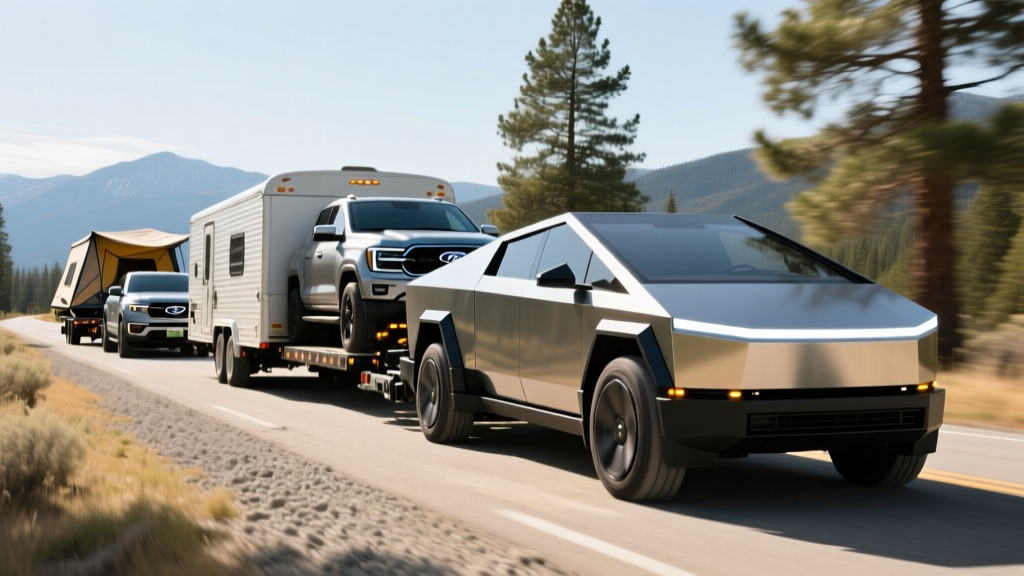
| Tesla Cybertruck (AWD) | 340 mi | 123 kWh (NMC) | 11,000 lbs | 250 kW | $79,990 |
These specs look impressive on paper, but real-world recreational use tells a different story. Let's break down what actually happens when you hook up a trailer and head for the mountains.
The Towing Reality: Range Drops You Need to Plan For
Here's the physics: towing a 5,000-lb camper at 65 mph increases energy consumption from roughly 2.0 kWh/mile (unloaded) to 3.5–4.0 kWh/mile. That's a 75–100% increase in energy draw, which translates directly to range loss.
| Scenario | Ford F-150 Lightning (131 kWh) | Ford F-150 PowerBoost Hybrid (30.6 gal tank) |
|---|---|---|
| Unloaded, mixed driving | 320 mi (EPA) | 570 mi (EPA 18 MPG combined) |
| Towing 5,000-lb trailer, 65 mph | ~160–180 mi (real-world) | ~340–380 mi (real-world 11-12 MPG) |
| Towing 8,000-lb trailer, 65 mph | ~110–130 mi (real-world) | ~250–290 mi (real-world 9-10 MPG) |
| Refuel/recharge time | 10-80% in ~45 min (150 kW DC) | 5 min (gas station) |
The hybrid wins on range and refueling speed when towing heavy, but the EV offers massive advantages in torque (instant, no gear hunting on grades), regenerative braking on descents (recovering energy instead of burning brake pads), and zero tailpipe emissions at the campsite.
Charging Infrastructure: Can You Actually Reach Your Destination?
Public DC fast charging has expanded significantly by 2026, with networks like Electrify America, EVgo, and Tesla Superchargers (now open to NACS-equipped non-Tesla vehicles) covering most interstate corridors. But recreational destinations often sit in charging deserts.
Before you buy, map your typical trips:
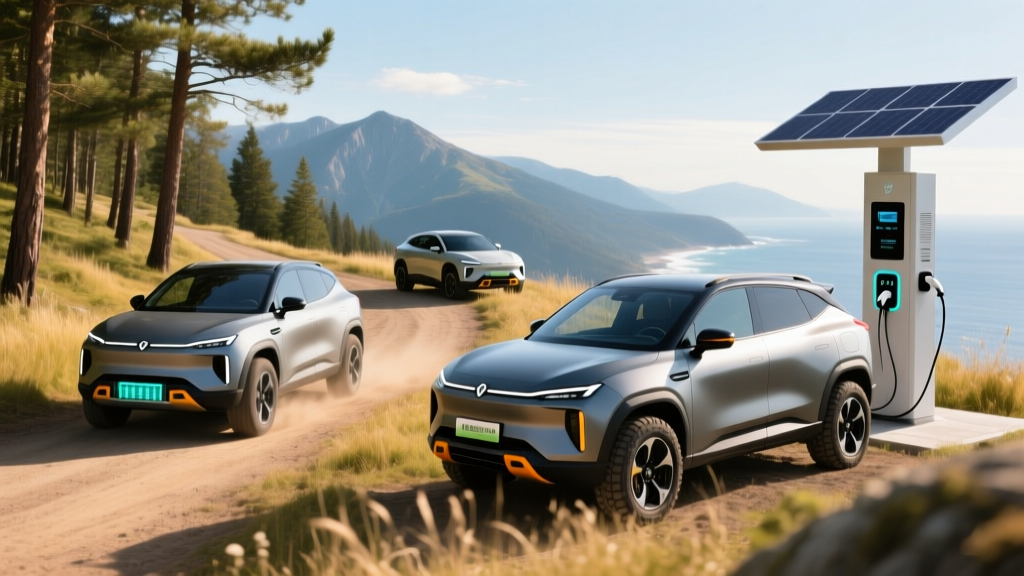
- National parks and remote campgrounds: Many lack DC fast chargers within 50 miles. You'll need to plan overnight stays near charging hubs or invest in portable solar/generator backup.
- Boat ramps and trailheads: Rarely have charging infrastructure. You'll be running on battery alone for the final 20–50 miles.
- Mountain passes: Regenerative braking helps on descents, but climbing at altitude with a trailer can drain 30% of your battery in 50 miles.
Home charging is non-negotiable for recreational EV owners. You'll want a Level 2 charger (240V, 48A minimum) installed in your garage or driveway. Expect to pay $1,200–$2,500 for equipment and electrician labor, plus potential panel upgrades ($1,500–$3,000) if your home has a 100A service. A full charge on a 131 kWh battery takes 10–12 hours on Level 2 — fine for overnight, but you can't "quick top-off" before a trip.
Real Costs: Purchase, Charging, Maintenance & Insurance
| Cost Category | Ford F-150 Lightning (Extended Range) | Ford F-150 PowerBoost Hybrid |
|---|---|---|
| Base MSRP | $69,995 | $62,520 |
| Federal Tax Credit (§30D, 2026) | $3,750 (partial, battery sourcing limits) | $0 (not a BEV/PHEV) |
| Home Level 2 Charger Install | $1,800 (typical) | $0 |
| Fuel/Energy Cost (5 years, 75K miles) | $4,500 (avg $0.14/kWh home, some DC fast) | $11,250 (avg $3.50/gal, 18 MPG combined) |
| Maintenance (5 years) | $1,500 (tires, cabin filter, fluid checks) | $3,500 (oil changes, filters, spark plugs, brakes) |
| Insurance (5 years, avg) | $9,000 (EV surcharge) | $7,500 |
| 5-Year Total Cost | $81,545 | $84,770 |
The EV wins on 5-year total cost by ~$3,200, primarily from fuel and maintenance savings. But that assumes you qualify for at least a partial tax credit (check IRS §30D rules for income caps, MSRP limits, and battery sourcing requirements — these change annually) and have home charging access. If you rely solely on public DC fast charging at $0.40–$0.60/kWh, your energy costs jump to $8,000–$12,000 over 5 years, erasing the savings.
Common Misconceptions About Electric Recreational Vehicles
| Myth | Fact |
|---|---|
| "EVs can't tow heavy loads." | Modern EV trucks tow 10,000–11,000 lbs. The issue isn't capability — it's range reduction when towing. |
| "You'll get stranded in the wilderness." | With proper trip planning and a 400-mile-range model, you can reach most trailheads. But always carry a backup plan (portable charger, campground with 240V outlet). |
| "EV batteries won't last in extreme temperatures." | Cold weather reduces range 20–30% (not permanent damage). Modern thermal management systems protect battery health. Expect 80–90% capacity retention after 8 years/100K miles. |
| "Charging takes too long on road trips." | 10-80% takes 25–45 minutes on DC fast chargers. Plan meal/rest stops around charging, and it's manageable. But yes, it's slower than 5-minute gas stops. |
| "I can use any extension cord to charge at a campground." | Most campground 120V outlets are 15A (1.4 kW) — that's 1–2 miles of range per hour. You'd need a 240V/50A RV pedestal (common at modern campgrounds) for meaningful charging (7–10 kW, ~25-35 miles/hour). |
Decision Framework: Should You Buy an Electric Recreational Vehicle?
Choose an electric recreational vehicle if:
- You tow occasionally (under 7,000 lbs) and primarily within 150 miles of home
- You have reliable home charging (Level 2, 240V/48A)
- You value instant torque for boat launches, steep grades, and off-road crawling
- You want to eliminate tailpipe emissions at campsites and reduce maintenance costs
- You're comfortable planning trips around charging infrastructure
Stick with a hybrid or gas truck if:
- You regularly tow 8,000+ lbs on 300+ mile trips through rural areas
- You lack home charging access or can't install a Level 2 charger
- You frequently visit remote destinations with no DC fast charging within 100 miles
- You need maximum range flexibility without trip planning overhead
- Upfront cost is a primary concern (EV trucks cost $7K–$20K more than gas equivalents)
What First-Time EV Buyers Need to Know
If this is your first electric vehicle, understand these fundamentals:
kW vs kWh: kW (kilowatts) is power — how fast you can charge or how hard the motors can pull. kWh (kilowatt-hours) is energy — how much "fuel" your battery holds. A 131 kWh battery holds 131 units of energy; a 150 kW charger delivers energy at 150 units per hour (though charging slows above 80% to protect the battery).
Charging curves matter: DC fast chargers don't deliver peak speed the entire session. A "150 kW charger" might only deliver 150 kW from 10–50% state of charge, then taper to 80 kW from 50–80%, and 40 kW from 80–100%. That's why we quote 10-80% charge times — it's the practical range for road trips.
Preconditioning is critical: Cold batteries charge slowly. Use your EV's preconditioning feature (heats the battery before charging) to hit peak charge speeds. Skipping this in winter can double your charge time.
Tax credits aren't guaranteed: The federal §30D credit has income caps ($150K single, $300K joint), MSRP limits ($80K for trucks/SUVs), and battery sourcing requirements that exclude many models. Always verify eligibility on IRS.gov before assuming you'll get $7,500.
FAQ: Electric Recreational Vehicle Questions
Can I charge my EV truck at a campground?
Yes, but speed varies wildly. A standard 120V/15A outlet adds 1–2 miles of range per hour (useless for a full charge). A 240V/50A RV pedestal (common at modern campgrounds) delivers 7–10 kW, adding 25–35 miles per hour — enough to fully charge overnight. Always call ahead to confirm electrical hookups.
How much range do I lose towing a boat or camper?
Expect 30–50% range reduction towing 5,000–7,000 lbs at highway speeds. An F-150 Lightning with 320 miles EPA range drops to 160–220 miles real-world when towing. Heavier loads (8,000+ lbs) cut range by 50–60%.
Are EV trucks good for off-roading?
Excellent. Instant torque, precise throttle control, and low center of gravity (battery pack under the floor) make EV trucks capable off-roaders. The Rivian R1T's quad-motor setup offers tank turns and individual wheel torque vectoring. But watch for ground clearance (battery packs are vulnerable to rock strikes) and range — low-speed crawling uses less energy than highway towing, but you still need to plan your return trip.
What's the best electric recreational vehicle for towing a 6,000-lb camper?
The Rivian R1T Max Pack (410 mi EPA, 11,000 lb tow rating) offers the best range buffer, but at $87,600 it's expensive. The Ford F-150 Lightning Extended Range (320 mi, 10,000 lb tow, $69,995) is more affordable and has broader charging network compatibility. For heavy towing, the Chevrolet Silverado EV 4WT (400 mi, 350 kW charging) is compelling if you can find one in stock.
Do I need a generator as backup for remote camping?
It's smart insurance. A portable power station (2–5 kWh, $1,500–$3,000) can add 10–25 miles of range in an emergency — enough to reach a charger. Some owners tow a small gas generator trailer for extended off-grid trips, though this defeats the emissions benefit.
How long do EV truck batteries last?
Most manufacturers warrant batteries for 8 years/100,000 miles with a minimum 70% capacity retention. Real-world data from fueleconomy.gov and owner forums suggests modern NMC batteries retain 85–90% capacity after 8 years with proper care (avoid frequent 100% charges, use preconditioning, limit DC fast charging to road trips). Replacement costs $15,000–$25,000 out of warranty — a significant long-term ownership risk.
Can I use my EV truck to power my campsite?
Yes! Vehicle-to-load (V2L) capability lets you power appliances, lights, and tools from your truck's battery. The Ford F-150 Lightning offers up to 9.6 kW of onboard power (Pro Power Onboard), enough to run a microwave, coffee maker, and campsite lighting simultaneously for days. This is a massive advantage over gas trucks, which require a separate generator.