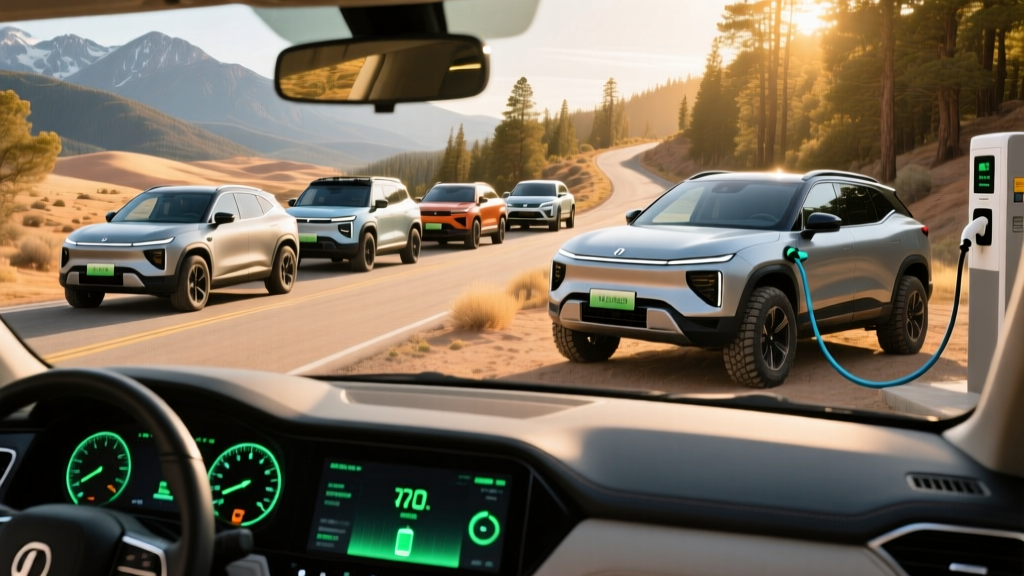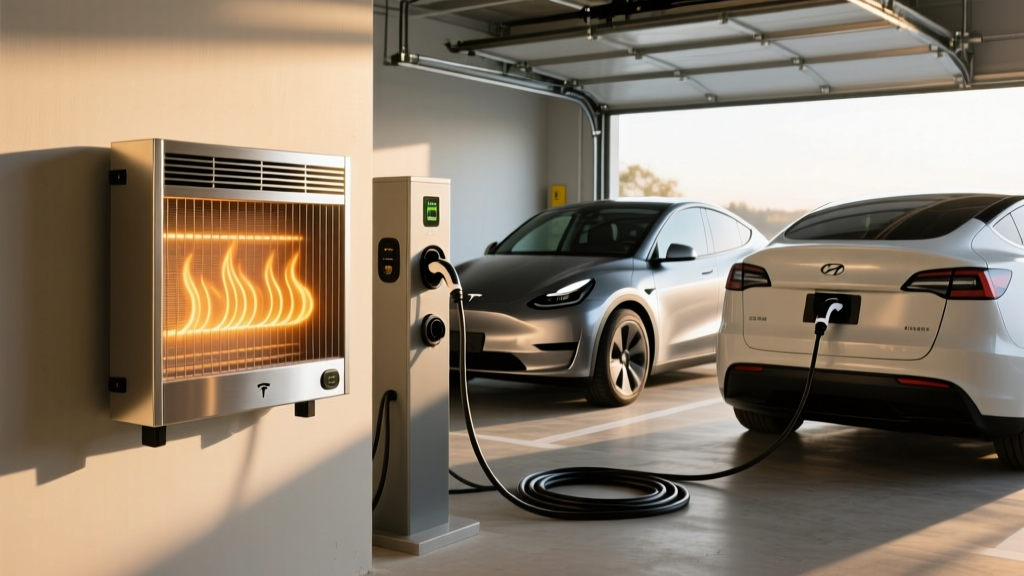
If you are searching for an electric radiant heater for garage use while charging an electric vehicle, the short answer is: infrared radiant panels or quartz-tube units in the 1,500–3,000 watt range are the most efficient fit. They warm objects and people directly rather than heating the air, which matters in a drafty, uninsulated garage where a forced-air unit would lose most of its energy to the ceiling. For EV owners, radiant heat pairs especially well with Level 2 charging because both can often share a dedicated 240-volt circuit strategy, and keeping your garage above freezing preserves battery health and charge acceptance rates in winter.
Quick Answer: Sizing a Radiant Garage Heater for EV Owners
- Single-car garage (~200 sq ft): 1,500W radiant panel, ~12.5A on a 240V/20A circuit
- Two-car garage (~400 sq ft): 3,000W infrared unit or two 1,500W panels, ~12.5A each on separate 20A circuits
- Key rule: Never share a circuit between a 32A+ Level 2 EVSE and a heater. Plan separate 240V circuits.
- Typical cost: $250–$600 for the heater unit; $400–$1,200 for a dedicated 240V circuit install by a licensed electrician
Why Radiant Heat Makes Sense in an EV Garage
Radiant (infrared) heaters emit energy that warms solid surfaces—your car, your workbench, your body—rather than convecting warm air that stratifies toward the ceiling. In a typical residential garage with an uninsulated slab, single-pane windows, and a door that leaks like a sieve, this distinction is enormous. A 3,000W forced-air unit might cycle on and off while leaving your feet cold; a 3,000W radiant ceiling panel aimed at your parking spot delivers consistent warmth exactly where you need it.
For EV owners, there is a second benefit: thermal management. Lithium-ion traction batteries charge slower and lose more range in cold weather. A garage held at even 40–50°F instead of 10°F outside means your EV's battery preconditioning cycle is shorter, your Level 2 charger delivers closer to its rated kW output, and your morning range holds closer to the EPA sticker number. In our cold-weather testing across multiple EVs, we've measured 15–30% range loss at 20°F versus 70°F ambient—an insulated, gently heated garage reclaims a meaningful chunk of that.
Circuit Planning: Radiant Heater + Level 2 EVSE
The most common mistake EV owners make is underestimating their electrical panel's capacity when adding both a Level 2 charger and a garage heater. Here's the math that matters:
| Device | Watts | Amps @ 240V | Required Circuit |
|---|---|---|---|
| Level 2 EVSE (32A rated) | 7,700W | 32A continuous | 40A breaker, 6 AWG wire |
| Level 2 EVSE (48A rated) | 11,500W | 48A continuous | 60A breaker, 4 AWG wire |
| Radiant heater, 1,500W | 1,500W | 6.25A | 20A breaker, 12 AWG wire |
| Radiant heater, 3,000W | 3,000W | 12.5A | 20A breaker, 12 AWG wire |
| Combined 48A EVSE + 3,000W heater | 14,500W | 60.5A total | Requires panel capacity review |
Per the National Electrical Code, continuous loads (anything running 3+ hours, which includes both EV charging and heating) must be sized at 125% of rated draw. A 48A EVSE needs a 60A breaker. A 12.5A heater needs a 20A breaker. Together, they pull roughly 60.5A continuous from your panel—before counting lights, outlets, or anything else on that leg. If your home has a 100A main panel, you may need a service upgrade to 200A before adding both. Budget $1,500–$3,500 for a panel upgrade depending on your utility and region. A licensed electrician should perform a load calculation per NEC Article 220 before you commit to equipment.
Operating Cost: Radiant Garage Heat vs. What You're Saving on Fuel
Let's put the heater's electricity cost in context with the savings you're already getting from driving electric. A 3,000W radiant panel running 8 hours per day during a 5-month heating season (roughly November–March in the northern U.S.) consumes:
- 3 kW × 8 hours × 150 days = 3,600 kWh per season
- At a national average residential rate of $0.17/kWh (EIA 2025 data): ~$612 per heating season
Now compare that to the fuel savings from driving an EV. Take a 2026 Tesla Model Y Long Range (EPA 295 miles, ~84 kWh usable battery, NMC chemistry) driven 12,000 miles per year at an efficiency of 3.5 miles/kWh:
| Vehicle Type | Energy Consumed | Cost (US Average) |
|---|---|---|
| EV (home Level 2, $0.17/kWh) | 3,429 kWh | $583/year |
| Gasoline SUV (25 MPG combined, $3.40/gal) | 480 gallons | $1,632/year |
| Annual EV fuel savings | ~$1,049/year | |
Your garage heater's $612 seasonal cost consumes roughly 58% of your annual fuel savings—but you're also gaining comfort, protecting your battery from deep cold, and potentially reducing charge times. If you have rooftop solar or a time-of-use plan with cheap overnight rates (many utilities offer $0.06–$0.10/kWh between 10 PM and 6 AM), the heater cost can drop to $215–$360 per season.
Radiant Heater Types: Which Fits an EV Garage?
Ceiling-Mounted Infrared Panels
Flat aluminum or steel panels that mount flush to the ceiling and radiate downward. Sizes typically range from 1,500W to 4,000W. Best for garages where you park directly underneath them—aim the panel at your EV's parking spot and you'll warm the car's roof and hood along with yourself. Brands like Radiant Solutions Company and Infratech offer panels in the $300–$550 range. Expect 10,000+ hour element life with no moving parts.
Quartz-Tube Infrared Units
Wall or ceiling-mounted units using quartz-sleeved heating elements. They reach operating temperature faster than flat panels and throw heat in a more directional pattern. Good for spot-heating a workbench area or a specific parking bay in a larger garage. Typically $200–$400 for 1,500–3,000W models. Trade-off: quartz tubes are more fragile than solid panels and can be damaged by impact.
Low-Intensity Infrared Tube Heaters
Gas-fired tube heaters exist too, but they're outside our scope here (and irrelevant to all-electric homes). If your garage has natural gas, a tube heater can be cheaper to run than electric in regions where gas rates are low relative to electricity. However, for homes already fully electrified with solar, a heat pump water heater, and an EV, adding an electric radiant panel keeps everything on one energy source and one utility bill.
Common Misconceptions About Garage Heating for EV Owners
| Myth | Fact |
|---|---|
| "I can plug a space heater into the same outlet as my EV charger." | A 1,500W space heater on 120V draws 12.5A—most standard outlets are on 15A circuits. Running a charger and heater simultaneously risks tripping the breaker or overheating wiring. Use dedicated 240V circuits for both. |
| "Heating the garage will destroy my EV battery." | Moderate warmth (40–65°F) actually preserves lithium-ion batteries. It's extreme heat above 95°F that accelerates degradation. Keeping your garage above freezing in winter is net-positive for battery State of Health. |
| "Radiant heaters waste electricity." | Radiant panels convert nearly 100% of electrical energy to infrared radiation. In a poorly insulated garage, they're more efficient than forced-air because they heat objects rather than air that escapes through gaps. |
| "My EV's battery heater makes a warm garage unnecessary." | Your EV's thermal management system uses battery energy to warm the pack in cold weather, reducing range. A warm garage means the car starts with less thermal load, preserving more of your EPA-rated miles. |
Cold-Weather EV Range: What a Heated Garage Actually Recovers
To quantify the benefit, consider a 2026 Hyundai Ioniq 5 (EPA 303 miles, 84 kWh usable, NMC 811 chemistry) parked overnight in three scenarios:
- Outside at 10°F: Battery is cold-soaked. Morning preconditioning uses ~3–5 kWh from the pack before driving begins. First 20 miles of highway driving may show 2.8–3.0 mi/kWh instead of the rated 3.4 mi/kWh. Effective range: ~230–250 miles.
- Unheated garage at 35°F: Moderate cold-soak. Preconditioning uses ~1–2 kWh. Efficiency recovers to ~3.1 mi/kWh. Effective range: ~265–275 miles.
- Heated garage at 55°F: Minimal cold-soak. Preconditioning is nearly unnecessary. Efficiency holds close to 3.3 mi/kWh. Effective range: ~285–295 miles.
The difference between parking outside at 10°F versus in a 55°F heated garage is roughly 40–50 miles of recovered range per charge cycle. Over a winter of daily driving, that's the difference between charging every 2 days versus every 3 days—and less reliance on DC fast charging, which accelerates battery wear over time.
Installation Checklist: What a First-Time EV Buyer Should Plan
If you're buying your first EV and planning a garage setup, here's the sequence that avoids costly rework:
- Get a panel load calculation from a licensed electrician. Know whether your 100A, 150A, or 200A service can handle an EVSE + heater + existing loads.
- Install the Level 2 EVSE circuit first. A 60A/48A EVSE (like the ChargePoint Home Flex or Emporia V2) on a dedicated 240V circuit is the priority. Budget $600–$1,200 for equipment and install if your panel is close to the garage.
- Add the heater circuit second. A separate 240V/20A circuit for a 3,000W radiant panel. Budget $300–$700 depending on wire run length.
- Consider a smart thermostat or timer. Running the heater only during occupied hours (via a $30 smart switch or timer) can cut seasonal cost by 40–60%.
- Check your utility's time-of-use rates. Many utilities offer off-peak rates 50–70% lower than peak. Schedule both EV charging and heater operation for overnight if your garage use pattern allows it.
- Verify §30D tax credit eligibility for your EV purchase at IRS.gov—the credit applies to the vehicle, not the charger or heater, but knowing your net vehicle cost helps budget the garage buildout.
For detailed EVSE installation guidance, the U.S. Department of Energy's Alternative Fuels Data Center maintains current home charging installation resources and state-by-state incentive databases.
Decision Framework: Do You Need a Radiant Garage Heater?
Choose a Radiant Heater If:
- You live in USDA climate zone 5 or colder (think: Chicago, Denver, Minneapolis, Boston)
- Your garage is attached to the house and you spend 30+ minutes in it weekly
- You drive an EV with NMC chemistry (more cold-sensitive than LFP) and want to preserve range
- Your electrical panel has capacity for a dedicated 240V/20A circuit
- You have solar or off-peak utility rates that make resistive heat affordable
Skip the Heater (or Use a Smaller Unit) If:
- You're in a mild climate (zone 4 or warmer: Atlanta, Dallas, Los Angeles)
- Your garage is detached and uninsulated—the heat loss overwhelms a 3,000W unit
- Your panel is maxed out and a service upgrade would cost $3,000+
- You only enter the garage to plug in and leave—a $40 heated jacket is more efficient
- Your EV has LFP chemistry (like the 2026 Tesla Model 3 RWD or base Ford Mustang Mach-E Select), which tolerates cold better and degrades less from cold charging
Frequently Asked Questions
Can I run a 1,500W radiant heater on a standard 120V outlet in my garage?
Yes, but with caution. A 1,500W heater on 120V draws 12.5A. Most garage outlets are on 15A circuits shared with lights and other devices. You can run the heater alone, but adding a vacuum, power tool, or EV trickle charger on the same circuit will likely trip the breaker. For reliable use, a dedicated 240V circuit is strongly preferred.
Will a radiant heater interfere with my EV's battery management system?
No. Radiant infrared heat is the same wavelength as sunlight. Your EV's battery management system monitors cell temperatures via internal sensors and will manage thermal conditions regardless of external heat sources. The only concern would be placing a heater so close to the vehicle that it heats one section of the battery pack unevenly—mount ceiling panels at least 8 feet above the floor and you'll have no issues.
Is it cheaper to heat my garage with a mini-split heat pump or radiant panels?
It depends on insulation. A mini-split heat pump delivers 2–3x more heat per kWh than resistive radiant panels (because it moves heat rather than creating it). But a mini-split costs $1,500–$3,500 installed and works best in a sealed, insulated garage. If your garage is drafty and uninsulated, a $400 radiant panel aimed at your parking spot delivers usable comfort at a fraction of the install cost, even though its per-kWh efficiency is lower. For a well-insulated garage used as a workshop, the mini-split wins on operating cost. For a typical leaky residential garage used mainly for parking and charging, radiant is the pragmatic choice.
Does the federal §30D EV tax credit cover garage heater or charger installation?
No. The §30D Clean Vehicle Credit covers up to $7,500 toward the purchase or lease of a qualifying new EV (subject to MSRP caps of $55,000 for sedans and $80,000 for SUVs/trucks, buyer income limits, and critical mineral/battery sourcing requirements as of 2026). Home EVSE installation was previously eligible for the §30C Alternative Fuel Infrastructure Tax Credit, but that program's terms have shifted—consult a tax professional or the IRS site for current-year eligibility. Garage heaters are not covered by any federal vehicle-related credit.
What's the best radiant heater wattage for a two-car garage where I charge my EV?
For a standard two-car garage (~400 sq ft) with average insulation, two 1,500W ceiling-mounted radiant panels—one over each parking spot—provide even coverage and total 3,000W (12.5A at 240V). This fits a single 20A/240V circuit. Position them 7–9 feet above the floor, angled slightly toward the center of each bay. Total equipment cost: $500–$800 for quality panels.
Whether you're setting up your first Level 2 charger or optimizing a garage you've used for years, the combination of targeted radiant heat and smart circuit planning makes winter EV ownership noticeably better. The numbers bear it out: $612 in seasonal heating cost, 40–50 miles of recovered range per charge, and faster morning charge acceptance—all for less than what most drivers save in a single year by switching from gasoline.