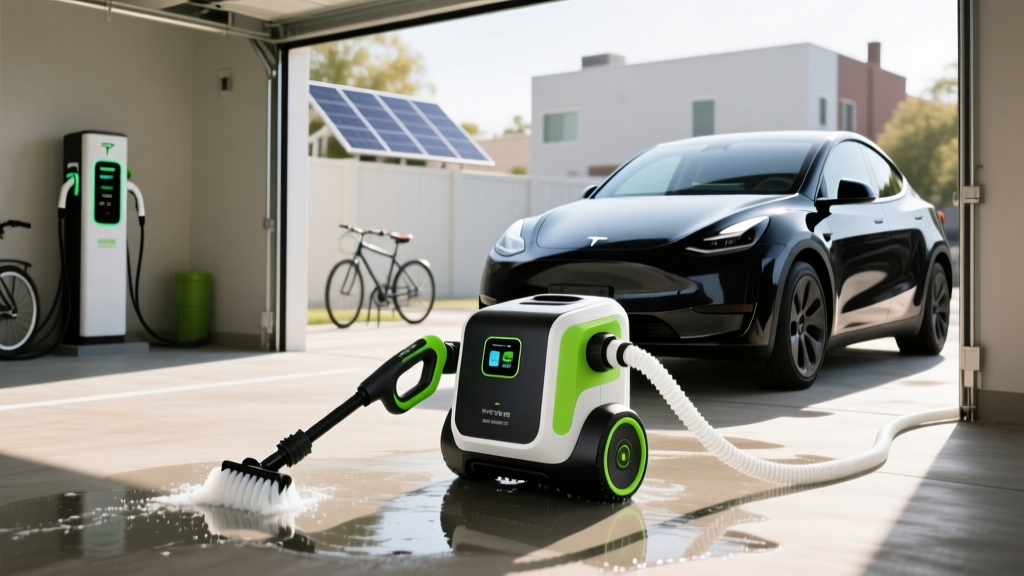
If you own an electric vehicle—or are about to buy one—an electric power washer is one of the most practical accessories you can add to your garage. Unlike gas-powered pressure washers, electric models produce zero tailpipe emissions, run significantly quieter (typically 60–75 dB versus 85–100 dB for gas), and pair perfectly with the home-charging lifestyle many EV owners already maintain. For most car-washing tasks, a unit rated between 1,500 and 2,300 PSI with a flow rate of 1.2–1.8 GPM is the ideal sweet spot: enough pressure to remove road grime, brake dust, and bug splatter without risking damage to your EV's sensors, cameras, or paint clear coat.
The Quick Answer
For washing a modern EV at home, choose a corded electric pressure washer in the 1,600–2,000 PSI range with 1.4–1.6 GPM flow. Expect to pay $150–$350 for a quality unit. Avoid aiming the nozzle directly at EV sensor housings, charge ports, or the 12V battery compartment. A 15-amp, 120V outlet is sufficient for most models; a dedicated 240V circuit is unnecessary for car washing.
Why EV Owners Are Switching to Electric Power Washers
The typical EV owner drives fewer annual miles than the national average—around 9,500 miles per year compared to 13,500 for gas vehicles, according to fueleconomy.gov data patterns. That means your EV likely spends more time parked at home, making driveway detailing a regular part of ownership. An electric power washer aligns with the EV ethos: no gasoline to store, no small-engine maintenance (oil changes, spark plugs, carburetor cleaning), and no noise complaints from neighbors during early-morning washes.
Modern EVs also present unique cleaning considerations. Vehicles like the Tesla Model Y, Hyundai Ioniq 5, and Ford Mustang Mach-E are equipped with multiple exterior cameras, ultrasonic sensors, and radar housings that support Level 2 driver-assistance systems such as Autopilot, Highway Driving Assist, or BlueCruise. High-pressure water directed at these components can force moisture past weather seals. Electric pressure washers in the sub-2,000 PSI range reduce this risk while still providing effective cleaning power.
Electric vs. Gas Power Washers: By the Numbers
Before choosing a unit, it helps to understand how electric and gas pressure washers compare across the metrics that matter for car care.
| Specification | Electric (Corded 120V) | Gas-Powered |
|---|---|---|
| PSI Range | 1,300–2,300 PSI | 2,500–4,000 PSI |
| Flow Rate (GPM) | 1.2–1.8 GPM | 2.0–4.0 GPM |
| Noise Level | 60–75 dB | 85–100 dB |
| Weight | 15–30 lbs | 50–90 lbs |
| Maintenance | Virtually none | Oil, spark plug, air filter, fuel stabilizer |
| Operating Cost per Hour | $0.15–$0.30 (electricity) | $1.50–$3.00 (gasoline) |
| Cold-Start Issues | None | Common below 40°F |
| Emissions | Zero at point of use | CO₂, NOₓ, unburned hydrocarbons |
| Average Purchase Price | $120–$400 | $250–$700 |
| Typical Lifespan | 5–10 years | 5–8 years (with maintenance) |
The takeaway: gas pressure washers deliver more raw power, which is useful for stripping paint or cleaning concrete. But for car washing—including EVs with sensitive exterior electronics—electric units offer the right balance of cleaning ability, convenience, and safety.
Key Specs to Evaluate When Shopping
Not all electric power washers are created equal. Here are the specifications that directly impact your car-washing results:
PSI (Pounds per Square Inch)
PSI measures the force of the water stream. For automotive paint and clear coat, stay between 1,200 and 2,000 PSI. Pressures above 2,200 PSI can chip paint, force water into seal gaps, and damage camera lenses. Most EV manufacturers recommend no more than 2,000 PSI and maintaining at least a 12-inch distance from the vehicle surface.
GPM (Gallons per Minute)
GPM determines how much water flows through the nozzle. Higher GPM means faster rinsing. For car washing, 1.4–1.6 GPM is efficient without being wasteful. Cleaning power is actually the product of PSI × GPM, known as Cleaning Units (CU). A 1,800 PSI / 1.5 GPM unit produces 2,700 CU—more than enough for weekly or biweekly car washes.
Motor Type: Universal vs. Induction
Induction motors run cooler, last longer, and are quieter, but add weight and cost. Universal motors are lighter and cheaper but have a shorter lifespan due to carbon brush wear. For a unit you'll use 30–50 times per year, an induction motor is worth the $30–$60 premium.
Nozzle Options and Spray Patterns
Look for units that include at least three nozzle tips: a 40° white tip (low pressure, wide fan for soap application), a 25° green tip (medium pressure for general washing), and a 15° yellow tip (narrower stream for stubborn grime on wheels and tires). Never use a 0° red tip on automotive surfaces—it concentrates full PSI into a pinpoint and will damage paint instantly.
Real-World Cost Breakdown: Electric Power Washer Ownership
Here's what you'll actually spend over a 5-year ownership period, compared to using a gas-powered unit or paying for commercial car washes.
| Cost Category | Electric Pressure Washer | Gas Pressure Washer | Commercial Car Wash |
|---|---|---|---|
| Equipment Purchase | $200–$300 | $350–$500 | $0 |
| Energy/Fuel (5 years, 50 washes/yr) | $15–$25 | $150–$250 | $0 |
| Maintenance (5 years) | $0–$20 | $100–$200 | $0 |
| Soap/Chemicals | $50–$75 | $50–$75 | Included |
| Per-Wash Cost (commercial) | $0 | $0 | $15–$35 per visit |
| 5-Year Total (50 washes/yr) | $265–$420 | $650–$1,025 | $3,750–$8,750 |
The math is clear: an electric pressure washer pays for itself within the first year if you're currently using commercial wash services. Even compared to a gas unit, the electric model saves $200–$600 over five years while eliminating small-engine maintenance entirely.
EV-Specific Washing Considerations
Washing an electric vehicle requires a few extra precautions that gas-car owners don't need to think about. These aren't deal-breakers—they're simply part of the EV ownership learning curve.
Protecting the Charge Port
Your EV's charge port (whether NACS, CCS, or CHAdeMO) is weather-sealed to IP67 standards, meaning it can handle rain and splashing. However, direct high-pressure spray into an open charge port can compromise internal contacts. Always close the charge port door before washing, and avoid directing the spray nozzle at the port seam from close range.
Sensor and Camera Care
Most 2024–2026 EVs carry 8–12 exterior cameras and multiple ultrasonic sensors. These are typically housed behind small, flush-mounted lenses. When washing around these components, use the wide-angle (40°) nozzle and maintain a minimum 18-inch distance. After washing, wipe camera lenses with a microfiber cloth to prevent water-spot distortion that could affect Autopilot or FSD Supervised vision processing.
Undercarriage and Battery Pack
EV battery packs are sealed and rated for water immersion (typically IP67 or IP69K). You can safely rinse the undercarriage to remove road salt and debris. However, avoid using a pressure washer's zero-degree nozzle or a turbo-blast attachment on the battery skid plate—micro-abrasions from concentrated spray could eventually compromise protective coatings. A standard garden hose with a spray nozzle is often sufficient for undercarriage rinsing.
Regenerative Braking and Brake Dust
One unexpected benefit of EV ownership: significantly less brake dust. Because regenerative braking handles 70–90% of deceleration in most EVs, the friction brakes engage far less frequently. This means your wheels stay cleaner between washes, and you'll need less aggressive cleaning chemicals. A mild wheel cleaner and the 40° nozzle tip are usually sufficient.
Common Misconceptions About Electric Power Washers
| Myth | Fact |
|---|---|
| "Electric pressure washers aren't powerful enough to clean a car." | A 1,600–2,000 PSI electric unit with 1.4+ GPM easily removes road grime, bird droppings, and bug splatter. Most car washing only requires 1,200–1,500 PSI. |
| "You need a 240V outlet for a good electric pressure washer." | All consumer-grade electric pressure washers run on standard 120V / 15-amp household outlets. No electrical upgrade needed. |
| "Pressure washing an EV will damage the battery." | EV battery packs are sealed to IP67+ standards and tested for high-pressure wash bay conditions. Normal pressure washing poses no risk to the traction battery. |
| "Electric models can't use foam cannons." | Most electric pressure washers with 1.4+ GPM work effectively with aftermarket foam cannon attachments, producing thick, clinging snow foam for touchless pre-washes. |
| "Cordless/battery-powered pressure washers are just as good." | Battery-powered units (typically 300–700 PSI) lack the pressure for effective car cleaning. They're useful for light rinsing but can't replace a corded electric unit for thorough washing. |
Decision Framework: Which Electric Power Washer Is Right for You?
Choose Based on Your Situation
- If you wash your EV once a week or more: Invest in a $250–$350 unit with an induction motor, onboard detergent tank, and 25-foot high-pressure hose. The durability and convenience justify the cost.
- If you wash every 2–4 weeks: A $150–$225 universal-motor unit with 1,600–1,800 PSI is perfectly adequate. Prioritize lightweight design and quick-connect fittings.
- If you live in an apartment or have no outdoor outlet: Consider a portable, battery-powered unit (500–700 PSI) for light rinsing between professional washes. Accept that it won't replace a full pressure wash.
- If you also need to clean decks, fences, or concrete: Step up to a 2,000–2,300 PSI electric model with a turbo nozzle attachment. Use the wider spray pattern and lower pressure setting when washing the car.
- If you wash multiple vehicles (family fleet): Prioritize GPM over PSI. A 1.8 GPM unit rinses faster, cutting total wash time by 20–30% compared to a 1.2 GPM model.
Frequently Asked Questions
Can I use an electric power washer on my Tesla, Rivian, or other EV?
Yes. All major EV manufacturers approve pressure washing as long as you stay under 2,000 PSI, maintain at least 12 inches of nozzle distance, and avoid direct spray into the charge port, sensor housings, or any open panel gaps. Tesla's owner manuals specifically reference pressure washing as an approved cleaning method.
How much electricity does an electric pressure washer use?
A typical 1,800 PSI unit draws about 13–15 amps at 120V, consuming roughly 1.5–1.8 kWh per hour of continuous use. A 20-minute car wash therefore uses approximately 0.5–0.6 kWh, costing about $0.07–$0.10 at the national average electricity rate of $0.16/kWh. That's less than running a space heater for 30 minutes.
Do I need a special soap for washing my EV?
No EV-specific soap is required, but you should use a pH-neutral car wash shampoo (pH 6.5–7.5) rather than household dish detergent, which can strip wax and ceramic coatings. EV paint finishes are identical to those on gas vehicles—same clear coats, same care requirements.
Can I use my EV's V2L (Vehicle-to-Load) feature to power a pressure washer?
Technically, yes—if your EV supports V2L (available on the Hyundai Ioniq 5/6, Kia EV6, Ford F-150 Lightning, and select others) and outputs 1,800W or more through its V2L port. However, this is impractical for routine use: you'd be draining your traction battery to wash the car it powers. A standard outdoor GFCI outlet is the far more sensible power source.
What about cordless battery-powered pressure washers?
Cordless units (typically powered by 20V–40V lithium-ion batteries) produce 300–700 PSI—adequate for rinsing off loose dust or applying soap, but insufficient for removing bonded contaminants like tree sap, bird droppings, or road tar. They're a useful supplement to, not a replacement for, a corded electric pressure washer.