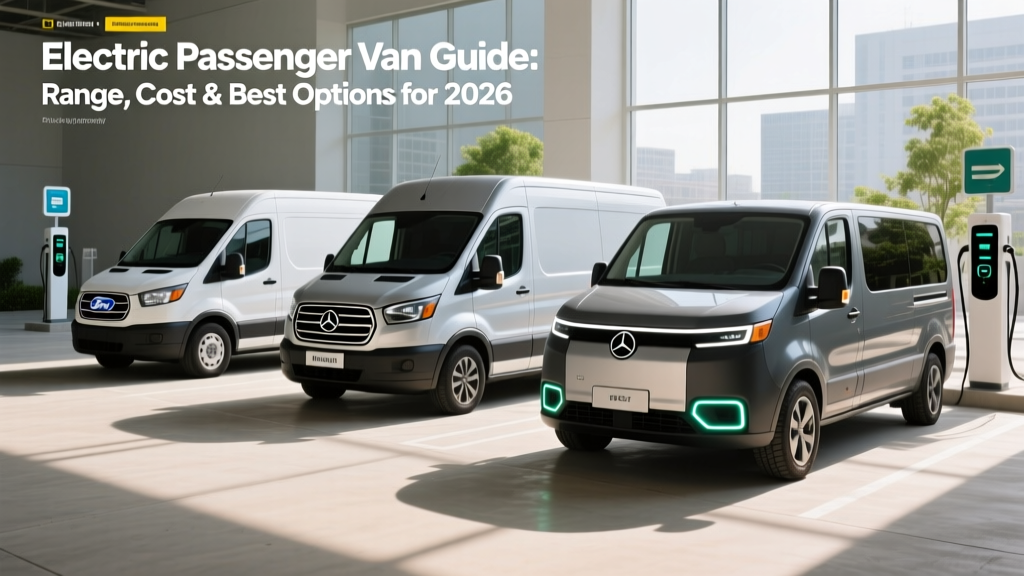
Quick Answer: Are Electric Passenger Vans Worth It?
The best electric passenger van for most families in 2026 is the Chrysler Pacifica-inspired VW ID. Buzz, offering an EPA-estimated 234 miles of range, seating for up to seven, and a starting MSRP around $59,995. The Kia EV9 (three-row SUV alternative) provides 304 miles EPA from $54,900. Compared to a gas minivan averaging 22 MPG combined, an electric passenger van cuts per-mile fuel costs by roughly 55–65% when charging at home on average U.S. electricity rates ($0.16/kWh), but expect a higher purchase price, limited DC fast-charging infrastructure for road trips, and 20–30% range loss in freezing temperatures. Federal §30D tax credits of up to $7,500 may apply depending on your income, the vehicle's MSRP cap compliance, and battery-sourcing requirements — verify current eligibility at IRS.gov.
The Electric Passenger Van Landscape in 2026
The electric passenger van segment remains small but growing. Unlike the dozens of electric sedans and crossovers on the market, true passenger vans — vehicles prioritizing interior volume, sliding doors, and three-row seating for six or seven — have only a handful of battery-electric options. Here's what's currently available or arriving at dealerships for the 2026 model year:
| Vehicle | Body Style | EPA Range | Battery (kWh) | Peak DC Charge (kW) | 10–80% Time | Seating | Starting MSRP |
|---|---|---|---|---|---|---|---|
| VW ID. Buzz | Minivan | 234 mi | 91 kWh (NMC) | 175 kW | ~26 min | 7 | $59,995 |
| Kia EV9 (LR RWD) | 3-Row SUV | 304 mi | 100 kWh (NMC) | 236 kW | ~24 min | 6–7 | $54,900 |
| Hyundai Ioniq 9 (est.) | 3-Row SUV | ~300 mi (prelim.) | 110.3 kWh (NMC) | 350 kW (800V) | ~20 min | 6–7 | $56,000 (est.) |
| Mercedes EQV (if imported) | Minivan | ~213 mi (WLTP adj.) | 90 kWh (NMC) | 110 kW | ~45 min | 7–8 | TBD |
The VW ID. Buzz is the only true minivan-style electric passenger van sold in the U.S. as of 2026, with sliding rear doors, a flat floor, and a car-like driving position reminiscent of a traditional minivan. The Kia EV9 and the upcoming Hyundai Ioniq 9 are three-row SUVs that compete on passenger capacity but sacrifice the low step-in height and cargo flexibility of a van. If you specifically need a van body style — for wheelchair accessibility, commercial shuttle use, or maximum interior volume — the ID. Buzz is your primary option.
Electric Passenger Van vs. Gas Minivan: Cost & Efficiency
The core question for most buyers: does electrifying a people-hauler make financial sense? Let's compare the VW ID. Buzz against the segment benchmark, the Toyota Sienna hybrid (which achieves an EPA-estimated 36 MPG combined — the most efficient gas/hybrid minivan available).
| Cost Factor | VW ID. Buzz (AWD Pro S) | Toyota Sienna XLE (Hybrid) |
|---|---|---|
| Base MSRP | $59,995 | $42,295 |
| Federal Tax Credit (§30D) | Up to $7,500 (eligibility varies) | $0 |
| Effective Purchase Price | ~$52,495 | $42,295 |
| Energy Cost / 15,000 mi/yr | $720 (home L2 @ $0.16/kWh, 2.2 kWh/mi) | $1,364 (36 MPG @ $3.27/gal) |
| 5-Year Energy Total | $3,600 | $6,820 |
| Maintenance (5-yr est.) | ~$1,800 | ~$3,200 |
| Insurance (5-yr avg.) | ~$10,500 | ~$7,800 |
| 5-Year Total Cost | ~$68,395 | ~$60,115 |
The electric passenger van saves roughly $3,220 in energy and $1,400 in maintenance over five years (no oil changes, fewer brake replacements due to regenerative braking, no transmission fluid). However, higher insurance premiums (typically 25–35% more for EVs per IIHS industry data) and the higher initial purchase price mean the Sienna hybrid still wins on total cost for most buyers unless you drive significantly more than 15,000 miles annually or have access to very cheap electricity (under $0.10/kWh via solar or time-of-use plans).
Real-World Range: What the EPA Sticker Doesn't Tell You
The VW ID. Buzz carries an EPA-estimated 234 miles of range. In real-world conditions, expect:
- Highway driving (70–75 mph): ~190–210 miles — aerodynamic drag hits vans hard due to their boxy shape and tall profile
- Cold weather (below 32°F): ~165–185 miles — battery chemistry slows and cabin heating draws significant energy
- City/suburban mixed driving: ~220–235 miles — regenerative braking recovers energy in stop-and-go traffic
- Full load (7 passengers + cargo): subtract ~5–8% from any estimate above
For comparison, the Toyota Sienna hybrid delivers a consistent ~560 miles per tank regardless of weather, and refueling takes 3 minutes. If your typical week involves only local driving under 150 miles round-trip with home charging, the ID. Buzz's real-world range is perfectly adequate. If you regularly road-trip 300+ miles, plan for one or two DC fast-charging stops of 25–35 minutes each.
Charging an Electric Passenger Van: Home & Public
A passenger van's large battery means charging times are longer than smaller EVs. The ID. Buzz's 91 kWh (usable ~86 kWh) battery requires careful planning.
| Charging Level | Power (kW) | Miles Added per Hour | Full Charge Time (0–100%) | Typical Location |
|---|---|---|---|---|
| Level 1 (120V) | 1.4 kW | ~3–4 mi/hr | ~60+ hours | Standard outlet |
| Level 2 (240V, 32A) | 7.7 kW | ~20 mi/hr | ~11–12 hours | Home wallbox / public L2 |
| Level 2 (240V, 48A) | 11.5 kW | ~30 mi/hr | ~8 hours | Home wallbox (upgraded) |
| DC Fast Charge | 175 kW peak | ~150 mi in 25 min | 10–80% in ~26 min | Electrify America, EVgo |
Home charging is nearly essential for electric passenger van ownership. Level 1 (standard 120V outlet) adds only 3–4 miles per hour — inadequate for daily use if you drive more than 30 miles per day. A Level 2 home charger on a 240V circuit is the practical baseline.
| Item | Low Estimate | High Estimate |
|---|---|---|
| Level 2 Charger (hardware) | $350 | $700 |
| Electrician labor (240V/50A circuit) | $600 | $2,000 |
| Permit & inspection | $50 | $300 |
| Electrical panel upgrade (if needed) | $1,500 | $4,000 |
| Total (no panel upgrade) | $1,000 | $3,000 |
| Total (with panel upgrade) | $2,500 | $7,000 |
If your home has a 200-amp electrical panel with spare capacity, expect to pay $1,000–$3,000 for a professional Level 2 installation. Older homes with 100-amp panels may require an upgrade to support a 48-amp charger alongside existing loads — this is the single biggest variable in home charging cost. Always get a quote from a licensed electrician before purchasing the vehicle.
On public DC fast chargers, the ID. Buzz's 175 kW peak rate is moderate by 2026 standards. The charge curve peaks around 175 kW up to roughly 40% State of Charge (SoC), then tapers progressively — expect an average of ~110 kW across a 10–80% session. That translates to roughly 26 minutes at a functioning 175+ kW station. Note: kW is the rate of energy flow (like water pressure), while kWh is the total energy stored (like gallons in a tank). A 175 kW charge rate doesn't mean you'll add 175 kWh in an hour — the rate decreases as the battery fills.
Federal Tax Credits & Incentives for Electric Passenger Vans
The IRS §30D Clean Vehicle Credit offers up to $7,500 for qualifying new EVs, but eligibility depends on multiple factors that change annually. For 2026:
§30D Tax Credit Requirements (2026)
- MSRP cap: Vans, SUVs, and pickups must have an MSRP at or below $80,000 — the ID. Buzz qualifies
- Buyer income cap: AGI must not exceed $300,000 (married filing jointly), $225,000 (head of household), or $150,000 (single)
- Battery sourcing: Required percentages of critical minerals and battery components must be sourced from the U.S. or free-trade-agreement countries — this requirement tightens each year and may reduce the credit to $3,750 or eliminate it for some models
- Point-of-sale transfer: You can transfer the credit to the dealer at purchase, reducing your out-of-pocket cost immediately (rather than waiting for tax filing)
- Final assembly: Vehicle must undergo final assembly in North America
Source: IRS Clean Vehicle Credits. Consult a tax professional — rules are subject to change and individual circumstances vary.
As of early 2026, the VW ID. Buzz is assembled in Hannover, Germany, which means it does not qualify for the §30D new-vehicle credit due to the North American final assembly requirement. This is a significant disadvantage compared to the Kia EV9 (assembled in Georgia), which does qualify for up to $7,500 depending on battery-sourcing compliance. Always verify current eligibility at fueleconomy.gov before purchasing.
Real-World Ownership: What First-Time EV Buyers Should Know
| Myth | Fact |
|---|---|
| "The battery will need replacing in 5 years" | VW covers the ID. Buzz battery for 8 years/100,000 miles with a 70% capacity retention guarantee. Industry data shows most NMC batteries retain 85–90% capacity at 100,000 miles. |
| "You can't road-trip in an electric van" | You can, but it requires planning. A 300-mile trip requires one 25-minute DC fast-charge stop. Use apps like PlugShare or A Better Routeplanner. Charging deserts still exist in rural areas. |
| "Electric vans cost less to own, period" | Lower fuel and maintenance costs are real, but higher purchase price, insurance, and potential home charging installation can offset savings for the first 5–7 years. |
| "I can charge on any standard outlet" | Level 1 (120V) adds only ~3 miles per hour on a van-sized battery. It's useful for emergencies or very low-mileage days but not practical as a primary charging strategy. |
| "All public chargers work the same" | The ID. Buzz uses the CCS1 connector. Tesla Superchargers use NACS. As of 2026, VW has not announced NACS adoption for the ID. Buzz, so you're limited to Electrify America, EVgo, and other CCS networks — which have lower reliability scores than Tesla's network. |
Battery Longevity & Warranty
The ID. Buzz uses an NMC (nickel manganese cobalt) lithium-ion battery. NMC offers higher energy density than LFP (lithium iron phosphate) chemistry, enabling the 234-mile range in a van-sized package, but it's more sensitive to sustained high State of Charge and extreme heat. Best practices for longevity:
- Set daily charge limit to 80% — only charge to 100% before long trips
- Use preconditioning (the van's built-in battery thermal management) before DC fast charging to optimize charge speed and reduce stress
- Avoid leaving the van at 100% SoC in hot weather for extended periods
A full battery replacement out of warranty would cost approximately $15,000–$22,000 based on current NMC pack pricing, though industry trends show replacement costs declining ~5–8% annually.
Insurance & Depreciation
Electric passenger vans carry higher insurance premiums than their gas counterparts — expect to pay $1,800–$2,400 annually depending on your location, driving record, and coverage level. This is driven by higher repair costs for battery-adjacent damage and limited collision-repair networks trained on high-voltage systems. Get quotes from at least three insurers before purchasing.
Depreciation for EVs has historically been steeper than gas vehicles, though this is narrowing as the market matures. The ID. Buzz, as a niche product with retro styling appeal, may hold value better than typical EVs — but plan for 45–55% depreciation over five years rather than the 35–40% a Sienna hybrid might experience.
Decision Framework: Should You Buy an Electric Passenger Van?
Choose an Electric Passenger Van If:
- You have home charging access (garage or driveway with 240V circuit potential)
- Your daily driving is under 120 miles round-trip with occasional longer trips
- You want the lowest per-mile operating cost and minimal maintenance
- You value quiet, vibration-free driving with instant torque for merging
- You're motivated by tailpipe-emission reduction in your community
- You can absorb a $10,000–$18,000 higher upfront cost (before incentives) for long-term savings
Stick With a Gas/Hybrid Minivan If:
- You lack reliable home charging access (apartment, street parking, no panel capacity)
- You regularly drive 250+ miles in a single day or frequently travel in rural charging deserts
- You live in extreme cold climates (regularly below 10°F) where range loss compounds
- You need the lowest possible total cost of ownership within 5 years
- You tow more than 2,500 lbs (the ID. Buzz is rated for ~2,200 lbs; the Sienna for 3,500 lbs)
- You want access to Tesla's Supercharger network for road trips
Frequently Asked Questions
Can I charge an electric passenger van at home with a regular outlet?
Technically yes, but practically no. A standard 120V outlet (Level 1) delivers about 1.4 kW, adding roughly 3–4 miles of range per hour to the ID. Buzz's large 91 kWh battery. A full charge from empty would take over 60 hours. For daily use, a Level 2 (240V) home charger delivering 7.7–11.5 kW is strongly recommended, adding 20–30 miles per hour and fully recharging overnight.
How does an electric passenger van handle long road trips?
Plan for one DC fast-charge stop every 170–190 miles of highway driving (accounting for real-world range below the EPA estimate). At a 175 kW CCS station, a 10–80% charge takes about 26 minutes. Total trip time for a 400-mile journey increases by roughly 45–60 minutes compared to a gas minivan. Apps like A Better Routeplanner and PlugShare help locate reliable chargers along your route.
Does the VW ID. Buzz qualify for the $7,500 federal tax credit?
As of 2026, the ID. Buzz is assembled in Germany and does not meet the §30D North American final assembly requirement, making it ineligible for the new-vehicle federal tax credit. Check fueleconomy.gov for the most current list of qualifying vehicles, and consult a tax professional about potential state or local incentives that may still apply.
What's the difference between kW and kWh?
kW (kilowatts) measures power — the rate at which energy flows, like water pressure from a hose. kWh (kilowatt-hours) measures energy — the total amount stored or consumed, like gallons in a bucket. The ID. Buzz has a 91 kWh battery (energy capacity) and can accept up to 175 kW of charging power (charge rate). Higher kW means faster charging; higher kWh means more range.
Will the battery need to be replaced, and what does it cost?
VW warranties the ID. Buzz battery for 8 years or 100,000 miles against degradation below 70% of original capacity. Based on industry NMC battery data, most packs retain 85–90% capacity at 100,000 miles and remain functional well beyond 150,000 miles. If out-of-warranty replacement is ever needed, expect a cost of $15,000–$22,000, though prices continue to decline as battery manufacturing scales.
Is an electric passenger van safer than a gas minivan in a crash?
EVs have a lower center of gravity due to the floor-mounted battery pack, reducing rollover risk. However, crash-test ratings are model-specific. Check NHTSA and IIHS for the latest test results on any specific model. High-voltage systems are automatically disconnected in a collision, and first responders are trained on EV-specific extrication procedures.