The Short Answer on Electric Mini Cars for Adults
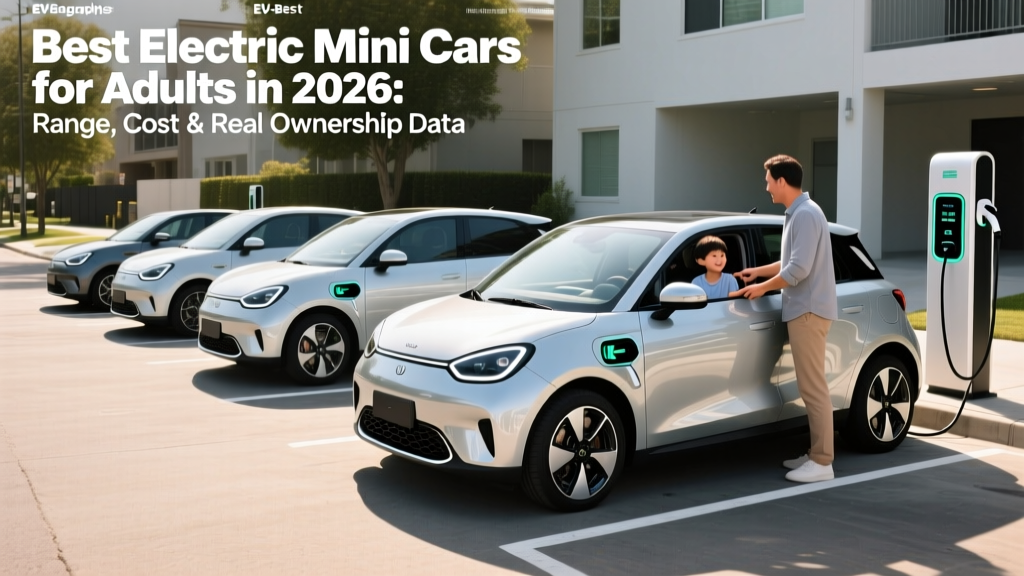
If you're searching for an electric mini car for adults in 2026, your best mainstream options are the MINI Cooper SE (EPA 114 miles, ~$30,900), the Fiat 500e (EPA 149 miles, ~$32,500), and the used-market Chevrolet Bolt EV (EPA 259 miles, discontinued but widely available). These subcompact EVs prioritize urban agility, low running costs, and easy home charging over long-distance road-trip capability. Expect real-world highway range to drop 15–25% below EPA estimates, and plan for home Level 2 charging to make ownership practical. If your daily commute stays under 60 miles round-trip and you have access to a garage or driveway outlet, a mini EV can cut fuel costs to roughly $0.04–$0.06 per mile versus $0.12–$0.16 for a comparable gas subcompact.
What Exactly Is an Electric Mini Car — and Who Is It For?
An electric mini car (sometimes called a subcompact EV or city EV) is a battery-electric vehicle under roughly 160 inches long with a battery pack typically between 28 and 45 kWh. These vehicles trade range and cargo space for a low purchase price, tight turning circles, and exceptional ease of parking. They're engineered primarily for urban and suburban use: grocery runs, commutes, school drop-offs, and weekend errands.
The adults buying these cars aren't looking for a Tesla Model Y replacement. They're often:
- Second-car households replacing a gas commuter with something cheaper to run
- Urban renters or condo owners who need a small footprint and can charge at home overnight
- Downsizers whose kids have moved out and who no longer need a crossover
- Budget-conscious first-time EV buyers who want to try electric without a $50,000 commitment
The critical question before you buy: Does your driving pattern fit the range envelope? A 114-mile EPA rating sounds modest, but the average American drives roughly 37 miles per day according to FHWA data. The mismatch between daily needs and range anxiety is where most mini EV ownership succeeds or fails.
2026 Electric Mini Car Lineup: Spec-by-Spec Comparison
Here's how the current crop of electric mini cars for adults stack up on the numbers that matter. All figures reflect 2025–2026 model-year data from manufacturer specifications and fueleconomy.gov.
| Spec | MINI Cooper SE (2026) | Fiat 500e (2025) | Nissan Sakura (Japan-market) |
|---|---|---|---|
| EPA Range | 114 mi | 149 mi | ~112 mi (WLTP 180 km) |
| Battery (usable kWh) | 28.9 kWh (NMC) | 37.3 kWh (NMC) | 20.0 kWh (NMC) |
| Motor Output | 181 hp / 199 lb-ft | 118 hp / 162 lb-ft | 63 hp / 140 lb-ft |
| 0–60 mph | 6.9 sec | 8.5 sec | ~12.0 sec (est.) |
| DC Fast Charge (peak kW) | 50 kW (CCS) | 85 kW (CCS) | ~30 kW (CHAdeMO) |
| 10–80% DCFC Time | ~36 min | ~35 min | ~40 min |
| Level 2 Charge Rate | 11 kW (AC) | 11 kW (AC) | ~5.8 kW (AC) |
| EPA MPGe (combined) | 110 MPGe | 116 MPGe | N/A (not US-sold) |
| Base MSRP | $30,900 | $32,500 | ~¥2,500,000 (Japan only) |
| Battery Warranty | 8 yr / 100,000 mi | 8 yr / 100,000 mi | 8 yr / 100,000 km |
Key takeaway: The Fiat 500e offers the best range and fastest charging of the US-available mini EVs, while the MINI Cooper SE trades range for a sportier drive and lower entry price. The Nissan Sakura is a compelling kei-car option but is not sold in the United States and uses CHAdeMO, a connector standard that is being phased out at public stations.
Real-World Range: What the EPA Sticker Doesn't Tell You
EPA vs. Reality for Mini EVs
MINI Cooper SE: EPA 114 mi → Expect ~90–100 mi on the highway at 70 mph; ~75–85 mi in freezing weather with cabin heat.
Fiat 500e: EPA 149 mi → Expect ~120–135 mi highway; ~100–115 mi in cold conditions.
Mini EVs are disproportionately affected by range loss for two physics-driven reasons:
- Small battery, fixed overhead. Cabin heating, battery thermal management, and accessory loads consume a relatively fixed amount of energy regardless of battery size. When your total pack is 29–37 kWh, a 3 kW heater represents a much larger percentage draw than it would in a 75 kWh pack.
- Aerodynamic penalty at speed. Short, tall vehicles like the 500e have higher drag coefficients relative to their frontal area. Efficiency drops sharply above 65 mph. If your commute is 40 miles of 75-mph interstate, budget accordingly.
Neither car includes a heat pump as standard equipment in base trims (the MINI offers one in higher trims), which means resistive cabin heating will consume 2–5 kW continuously in cold weather. For a 28.9 kWh battery, that's a meaningful hit.
Cost Breakdown: Purchase, Charging, and 5-Year Ownership
Here's a realistic 5-year total cost of ownership comparison between the Fiat 500e and a similarly sized gas car — the Honda Civic LX (~$25,000 MSRP, EPA 33 mpg combined) — assuming 12,000 miles/year and $3.50/gallon gas.
| Cost Category (5 years / 60k mi) | Fiat 500e | Honda Civic LX (Gas) |
|---|---|---|
| Purchase Price (MSRP) | $32,500 | $25,000 |
| Federal Tax Credit (§30D) | Up to $7,500* | $0 |
| Effective Purchase Price | ~$25,000 | $25,000 |
| Fuel / Electricity (60k mi) | $2,160 (home L2, $0.13/kWh) | $6,364 ($3.50/gal, 33 mpg) |
| Maintenance (oil, filters, brakes) | ~$600 (tire rotations, cabin filter) | ~$2,800 (oil changes, brakes, filters) |
| Insurance (avg. estimate) | ~$7,200 | ~$6,000 |
| Estimated Depreciation | ~$12,000 | ~$9,000 |
| 5-Year Total (approx.) | ~$46,960 | ~$49,164 |
*The §30D federal tax credit eligibility depends on MSRP caps (under $55,000 for sedans/hatchbacks), buyer income limits ($150,000 single / $300,000 joint AGI), and battery critical-mineral sourcing requirements. Verify current eligibility at irs.gov before purchasing. The credit can now be transferred to the dealer at point of sale, reducing your out-of-pocket cost immediately.
The bottom line: The mini EV roughly breaks even with a gas subcompact over 5 years when the full tax credit applies. Without the credit, the EV costs roughly $6,000–$8,000 more over 5 years, primarily due to higher upfront price and steeper depreciation. The savings case strengthens dramatically if you have access to free or subsidized workplace charging, solar panels, or live in a state with additional rebates (check afdc.energy.gov for state incentives).
Charging at Home: The Make-or-Break Factor
Home charging access is the single biggest determinant of whether an electric mini car for adults will work in your life. These small batteries actually make home charging easier than larger EVs because they refill faster.
| Charging Level | Power (kW) | Miles Added per Hour | 0–100% Time (Fiat 500e) |
|---|---|---|---|
| Level 1 (120V outlet) | 1.4 kW | ~4–5 mi/hr | ~26–30 hours |
| Level 2 (240V, 32A) | 7.7 kW | ~25–28 mi/hr | ~5 hours |
| Level 2 (240V, 48A) | 11.5 kW | ~35–38 mi/hr | ~3.5 hours |
| DC Fast Charge (CCS) | Up to 85 kW | ~180–220 mi/hr (peak) | 10–80% in ~35 min |
Important distinction: kW (kilowatts) measures power — how fast energy flows into the battery. kWh (kilowatt-hours) measures energy capacity — how much the battery holds. The Fiat 500e has a 37.3 kWh battery and can accept up to 85 kW of charging power at peak.
Level 1 is viable for mini EVs. Unlike a 100 kWh truck battery that would take days on a 120V outlet, a 29–37 kWh mini EV battery can recover 40–50 miles overnight (8–10 hours) on a standard household outlet. If your daily driving is under 40 miles, you may not need a Level 2 installation at all.
Level 2 home installation costs typically range from $500 (simple NEMA 14-50 outlet near the panel) to $2,500+ (new subpanel, long conduit runs, panel upgrades). For a mini EV, a basic 32-amp Level 2 EVSE ($300–$500 for the unit) is more than sufficient — you don't need a 48-amp hardwired unit for a car that can only accept 11 kW AC.
Electric Mini Car vs. Gas Subcompact vs. Hybrid: Which Fits?
| Factor | Electric Mini (Fiat 500e) | Gas Subcompact (Honda Civic) | Hybrid (Toyota Prius LE) |
|---|---|---|---|
| EPA Range / Tank | 149 mi | ~430 mi | ~620 mi |
| Energy Cost per Mile | $0.04–$0.06 | $0.11–$0.16 | $0.07–$0.09 |
| Refuel / Recharge Time | 3.5 hr (L2) / 35 min (DCFC) | 5 min | 5 min |
| Home "Refueling" Possible? | Yes (overnight) | No | No |
| Maintenance Complexity | Low (no oil, fewer brakes) | Moderate | Moderate-High (dual systems) |
| Cold-Weather Range Loss | 20–35% | Negligible | Negligible (electric range N/A) |
| Road-Trip Practicality | Poor (frequent stops, slow DCFC) | Excellent | Excellent |
| Best For | City commuters w/ home charging | All-purpose, no charging needed | High-mileage drivers, no home charging |
When the mini EV wins: You drive under 60 miles daily, charge at home, rarely take long road trips, and want the lowest per-mile operating cost. Regenerative braking also means you'll replace brake pads far less often — many EV owners go 80,000+ miles on original pads.
When the hybrid wins: You lack reliable home charging, drive over 15,000 miles/year, take regular road trips, or live in an area with sparse public charging infrastructure. A Prius at 57 mpg combined still delivers excellent fuel economy with zero lifestyle adaptation.
When the gas car wins: You need maximum flexibility on a minimum budget, live in a rural area, or want to minimize upfront cost with no charging considerations.
Common Misconceptions About Mini EVs — Addressed with Data
| Myth | Fact |
|---|---|
| "114 miles of range is useless." | The average US commute is ~16 miles each way. A 114-mile EV covers 95%+ of daily trips with nightly home charging. The problem isn't range — it's trip planning for the 5% of outlier days. |
| "EV batteries need replacing every few years." | Modern NMC batteries in the MINI and Fiat carry 8-year/100,000-mile warranties against dropping below 70% capacity. Real-world degradation data from similar packs shows ~10–15% loss over 8 years. A replacement pack (if ever needed) costs $5,000–$8,000, but most packs outlast the car's economic life. |
| "Mini EVs are slow and unsafe." | The 2026 MINI Cooper SE hits 60 mph in 6.9 seconds — quicker than many gas hot hatches from a decade ago. Both the MINI and Fiat 500e include standard automatic emergency braking, lane-departure warning, and multiple airbags. Check IIHS and NHTSA for specific crash-test ratings. |
| "I'll save a fortune vs. gas." | You'll save ~$4,200 in fuel over 5 years vs. a Civic, but insurance may cost $1,200 more and depreciation could be $3,000 steeper. Net savings: roughly $0–$1,000 over 5 years with the tax credit; a net loss without it. The real financial win comes at 10+ years of ownership. |
| "Public charging is everywhere now." | As of 2026, the US has roughly 200,000 public charging ports, but reliability varies widely. Electrify America, EVgo, and ChargePoint stations average 75–85% uptime depending on network. For a mini EV with a 114–149 mile range, a single broken charger on a road trip is a real problem. Plan routes carefully. |
Decision Framework: Should You Buy an Electric Mini Car?
Choose an Electric Mini Car If:
- ✅ Your daily round-trip driving is under 60 miles (covers the vast majority of commuters)
- ✅ You have a garage, carport, or driveway with access to at least a 120V outlet (ideally 240V)
- ✅ You already own or can borrow/rent a larger vehicle for road trips (or fly/drive a rental for long trips)
- ✅ You qualify for the §30D federal tax credit (income under $150K single / $300K joint, and the vehicle meets sourcing requirements)
- ✅ You value low running costs, quiet operation, and instant torque over long-range flexibility
- ✅ You live in a mild-to-moderate climate (extreme cold compounds range loss significantly on small packs)
Choose a Hybrid or Gas Car Instead If:
- ❌ You drive over 80 miles daily or regularly take trips exceeding 150 miles
- ❌ You live in an apartment without any charging access and public infrastructure is sparse
- ❌ You live in a region with sustained sub-freezing winters and cannot precondition while plugged in
- ❌ This will be your only vehicle and you need it for everything, including long road trips
- ❌ You don't qualify for federal or state incentives, making the effective purchase price significantly higher
First-Time Mini EV Buyer Checklist
- Measure your real daily mileage. Track it for two weeks. If 90% of your days fall under 50 miles, a mini EV works.
- Verify your home electrical capacity. A licensed electrician can confirm whether your panel supports a 240V circuit (typically requires a 200-amp panel for a dedicated 40-amp EV circuit). Budget $500–$2,500 for installation.
- Check §30D eligibility before signing. Use the IRS clean vehicle credit page and verify the specific VIN's battery sourcing compliance. Ask the dealer for the point-of-sale transfer paperwork.
- Test-drive in conditions you'll actually experience. Drive the car on your actual commute route, at the speeds you normally travel. Note the real-time energy consumption display.
- Research insurance costs. Get quotes before purchasing. EVs often carry 15–25% higher premiums due to repair complexity and battery replacement costs.
- Download and test the charging apps. PlugShare, ChargePoint, EVgo, and Electrify America — map out the DC fast chargers along any route you might take. Confirm CCS connector availability (both the MINI and Fiat use CCS1).
Frequently Asked Questions
Can I take an electric mini car on a road trip?
Yes, but it requires planning. A Fiat 500e with 149 miles of EPA range can handle a 300-mile trip with one DC fast-charge stop (~35 minutes, 10–80%). However, charging-curve taper means the last 20% charges much slower than the peak 85 kW rate. For trips over 200 miles, budget 45–60 minutes of total charging time. Apps like A Better Routeplanner (ABRP) can model your specific route with elevation, temperature, and speed factored in.
Are electric mini cars safe in a crash?
Modern subcompact EVs are significantly safer than older small cars due to rigid battery-pack structures that add torsional stiffness and lower the center of gravity. The Fiat 500e earned strong marks in European NCAP testing. For US-specific ratings, check NHTSA's 5-star safety database and IIHS crash-test results. Both the MINI and Fiat include standard automatic emergency braking and multiple airbags as baseline equipment.
How long will the battery last before it needs replacing?
Based on degradation data from similar NMC packs in the BMW i3 and earlier MINI Cooper SE, expect approximately 10–15% capacity loss over 8 years of typical use. The 8-year/100,000-mile warranty covers drops below 70% state of health. Most owners will sell or trade the vehicle before the battery requires replacement. If a replacement is needed out of warranty, expect $5,000–$8,000 for the pack plus labor.
Do I need a Level 2 charger at home, or is a regular outlet enough?
For a mini EV with a 29–37 kWh battery, a standard 120V outlet (Level 1) adds roughly 4–5 miles of range per hour. Over a 10-hour overnight charge, that's 40–50 miles — sufficient if your daily driving stays under 40 miles. If you regularly drive 50–80 miles per day, a 240V Level 2 installation ($500–$1,500 for most homes) is strongly recommended to fully replenish the battery overnight.
What about the Chevrolet Bolt EV — isn't that a mini electric car?
The Bolt EV (discontinued after 2023) offers an EPA-estimated 259 miles of range from a 65 kWh battery — far more than any current mini EV — at a used price of roughly $15,000–$22,000. It's larger than a true mini car (it's a subcompact hatchback) but is often cross-shopped by buyers looking for an affordable electric car for adults. Its main drawback: DC fast charging peaks at just 55 kW, making road trips slower than in the Fiat 500e. The Bolt EUV (the slightly larger variant) was also discontinued. GM has announced a next-generation Bolt on the Ultium platform, but as of 2026, it remains in pre-production.
Are there any electric mini cars with over 200 miles of range?
Not in the true mini/subcompact category available in the US for 2026. The closest is the Hyundai Kona Electric (EPA 261 miles, ~$33,000), but it's a subcompact crossover, not a mini car. If range is your priority over size, the Kona Electric or the Chevrolet Equinox EV (EPA ~315 miles, ~$33,000) are worth considering — though they sacrifice the ultra-tight parking footprint that defines the mini car segment.