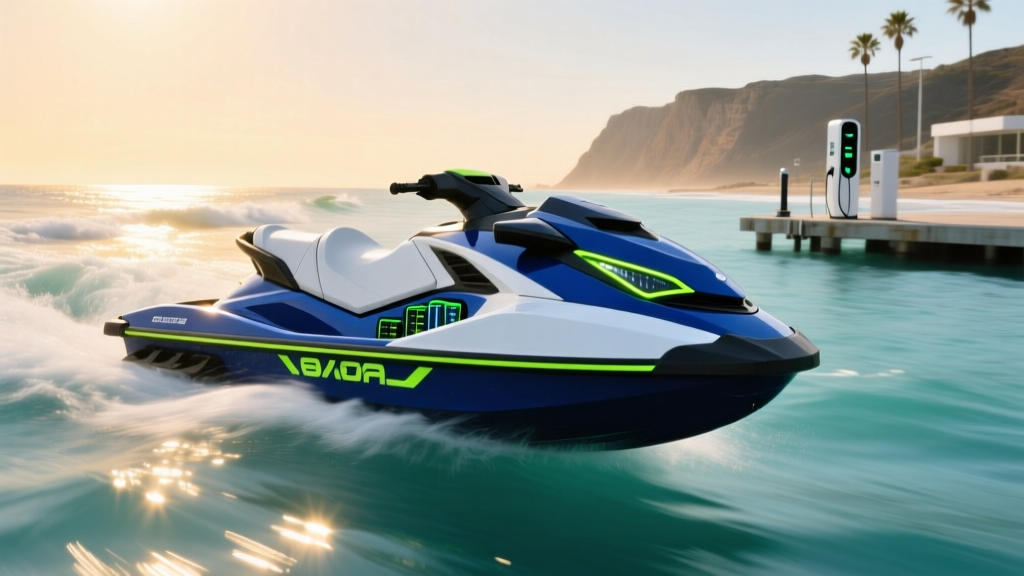
The short answer: Electric jet skis (electric personal watercraft) are a viable, low-maintenance alternative to gas PWCs — but they come with real trade-offs. The market leader, the Taiga Orca, delivers 45–60 minutes of ride time per charge, 0–60 mph in under 4 seconds, and starts around $15,990. That's roughly 2–3× the price of a comparable gas Sea-Doo or Yamaha, with significantly less range. You'll save on fuel and maintenance, but you need dockside or home charging access and must accept shorter sessions. If you ride at a lake house with shore power and value quiet, instant torque, and zero exhaust fumes, an electric jet ski is worth serious consideration. If you need all-day range or ride in remote areas without charging, stick with gas for now.
What Is an Electric Jet Ski — and Who Makes Them?
An electric jet ski replaces the internal combustion engine and fuel tank with a lithium-ion battery pack and electric motor, driving the same waterjet propulsion system as a gas PWC. The result is instant throttle response, near-silent operation (no engine drone, just water noise), and zero direct emissions on the water.
As of 2026, the dominant player is Taiga Motors, a Canadian manufacturer that began deliveries of its Orca personal watercraft in 2022 and has expanded its lineup through 2025–2026. A few smaller entrants and prototypes exist, but Taiga is the only company currently producing electric PWCs at meaningful scale with an established dealer and service network.
The Taiga Orca lineup includes three trims for 2026:
- Orca Recreational — ~$15,990 base, 21 kWh battery, ~160 HP equivalent
- Orca Performance — ~$19,490, 23 kWh battery, ~180 HP equivalent
- Orca Carbon — ~$24,990, 23 kWh battery with carbon-fiber hull, lightest weight, ~180 HP
These are announced/current MSRP figures from Taiga Motors; pricing may vary by dealer and region. Taiga's battery chemistry uses NMC (nickel manganese cobalt) cells optimized for high discharge rates and marine moisture resistance.
Electric Jet Ski vs Gas PWC: Head-to-Head Numbers
The decision between electric and gas personal watercraft comes down to measurable trade-offs. Here's how the Taiga Orca Performance stacks up against two popular gas alternatives — the Sea-Doo RXT-X 325 and the Yamaha GP SVHO — across the metrics that matter.
| Spec | Taiga Orca Performance | Sea-Doo RXT-X 325 | Yamaha GP SVHO |
|---|---|---|---|
| Base MSRP | ~$19,490 | ~$18,299 | ~$19,199 |
| Power | ~180 HP (electric) | 325 HP (supercharged) | 270 HP (supercharged) |
| 0–60 mph | ~3.9 sec | ~4.8 sec | ~5.0 sec |
| Top Speed | ~62 mph | ~72 mph | ~67 mph |
| Range / Ride Time | ~45–60 min (battery dependent) | ~3–4 hrs (16 gal tank) | ~3–4 hrs (18.5 gal tank) |
| Fuel / Energy Cost per Hour | ~$1.50–$3.00 (electricity) | ~$12–$18 (premium gas) | ~$12–$18 (premium gas) |
| Weight | ~580 lbs | ~850 lbs | ~880 lbs |
| Noise Level | Very low (water noise only) | Loud (supercharged engine) | Loud (supercharged engine) |
| Annual Maintenance | ~$100–$200 | ~$500–$800 | ~$500–$800 |
| Winterization | Minimal (no engine fluids) | Required (oil, coolant, fuel stabilizer) | Required (oil, coolant, fuel stabilizer) |
Key takeaway: The electric jet ski wins on acceleration (instant torque), noise, weight, and operating cost. Gas PWCs win decisively on top speed, total range, and refueling speed. The price gap has narrowed — the Orca Performance is now within ~$1,200 of a fully optioned Sea-Doo RXT-X — but the range gap remains massive.
Real-World Range: What 21–23 kWh Actually Gets You on the Water
This is where electric jet ski ownership gets real. Taiga rates the Orca for approximately 45 minutes of "sport mode" riding or up to 60 minutes at moderate cruising speeds. Unlike EVs measured in EPA miles, PWC range depends entirely on how aggressively you ride.
Here's what the battery math looks like in practice:
- Aggressive riding (sport mode, jumps, hard turns): ~30–40 minutes on the Orca Recreational (21 kWh); ~40–50 minutes on the Performance/Carbon (23 kWh)
- Moderate cruising (25–35 mph, steady throttle): ~50–60 minutes on the Recreational; ~60–75 minutes on the Performance/Carbon
- Light use (towing a tube at low speed, idle-heavy): Up to 90 minutes on the larger battery
For comparison, a gas Sea-Doo with a 16-gallon tank burning roughly 4–6 gallons per hour of hard riding gives you 2.5–4 hours before needing to refuel — and refueling takes 5 minutes at a marina pump or with a portable gas can.
Charging times for the Taiga Orca:
- Level 1 (standard 120V outlet): ~12–14 hours for a full charge — essentially overnight only
- Level 2 (240V, 32A): ~3–4 hours for a full charge — viable for a lunch break between sessions
- Optional fast charge (DC, where available): ~40 minutes to 80% — but marine DC fast-charging infrastructure is extremely limited as of 2026
If you ride at a private lake house with a 240V outlet on the dock, you can realistically get two sessions per day with a midday charge. If you rely on public marinas, charging access is a serious constraint — most marinas do not offer dedicated Level 2 charging for PWCs.
Total Cost of Ownership: 5-Year Breakdown
The higher upfront cost of an electric jet ski is offset by dramatically lower operating costs. Here's a realistic 5-year comparison assuming 50 hours of riding per year (typical for a weekend lake-house owner):
| Cost Category | Taiga Orca Performance (Electric) | Sea-Doo RXT-X 325 (Gas) |
|---|---|---|
| Purchase Price | $19,490 | $18,299 |
| Fuel / Energy (5 yrs, 250 hrs) | $375–$750 | $3,000–$4,500 |
| Annual Maintenance (5 yrs) | $500–$1,000 | $2,500–$4,000 |
| Winterization (5 yrs) | $0–$250 | $750–$1,250 |
| Insurance (5 yrs, estimated) | $2,500–$3,500 | $2,000–$3,000 |
| Estimated Resale Value (Year 5) | ~$10,000–$12,000 | ~$9,000–$11,000 |
| Net 5-Year Cost | ~$10,500–$14,000 | ~$13,000–$17,000 |
Electricity cost is based on the U.S. average of ~$0.16/kWh (per EIA data). A 23 kWh battery charged fully costs roughly $3.70; at 50 hours/year you'll need approximately 40–50 full charges annually. Gas cost assumes premium unleaded at $4.00–$4.50/gallon and 5–6 GPH consumption during hard riding.
The electric jet ski breaks even on operating costs within roughly 2–3 years, depending on local electricity and fuel prices. The higher insurance estimate for the Taiga reflects its novelty and limited actuarial data — insurers are still pricing electric PWCs with a premium in many states.
What First-Time Electric Jet Ski Buyers Must Know
If you're considering an electric PWC as your first or replacement watercraft, here are the practical realities that don't appear in marketing brochures:
Charging Access Is Your #1 Constraint
Unlike an electric car, which can use a vast public charging network, electric jet skis have almost no public charging infrastructure. You must have reliable shore power — ideally a 240V Level 2 connection at your dock, boat house, or trailer parking spot. If you trailer your PWC to different lakes each weekend, you'll need to plan charging carefully or accept one session per trip.
Battery Degradation and Warranty
Taiga provides a battery warranty covering defects for a specified period (check current terms with your dealer — historically 2 years on the battery pack). NMC cells in marine applications face thermal and moisture stress. Expect gradual capacity loss over 5–8 years, similar to EV battery degradation patterns. A full battery replacement, if needed out of warranty, could cost $4,000–$7,000 based on current cell pricing and pack integration — a significant factor in long-term ownership economics.
No Federal Tax Credit
The IRS §30D Clean Vehicle Credit applies to qualified on-road vehicles — cars, trucks, SUVs, and certain neighborhood electric vehicles. Personal watercraft, boats, and off-road recreation vehicles do not qualify for the federal EV tax credit. Some states or local utilities may offer rebates for electric marine equipment, but check your specific jurisdiction.
Service Network Is Limited
Taiga's dealer network is growing but remains far smaller than Sea-Doo's or Yamaha's. Before buying, confirm there is an authorized service center within reasonable distance of where you store and ride your PWC. Marine-specific electrical diagnostics require trained technicians — a standard PWC mechanic may not be equipped to service the Orca's powertrain.
Common Misconceptions — Myth vs. Fact
| Myth | Fact |
|---|---|
| "Electric jet skis are slow." | The Taiga Orca Performance hits 0–60 mph in ~3.9 seconds — faster than most gas PWCs. Top speed (~62 mph) is lower than supercharged gas models (~67–72 mph). |
| "You can charge it anywhere on the water." | Marine DC fast-charging stations are virtually nonexistent in 2026. You need shore power — 120V for overnight, 240V for a few-hour turnaround. |
| "No maintenance means no costs." | While there's no oil, spark plugs, or fuel system to service, you still need hull maintenance, impeller inspection, battery management, and winter storage prep. |
| "Electric PWCs are unsafe around water." | Taiga's battery pack is fully sealed and marine-rated (IP67+). Electric marine propulsion is used extensively in commercial ferries and is well-proven in wet environments. |
| "The battery will die in 2 years." | NMC marine batteries, properly managed (avoiding deep discharge and extreme heat storage), should retain 80%+ capacity for 5–8 years of typical recreational use. |
| "You get a $7,500 tax credit." | Personal watercraft are not eligible for the federal §30D EV tax credit. That credit applies to on-road vehicles only. |
Decision Framework: Should You Buy an Electric Jet Ski?
Buy an electric jet ski (Taiga Orca) if:
- You ride primarily at a private lake house or dock with 240V shore power
- Your typical sessions are 45–60 minutes or less
- You value near-silent operation (lake noise ordinances, early-morning rides, wildlife areas)
- You want instant torque and quick acceleration for sport riding
- You want to minimize annual maintenance and winterization hassle
- You accept a higher purchase price in exchange for lower operating costs over 3–5 years
Stick with a gas PWC (Sea-Doo, Yamaha, Kawasaki) if:
- You need 3+ hours of continuous ride time per outing
- You ride at remote lakes or rivers without shore-power access
- Top speed above 65 mph matters to you
- You trailer to different locations frequently and can't guarantee charging
- You want a large, established dealer service network nearby
- Your budget is strictly under $15,000
Consider waiting if:
- You want to see how battery degradation plays out on 2022–2024 Orca models before committing
- You're hoping for a larger-battery option or a competing model from Sea-Doo/Yamaha (both have announced electric PWC research programs, but no production models are on sale as of early 2026)
- Marine DC fast-charging infrastructure develops in your area over the next 1–2 years
Frequently Asked Questions
How long does an electric jet ski battery last on a single charge?
The Taiga Orca with a 23 kWh battery delivers approximately 45–60 minutes of sport-mode riding or 60–75 minutes of moderate cruising. Actual ride time depends heavily on throttle usage, rider weight, water conditions, and ambient temperature. Cold water (below 55°F) can reduce battery efficiency by 10–15%.
How do you charge an electric jet ski?
The Taiga Orca charges via a standard charging port compatible with 120V (Level 1, ~12–14 hours for full charge) and 240V (Level 2, ~3–4 hours for full charge). You plug in at your dock, boat house, or garage — similar to charging an EV at home. There is no practical way to charge on open water.
Are electric jet skis legal everywhere?
Electric PWCs are street-legal (water-legal) in all U.S. states and are subject to the same registration, safety equipment, and operator licensing requirements as gas PWCs. Some lakes with noise restrictions actually favor electric watercraft. Always check local waterway regulations for specific rules.
Can you tow a tube or wakeboarder with an electric jet ski?
Yes. The Taiga Orca Performance and Carbon trims have sufficient torque and power for towing. However, towing is energy-intensive — expect ride time to drop to 30–40 minutes when pulling a tube or boarder at speed. Plan your sessions accordingly.
What happens if the battery runs out on the water?
The Orca includes a reserve buffer and low-battery warnings. If you deplete the battery entirely, the PWC will stop — you'll need to be towed back to shore or to a charging point, just like a gas PWC that runs out of fuel. Responsible charge management (returning to dock at 15–20% remaining) prevents this scenario.
Is an electric jet ski worth it in 2026?
For lake-house owners with shore power who ride in 45–60 minute sessions and value quiet, low-maintenance operation, yes — the Taiga Orca delivers a genuinely different and compelling experience. For riders who need all-day range, remote-water access, or maximum top speed, gas PWCs remain the better tool. The electric PWC market is young; expect more competition and longer-range models within the next 2–3 model years.