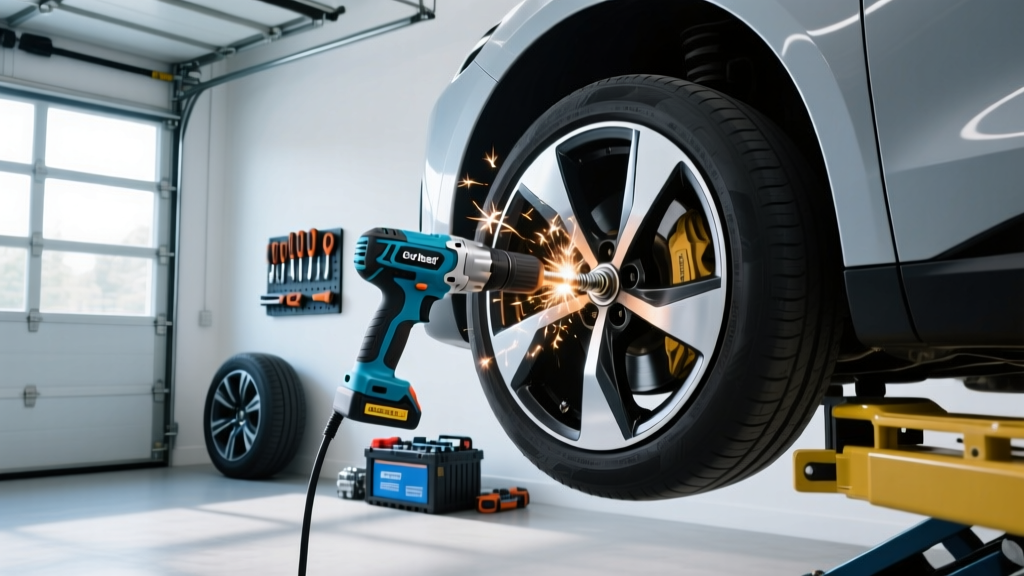
Electric vehicles are heavier than their gas counterparts, and that extra mass — often 500 to 1,000 pounds more due to the battery pack — puts significantly more stress on tires and suspension components. For EV owners who want to rotate their own tires, swap seasonal rubber, or handle basic undercarriage work, a quality electric impact tool is one of the most practical investments you can make. This guide breaks down exactly what to look for, what it costs, and whether DIY maintenance makes financial sense for your EV.
Quick Answer: Do EV Owners Need an Electric Impact Wrench?
Yes, if you plan to rotate tires or swap wheels at home. EVs typically use lug nuts torqued to 100–140 lb-ft, and many models (Tesla Model Y, Ford Mustang Mach-E, Hyundai Ioniq 5) weigh between 4,400 and 5,000 lbs, making manual tire work exhausting. A mid-range cordless electric impact wrench ($150–$300) with 300+ lb-ft of breakaway torque handles EV lug nuts easily and pays for itself in 2–3 shop-visit savings.
Why EVs Demand More From Your Tools
The physics are straightforward: electric vehicles carry substantially more weight than internal-combustion equivalents. A 2026 Tesla Model Y Long Range weighs approximately 4,400 lbs. A comparably sized gas SUV like the Toyota RAV4 sits around 3,600 lbs. That 800-pound difference concentrates on four contact patches, accelerating tire wear by roughly 20–30% according to tire industry data.
Here's what that means for maintenance:
- Tire rotation frequency: Most EV manufacturers recommend rotation every 5,000–7,500 miles. With faster wear, staying on schedule matters more.
- Lug nut torque specs: EVs often spec higher torque values. The Tesla Model 3/Y calls for 129 lb-ft; the Ford F-150 Lightning requires 150 lb-ft. These figures exceed what most people can comfortably achieve with a standard lug wrench.
- Wheel size trends: Many 2026 EVs ship with 19- to 22-inch wheels. Larger, heavier wheels are harder to maneuver by hand during swaps.
An electric impact wrench — specifically a cordless, brushless 1/2-inch drive model — solves all three problems. It removes lug nuts in seconds, handles high torque specs without strain, and lets one person manage heavy wheels safely.
Electric Impact Tool Specs That Matter for EV Work
Not every impact wrench on the shelf is suited for EV maintenance. Here are the specifications to evaluate, and why each matters for electric vehicle applications:
| Specification | Minimum for EV Use | Recommended | Why It Matters |
|---|---|---|---|
| Breakaway Torque | 250 lb-ft | 350+ lb-ft | Over-torqued or corroded lug nuts need extra force to crack loose |
| Fastening Torque | 200 lb-ft | 300+ lb-ft | Must meet EV lug-nut torque specs (typically 100–150 lb-ft) |
| Drive Size | 1/2 inch | 1/2 inch | Standard for automotive lug nuts; 3/8" is too small for wheel work |
| Motor Type | Brushed | Brushless | Brushless motors run cooler, last longer, deliver more torque per watt |
| Battery Voltage | 18V | 20V Max | Higher voltage = more sustained power under load |
| Impacts Per Minute (IPM) | 2,000 | 2,400+ | Higher IPM removes stubborn fasteners faster |
| Weight (bare tool) | — | Under 5 lbs | You'll be working overhead and in tight wheel wells |
Understanding Torque Numbers
Manufacturers list two torque figures: fastening torque (what the tool applies when tightening) and breakaway torque (what it delivers in short bursts to remove stuck fasteners). Breakaway torque is typically 20–50% higher than fastening torque. For EV work, prioritize breakaway torque — you need it to crack loose lug nuts that may have been over-torqued at a shop or corroded from road salt.
Cost Breakdown: DIY Tire Rotation vs. Shop Visits
The financial case for owning an electric impact wrench hinges on how often you'd otherwise pay for tire service. Here's a realistic 5-year comparison for a typical EV owner driving 12,000 miles annually:
| Cost Category | Shop Service (5 Years) | DIY with Impact Wrench (5 Years) |
|---|---|---|
| Tire rotations (every 6,000 mi = ~10 rotations) | $250–$500 ($25–$50 each) | $0 (after tool purchase) |
| Seasonal tire swaps (2x/year × 5 = 10 swaps) | $500–$1,000 ($50–$100 each) | $0 (after tool purchase) |
| Electric impact wrench (mid-range brushless kit) | — | $200–$300 |
| Torque wrench (for final lug-nut spec) | — | $40–$80 |
| Floor jack + jack stands | — | $120–$250 |
| Total 5-year cost | $750–$1,500 | $360–$630 |
The break-even point arrives within 12–18 months for owners who swap seasonal tires, or within 2–3 years for those who only rotate. After that, every service event is essentially free.
Hidden Savings: Time and Convenience
A shop tire rotation typically requires scheduling, a 30–60 minute wait, or a second trip. At-home rotation with an electric impact wrench takes 15–20 minutes once you're practiced. Over five years, that's 10–20 hours reclaimed.
EV vs. Gas: How Maintenance Costs Compare
One of the most compelling arguments for EV ownership is reduced maintenance, but tire care is the one area where EVs can actually cost more. Here's how the full maintenance picture compares:
| Maintenance Item | EV (Annual Cost) | Gas Vehicle (Annual Cost) |
|---|---|---|
| Oil changes | $0 | $120–$200 |
| Brake pads (replacement interval) | $0–$50 (every 80,000+ mi thanks to regen) | $150–$300 (every 30,000–50,000 mi) |
| Transmission fluid | $0 (most EVs have sealed single-speed reducers) | $100–$200 (every 30,000–60,000 mi) |
| Tire replacement | $800–$1,400 (every 30,000–40,000 mi) | $600–$1,000 (every 40,000–60,000 mi) |
| Coolant / fluid top-offs | $20–$50 | $50–$100 |
| Cabin air filter | $20–$40 | $20–$40 |
| Estimated annual total | $300–$500 | $700–$1,200 |
EVs save $400–$700 per year on routine maintenance, according to fueleconomy.gov data and industry analyses. However, tires are the equalizer: EV owners typically spend 20–35% more on tires over the vehicle's life due to higher weight and instant torque delivery. This makes DIY tire service — enabled by a quality electric impact wrench — one of the few ways EV owners can actively reduce their biggest maintenance expense.
Real-World Ownership Considerations
Do You Have the Space?
DIY tire work requires a flat, level surface — ideally a garage or driveway. Apartment dwellers without ground-floor parking access will find shop service more practical. You also need storage for a floor jack, jack stands, and off-season tires (four tires on rims take up roughly 16 cubic feet).
Climate and Seasonal Tire Swaps
If you live in a region with harsh winters (sustained temperatures below 45°F), dedicated winter tires on separate rims are strongly recommended for EVs. The extra weight means longer stopping distances on snow and ice. Electric impact tools make seasonal swaps feasible at home — swap all four corners in under 20 minutes instead of paying $50–$100 per visit at a shop.
In warmer climates where all-season tires suffice year-round, the tool still pays dividends through regular rotations that extend tire life by 5,000–10,000 miles.
Cold-Weather Tool Performance
Lithium-ion batteries in cordless impact wrenches lose efficiency below freezing. If you're swapping to winter tires in November in Minnesota, store the tool battery indoors and bring it out just before use. Most modern brushless tools operate fine down to about 20°F, but expect reduced runtime.
Common Misconceptions About Electric Impact Tools and EVs
| Myth | Fact |
|---|---|
| "Impact wrenches will over-torque and damage EV lug nuts" | True if used carelessly. The correct method: use the impact wrench to run the nut down, then finish with a calibrated torque wrench set to your vehicle's spec (e.g., 129 lb-ft for Model Y). Never use an impact wrench for final tightening. |
| "You can't jack up an EV — the battery is in the floor" | Every EV has designated jacking points, typically reinforced pinch-welds or puck-style adapters near each wheel. Consult your owner's manual. Using the wrong point CAN damage the battery enclosure. |
| "Electric impact tools are weak compared to pneumatic (air) tools" | Outdated. Modern brushless 20V cordless impact wrenches from Milwaukee, DeWalt, and Makita deliver 400–700 lb-ft of breakaway torque — matching or exceeding most shop air tools. Pneumatic tools still win on sustained heavy-duty use, but for 4–5 lug nuts per wheel, cordless is more than adequate. |
| "EVs don't need tire rotations" | False. EVs need rotations as much as or more than gas cars due to weight and torque. Tesla, Hyundai, and Ford all specify rotation intervals in their maintenance schedules. |
| "You'll void your EV warranty by doing your own tire work" | The Magnuson-Moss Warranty Act protects your right to perform maintenance. As long as you use correct torque specs and don't damage components, DIY tire service does not affect your battery or powertrain warranty. |
Decision Framework: Should You Buy an Electric Impact Wrench for Your EV?
Choose DIY + Electric Impact Tool If:
- You own your home or have reliable garage/driveway access
- You run seasonal tire swaps (winter/summer) — savings compound fast
- You drive 12,000+ miles/year and want to stay on rotation schedule
- You enjoy basic mechanical work and want self-sufficiency
- You own or plan to own multiple EVs (tool cost amortizes further)
Stick With Shop Service If:
- You live in an apartment without ground-level parking
- You lease your EV and plan to return it within 3 years
- You drive under 8,000 miles/year (fewer service events)
- You're uncomfortable working under a 4,500+ lb vehicle
- Your EV came with free scheduled maintenance (some brands include 2–3 years)
Recommended Starter Kit (2026 Pricing)
If you decide to go DIY, here's a practical, no-regrets setup:
- Cordless impact wrench kit (Milwaukee M18 Fuel 1/2" or DeWalt 20V Max XR): $200–$300 including battery and charger
- Torque wrench (1/2" drive, 30–250 lb-ft range): $40–$80
- Low-profile floor jack (3-ton capacity, EV-compatible): $80–$150
- Jack stands (pair, 3-ton rated): $40–$60
- Wheel chocks: $15–$25
- Total investment: $375–$615
Frequently Asked Questions
Can I use an electric impact wrench on my Tesla's lug nuts?
Yes. Tesla Model 3 and Model Y lug nuts are torqued to 129 lb-ft (175 Nm) at the factory. A brushless cordless impact wrench with 300+ lb-ft of breakaway torque removes them easily. Always use a torque wrench for final tightening to spec — never rely on the impact wrench alone for proper torque.
Will an impact wrench damage my EV's wheel bolts?
Not if used correctly. Use impact-rated sockets (not chrome-finish standard sockets, which can shatter). Run the nut on by hand first to avoid cross-threading, then use the impact wrench at low speed. Finish with a torque wrench. The risk of damage comes from over-torquing, not from the tool itself.
How is an electric impact tool different from an electric impact driver?
An impact driver is designed for screws and small fasteners — it uses a 1/4-inch hex collet and delivers 1,500–2,000 in-lb of torque. An impact wrench uses a 1/2-inch (or 3/8-inch) square drive anvil and delivers 200–700 ft-lb of torque — roughly 10–50× more force. You need the wrench for lug nuts, not the driver.
Do I need a special jack for my electric vehicle?
You don't necessarily need a special jack, but you do need to use the correct jacking points. Most EVs have reinforced jacking points along the rocker panel, and some (like Teslas) use puck-style adapters. Using a standard floor jack on the wrong point can crush the battery enclosure, leading to a $15,000–$25,000 repair. Check your owner's manual or NHTSA documentation for your specific model's jacking procedure.
What's the best battery platform to invest in?
If you already own cordless tools, stay within that ecosystem (Milwaukee M18, DeWalt 20V Max, Makita 18V LXT). Battery interoperability across tools is the biggest cost advantage of cordless platforms. If starting fresh, Milwaukee's M18 Fuel line and DeWalt's 20V Max XR are the two strongest contenders for automotive-grade torque and durability, with widespread parts availability.
How often should I rotate my EV's tires?
Most EV manufacturers recommend rotation every 5,000–7,500 miles. Because EVs are heavier and deliver instant torque, many owners find that 5,000-mile intervals produce more even wear. Check your specific vehicle's maintenance schedule — for example, Hyundai recommends 7,500-mile intervals for the Ioniq 5, while Tesla suggests inspection at every service and rotation "as needed."