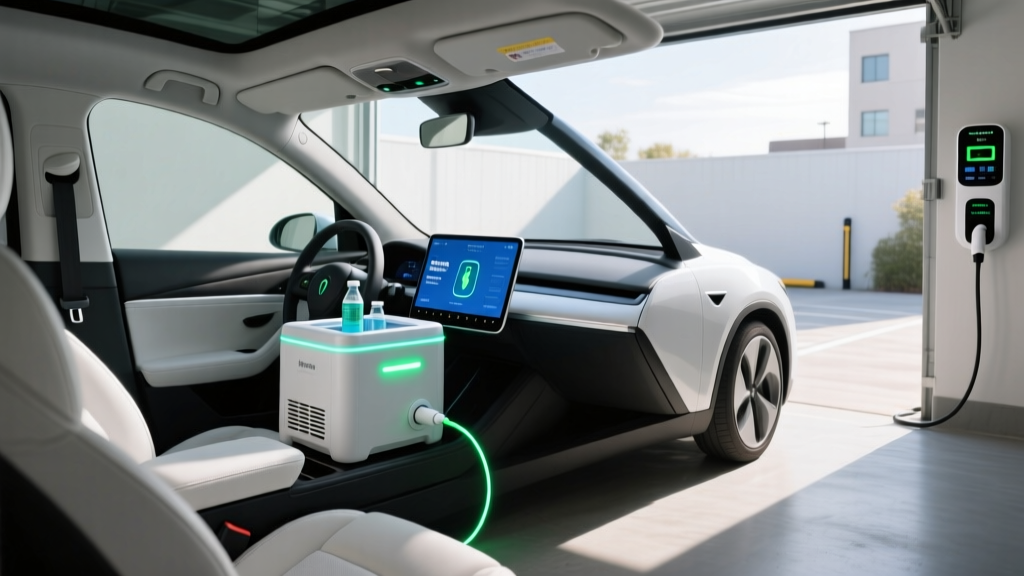
If you're planning to run an electric drink cooler from your EV—whether for tailgating, camping, or a beach day—the short answer is yes, it works well, provided your vehicle supports Vehicle-to-Load (V2L) or you use a 12V DC cooler. A typical 45-quart electric cooler draws 40–60 watts on 12V DC and 60–90 watts on 120V AC via inverter. Over a full 24-hour period, expect to use roughly 0.8–1.5 kWh from your EV's battery. On a 75 kWh usable pack (like the Hyundai Ioniq 5 or Ford F-150 Lightning extended-range), that translates to about 1–2% of total battery capacity per day—negligible for most outings.
Quick Answer: Can My EV Power an Electric Drink Cooler?
Yes. Most EVs with V2L (Hyundai Ioniq 5/6, Kia EV6/EV9, Ford F-150 Lightning, Rivian R1T/R1S, Genesis GV60) can run a 120V electric cooler for days with minimal range loss. Without V2L, a 12V DC cooler plugged into the accessory outlet works, but draws from the 12V auxiliary system—monitor usage to avoid draining the 12V battery. Expect ~1–2% battery drain per 24 hours on a mid-size EV battery.
How V2L Works and Which EVs Support It
Vehicle-to-Load (V2L) is a feature that lets your EV's high-voltage traction battery output standard 120V AC power through a dedicated outlet—either inside the cabin or via an adapter plugged into the charge port. This is different from the 12V accessory socket (cigarette-lighter style), which is limited to ~120–180 watts and runs through the smaller 12V auxiliary battery and DC-DC converter.
As of the 2026 model year, V2L-capable EVs include:
- Hyundai Ioniq 5 / Ioniq 6: Up to 3.6 kW output via interior V2L outlet or charge-port adapter
- Kia EV6 / EV9: Up to 3.6 kW (EV9 up to 7.2 kW with available V2L package)
- Ford F-150 Lightning: Pro Power Onboard—2.4 kW standard, 9.6 kW available (via bed and cabin outlets)
- Rivian R1T / R1S: 120V and 240V outlets in bed and cabin, up to 9.6 kW
- Genesis GV60 / Electrified GV70: 3.6 kW V2L via charge-port adapter
- Chevrolet Silverado EV: Up to 10.2 kW with available Pro Power
Even an electric drink cooler running at peak 90W draw is well within every V2L system's capacity. For context, you could simultaneously power a cooler (90W), LED camp lights (20W), and a laptop charger (65W) and still be under 200W—far below the 3.6 kW ceiling most systems provide.
Energy Consumption: What an Electric Drink Cooler Actually Draws
Understanding the real energy cost requires distinguishing between kW (power—the instantaneous draw) and kWh (energy—total consumed over time). An electric cooler rated at 50W doesn't pull 50W constantly; its compressor cycles on and off to maintain temperature, much like a home refrigerator.
| Cooler Type | Peak Draw (W) | Avg. Draw Over 24h (W) | 24h Energy Use (kWh) | EV Range Impact (est.) |
|---|---|---|---|---|
| Compact 12V compressor (25–35 qt) | 35–45W | 15–25W | 0.4–0.6 kWh | ~1–2 miles on 75 kWh pack |
| Mid-size 12V/120V compressor (45–55 qt) | 50–70W | 25–40W | 0.6–1.0 kWh | ~2–3 miles on 75 kWh pack |
| Large 120V compressor (65–80 qt) | 70–100W | 35–55W | 0.8–1.3 kWh | ~3–4 miles on 75 kWh pack |
| Thermoelectric 12V (no compressor) | 40–60W | 40–60W (continuous) | 1.0–1.4 kWh | ~3–5 miles on 75 kWh pack |
The key takeaway: compressor-based coolers are more energy-efficient than thermoelectric models because they cycle off once the target temperature is reached. Thermoelectric coolers run continuously and struggle to cool more than ~20°F below ambient temperature. For EV use, a compressor cooler like the Dometic CFX3 45 (avg ~25W over 24h at 37°F target in 85°F ambient) or the Fridge Freez 55L offers the best efficiency-to-capacity ratio.
Real-World Range Impact
Running a 45-quart compressor cooler for a full weekend (48 hours) from a Hyundai Ioniq 5 Long Range (84 kWh usable, EPA 310 miles) will consume approximately 1.2–2.0 kWh—reducing available range by roughly 4–7 miles. In cold weather (below 32°F), the cooler's compressor runs less frequently, further reducing draw. The range penalty is effectively negligible for multi-day trips.
12V vs. 120V: Which Electric Cooler Connection Is Better for EV Use?
This is where many first-time EV campers make a costly mistake. Your EV has two electrical systems:
- The high-voltage traction battery (400V or 800V, 50–130+ kWh) — this is what powers the motors and what V2L taps into.
- The 12V auxiliary battery (a small lead-acid or lithium 12V pack, typically 12–20 Ah) — this powers accessories, lights, computers, and the DC-DC converter.
When you plug a 12V cooler into the cigarette-lighter socket without V2L, you're drawing through the DC-DC converter, which steps down the high-voltage pack to 12V. Most EVs allow this while the vehicle is on or in "utility/camp mode," but the continuous draw limit is typically 120–180W. A 50W cooler is fine, but stacking it with other 12V accessories risks tripping the fuse or overloading the DC-DC converter.
With V2L, you use a proper 120V AC outlet powered directly from the traction battery through an inverter. This is the cleaner, higher-capacity path. If your cooler supports both 12V DC and 120V AC input, use 120V via V2L for best results—the inverter loss (typically 5–10%) is offset by the higher available power headroom and the fact that V2L systems are designed for sustained loads.
Common Electric Cooler + EV Misconceptions
| Myth | Fact |
|---|---|
| "Running a cooler will drain my EV battery and strand me." | A compressor cooler uses ~0.8–1.5 kWh/day. On a 75+ kWh pack, that's 1–2% per day. You'd need to camp for weeks before it meaningfully impacted range. |
| "I need a special EV-approved cooler." | Any quality compressor cooler works. Brands like Dometic, ARB, and ICECO make 12V/120V dual-input models that pair perfectly with V2L. |
| "The 12V outlet in my EV is the same as V2L." | The 12V accessory socket is limited to ~120–180W and runs through the DC-DC converter. V2L provides up to 3,600W+ directly from the traction battery via 120V AC. |
| "Thermoelectric coolers are cheaper, so they're better for EVs." | Thermoelectric models run continuously (no compressor cycling), drawing more total energy and cooling less effectively. Compressor coolers are more efficient for sustained use. |
| "Running a cooler will damage my EV's battery warranty." | V2L is a manufacturer-supported feature. Drawing 50–100W is trivially within design parameters and does not affect battery warranty coverage. |
Best Electric Drink Coolers for EV Owners (2026 Picks)
Based on energy efficiency, build quality, dual-voltage flexibility, and real-world EV camping use, here are the top picks organized by use case:
Best Overall for V2L-Equipped EVs: Dometic CFX3 45
- Capacity: 45 quarts (60 cans)
- Power: 12V DC / 120V AC / 24V DC input
- Avg draw: ~25W at 37°F in 85°F ambient
- Weight: 41 lbs
- Price: ~$1,000–$1,100 MSRP
- Why it wins: Best-in-class VarioSpeed compressor cycles efficiently, Wi-Fi monitoring via app lets you check temperature and power draw from your phone, rugged build withstands truck-bed use.
Best Budget Pick: ICECO JP42 Pro
- Capacity: 42 quarts
- Power: 12V DC / 120V AC
- Avg draw: ~30W at 37°F in 85°F ambient
- Weight: 33 lbs
- Price: ~$400–$500 MSRP
- Why it wins: Secop compressor at roughly half the price of the Dometic, solid efficiency, lighter weight for hatchback cargo areas.
Best for 12V-Only Use (No V2L): ARB Zero 63qt
- Capacity: 63 quarts (dual-zone fridge/freezer)
- Power: 12V DC / 24V DC (no native 120V—use with separate inverter for AC)
- Avg draw: ~35W combined zones
- Weight: 52 lbs
- Price: ~$1,200–$1,300 MSRP
- Why it wins: Dual-zone lets you keep drinks at 37°F in one compartment and freeze food in the other, optimized for 12V DC efficiency.
EV Camping Power Budget: Cooler + Other Accessories
If you're using your EV as a basecamp power station, here's what a realistic weekend power budget looks like when stacking an electric drink cooler with other common accessories:
| Device | Avg. Wattage | Hours Used/Day | Daily kWh | 48h Total kWh |
|---|---|---|---|---|
| Electric compressor cooler (45 qt) | 25W avg | 24 | 0.60 | 1.20 |
| LED camp string lights | 12W | 6 | 0.07 | 0.14 |
| Laptop charging (2 devices) | 65W each | 3 | 0.39 | 0.78 |
| Portable induction cooktop | 1,200W | 0.5 | 0.60 | 1.20 |
| Phone charging (2 devices) | 20W each | 2 | 0.08 | 0.16 |
| CPAP machine | 40W avg | 8 | 0.32 | 0.64 |
| Total 48-Hour Consumption | ~4.12 kWh | |||
On a Ford F-150 Lightning Extended Range (131 kWh usable), 4.12 kWh over a weekend represents just 3.1% of total battery capacity—roughly 10 miles of range. On a Hyundai Ioniq 5 (84 kWh usable), it's about 4.9%—roughly 15 miles. Set your vehicle's V2L discharge limit to 20% SoC (most systems allow this) and you'll never risk stranding yourself.
Decision Framework: Which Setup Is Right for You?
Choose Your Electric Cooler Setup
Choose a 120V compressor cooler via V2L if:
- Your EV has V2L (Ioniq 5, EV6, F-150 Lightning, Rivian, etc.)
- You camp or tailgate for 2+ days at a time
- You want to power multiple devices simultaneously
- You value precise temperature control (fridge and freezer modes)
Choose a 12V DC compressor cooler via the accessory outlet if:
- Your EV does not have V2L (most Teslas, older Bolt, Nissan Leaf)
- You only need to keep drinks cold for day trips (4–8 hours)
- Your total 12V accessory draw stays under 120W
- You can enable "camp mode" or "utility mode" to keep the DC-DC converter active
Choose a standalone battery-powered cooler (like EcoFlow Glacier) if:
- You want zero drain on your EV battery
- You need portability away from the vehicle (beach, picnic table)
- You already own a portable power station and want integrated compatibility
Skip the electric cooler entirely if:
- You're only out for a few hours—a well-insulated passive cooler with ice costs $40 and uses zero electricity
- You don't have reliable access to your vehicle during the outing
Practical Tips for Running a Cooler From Your EV
Based on real-world EV camping experience, here are the details that make or don't make a setup work:
- Pre-cool your cooler before the trip. Plug it into wall power at home for 4–6 hours before loading it into the EV. Starting at target temperature means the compressor runs far less in the field.
- Pre-chill your drinks. Loading warm cans into a cold cooler forces the compressor to run hard for hours. Cold-in, cold-stay is dramatically more efficient.
- Set the V2L discharge limit. Most V2L systems let you set a minimum SoC threshold (e.g., 20%). The car will cut power to the outlet before draining below that level—protecting your ability to drive home.
- Use camp mode / utility mode. On vehicles without dedicated V2L, this mode keeps the DC-DC converter active so the 12V system stays powered without the car "idling." Check your owner's manual for the exact activation sequence—on a Tesla, for example, Camp Mode maintains climate and 12V power indefinitely.
- Keep the cooler shaded and ventilated. Ambient temperature is the single biggest factor in compressor duty cycle. A cooler in direct sun at 95°F will draw roughly 40–60% more energy than one in shade at 75°F.
- Don't confuse your 12V auxiliary battery with the traction pack. If your EV is off and not in utility/camp mode, the 12V accessory socket draws from the small 12V battery—which can be fully depleted in 2–4 hours by a 50W cooler. A dead 12V battery can prevent the car from starting, even if the main pack is full. Always ensure the vehicle is in a mode that activates the DC-DC converter.
Frequently Asked Questions
Will running an electric drink cooler void my EV battery warranty?
No. V2L is a manufacturer-designed and warrantied feature. Drawing 50–100W from a system rated for 3,600W+ is well within engineering tolerances. Your battery warranty (typically 8 years/100,000 miles per federal mandate) remains fully intact. The only scenario that could raise warranty concerns is using an aftermarket inverter improperly wired to the high-voltage system—never attempt this.
Can I run an electric cooler while charging my EV at a DC fast charger?
Generally yes. Most V2L systems continue to supply power during charging, though some vehicles may temporarily reduce V2L output during peak DC fast charging (above 150 kW). The cooler will experience brief interruptions but will resume when charging tapers. Since DC fast charging sessions last 20–40 minutes, this has negligible impact on cooler temperature.
How long can I run a cooler from my EV before I need to recharge?
At ~1 kWh/day for a mid-size compressor cooler, a 75 kWh battery (set to cut off at 20% SoC, giving you 60 kWh of usable draw) could theoretically power the cooler for 60 days. In practice, you're also driving, running climate, and powering other devices—but for a weekend trip, battery drain from the cooler alone is a non-issue.
Is a thermoelectric cooler OK for EV use?
It works, but it's less efficient. Thermoelectric coolers draw power continuously (they have no compressor to cycle off), typically consuming 1.0–1.4 kWh/day versus 0.6–1.0 kWh for a compressor unit. They also can only cool ~20°F below ambient—so on a 95°F day, your drinks bottom out around 75°F. For EV use where efficiency matters, a compressor cooler is the better investment.
Do I need a pure sine wave inverter if my EV doesn't have V2L?
If you're running a 120V cooler through an aftermarket inverter connected to your 12V system, yes—use a pure sine wave inverter. Modified sine wave inverters can damage compressor motors and cause erratic operation. However, the cleaner solution is simply buying a cooler with native 12V DC input, which eliminates the inverter entirely and avoids the 5–15% efficiency loss of DC-to-AC conversion.