The Short Answer: Which 3-Row EV Should You Buy?
If you need three rows of seats in an electric vehicle in 2026, your realistic options come down to six production models. Here's the fast breakdown:
- Best overall value: Kia EV9 — starts ~$54,900, EPA 304 mi range, 236 kW peak DC charging, qualifies for partial §30D credit.
- Best for range & road trips: Rivian R1S (Dual-Motor Max Pack) — EPA 410 mi, but starts ~$89,900 and exceeds the SUV MSRP cap for federal credits.
- Best luxury/performance: Tesla Model X — EPA 348 mi, 348 mi, Falcon Wing doors, starts ~$79,990.
- Best budget entry: Volkswagen ID.4 (with optional 3rd row on select trims) — ~$44,000 base, EPA 291 mi, but the third row is tight for anyone over 5'4".
- Best for large families (full-size): Cadillac Escalade IQ — EPA ~460 mi (est.), massive interior, starts ~$130,000.
- Upcoming/announced: Hyundai Ioniq 9 (expected late 2026) — preliminary specs suggest ~300+ mi range, ~$55,000 starting price.
Every model below is evaluated on EPA range, real-world highway expectations, DC fast-charging speed, interior practicality, and total cost of ownership. Let's get into the numbers.
Every 3-Row EV Available in 2026: Side-by-Side Specs
Before diving into ownership realities, here is the full spec matrix. All figures are manufacturer-published or EPA-verified for the 2025–2026 model year. Prices reflect base MSRP before destination charges and before any tax incentives.
| Model | EPA Range | Battery (kWh usable) | Chemistry | Peak DC kW | 10–80% Time | 0–60 mph | Base MSRP | §30D Credit Eligible? |
|---|---|---|---|---|---|---|---|---|
| Kia EV9 (LR RWD) | 304 mi | 99.8 kWh | NMC | 236 kW | ~24 min | 8.2 sec | $54,900 | Partial (sourcing dependent) |
| Rivian R1S (Dual Max) | 410 mi | 149 kWh | NMC | 220 kW | ~30 min | 3.5 sec (Tri) | $89,900 | No (over MSRP cap) |
| Tesla Model X (LR) | 348 mi | 100 kWh | NMC/NCA | 250 kW | ~22 min | 3.8 sec | $79,990 | No (over MSRP cap) |
| VW ID.4 (AWD Pro S+) | 291 mi | 82 kWh | NMC | 175 kW | ~28 min | 6.7 sec | $44,495 | Yes (if sourcing qualifies) |
| Cadillac Escalade IQ | ~460 mi (est.) | 200+ kWh | NMC | 350 kW | ~20 min | ~4.5 sec | $130,000 | No (over MSRP cap) |
Sources: fueleconomy.gov, manufacturer press sites. §30D eligibility depends on battery sourcing, buyer income, and MSRP caps per IRS rules. Always verify current-year requirements.
Real-World Range vs. EPA Sticker: What to Actually Expect
EPA range is a lab estimate — here's what real driving looks like:
- Highway driving at 75 mph: Expect 12–18% less than EPA. A 304-mi Kia EV9 delivers roughly 250–265 miles on a flat interstate run.
- Cold weather (below 32°F): Add another 15–30% reduction. The same EV9 in a Minnesota January may deliver only 200–220 miles per charge. Models with heat pumps (EV9, Model X, R1S) fare better than those without.
- Full passenger + cargo load: Towing or hauling six passengers with gear typically costs 5–10% additional range.
For three-row EV buyers, this matters because you're often carrying a full family. The Rivian R1S Max Pack's 410-mile EPA rating translates to a real-world road-trip range of roughly 340–355 miles in fair weather — enough to space DC fast-charger stops about 4–5 hours apart. The VW ID.4's 291-mile EPA figure becomes roughly 240–250 miles highway, which means stopping every 3 hours on longer trips.
Charging-curve reality: Peak DC fast-charging rates are not sustained. A Kia EV9 that peaks at 236 kW will taper to ~100 kW above 60% SoC and ~50 kW above 80%. The published 10–80% time (24 minutes) reflects this taper. Plan for 25–35 minutes at a 350 kW station for a practical road-trip stop, not the 15 minutes marketing sometimes implies.
EV vs. Gas 3-Row SUV: The Real Cost Breakdown
Three-row gas SUVs like the Toyota Highlander, Kia Telluride, and Honda Pilot still dominate this segment by volume. Here's how a comparable EV stacks up over five years of ownership, assuming 15,000 miles/year, $3.50/gallon regular unleaded, and $0.14/kWh average home electricity.
| Cost Category | Kia EV9 (LR RWD) | Kia Telluride (V6 AWD) |
|---|---|---|
| Base MSRP | $54,900 | $39,790 |
| Federal tax credit (§30D) | Up to $3,750* | $0 |
| Effective purchase price | ~$51,150 | $39,790 |
| Home Level 2 charger install | $800–$2,000 | $0 |
| Fuel / electricity (5 yrs, 75k mi) | $3,675 | $7,875 |
| Maintenance (5 yrs) | ~$1,200 | ~$3,500 |
| Insurance (5 yrs avg.) | ~$12,500 | ~$9,500 |
| 5-year depreciation (est.) | ~$22,000 | ~$16,000 |
| Total 5-yr cost of ownership | ~$91,325 | ~$76,665 |
*§30D credit for the EV9 depends on battery critical-mineral and component sourcing. Credit amounts and eligibility change — verify at irs.gov before purchasing. The credit can now be transferred to the dealer as a point-of-sale discount.
Common Misconceptions About 3-Row EVs
| Myth | Fact |
|---|---|
| "There aren't enough charging stations for road trips with a big family EV." | The U.S. now has over 7,000 DC fast-charging stations. Tesla's Supercharger network (open to NACS-equipped vehicles) plus Electrify America and EVgo cover all major interstate corridors. Plan stops around 200–280 miles apart and you'll rarely wait. |
| "The third row in an EV is always cramped." | The Rivian R1S and Kia EV9 offer genuine adult-capable third rows with 30+ inches of legroom. The VW ID.4's third row is best reserved for children under 12. Always test-sit in the third row before buying. |
| "EV batteries will need expensive replacement within a few years." | Federal law mandates battery warranties of at least 8 years/100,000 miles. Real-world degradation data from Tesla, Rivian, and Hyundai/Kia fleets shows most batteries retain 85–92% capacity after 100,000 miles. Replacement is rare and typically covered under warranty during that period. |
| "You'll save $15,000+ over gas in 5 years." | Not always. Higher purchase prices, potentially higher insurance premiums, and steeper depreciation on some EV models can offset fuel and maintenance savings. Run the numbers for your specific situation using the table above as a template. |
Charging a 3-Row EV at Home: What You Actually Need
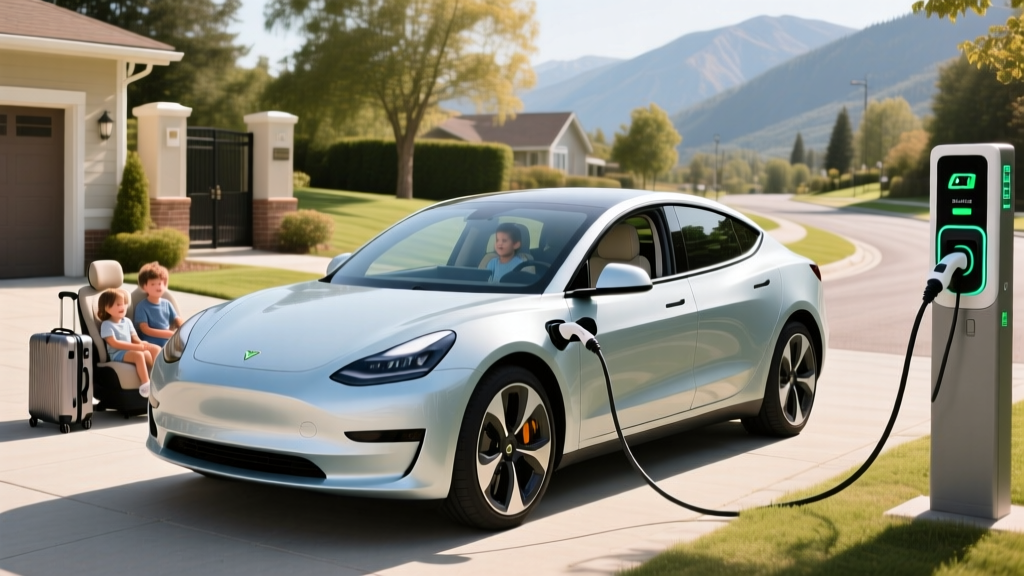
Home charging is the backbone of EV ownership. If you can install a Level 2 charger, daily life with a 3-row EV is dramatically simpler than relying solely on public infrastructure. Here's the reality:
| Charging Level | Power (kW) | Miles Added per Hour | Typical Use Case |
|---|---|---|---|
| Level 1 (120V outlet) | 1.4–1.9 kW | 3–5 mi/hr | Overnight trickle; insufficient for large-battery 3-row EVs as primary charging |
| Level 2 (240V, 32A–48A) | 7.7–11.5 kW | 20–35 mi/hr | Primary home charging; fully recharges a 100 kWh battery in 9–13 hours |
| DC Fast Charge | 50–350 kW | 150–800+ mi/hr | Road trips; 10–80% in 20–35 minutes depending on vehicle and station |
Installation cost reality: A Level 2 home charger (such as a ChargePoint Home Flex, Emporia Level 2, or Tesla Wall Connector) costs $300–$700 for the equipment. Professional installation by a licensed electrician runs $500–$2,500 depending on your panel proximity and whether a 240V/50A circuit already exists. If your electrical panel needs an upgrade from 100A to 200A service, add $1,500–$3,500. Total realistic range: $800–$6,000, with most homeowners spending $1,200–$2,500.
If you can't charge at home (apartment living, no garage, street parking only), a 3-row EV becomes significantly more challenging. You'll depend entirely on public Level 2 and DC fast charging. In that case, prioritize models with the fastest DC charge rates (Tesla Model X at 250 kW, Escalade IQ at 350 kW) and map the public chargers within 2 miles of your home and workplace before buying.
Tax Credits and Incentives: What Actually Applies to 3-Row EVs
The federal §30D clean vehicle credit offers up to $7,500, but the rules are strict and many 3-row EVs fall outside eligibility. Here's the checklist:
Federal §30D Credit Requirements (2026)
- MSRP cap: SUVs/vans/pickups must have MSRP ≤ $80,000. This eliminates the Rivian R1S (most trims), Tesla Model X, and Cadillac Escalade IQ.
- Buyer income cap: Modified AGI ≤ $300,000 (joint), $225,000 (head of household), $150,000 (single).
- Battery sourcing: Critical minerals and battery components must meet escalating domestic/free-trade-partner thresholds. This can reduce the credit to $3,750 or $0 depending on the specific vehicle's supply chain.
- Point-of-sale transfer: You can now transfer the credit to the dealer at purchase, reducing your out-of-pocket cost immediately rather than waiting for tax filing.
- Assembly: Vehicle must undergo final assembly in North America.
Verify current eligibility at irs.gov and fueleconomy.gov. State incentives vary — check your state energy office.
Models most likely to qualify (full or partial): Kia EV9 (depending on trim MSRP and sourcing), VW ID.4. Models that do not qualify: Rivian R1S, Tesla Model X, Cadillac Escalade IQ (all exceed the $80,000 SUV MSRP cap).
Decision Framework: Which 3-Row EV Fits Your Life?
If-Then Buyer's Guide
Choose the Kia EV9 if: You want the best balance of interior space, range, charging speed, and price. You need a usable adult third row, you value the 10-year/100,000-mile powertrain warranty, and you want to stay under the §30D MSRP cap. Best for: families of 5–6 with daily commutes under 60 miles and periodic road trips.
Choose the Rivian R1S if: You need maximum range (410 mi EPA with Max Pack), genuine off-road capability, and you're comfortable paying $90,000+ without federal credit eligibility. Best for: adventure-oriented families who tow (up to 7,700 lbs), ski, or drive in remote areas.
Choose the Tesla Model X if: You want the Supercharger network advantage, best-in-class performance (3.8s 0–60), and over-the-air updates. The Falcon Wing rear doors are practical for car-seat loading in tight spaces. Best for: performance-minded families already in the Tesla ecosystem.
Choose the VW ID.4 (3-row option) if: Budget is the primary driver and your third-row passengers are small children. You want the lowest entry price with federal credit potential. Best for: budget-conscious families of 4–5 who rarely use the third row.
Choose the Cadillac Escalade IQ if: You need maximum interior volume, luxury amenities, and range, and price is not a constraint. Best for: large families or executive transport where the $130,000+ investment replaces both a luxury SUV and a premium experience.
Wait for the Hyundai Ioniq 9 if: You want a Kia EV9 sibling with different styling and potentially updated battery tech, expected late 2026 at a similar price point. Specs are preliminary — don't commit until EPA figures are published.
First-Time EV Buyer: What Nobody Tells You About 3-Row Ownership
Buying your first EV with three rows involves considerations that don't appear on spec sheets:
Tire costs are higher. Three-row EVs are heavy (EV9: ~5,600 lbs; R1S: ~6,800 lbs; Model X: ~5,100 lbs). That weight plus instant torque accelerates tire wear. Expect to replace tires every 25,000–35,000 miles at $250–$450 per tire for the larger sizes these vehicles require.
Insurance premiums run 15–30% higher than equivalent gas SUVs, driven by higher repair costs and parts pricing. Get quotes from your insurer before committing to a purchase — the difference between insuring a Model X and an EV9 can exceed $1,000/year.
Cargo space shrinks with the third row up. This is the universal trade-off. The Kia EV9 offers about 20 cu ft behind the third row — enough for a few grocery bags or two carry-ons. Fold the third row and you get 43+ cu ft. If you regularly need all seven seats AND substantial cargo, no current 3-row EV matches a gas Chevrolet Tahoe or Ford Expedition. Consider a roof box for family road trips.
Preconditioning matters for fast charging. On road trips, use your EV's built-in navigation to route to DC fast chargers. The vehicle will precondition the battery (warm it to optimal temperature) during the final miles of approach, significantly improving charge speed. Without preconditioning, a cold battery may charge at half its peak rate — turning a 24-minute stop into a 45-minute stop.
Regenerative braking changes how you drive. Most 3-row EVs offer adjustable regen, from mild coasting to aggressive one-pedal driving. With a full passenger load, strong regen can cause passenger discomfort (the "head toss" effect). Learn to modulate regen settings for your typical load.
Frequently Asked Questions
Are there any 3-row electric SUVs under $50,000?
The VW ID.4 with its optional third row starts around $44,495, making it the only current 3-row EV under $50,000. However, that third row is very small — suitable only for young children. The Kia EV9 at $54,900 is the next most affordable option and offers a genuinely usable third row.
Which 3-row EV has the most cargo space?
With all rows in use, the Rivian R1S offers approximately 18 cu ft behind the third row, and the Kia EV9 offers about 20 cu ft. With the third row folded, the EV9 leads at approximately 43 cu ft. The Cadillac Escalade IQ is expected to lead in total cargo volume but exact figures for production models should be verified before purchase.
Can I tow with a 3-row EV?
Yes, but range drops dramatically when towing. The Rivian R1S is rated for 7,700 lbs, the Kia EV9 for 5,000 lbs (AWD trims), and the Tesla Model X for 5,000 lbs. Expect a 30–50% range reduction when towing near maximum capacity. Plan charging stops accordingly — roughly every 120–180 miles under heavy tow loads.
How long will the battery last in a 3-row EV?
All EVs sold in the U.S. carry a federally mandated battery warranty of at least 8 years/100,000 miles (10 years/150,000 miles in CARB states like California). Real-world data from high-mileage Tesla, Hyundai, and Kia fleets shows NMC batteries typically retain 85–92% capacity at 100,000 miles. Full battery replacement outside warranty is rare but expensive — $15,000–$30,000 depending on the model. Most owners will sell or trade the vehicle before battery replacement becomes necessary.
Do 3-row EVs qualify for the $7,500 federal tax credit?
Only if they meet all §30D requirements: MSRP under $80,000 (for SUVs), buyer income under the caps, North American assembly, and battery sourcing thresholds. In practice, this limits full or partial eligibility primarily to the Kia EV9 and VW ID.4. Always confirm current-year eligibility at irs.gov before purchasing, as sourcing rules tighten annually.
Is a plug-in hybrid 3-row SUV a better choice?
It depends on your situation. A PHEV like the Toyota Grand Highlander Hybrid offers 36 MPG combined with no range anxiety and a lower purchase price (~$45,000). If you lack reliable home charging access, drive more than 300 miles regularly, or live in an area with sparse DC fast-charging infrastructure, a hybrid may be more practical today. If you can charge at home and your daily driving is under 60 miles, a 3-row EV will deliver lower per-mile energy costs and a smoother, quieter driving experience.