Quick Answer: The best electric cars for seniors prioritize easy entry (higher seating position), intuitive controls, excellent visibility, strong safety ratings, and manageable charging routines. Top picks for 2026 include the Hyundai Ioniq 5 (EPA 318 miles, $42,600), Kia EV6 (EPA 310 miles, $42,900), and Ford Mustang Mach-E (EPA 320 miles, $43,495). For buyers who can install a Level 2 home charger, an EV can cut annual fueling costs by $800–$1,400 versus a comparable gas crossover while eliminating oil changes and reducing brake wear.
Why Seniors Are Switching to Electric Vehicles
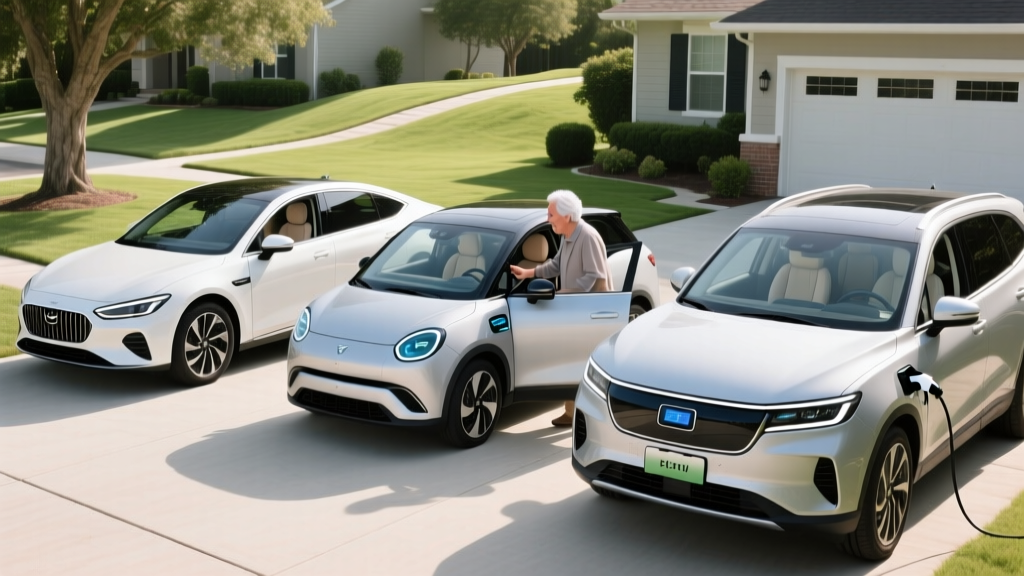
Electric vehicles offer distinct advantages that align with the priorities of many older drivers: a smooth, quiet ride with no gear shifts; instant torque for confident highway merging; lower routine maintenance; and the ability to "refuel" at home without visiting a gas station. The higher seating position in popular electric crossovers also makes entry and exit easier compared to low-slung sedans.
According to IIHS ratings, most mainstream EVs earn Top Safety Pick or Top Safety Pick+ designations, with standard automatic emergency braking, lane-keeping assist, and blind-spot monitoring — features that benefit drivers of all ages but are especially valued by those wanting an extra layer of protection.
What to Look for in an EV as a Senior Driver
Not every electric vehicle suits every driver. Here are the practical criteria that matter most for older buyers:
- Seating height and door openings: Crossovers like the Ioniq 5 and EV6 sit roughly 2–4 inches higher than sedans, reducing the effort needed to get in and out.
- Visibility: Large glass areas and thin roof pillars improve sightlines. The Ioniq 5's slim A-pillars and available digital side mirrors enhance forward and lateral visibility.
- Control simplicity: Physical buttons for climate and volume are easier to use while driving than touchscreen-only interfaces. The Kia EV6 retains a mix of tactile and touch controls.
- Regenerative braking adjustability: Paddle-shifters that let you dial regen from coasting to near one-pedal driving allow you to match the feel you prefer without menu-diving.
- ADAS features: Standard adaptive cruise control, lane centering, and rear cross-traffic alert reduce fatigue on longer drives and add confidence in parking lots.
- Charging simplicity: Plug-and-charge capability (available on most NACS and newer CCS vehicles) means you plug in and walk away — no app fumbling or RFID cards needed at compatible networks.
Top Electric Cars for Seniors: 2026 Spec Comparison
| Spec | Hyundai Ioniq 5 SEL AWD | Kia EV6 Wind AWD | Ford Mustang Mach-E Premium AWD |
|---|---|---|---|
| EPA Range | 290 mi (AWD) / 318 mi (RWD) | 282 mi (AWD) / 310 mi (RWD) | 290 mi (Ext. Range AWD) / 320 mi (RWD) |
| Battery (usable) | 77.4 kWh, NMC | 77.4 kWh, NMC | 91 kWh, NMC |
| Peak DC Fast Charge | 240 kW (10–80% in ~18 min) | 240 kW (10–80% in ~18 min) | 150 kW (10–80% in ~38 min) |
| Level 2 Home Charge | 10.9 kW (~7.5 hrs 10–100%) | 10.9 kW (~7.5 hrs 10–100%) | 10.5 kW (~8.5 hrs 10–100%) |
| 0–60 mph | 5.1 sec (AWD) | 5.2 sec (AWD) | 5.1 sec (Ext. Range AWD) |
| Horsepower | 320 hp | 320 hp | 365 hp |
| Base MSRP | $47,450 (SEL AWD) | $47,900 (Wind AWD) | $48,995 (Premium AWD) |
| §30D Federal Tax Credit | Up to $7,500 (eligibility varies) | Up to $7,500 (eligibility varies) | Up to $7,500 (eligibility varies) |
| Battery Warranty | 10 yr / 100,000 mi | 10 yr / 100,000 mi | 8 yr / 100,000 mi |
| IIHS Rating | Top Safety Pick+ | Top Safety Pick+ | Top Safety Pick |
Real-World Range Note: EPA estimates assume a mix of city and highway driving at moderate temperatures. Expect approximately 10–15% less range on sustained highway trips at 70+ mph, and 20–30% less in freezing temperatures. An Ioniq 5 AWD rated at 290 miles EPA will realistically deliver 245–260 miles on a warm-weather highway drive and roughly 200–225 miles in sub-30°F conditions.
EV vs. Gas: Real Cost Comparison for Senior Drivers
Many retirees are on fixed incomes, making predictable costs a priority. Here's how an electric crossover compares to a comparable gas model — using the Hyundai Ioniq 5 AWD versus the Hyundai Tucson AWD as a representative pair — over a typical senior driving pattern of 10,000 miles per year.
| Annual Cost (10,000 mi/yr) | Hyundai Ioniq 5 AWD (EV) | Hyundai Tucson AWD (Gas) |
|---|---|---|
| Fuel / Electricity | $375 (home L2 at $0.14/kWh) | $1,400 (26 MPG combined at $3.65/gal) |
| Oil Changes | $0 | $180 (3× per year) |
| Brake Pad Replacement | Every 80,000+ mi (regen saves pads) | Every 35,000–50,000 mi |
| Average Insurance | $1,650/yr | $1,350/yr |
| Estimated Annual Maintenance | $200 (cabin filter, tire rotation, fluid top-off) | $650 (oil, filters, belts, fluids) |
| Total Annual Operating Cost | ~$2,225 | ~$3,580 |
Net annual savings with the EV: approximately $1,355, even accounting for higher insurance premiums. Over a 7-year ownership period, that's roughly $9,485 in operating savings. The EV's higher purchase price (roughly $14,000–$16,000 more before incentives) narrows the gap, but the §30D federal tax credit can offset up to $7,500 if you meet income, MSRP, and battery-sourcing requirements.
Home Charging: The Make-or-Break Factor
For most senior EV owners, home charging is the foundation. If you can install a Level 2 (240V) charger in your garage or carport, daily "refueling" takes zero extra time — you plug in when you park and wake up to a full battery. But not every situation is straightforward.
What a Level 2 Home Installation Involves
| Item | Cost Range | Notes |
|---|---|---|
| Level 2 Charger (hardware) | $350–$700 | ChargePoint Home Flex, Emporia Vue, Wallbox Pulsar Plus |
| Electrician Labor (50-amp circuit) | $800–$2,000 | Varies by distance from panel; longer runs cost more |
| Electrical Permit | $50–$200 | Required in most jurisdictions |
| Panel Upgrade (if needed) | $1,500–$3,500 | Older homes with 100-amp service may need a 200-amp upgrade |
| Total (no panel upgrade) | $1,200–$2,900 | Most homes with 200-amp service fall here |
| Total (with panel upgrade) | $2,700–$6,400 | Common in homes built before 1990 |
Key consideration: If you live in a condo, apartment, or community without private parking, home Level 2 charging may not be feasible. In that case, evaluate whether reliable public Level 2 or DC fast charging is within 5–10 minutes of your home. Relying solely on public charging adds cost (typically $0.35–$0.55/kWh at DC fast chargers vs. $0.14/kWh at home) and time. A plug-in hybrid (PHEV) may be a better fit if home charging isn't possible — you get 30–40 miles of electric range for local errands with a gas engine for longer trips.
Common EV Myths Seniors Hear — and the Facts
| Myth | Fact |
|---|---|
| "The battery will need replacing and cost $20,000." | Modern NMC and LFP batteries are warrantied for 8–10 years / 100,000 miles. Real-world degradation data shows most EVs retain 85–92% capacity at 100,000 miles. Full replacement is rare and costs $8,000–$16,000 depending on the model, but is seldom needed within typical ownership periods. |
| "EVs are complicated to drive." | EVs are simpler than gas cars: no gears to shift, no engine noise, no clutch. You press the pedal and go. Regenerative braking takes a day or two to adjust to, and most cars let you turn it down to feel like a conventional car. |
| "You'll get stranded with no charge." | With 250+ miles of EPA range and home charging, most drivers wake up every morning with a "full tank." For road trips, DC fast chargers along interstates add 150–200 miles in 20 minutes. Fueleconomy.gov and apps like PlugShare map every public charger. |
| "The tax credit is $7,500 for everyone." | The §30D credit has income caps ($150K single / $300K joint), MSRP caps ($55K cars / $80K SUVs and trucks), and battery critical-mineral sourcing requirements that change annually. Some vehicles qualify for the full $7,500, some for $3,750, and some for nothing. Check the IRS clean vehicle credit page and confirm with a tax professional. |
| "EVs can't handle cold weather." | Cold weather reduces range by 20–30% due to battery chemistry and cabin heating demands. A vehicle rated at 290 miles EPA may deliver ~210 miles in 10°F weather. Preconditioning the battery while plugged in recovers some of this loss. For seniors in northern climates, choosing a model with a heat pump (standard on the Ioniq 5 and EV6) reduces winter efficiency penalties. |
When a Hybrid or PHEV Might Be the Smarter Choice
An EV isn't the right answer for every senior driver. A hybrid (HEV) or plug-in hybrid (PHEV) can be a better match in these situations:
- No home charging access: A standard hybrid like the Toyota RAV4 Hybrid (39 MPG combined, ~$33,000) requires zero behavior change — you fuel at gas stations as always but burn significantly less.
- Frequent long road trips through rural areas: A PHEV like the Toyota RAV4 Prime (42 miles electric-only, 38 MPG combined after battery depletes, ~$44,000) gives you electric commuting and gas-engine freedom for 400+ mile trips without route-planning around chargers.
- Budget sensitivity without charging infrastructure: Hybrids carry a smaller price premium ($2,000–$4,000 over gas models) versus EVs ($10,000–$18,000) and don't require a home charger investment.
- Very low annual mileage (under 5,000 miles): If you drive infrequently, the fuel savings from an EV may not justify the higher purchase price within your ownership window.
Decision Framework: Is an EV Right for You?
Choose a battery-electric vehicle (BEV) if:
- You can install a Level 2 charger at home (garage or carport with 240V access).
- Your daily driving is under 150 miles round-trip.
- You want the lowest operating costs and minimal maintenance.
- You value a smooth, quiet ride with strong safety technology.
- You qualify for the §30D tax credit or your state offers EV incentives.
Choose a plug-in hybrid (PHEV) if:
- You want electric commuting (30–45 miles) but take regular long trips.
- You have limited or no access to public DC fast chargers near your home.
- You live in a very cold climate where winter range loss would be frustrating.
Choose a conventional hybrid (HEV) if:
- You have no home charging option and don't want to rely on public chargers.
- You want better fuel economy without changing your refueling habits at all.
- Your budget is tighter and you want a smaller upfront premium.
Frequently Asked Questions
Are electric cars safe for older drivers?
Yes. Mainstream EVs consistently earn top ratings from IIHS and NHTSA. Standard ADAS features like automatic emergency braking, lane-keeping assist, and blind-spot monitoring are included on most 2026 EV models, even base trims. The added weight of EV batteries also contributes to stability in collisions.
How much does it cost to charge an EV at home per month?
At the national average electricity rate of ~$0.14/kWh, driving 10,000 miles per year in an Ioniq 5 (consuming roughly 30 kWh per 100 miles) costs about $420 annually, or $35 per month. That compares to roughly $117 per month for gas in a 26 MPG crossover at $3.65 per gallon.
What if I can't charge at home — should I still buy an EV?
It depends on your local public charging infrastructure. If you have reliable Level 2 chargers within a 10-minute drive (at a grocery store, library, or community center), it can work. But expect to pay $0.25–$0.55/kWh at public chargers versus $0.14/kWh at home, and budget 20–40 minutes for DC fast charging sessions on a weekly basis. If public charging is sparse or unreliable in your area, a hybrid or PHEV is likely a better fit.
Do EVs require special maintenance?
EVs require less maintenance than gas cars. There are no oil changes, spark plugs, timing belts, or exhaust systems. Routine service includes cabin air filter replacement (~$30–$50 every 15,000–20,000 miles), tire rotation (every 7,500 miles — EVs can wear tires slightly faster due to instant torque and heavier weight), brake fluid checks, and windshield washer fluid. Regenerative braking significantly extends brake pad life, often to 80,000+ miles.
How long do EV batteries last?
Data from vehicles on the road for 8+ years shows most EV batteries retain 85–92% of original capacity at 100,000 miles. Hyundai and Kia warrant their batteries for 10 years / 100,000 miles with a 70% capacity retention threshold. Ford covers 8 years / 100,000 miles. Catastrophic battery failure is rare; gradual degradation means you'll notice slightly less range over time, not a sudden loss.
Can I get the $7,500 federal tax credit?
Eligibility for the §30D credit depends on your modified adjusted gross income (under $150,000 single / $300,000 joint filer), the vehicle's MSRP (under $55,000 for cars / $80,000 for SUVs and trucks), and whether the battery meets critical-mineral and component sourcing thresholds set by the IRS. As of 2026, the Ioniq 5, EV6, and Mach-E are assembled in North America, which satisfies one requirement, but critical-mineral sourcing rules may limit the credit to $3,750 rather than the full $7,500 for some trims. Always verify current eligibility on the IRS clean vehicle credits page and consult a tax professional before purchasing.
What's the easiest EV to get in and out of?
Crossovers with higher ride heights and wide door openings are generally easiest. The Hyundai Ioniq 5 and Kia EV6 both offer a seat height around 25–27 inches from the ground (comparable to a compact SUV), wide-opening rear doors, and flat floors with no transmission tunnel hump. Test-sitting before buying is always recommended — seat comfort and entry ease are personal and vary by body type.