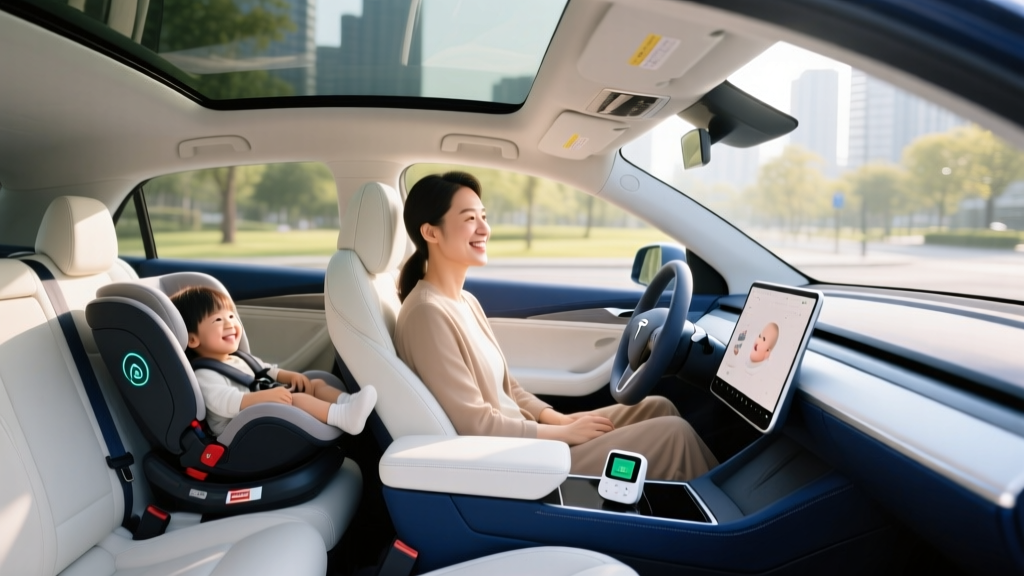
New parents shopping for electric cars for infants need three things above all else: top-tier crash safety, easy rear-facing car-seat installation, and a cabin quiet enough for a sleeping baby. EVs deliver a natural advantage on noise and smoothness — electric motors produce almost no vibration, and the absence of engine drone keeps interior sound levels 3–6 dB lower than comparable gas cars at highway speeds. Add the lowest center of gravity in their class (thanks to under-floor battery packs) and you get vehicles that are stable, planted, and exceptionally well-suited to family duty.
Quick Answer: Are EVs Good Cars for Families with Infants?
Yes — with caveats. The best EVs for infant transport combine IIHS Top Safety Pick+ ratings, ISOFIX/LATCH anchors that are easy to access, 300+ miles of EPA range for road trips, and a total cost of ownership that undercuts gas SUVs by $3,000–$6,000 over five years when home charging is available. The main limitations are higher upfront purchase prices, potential cold-weather range loss (15–30%), and the need for reliable home or workplace charging.
Why EVs Excel as Infant-Friendly Vehicles
The physics of a skateboard-platform EV directly benefits child-passenger comfort and safety:
- Low center of gravity: Battery packs mounted beneath the floor reduce rollover risk. The Hyundai Ioniq 5 and Tesla Model Y both earn IIHS Top Safety Pick+ — the institute's highest honor.
- Quiet cabin: Without internal-combustion noise, infant sleep is less disturbed on drives. Measured interior noise in EVs like the Kia EV6 typically sits around 64–66 dB at 70 mph, compared to 68–72 dB in similarly priced gas crossovers.
- Instant torque, no lurching: Smooth, linear acceleration avoids the head-snapping shifts of traditional automatics — a real comfort when a rear-facing infant seat is installed.
- Regenerative braking: One-pedal driving reduces the abrupt brake application that can startle a sleeping baby.
- No tailpipe emissions: Especially meaningful when idling in a driveway with the baby in the car — no carbon monoxide risk from exhaust.
Top Electric Cars for Infants: 2026 Specs Compared
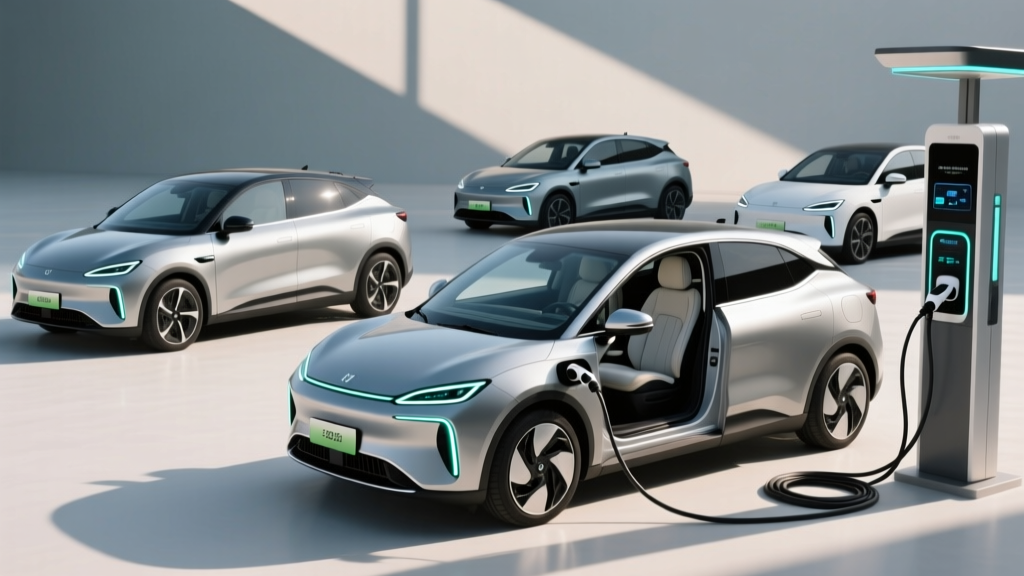
Below are five current-production EVs that rank highest for infant-carrying families, selected for safety ratings, rear-seat space, cargo volume (stroller-friendly), and charging practicality.
| Model | EPA Range | Battery (kWh) | Max DC Charge | 10–80% Time | 0–60 mph | Cargo (cu ft) | Base MSRP |
|---|---|---|---|---|---|---|---|
| Hyundai Ioniq 5 (2026) | 318 mi | 84.0 (NMC) | 240 kW | ~18 min | 5.1 sec | 27.2 / 59.3 | $44,950 |
| Kia EV6 (2026) | 310 mi | 84.0 (NMC) | 240 kW | ~18 min | 5.1 sec | 24.4 / 50.2 | $44,500 |
| Tesla Model Y (2026) | 320 mi | 75.0 (NMC) | 250 kW | ~20 min | 5.0 sec | 30.2 / 76.2 | $44,990 |
| Ford Mustang Mach-E (2026) | 320 mi | 91.0 (NMC) | 150 kW | ~32 min | 5.2 sec | 29.7 / 59.7 | $42,995 |
| Volkswagen ID.4 (2026) | 291 mi | 82.0 (NMC) | 170 kW | ~28 min | 6.7 sec | 30.3 / 64.2 | $40,790 |
Real-world range caveat: On sustained highway driving at 75 mph, expect 80–88% of EPA range. In freezing temperatures (below 32°F / 0°C), range can drop 20–30% due to battery heating demands and cabin climate use. A 318-mile Ioniq 5 may deliver ~220–250 miles on a cold winter road trip — still adequate for most family drives with a single charge stop.
Car-Seat Compatibility: What New Parents Must Check
Not all EV back seats are created equal when it comes to rear-facing infant seats. Here is what to evaluate during a test drive:
- LATCH anchor accessibility: Some EVs bury lower anchors deep in the seat bight (the crevice between cushion and backrest). The Ioniq 5 and Model Y expose theirs clearly — you should not need to dig.
- Rear-seat legroom vs. front-passenger compromise: A rear-facing infant seat (typically 27–32 inches long) can push the front passenger seat forward. Vehicles with 38+ inches of rear legroom (Ioniq 5: 39.4 in, Model Y: 41.6 in) accommodate this without forcing the front passenger into a cramped position.
- Door opening width: Wider rear doors make loading an infant carrier easier. Crossover-style EVs (all five above) outperform sedans here.
- Flat floor advantage: EVs typically lack a transmission tunnel, creating a flat rear floor. This makes it easier to install a center-position car seat using the seat belt if LATCH is only rated for outboard positions.
EV vs Gas: True Cost of Ownership for a Family Vehicle
Family vehicles rack up miles — school runs, pediatrician visits, weekend trips. Here is how a mid-size electric crossover compares to a comparable gas SUV (e.g., Toyota RAV4 or Honda CR-V) over five years and 75,000 miles.
| Cost Category | EV (e.g., Ioniq 5) | Gas SUV (e.g., RAV4 AWD) | Difference |
|---|---|---|---|
| Purchase price (after §30D credit) | $37,450* | $33,500 | +$3,950 EV |
| Fuel / electricity (75k mi) | $3,750** | $9,375*** | –$5,625 EV |
| Maintenance (5 yr) | $1,800 | $3,900 | –$2,100 EV |
| Insurance (5 yr avg) | $8,500 | $7,250 | +$1,250 EV |
| Estimated depreciation | $15,200 | $12,800 | +$2,400 EV |
| 5-Year Total | $66,700 | $66,825 | –$125 EV |
*Assumes full $7,500 federal §30D credit eligibility — see tax-credit section below. **Based on $0.15/kWh home charging average and 3.5 mi/kWh efficiency. ***Based on $3.50/gal and 28 MPG combined. Sources: fueleconomy.gov, AAA Your Driving Costs 2025.
The takeaway: EVs reach cost parity with gas SUVs within five years for most families, primarily through fuel and maintenance savings. The break-even point arrives faster if you drive more than 15,000 miles per year or if your local electricity rates are below $0.13/kWh.
Federal Tax Credit and Incentives: What Families Actually Qualify For
The federal §30D clean vehicle credit can reduce your EV purchase cost by up to $7,500 — but eligibility depends on several requirements that change periodically. As of the 2026 tax year, here is the framework:
- MSRP cap: SUVs, vans, and pickups must be priced at or below $80,000; sedans at or below $55,000.
- Buyer income cap: Modified adjusted gross income must not exceed $300,000 (joint), $225,000 (head of household), or $150,000 (single).
- Battery sourcing: Increasing percentages of critical minerals and battery components must be sourced from the U.S. or free-trade-agreement partners. This requirement tightens annually and disqualifies some trims.
- Point-of-sale transfer: Buyers can transfer the credit to the dealer at purchase, effectively reducing the sale price rather than waiting for a tax refund.
Always verify current eligibility on IRS.gov before purchasing, as battery-sourcing compliance can change mid-year. Consult a tax professional for your specific situation.
Real-World Ownership Considerations for New Parents
Beyond the spec sheet, infant-carrying families face unique practical questions:
Home Charging: The Make-or-Break Factor
A Level 2 home charger (240V, 32–48 amps / 7.7–11.5 kW) adds roughly 25–37 miles of range per hour of charging. For most families, plugging in overnight restores a full battery by morning — no gas station detours with a crying baby. Installation typically costs $800–$2,500 depending on panel capacity and run length. If your home has a 200-amp electrical panel with spare capacity, expect the lower end. A panel upgrade to 200A adds $1,500–$3,500.
Road Trips with an Infant
DC fast charging stops double as feeding and diaper-change breaks. A 20-minute 10–80% charge session at a 240 kW station (like Ioniq 5 or EV6 support) aligns almost perfectly with an infant feeding stop. Plan routes around reliable networks — Tesla Superchargers (now open to NACS-equipped non-Teslas), Electrify America, and EVgo offer the highest uptime rates.
Cold-Weather Range Planning
If you live in a climate with sub-freezing winters, budget for 20–30% range loss. Preconditioning the battery (warming it before fast charging or departure) is essential — all five EVs above support scheduled preconditioning via their apps. A heat pump (standard on Ioniq 5, EV6, Model Y) reduces cabin-heating energy draw by roughly 30% compared to resistive heating.
Common Misconceptions About EVs and Young Children
| Myth | Fact |
|---|---|
| "EV battery radiation is dangerous for infants." | EMF levels inside EVs are well below ICNIRP safety limits — typically 0.2–2 µT, comparable to household appliances. No peer-reviewed study links EV EMF exposure to health risks. |
| "EVs are unsafe in crashes because of the battery." | Battery packs are housed in reinforced steel/aluminum enclosures. EVs consistently earn top IIHS and NHTSA ratings. Thermal runaway events are statistically far rarer than gas-vehicle fires per 100,000 vehicles. |
| "You can't take an EV on a family road trip." | With 300+ miles of range and 18–25 minute fast-charge stops, a 500-mile trip requires one charge break — about the same interval you'd stop for an infant feeding anyway. |
| "EV maintenance is complicated and expensive." | No oil changes, no spark plugs, no transmission fluid. Brake pads last 100,000+ miles due to regen braking. Typical EV maintenance runs $0.04/mile vs $0.09/mile for gas cars (AAA 2025). |
| "The battery will need replacement before the car is paid off." | All five models above carry 8-year / 100,000-mile battery warranties with a 70% capacity retention guarantee. Real-world degradation data shows most NMC packs retain 88–92% capacity at 100,000 miles. |
Decision Framework: Which EV Fits Your Family?
Choose Based on Your Situation
Choose the Hyundai Ioniq 5 if: You want the fastest charging in the segment (18-min 10–80%), a spacious flat-floor rear seat for car seats, and IIHS Top Safety Pick+. Best all-around pick for infant-carrying families.
Choose the Tesla Model Y if: You want the largest cargo volume (76.2 cu ft for double-stroller families), access to the Supercharger network, and over-the-air updates that keep adding features. Trade-off: firmer ride quality than competitors.
Choose the Kia EV6 if: You prefer sportier styling and a slightly lower starting price, while sharing the Ioniq 5's 800V fast-charging architecture and powertrain.
Choose the Ford Mustang Mach-E if: You want a familiar brand, a comfortable ride, and BlueCruise hands-free highway driving (SAE Level 2 — eyes-on supervision still required) for less stressful long trips.
Choose the Volkswagen ID.4 if: Budget is the priority — at $40,790 it undercuts the field, still offers strong cargo space, and qualifies for the full federal credit on eligible trims.
Consider a PHEV instead if: You lack reliable home charging or regularly drive 400+ miles in rural areas with sparse DC fast-charging infrastructure. A plug-in hybrid like the Toyota RAV4 Prime (42 mi electric-only, 38 MPG gas) eliminates range anxiety while still delivering electric daily driving.
Frequently Asked Questions
Is it safe to put a rear-facing infant car seat in an EV?
Yes. EVs undergo the same FMVSS crash-testing as gas vehicles and often score higher due to their rigid battery enclosures and low center of gravity. Always follow the car-seat manufacturer's installation instructions and use LATCH anchors or seat-belt installation per your vehicle's owner manual.
Will an EV's regenerative braking motion-sick my baby?
Most parents report the opposite — regen braking produces smoother deceleration than a gas car's brake pedal. If your EV has adjustable regen levels, set it to a moderate setting for the smoothest ride with an infant on board.
How much does home charging cost per month for a family EV?
At 1,250 miles/month and $0.15/kWh (U.S. average), expect roughly $53/month in electricity — compared to $156/month in gasoline for a 28 MPG SUV at $3.50/gallon. That is over $1,200/year in fuel savings.
Can I install a car seat in the center rear position of an EV?
Most EVs have flat rear floors (no transmission tunnel), making center installation easier than in many gas cars. However, most manufacturers only rate LATCH anchors for the outboard positions. Center installation typically requires seat-belt routing — consult your vehicle manual and car-seat guide.
Do EVs qualify for the $7,500 federal tax credit in 2026?
Several do, but eligibility depends on the specific model, trim, battery sourcing compliance, buyer income, and MSRP caps. The Ioniq 5, EV6, Model Y, and ID.4 have eligible trims. Always verify on IRS.gov before purchase.
What happens if the EV battery degrades — is it covered?
Federal law mandates that EV battery warranties cover at least 8 years / 100,000 miles. Hyundai, Kia, Tesla, Ford, and VW all meet or exceed this. If capacity drops below 70% within the warranty period, the manufacturer must repair or replace the battery at no cost.