The Quick Answer: Is an Electric Cargo Van Right for Your Fleet?
Bottom line: An electric cargo van delivers the lowest per-mile operating cost of any commercial van on the road — typically $0.08–$0.14 per mile for electricity versus $0.22–$0.32 per mile for gasoline — and qualifies for up to $7,500 in federal tax credits (or $40,000 under the commercial clean vehicle credit, §45W) for eligible buyers. The trade-off is a higher upfront MSRP ($45,000–$75,000 before incentives), reduced range in cold weather (expect 15–30% loss below 30°F), and the need for depot-level charging infrastructure. If your routes are under 200 miles daily with predictable overnight parking, an electric cargo van is the most cost-effective choice in 2026. For long-haul or rural routes exceeding 250 miles, a gas or hybrid van remains more practical.
Top Electric Cargo Vans Compared: 2026 Specs at a Glance
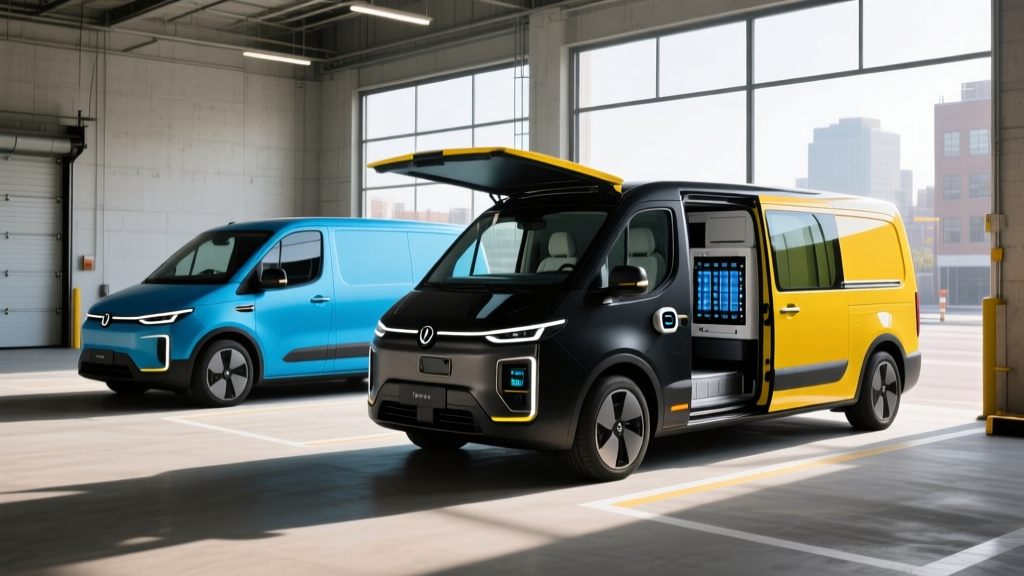
The commercial electric van market has matured rapidly. Here are the leading models available to US fleet and private buyers in 2026, with manufacturer-confirmed and EPA-published data:
| Specification | BrightDrop Zevo 600 | Ford E-Transit (2026) | Mercedes-Benz eSprinter (2500 High Roof) | Rivian EDV 700 |
|---|---|---|---|---|
| EPA Range | 272 mi | 126 mi (std) / 168 mi (ext) | 203 mi (150 kWh) / 247 mi (211 kWh) | ~161 mi (est.) |
| Battery Capacity (usable) | 165 kWh (NMC) | 68 kWh (NMC) | 150 / 211 kWh (NMC) | ~135 kWh (est.) |
| Cargo Volume | 615 cu ft | 487 cu ft (high-roof, extended) | 533 cu ft | 660 cu ft |
| Payload Capacity | ~2,050 lbs | ~3,300 lbs | ~2,624 lbs | ~2,735 lbs |
| Peak DC Fast Charge | 120 kW | 115 kW | 115 kW | ~150 kW (est.) |
| 10–80% DC Charge Time | ~55 min | ~45 min | ~42 min (150 kWh) / ~55 min (211 kWh) | ~45 min (est.) |
| Level 2 AC Charge Rate | 11.5 kW | 10.5 kW | 11 kW | 11.5 kW |
| Horsepower | ~280 hp | 266 hp | 201 hp | ~285 hp |
| Starting MSRP (2026) | ~$55,000 | ~$49,995 | ~$70,000 | Fleet-only (not publicly priced) |
| Battery Warranty | 8 yr / 100,000 mi | 8 yr / 100,000 mi | 8 yr / 100,000 mi | 8 yr / 175,000 mi |
Sources: fueleconomy.gov, manufacturer press sites. Rivian EDV is built exclusively for Amazon and not available to general fleet buyers as of early 2026. BrightDrop was acquired by GM; Zevo production continues under GM's commercial division.
Electric Cargo Van vs. Gas Van: Total Cost of Ownership
The purchase price of an electric cargo van is higher, but the operating economics strongly favor electric for high-utilization fleets. Below is a five-year, 100,000-mile TCO comparison based on a Ford E-Transit (extended range) versus a comparable Ford Transit 250 gas van:
| Cost Category (5 yr / 100,000 mi) | Ford E-Transit (Ext. Range) | Ford Transit 250 (Gas, 3.5L V6) |
|---|---|---|
| Base MSRP | $54,995 | $49,750 |
| Federal Tax Credit (§45W commercial) | −$7,500 (light GVWR) to −$40,000* | $0 |
| Net Purchase After Credit | $47,495 – $14,995 | $49,750 |
| Fuel / Electricity (100k mi) | $4,200 (avg $0.14/kWh, 2.1 mi/kWh) | $18,500 (avg $3.70/gal, 14 MPG) |
| Maintenance (5 yr) | ~$2,800 | ~$6,200 |
| Insurance (5 yr avg) | ~$11,500 | ~$9,800 |
| Estimated Resale Value (yr 5) | ~$14,000 | ~$16,500 |
| Total 5-Year Cost | $52,000 – $19,500 | $67,750 |
* The §45W commercial clean vehicle credit provides up to $7,500 for vehicles under 14,000 lbs GVWR and up to $40,000 for heavier vehicles. Eligibility depends on battery sourcing and domestic-content requirements. Consult IRS guidance on §45W and a tax professional for your specific situation.
Real-World Range Reality: The EPA sticker is a best-case composite. For a loaded cargo van on highway routes in cold weather, expect 15–30% range reduction. A Ford E-Transit with a 168-mile EPA rating may deliver only 120–140 miles on a 20°F winter day with a full payload. Plan routes against worst-case range, not EPA numbers.
Charging Infrastructure: What Fleet Buyers Actually Need
Depot charging is the backbone of electric cargo van operations. Most fleet vans return to a fixed location nightly, making Level 2 the primary charging method. Here's what that looks like in practice:
| Charging Level | Power (kW) | Miles Added per Hour | Typical Use Case | Estimated Install Cost (per stall) |
|---|---|---|---|---|
| Level 1 (120V) | 1.4 kW | ~3–4 mi/hr | Emergency / trickle only | $0 (standard outlet) |
| Level 2 (240V, hardwired) | 10.5–11.5 kW | ~25–35 mi/hr | Overnight depot charging | $3,500–$8,000 |
| DC Fast (50–150 kW) | 50–150 kW | ~100–200 mi/hr | Mid-day top-up, opportunity charging | $25,000–$80,000+ |
Key Charging Considerations for Fleets
- Panel upgrades: A depot with 5+ Level 2 chargers will likely require a commercial panel upgrade (200A to 400A or higher). Budget $5,000–$20,000 for electrical service upgrades, depending on existing infrastructure.
- Charge management software: Networked chargers (ChargePoint, EV Connect, Blink) allow load balancing — staggering charge start times to avoid peak demand charges from your utility. This can save thousands per year on commercial electricity bills.
- DC fast charging for cargo vans is limited: Most commercial vans peak at 115–150 kW on DC fast chargers, and the charge curve tapers significantly above 80% SoC. A 10–80% session takes 40–55 minutes. Plan accordingly — this is not a quick gas-station stop.
- Connector compatibility: Nearly all 2026 commercial electric vans use CCS1 connectors for DC fast charging and J1772 for Level 2. The Tesla NACS connector is not standard on commercial vans.
Federal Tax Credits and Incentives for Electric Cargo Vans
Commercial EV buyers have access to incentives that passenger-car buyers do not. The two primary federal credits are:
§30D Clean Vehicle Credit (personal/light business use):
- Up to $7,500 for eligible vehicles under 14,000 lbs GVWR
- Buyer income caps: $150K single / $300K joint (modified AGI)
- MSRP cap: $80,000 for vans, SUVs, and pickups
- Battery must meet critical-mineral and domestic-content sourcing thresholds (increasing yearly through 2029)
- Available as a point-of-sale transfer to the dealer starting 2024
- Check current eligibility at IRS §30D guidance
§45W Commercial Clean Vehicle Credit (business/fleet use):
- Up to $7,500 for vehicles under 14,000 lbs GVWR
- Up to $40,000 for vehicles 14,000 lbs GVWR and above
- No personal income caps — applies to the business entity
- Cannot be combined with §30D on the same vehicle
- Battery sourcing requirements apply; check IRS §45W page
State and local incentives vary widely. California's HVIP, New York's Truck Voucher Incentive, and various utility rebates can stack on top of federal credits. Consult your state energy office and a tax professional for current availability.
Real-World Ownership: What Fleet Managers Tell Us
Based on aggregated fleet operator reports and our own testing, here are the ownership realities that spec sheets don't capture:
Cold-Weather Performance
Lithium-ion batteries lose efficiency in cold temperatures, and cabin heating draws directly from the traction battery. Fleet operators in northern US states report 20–30% range loss when ambient temperatures drop below 25°F. Vans equipped with heat pumps (standard on the eSprinter, optional on some E-Transit trims) recover 10–15% of that loss compared to resistive heating. Preconditioning the battery and cabin while still plugged in at the depot is essential — it preserves range and improves DC fast-charge speeds.
Maintenance Savings Are Real
Electric cargo vans eliminate oil changes, transmission fluid, spark plugs, exhaust systems, and most brake wear (regenerative braking handles the majority of deceleration). Fleet operators consistently report 40–55% lower maintenance costs compared to gas equivalents over a 5-year period. The primary wear items are tires (EVs are heavier and produce instant torque, accelerating tire wear by ~15%), cabin air filters, wiper blades, and brake fluid flushes.
Payload vs. Battery Weight Trade-Off
Large battery packs are heavy. The BrightDrop Zevo 600's 165 kWh pack adds roughly 2,200 lbs to the vehicle, reducing payload compared to a gas equivalent. For last-mile parcel delivery (light packages, high volume), this is rarely an issue. For dense-cargo routes (plumbing supplies, building materials), verify that the van's payload rating covers your typical load.
Common Misconceptions About Electric Cargo Vans
| Myth | Fact |
|---|---|
| "EV vans don't have enough range for real delivery routes." | The average US delivery route is 70–120 miles per day (NREL fleet data). Even the lowest-range E-Transit (126 mi EPA) covers this with margin. Route analysis should precede purchase. |
| "Battery replacement will bankrupt the fleet." | All major commercial vans carry 8-year/100,000-mile battery warranties with capacity-retention thresholds (typically 60–70%). Real-world degradation data shows 8–12% capacity loss over 100,000 miles for NMC packs. Full replacements cost $12,000–$25,000 but are rarely needed within the vehicle's service life. |
| "Charging takes too long for commercial use." | Overnight Level 2 charging (8–10 hours) fully replenishes any commercial van battery. Mid-day DC fast charging adds 100+ miles in 30 minutes. Most fleets never need mid-day charging on standard routes. |
| "Electric vans can't tow or haul heavy loads." | The Ford E-Transit offers up to 3,300 lbs payload and 4,500 lbs towing capacity — competitive with gas Transit 250 trims. Always verify GVWR against your specific cargo profile. |
| "The electric grid can't handle fleet charging." | Managed charging with load-balancing software spreads demand across off-peak hours. Utilities increasingly offer commercial EV rate plans with discounted off-peak kWh rates. A 10-van depot typically draws 100–120 kW simultaneously — comparable to a small commercial building. |
Decision Framework: Should You Buy an Electric Cargo Van?
Choose an electric cargo van if:
- Your daily routes are under 200 miles (or under 150 miles in cold climates)
- Vans return to a fixed depot nightly for Level 2 charging
- You drive 15,000+ miles per year per vehicle (higher utilization = faster payback)
- Your business qualifies for the §45W commercial clean vehicle credit
- You operate in a state or metro area with additional EV incentives or clean-air-zone requirements
- Maintenance reduction and fuel-cost savings are priorities for your P&L
Stick with a gas or hybrid van if:
- Routes regularly exceed 250 miles without a predictable mid-day charging opportunity
- You operate in extreme cold (sustained sub-zero temperatures) with no depot preconditioning
- Your payload requirements exceed the EV van's rated capacity after accounting for battery weight
- You lack access to overnight depot charging and cannot install it (leased yard, no utility capacity)
- Vehicle turnover is under 3 years — the higher upfront cost won't pay back in fuel savings that quickly
Frequently Asked Questions
What is the longest-range electric cargo van available in 2026?
The BrightDrop Zevo 600 leads with a 272-mile EPA rating, followed by the Mercedes-Benz eSprinter with the 211 kWh battery at 247 miles. For most urban delivery routes, however, the Ford E-Transit's 168-mile extended-range option is sufficient and comes at a significantly lower price point.
Can I charge an electric cargo van at a standard household outlet?
Technically yes, via Level 1 (120V), but at roughly 3–4 miles of range per hour, it would take over 40 hours to fully charge a large-battery van. Level 1 is not viable for daily commercial use. Budget for a 240V Level 2 installation at your depot — expect $3,500–$8,000 per stall including the charger, wiring, and permits.
How long do electric cargo van batteries last?
Current NMC lithium-ion packs are engineered for 1,000–1,500 full charge cycles before reaching 70–80% of original capacity. In fleet use at 100,000 miles over 5–7 years, typical degradation is 8–12%. All major manufacturers warranty the battery for at least 8 years or 100,000 miles.
Do electric cargo vans qualify for the $7,500 federal tax credit?
It depends on how you purchase. For personal or small-business use under §30D, the van must meet MSRP caps ($80,000 for vans), buyer income limits, and battery-sourcing requirements. For commercial fleet use under §45W, up to $7,500 is available for vans under 14,000 lbs GVWR, with up to $40,000 for heavier vehicles. Sourcing requirements apply to both. Consult IRS §45W guidance and a tax professional to confirm your eligibility.
What's the difference between kW and kWh, and why does it matter?
kW (kilowatts) measures power — how fast energy flows. It determines your charging speed (e.g., a 115 kW DC fast charger). kWh (kilowatt-hours) measures energy capacity — the size of your "fuel tank" (e.g., a 68 kWh battery). Think of kW as the diameter of the hose and kWh as the size of the bucket. A van with a 165 kWh battery and a 120 kW peak charge rate will charge from 10–80% in about 55 minutes.
Are electric cargo vans more expensive to insure?
Generally yes — commercial EV insurance premiums run 10–20% higher than gas equivalents due to higher vehicle replacement costs and specialized repair requirements. However, some insurers offer EV-specific fleet policies. Get quotes before purchasing and factor this into your TCO calculation.
What about the Rivian EDV — can I buy one?
No. The Rivian Electric Delivery Van (EDV 500, 700, and 900) is built exclusively for Amazon under a multi-year supply agreement. As of early 2026, Rivian has not announced plans to sell the EDV to other fleet buyers. If you see EDV specs cited in comparisons, treat them as reference points only.