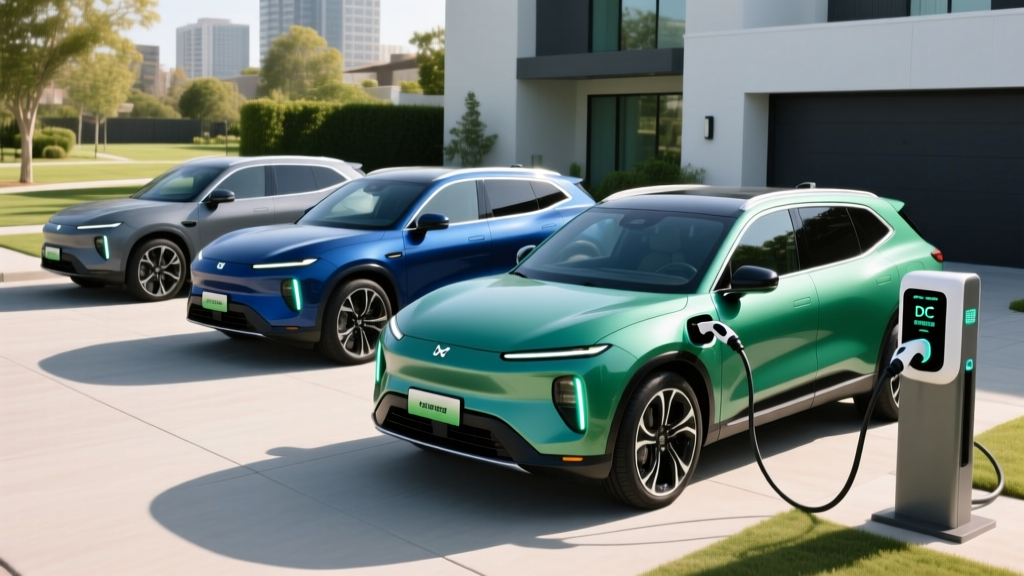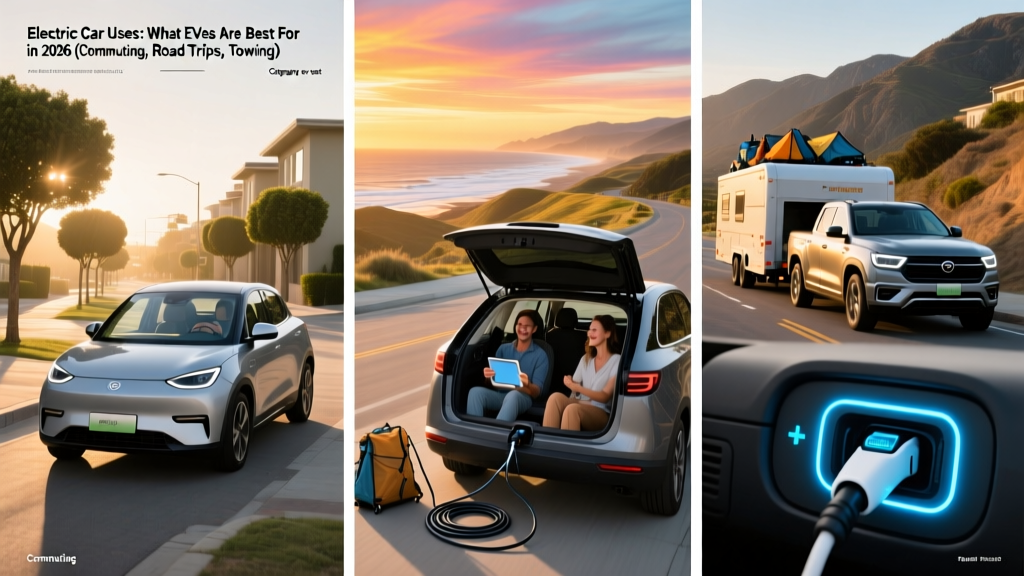
Quick Answer: What Are Electric Cars Best Used For?
Electric cars excel at daily commuting, city driving, and short-to-medium road trips (under 300 miles) where home or workplace Level 2 charging is available. A typical 2026 EV like the Tesla Model Y Long Range (EPA 320 miles, $47,990) or Hyundai Ioniq 5 (EPA 311 miles, $43,600) handles a 40-mile round-trip commute for 6–8 days between charges at a fuel-equivalent cost of $0.04–$0.08 per mile. EVs are less ideal for frequent 500+ mile highway road trips, heavy towing (range drops 40–50%), or rural areas with sparse DC fast-charging infrastructure. For those use cases, a plug-in hybrid (PHEV) or hybrid often makes more financial and practical sense.
Electric Car Uses: Matching the EV to Your Driving Life
The phrase "electric car uses" covers a wide spectrum — from a 6-mile school run to a 600-mile holiday road trip. The mistake most buyers make is evaluating an EV against their rare driving scenario (the annual cross-country trip) rather than their daily reality. According to FHWA data, the average American drives roughly 37 miles per day. That means a 270-mile real-world EV range covers nearly a week of typical driving without plugging in.
Here is a breakdown of the most common electric car uses and how current EVs perform in each scenario.
Daily Commuting and City Driving
This is the EV's strongest use case. Stop-and-go traffic triggers regenerative braking, which recovers kinetic energy and extends range. A Chevrolet Equinox EV (EPA 315 miles, 85 kWh usable, NMC battery) will routinely exceed its EPA rating in city driving at speeds under 45 mph. At a home electricity rate of $0.14/kWh, fully recharging that 85 kWh battery costs roughly $11.90 — compared to about $45 in gasoline for a 28-MPG compact SUV covering the same 315 miles at $3.80/gallon.
Road Trips (200–400 Miles)
A single-charge road trip within the EV's real-world range is seamless. For trips requiring one DC fast-charge stop, modern EVs with peak charge rates of 150–350 kW add 150–250 miles in 15–25 minutes (10–80% State of Charge). The Kia EV6, for instance, peaks at 239 kW on a 350 kW charger, reaching 10–80% in approximately 18 minutes under optimal battery preconditioning. Expect real-world highway range to be 10–15% below the EPA sticker at sustained 70–80 mph speeds.
Cold-Weather Driving
Lithium-ion batteries lose efficiency in cold temperatures. Expect a 15–30% range reduction at 20°F compared to 70°F, depending on whether the vehicle has a heat pump. The Tesla Model Y and Hyundai Ioniq 5 both use heat pump systems that mitigate cabin-heating energy draw, limiting losses closer to 15–20%. Without a heat pump, resistive cabin heating can consume 3–5 kW continuously, cutting a 300-mile EPA range to 210–240 miles in deep winter. Preconditioning the battery while plugged in (a feature on most 2026 EVs) preserves range by warming the pack using grid power rather than battery energy.
Towing and Hauling
EVs deliver instant torque, making them capable tow vehicles — the Ford F-150 Lightning (EPA 230–320 miles depending on trim, 563 HP, max tow 7,700 lbs) can pull a camper competently. However, towing a 5,000-lb trailer at highway speeds typically reduces range by 40–50%. A 320-mile EPA rating drops to roughly 160–190 real-world miles while towing. For frequent heavy towing over long distances, a diesel or hybrid truck remains more practical.
EV vs. Gas vs. Hybrid: Which Fits Your Use Case?
Choosing between an EV, a conventional hybrid (HEV), and a plug-in hybrid (PHEV) depends on your driving mix and charging access. The table below compares these powertrains across the most common electric car uses.
| Use Case | BEV (Battery Electric) | PHEV (Plug-in Hybrid) | HEV (Hybrid) |
|---|---|---|---|
| Daily commute (<50 mi) | Excellent — zero tailpipe emissions, lowest cost/mile | Excellent — runs on electric-only (25–45 mi range) | Good — 45–55 MPG, no plug-in needed |
| Road trips (300–500 mi) | Good — 1–2 DC fast-charge stops needed | Excellent — electric for city, gas for highway | Excellent — 450–600 mi total range |
| Cold-weather (<20°F) | Moderate — 15–30% range loss | Good — gas engine provides heat, no range anxiety | Good — minimal efficiency loss |
| Towing (>3,500 lbs) | Limited — 40–50% range reduction | Moderate — gas engine handles highway towing | Good — consistent MPG under load |
| Rural / charging desert | Poor — sparse DC infrastructure | Excellent — gas backup | Excellent — no plug required |
| Cost per mile (fuel/energy) | $0.04–$0.08 (home charging) | $0.04 electric / $0.12 gas | $0.09–$0.12 (gas) |
The Real Cost of EV Ownership in 2026
Upfront EV prices have moderated, but total cost of ownership (TCO) depends on electricity rates, insurance, maintenance, and available incentives. Below is a 5-year cost comparison for a midsize electric SUV versus a comparable gas SUV, assuming 15,000 miles per year.
| Cost Category (5 Years / 75,000 mi) | EV (e.g., Tesla Model Y LR) | Gas SUV (e.g., Toyota RAV4) |
|---|---|---|
| Purchase price (MSRP) | $47,990 | $33,500 |
| Federal tax credit (§30D) | –$3,750 to –$7,500* | $0 |
| Fuel / electricity | $3,150 (home charging at $0.14/kWh) | $10,260 (gas at $3.80/gal, 28 MPG) |
| Maintenance | $1,200 (tires, cabin filter, wipers, fluid top-offs) | $3,800 (oil changes, brakes, filters, belts) |
| Insurance (avg) | $9,600 ($160/mo) | $7,200 ($120/mo) |
| Estimated depreciation | $18,000 | $14,500 |
| Total 5-Year Cost | ~$46,240 – $49,990 | ~$69,260 |
*The IRS §30D federal tax credit ranges from $3,750 to $7,500 depending on battery critical-mineral sourcing and component requirements. Income caps ($150K single / $300K joint) and MSRP caps ($55K cars / $80K SUVs/trucks) apply. Credit can be transferred to the dealer at point of sale as of 2024 onward. Consult a tax professional for your specific eligibility.
The EV's higher insurance premiums and steeper depreciation partially offset fuel and maintenance savings, but the gap narrows significantly when the full §30D credit applies. Over 5 years, the EV can save $10,000–$20,000 depending on credit eligibility and local electricity rates.
Charging Access: The Make-or-Break Factor
The single most important variable in whether an EV works for your lifestyle is charging access. Here is a realistic breakdown of charging levels and what they mean for daily use.
| Charging Level | Power (kW) | Miles Added per Hour | Best For |
|---|---|---|---|
| Level 1 (120V household outlet) | 1.0–1.4 kW | 3–5 miles | Overnight top-ups, low-mileage drivers (<30 mi/day) |
| Level 2 (240V home/workplace) | 7.2–11.5 kW | 25–44 miles | Daily charging — wake up with a full battery every morning |
| DC Fast Charging | 50–350 kW | 150–1,000+ mi/hr (peak) | Road trips — 10–80% in 15–35 minutes |
Home Level 2 installation typically costs $800–$2,500 total (charger unit: $300–$700; electrician labor, wiring, and permit: $500–$1,800). If your electrical panel requires a 200-amp upgrade, add $1,500–$3,500. Most EV owners with a garage or dedicated parking spot find Level 2 home charging eliminates range anxiety entirely — you start each day with 200–320 miles of range.
For apartment dwellers and street parkers without home charging access, public DC fast-charging networks (Tesla Supercharger, Electrify America, EVgo) are viable but more expensive — typically $0.30–$0.50/kWh, pushing cost per mile closer to $0.10–$0.14. If public charging is your only option, a PHEV may be more practical and cost-effective.
Common EV Misconceptions — Fact vs. Fiction
| Myth | Fact |
|---|---|
| "EV batteries need replacing every few years." | Federal law mandates battery warranties of at least 8 years/100,000 miles. Real-world data shows most NMC and LFP packs retain 85–92% capacity after 100,000 miles. Full replacement costs $8,000–$18,000 but is rarely needed within the vehicle's lifetime. |
| "EVs don't work in cold climates." | Norway — one of the coldest European countries — has the highest per-capita EV adoption in the world. With a heat pump and preconditioning, modern EVs lose 15–20% range in winter but remain fully functional. Block heaters and garage parking further reduce losses. |
| "The power grid can't handle EVs." | Most EV charging happens overnight during off-peak hours when grid demand is low. A 2025 DOE analysis found that managed charging (time-of-use rates, smart chargers) keeps grid strain minimal even at high EV adoption rates. |
| "EVs are worse for the environment because of battery mining." | Lifecycle analyses by the EPA and ICCT consistently show that even accounting for battery production, EVs produce 50–70% fewer lifetime greenhouse gas emissions than comparable gas cars on the current US grid mix — and the grid is getting cleaner every year. |
| "Charging takes too long." | Home Level 2 charging adds 25–44 miles per hour — plug in at night, wake up fully charged. On road trips, DC fast-charging adds 150–250 miles in 15–25 minutes, which aligns with a typical rest stop. |
Decision Framework: Should You Buy an EV, Hybrid, or PHEV?
Use This If/Then Guide to Decide
- IF you have home or workplace Level 2 charging access AND your daily driving is under 80 miles round-trip AND you take fewer than four road trips over 350 miles per year → Choose a BEV. You'll save the most on fuel and maintenance, and wake up "full" every morning.
- IF you lack reliable home charging (apartment, street parking, no outlet access) AND you drive more than 40 miles daily → Choose a HEV or PHEV. Relying solely on public DC fast-charging is expensive and inconvenient for daily use.
- IF you have home charging BUT you frequently drive 400+ miles, tow heavy trailers, or live in a rural area with sparse charging → Choose a PHEV (e.g., Toyota RAV4 Prime, 42 miles electric-only, 38 MPG combined on gas). You get electric commuting with gas-engine range security.
- IF you live in an extreme cold climate (regularly below 0°F) AND your commute exceeds 60 miles one way → Consider a PHEV or HEV. EV range loss at deep-freeze temperatures can be significant, and a gas backup eliminates risk.
- IF your primary goal is lowest total cost of ownership AND you qualify for the full $7,500 §30D tax credit AND you can charge at home → A BEV is likely your best financial choice over a 5–7 year ownership period.
What First-Time EV Buyers Should Know Before Purchasing
If you've decided an EV fits your electric car uses, here are the practical realities to prepare for:
1. Budget for a Level 2 Home Charger
Factor $1,000–$2,500 into your purchase budget for a quality Level 2 charger (Emporia Vue, ChargePoint Home Flex, or Tesla Wall Connector) plus professional installation. Get a quote from a licensed electrician before buying the car — if your panel needs an upgrade, costs can double.
2. Understand the Charge Curve
DC fast-charging speeds are not linear. A vehicle advertising "250 kW peak" may only sustain that rate between 10–30% State of Charge, then taper progressively. The 10–80% time (typically 18–35 minutes) is a more useful metric than peak kW. Above 80%, charging slows dramatically to protect battery health — plan to charge to 80% on road trips and move on rather than waiting for 100%.
3. Check NACS vs. CCS Connector Compatibility
As of 2025–2026, most major automakers (Ford, GM, Rivian, Volvo, Hyundai, Kia) have adopted or committed to the Tesla NACS connector for DC fast charging. If you buy a vehicle with a CCS1 port, confirm that NACS adapters are available from the manufacturer. The Tesla Supercharger network — the largest and most reliable in North America — now accepts non-Tesla EVs with NACS connectors or approved adapters at many locations.
4. Verify Tax Credit Eligibility Before You Buy
The §30D credit has strict requirements: buyer income caps ($150K single, $225K head of household, $300K joint), vehicle MSRP caps ($55K for cars, $80K for SUVs/trucks/vans), and battery sourcing rules that change annually. A vehicle that qualified in 2025 may not qualify in 2026 due to updated critical-mineral thresholds. Always check the latest eligibility list on fueleconomy.gov and confirm with your dealer and tax professional before signing.
5. Insure Before You Drive
EV insurance premiums run 10–25% higher than comparable gas vehicles due to higher repair costs (specialized parts, battery shielding, sensor recalibration). Get quotes from at least three insurers before finalizing your purchase. Some insurers offer specific EV discounts or bundled home-charger coverage.
Frequently Asked Questions
Can I use an electric car as my only vehicle?
Yes, if you have home Level 2 charging and your typical weekly driving stays within 200–280 real-world miles. For the roughly 85% of Americans who drive fewer than 50 miles per day, a single EV with 250+ miles of EPA range covers daily needs entirely, with DC fast-charging handling the occasional road trip.
Are electric cars good for long road trips?
They're viable but require planning. A 600-mile trip in an EV with 280 real-world miles of range requires two DC fast-charge stops of roughly 20–25 minutes each, adding 40–50 minutes to your travel time. The Tesla Supercharger and Electrify America networks cover most interstate corridors. If you take more than six long road trips per year, a PHEV may be more convenient.
Do electric cars save money compared to gas cars?
Over 5 years and 75,000 miles, a typical EV saves $7,000–$10,000 in fuel and maintenance costs compared to a gas vehicle. Whether the total cost of ownership is lower depends on the purchase price gap, tax credit eligibility, insurance premiums, and depreciation. With the full $7,500 federal credit and home charging, most EVs break even or come out ahead within 4–5 years.
How long do EV batteries last?
Most 2026 EV batteries are warranted for 8 years/100,000 miles with a minimum 70% capacity retention threshold. Real-world degradation data from sources like Recurrent shows median capacity retention of 90–94% at 60,000 miles for liquid-cooled NMC and LFP packs. Replacement is rarely needed within the first 10–12 years of ownership.
What is the best electric car for a first-time EV buyer?
For most first-time buyers in 2026, the Hyundai Ioniq 5 ($43,600, EPA 311 mi, 10–80% in ~18 min), Tesla Model Y Long Range ($47,990, EPA 320 mi), and Chevrolet Equinox EV ($34,995, EPA 315 mi) offer the best balance of range, charging speed, price, and tax-credit eligibility. The Equinox EV is the value pick; the Model Y leads in charging-network access; the Ioniq 5 excels in design and 800V fast-charging capability.