Quick Answer: Is Electric Car Fleet Leasing Worth It?
Electric car fleet leasing makes financial sense in 2026 when your vehicles travel 25–60 miles daily on predictable routes, have access to overnight Level 2 charging, and the leasing company passes through the $7,500 federal commercial clean vehicle credit (§45W). Expect total cost per mile of $0.09–$0.14 for a midsize electric sedan or compact SUV (vs. $0.16–$0.22 for a gas equivalent), with monthly lease payments offset by near-zero maintenance and fuel savings of $800–$1,400 per vehicle annually. Fleet leasing avoids upfront capital outlay, transfers battery-degradation risk to the lessor, and simplifies vehicle turnover every 24–36 months.
The Fleet Leasing Advantage: Why EVs Work Better as Leases
For small-to-mid-size businesses running 5–50 vehicles, purchasing EVs outright means committing $35,000–$55,000 per unit and absorbing residual-value uncertainty as battery technology evolves rapidly. Leasing flips that equation. A 2026 Chevrolet Equinox EV LT leases for roughly $349–$429/month (36 months, 10K miles/year) through major fleet lessors, while a comparably equipped Toyota Camry LE (gas) leases for $289–$339/month. The EV costs more monthly, but the fuel and maintenance gap closes it fast.
Commercial fleet leases also access a tax incentive that consumer leases don't: the IRS §45W Commercial Clean Vehicle Credit. Unlike the consumer §30D credit (which has strict income caps, MSRP limits, and battery-sourcing rules), §45W offers up to $7,500 for vehicles under 14,000 lbs GVWR and up to $40,000 for heavier vehicles, with no buyer-income restrictions. Most fleet leasing companies either apply this credit to reduce your monthly payment or pass it through as a capitalized-cost reduction.
Fleet-Ready EVs: Spec Comparison for 2026
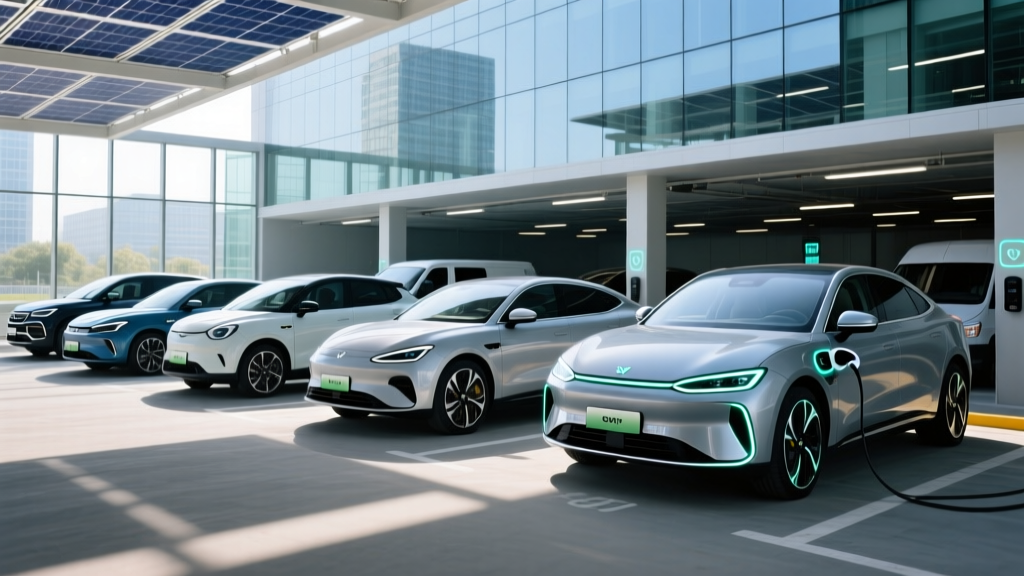
Not every EV suits fleet duty. Fleet vehicles need adequate range for daily routes, durable interiors, reasonable cargo space, fast-enough charging for multi-shift operations, and broad service-network coverage. Here's how the top contenders stack up with exact numbers:
| Model | EPA Range | Battery (kWh) | Peak DC Charge | 10–80% Time | Base MSRP | Est. Fleet Lease/mo |
|---|---|---|---|---|---|---|
| 2026 Tesla Model 3 RWD | 272 mi | 57.5 (LFP) | 170 kW | ~25 min | $38,990 | $329–$389 |
| 2026 Chevy Equinox EV LT | 319 mi | 85 (NMC) | 150 kW | ~30 min | $33,600 | $349–$429 |
| 2026 Hyundai Ioniq 5 SE | 303 mi | 77.4 (NMC) | 240 kW | ~18 min | $42,600 | $399–$469 |
| 2026 Ford F-150 Lightning Pro | 230 mi | 98 (NMC) | 150 kW | ~36 min | $54,995 | $599–$699 |
| 2026 Toyota bZ4X XLE | 252 mi | 71.4 (NMC) | 150 kW | ~30 min | $37,070 | $359–$419 |
Real-world caveat: EPA range assumes mixed driving at moderate temperatures. Expect 15–25% range reduction in sustained highway driving (75+ mph), and 20–35% loss in sub-30°F weather. A 319-mile Equinox EV realistically delivers ~220–250 miles on a cold highway day — still plenty for most fleet routes, but plan conservatively.
Total Cost of Ownership: EV Fleet vs. Gas Fleet
The monthly lease payment tells only part of the story. Fleet managers need the full cost picture over a typical 36-month lease term at 12,000 miles/year (36,000 miles total). Here's a head-to-head comparison using a midsize electric sedan (e.g., Tesla Model 3) versus a midsize gas sedan (e.g., Toyota Camry LE):
| Cost Category (36 months / 36K mi) | EV Fleet Sedan | Gas Fleet Sedan |
|---|---|---|
| Lease payments (36 × monthly) | $12,600 | $10,800 |
| Fuel / electricity | $1,620 (home L2 at $0.13/kWh) | $4,860 (gas at $3.50/gal, 30 MPG) |
| Maintenance (oil, filters, brakes) | $350 (cabin filter, tire rotation, wiper fluid) | $2,100 (oil changes, brake pads, filters) |
| Insurance (avg. fleet rate) | $5,400 | $4,500 |
| §45W credit applied | –$7,500 | $0 |
| Total 3-Year Cost | $12,470 | $22,260 |
| Cost Per Mile | $0.35 | $0.62 |
The EV fleet sedan saves approximately $9,790 over 36 months — roughly $2,720 per vehicle per year. For a 20-vehicle fleet, that's over $54,000 in annual savings. The break-even point against the higher lease payment arrives around month 8–10.
Important nuance: Insurance costs 15–25% more for EVs due to higher repair costs and specialized parts. Fleet insurance brokers familiar with EVs can often negotiate better rates than standard commercial auto policies. Always get fleet-specific insurance quotes before signing the lease.
Charging Infrastructure: The Make-or-Break Factor
The biggest variable in electric car fleet leasing isn't the vehicle — it's whether you can charge reliably and affordably. Here's what fleet operators need to plan for:
Depot Charging (Most Common for Fleets)
Install Level 2 chargers (7.2–19.2 kW) at your fleet parking location. A single 48-amp Level 2 station delivers roughly 30–45 miles of range per hour and costs $500–$1,500 for equipment plus $800–$3,000 for electrician installation per stall. If your panel needs an upgrade from 200A to 400A service, add $2,000–$5,000.
For a 10-vehicle fleet returning nightly with 50–60% battery remaining, you need approximately 4–5 Level 2 chargers (vehicles can share chargers via smart load-management software). Total depot charging investment: $8,000–$25,000, often partially offset by utility rebates of $500–$2,500 per charger.
Public DC Fast Charging (Supplemental Only)
DC fast charging at 150–250 kW adds 100–200 miles in 20–30 minutes, but costs $0.30–$0.50/kWh at networks like Electrify America or EVgo — roughly 2–3× the cost of depot charging. Use DCFC for mid-day top-ups on longer routes, not as your primary strategy. A fleet that relies on public DCFC will see electricity costs approach or exceed gasoline costs.
| Charging Level | Power (kW) | Miles Added/Hour | Cost/kWh | Best For |
|---|---|---|---|---|
| Level 1 (120V outlet) | 1.4 kW | 3–5 mi/hr | $0.10–$0.15 | Emergency / PHEV topping |
| Level 2 (240V depot) | 7.2–19.2 kW | 25–60 mi/hr | $0.08–$0.15 | Primary overnight fleet charging |
| DC Fast Charge | 50–350 kW | 150–600 mi/hr | $0.30–$0.55 | Mid-shift top-ups, long routes |
Fleet Lease Structures: Open vs. Closed-End and the Credit Question
Most fleet EV leases in 2026 are closed-end (fixed residual value, walk away at term-end) or open-end (TRAC — Terminal Rental Adjustment Clause, where you absorb the difference if resale value is below estimate). Closed-end leases are simpler but carry higher monthly payments because the lessor assumes residual risk. Open-end leases have lower payments but expose you to EV resale-value volatility.
Credit pass-through is critical. The §45W commercial credit technically goes to the entity that "places the vehicle in service." In a standard fleet lease, the lessor owns the vehicle, so the lessor claims the credit. Some fleet leasing companies reduce your capitalized cost by the full $7,500 and transparently show this on the lease worksheet. Others keep a portion as margin. Always ask your lessor in writing: "Will the full §45W credit be applied as a cap-cost reduction, and can I see it on the lease disclosure?"
Additionally, many states offer commercial EV incentives. California's Hybrid and Zero-Emission Truck and Bus Voucher Incentive Project (HVIP) and New York's NY Truck Voucher Program can stack thousands more per vehicle — but eligibility rules, fleet-size requirements, and application timelines vary by state. Check your state energy office or a fleet consultant for current programs.
Common Fleet EV Misconceptions — Corrected
| Myth | Fact (with data) |
|---|---|
| "EV batteries won't last the lease term" | Modern LFP and NMC batteries degrade 8–15% over 100K miles. All major manufacturers warrant 8 years/100,000 miles with ≥70% capacity retention. On a 36-month, 36K-mile lease, expect 93–97% of original capacity at turn-in — well above warranty thresholds. |
| "Charging takes too long for fleet operations" | Overnight depot charging (8–10 hours on Level 2) fully replenishes any fleet EV from 10% to 100%. For a vehicle returning at 6 PM and departing at 7 AM, charging time is irrelevant. Mid-day DCFC adds 150+ miles in ~20 minutes. |
| "Cold weather makes fleet EVs impractical" | Range loss of 20–35% in sub-freezing temps is real. Countermeasures: precondition the battery while plugged in (uses grid power, not battery), spec vehicles with heat pumps (standard on Ioniq 5, Model 3), and add 25–30% range buffer to your route planning in winter months. |
| "Fleet EV insurance is prohibitively expensive" | EV fleet insurance runs 15–25% higher than gas equivalents. But the total-cost-of-ownership math still favors EVs because fuel and maintenance savings dwarf the insurance premium difference. Specialized fleet brokers can often negotiate EV-specific rates. |
| "Resale value will crater" | EV residual values have stabilized since 2024's correction. Closed-end leases transfer this risk to the lessor entirely. Open-end TRAC leases carry residual risk — price conservatively. |
Decision Framework: Should Your Fleet Lease EVs?
Choose Electric Fleet Leasing If:
- Daily routes are under 150 miles round-trip (covers ~85% of light-duty commercial routes)
- Vehicles park at a depot overnight where Level 2 chargers can be installed
- Your business can utilize the §45W tax credit (you have sufficient tax liability, or your lessor passes through the benefit)
- You want predictable operating costs — electricity prices are far more stable than gasoline
- Sustainability reporting matters — Scope 1 emissions reduction for ESG compliance
- You prefer 24–36 month vehicle turnover to access improving technology without capital commitment
Stick with Gas or Hybrids If:
- Daily routes exceed 200+ miles with no mid-day charging opportunity
- Vehicles operate in extreme cold (sustained sub-0°F) with long highway routes
- No depot or residential charging access and public charging infrastructure is unreliable in your area
- Your fleet includes heavy-duty trucks over 14,000 lbs GVWR where electric options remain limited and expensive (though the §45W credit goes up to $40K for these)
- Multi-shift operations with less than 6 hours between shifts — DCFC costs and downtime may not pencil out vs. a PHEV like the Toyota Prius Prime (44 mi electric + 523 mi total range)
First-Time Fleet EV Buyer Checklist
- Audit daily mileage: Pull GPS or odometer logs for 30 days. If 90th-percentile daily miles are under 150, EVs work.
- Survey parking electrical capacity: Have an electrician assess your depot panel. A 200A residential-style panel supports ~3 Level 2 chargers; a 400A commercial panel supports 6–8.
- Get 3 fleet lease quotes: Request quotes from at least one OEM captive lessor (e.g., GM Financial, Tesla), one independent fleet lessor (e.g., Merchants Fleet, Wheels), and one broker. Compare the cap-cost reduction from §45W.
- Quote insurance early: Contact your fleet insurance broker before signing. Get EV-specific rates in writing.
- Plan charger installation 60–90 days ahead: Permitting, utility coordination, and electrician scheduling can take 2–3 months. Don't take vehicle delivery before chargers are live.
- Train drivers on charging habits: For LFP batteries (Tesla Model 3 RWD), charge to 100% daily. For NMC batteries (most others), set charge limit to 80–90% for daily use to maximize longevity.
- Track utility time-of-use rates: Schedule charging during off-peak hours (typically 10 PM – 6 AM) to cut electricity costs by 30–50%.
Frequently Asked Questions
Can my business claim both the §45W fleet credit and the §30D consumer credit?
No. The IRS treats these as mutually exclusive. Vehicles acquired for business/fleet use claim §45W (Commercial Clean Vehicle Credit). Vehicles purchased for personal use claim §30D. A vehicle cannot claim both. Your fleet lessor should document which credit is being applied.
What happens if battery capacity drops below warranty threshold during the lease?
If the battery falls below the manufacturer's guaranteed retention (typically 70% of original capacity within 8 years/100,000 miles), the manufacturer is obligated to repair or replace it at no cost. On a 36-month fleet lease, you're well within the warranty window. The lessor or manufacturer handles the claim — not you.
Do fleet EV leases include maintenance?
Most standard fleet leases do not include maintenance by default, but EVs require minimal scheduled maintenance: cabin air filter replacement (~$50–$80 annually), tire rotation ($30–$50 every 7,500 miles), and windshield washer fluid. Many fleet lessors offer optional maintenance packages for $25–$40/month. Even without a package, EV maintenance costs run 60–80% less than gas vehicles.
How does mileage overage work on an EV fleet lease?
Typical fleet leases allow 10,000–15,000 miles/year. Overage charges range from $0.15–$0.30 per mile. If your fleet vehicles average 18,000 miles/year, negotiate a higher-mileage lease upfront (e.g., 20K/year) — the per-mile cost baked into the lease is always cheaper than overage penalties.
Is an electric pickup viable for a commercial fleet?
Yes, for light-duty work. The 2026 Ford F-150 Lightning Pro offers 230 miles EPA range, a 2,235-lb payload, and 7,700-lb towing. Real-world range drops to ~160–180 miles when towing or hauling near capacity. For heavy towing daily, a diesel or PHEV may still be more practical. The §45W credit applies up to $7,500 for the Lightning (under 14K lbs GVWR).