If you're researching an electric camper trailer, you likely have two questions: will my EV's range survive towing, and what does it actually cost to camp on electrons? Here's the practical answer upfront.
The Short Answer
Towing a camper trailer — electric-assisted or conventional — typically cuts an EV's EPA-estimated range by 40–60% depending on weight, aerodynamics, and speed. A Ford F-150 Lightning (EPA 320 miles) towing a 5,000-lb trailer at 65 mph realistically delivers 130–170 miles before needing a charge. Lighter teardrop campers (1,500–2,500 lbs) reduce the penalty to roughly 25–40%. Electric-assisted camper trailers from brands like Lightship and Pebble use onboard batteries and motors to offset drag, potentially recovering 15–30% of lost range — but they carry a significant price premium and are still ramping up production as of 2026.
Below, we unpack the real numbers: which EVs can tow what, what charging on the road looks like with a trailer attached, and whether an electric camper trailer makes financial sense compared to a gas truck pulling a conventional rig.
What Is an Electric Camper Trailer — And How Does It Differ From a Standard Camper?
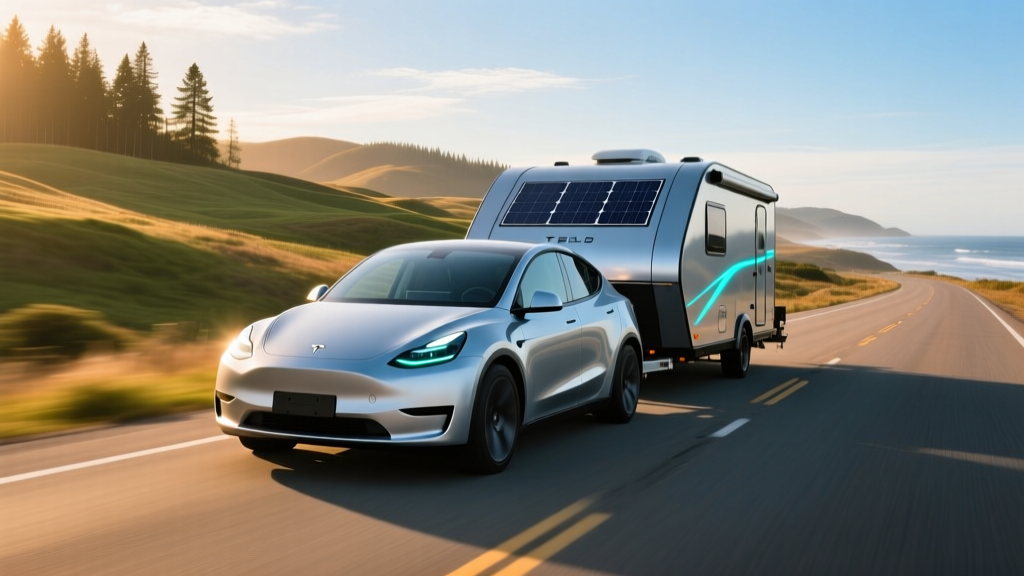
An electric camper trailer (sometimes called an e-trailer or EV-native camper) is a towable RV with its own battery pack and electric motor(s) on the axle. The concept: the trailer propels itself in sync with the tow vehicle, reducing the net towing load and preserving the EV's range. Some models also offer self-propulsion at low speeds for easier campsite maneuvering and off-grid power via large onboard batteries.
Key players as of 2026:
- Lightship L1 — Aerodynamic travel trailer with a ~80 kWh battery, solar roof, and claimed near-neutral towing impact on range. Base price approximately $125,000.
- Pebble Flow — Compact trailer with a ~45 kWh battery, active aero, and "InstantCamp" self-leveling/motorized setup. Starting around $109,000.
- Colorado Teardrop (e-droplet concept) — Smaller, more affordable segment, though most production models remain conventional as of 2026.
For comparison, a conventional travel trailer like the Airstream Bambi (~3,500 lbs GVWR, starting ~$58,000) or a Scamp 13' (~1,500 lbs, ~$19,000) has no propulsion assist — every pound of drag comes from your tow vehicle's battery.
The Range Reality: What Happens When You Tow With an EV
Range loss during towing is the single biggest concern for EV owners considering a camper trailer, and the physics are unforgiving. Energy consumption rises with the square of speed and linearly with weight, and trailers add both mass and aerodynamic drag.
| Vehicle | Battery (kWh usable) | EPA Range (mi) | Trailer Weight | Est. Towing Range (mi) | Range Retained |
|---|---|---|---|---|---|
| Ford F-150 Lightning Extended Range | 131 | 320 | 5,000 lbs | 140–170 | ~45–53% |
| Rivian R1T Dual-Motor Max Pack | 141 | 352 | 5,000 lbs | 155–185 | ~44–53% |
| Chevrolet Silverado EV 4WT | 200 | 440 | 7,500 lbs | 175–220 | ~40–50% |
| Tesla Model X Plaid | 100 | 326 | 3,500 lbs | 170–200 | ~52–61% |
| Hyundai Ioniq 5 (with tow package) | 77.4 | 305 | 1,600 lbs | 185–215 | ~61–70% |
The key variable isn't just weight — it's aerodynamic frontal area. A tall, boxy 5,000-lb travel trailer creates far more drag than a sleek 5,000-lb boat. This is precisely why electric camper trailer startups prioritize aerodynamic design: reducing drag coefficient matters more than shedding a few hundred pounds.
Towing Cost Comparison: EV vs Gas Truck
Does towing with electricity actually save money over a gas truck? The answer depends heavily on where you charge.
| Vehicle | Efficiency While Towing | Energy/Fuel Cost | Total Trip Cost |
|---|---|---|---|
| Ford F-150 Lightning (home charging at $0.14/kWh) | ~2.0 kWh/mi | $0.28/mi | $140 |
| Ford F-150 Lightning (DC fast charging at $0.48/kWh avg) | ~2.0 kWh/mi | $0.96/mi | $480 |
| Ford F-150 Gas 4x4 (towing, 12 MPG, $3.40/gal) | ~12 MPG | $0.28/mi | $140 |
| Rivian R1T Max Pack (home charging) | ~1.9 kWh/mi | $0.27/mi | $135 |
| Toyota Tundra V6 (towing, 13 MPG, $3.40/gal) | ~13 MPG | $0.26/mi | $130 |
The data from fueleconomy.gov confirms what experienced EV towers already know: home charging makes EV towing cost-competitive with gas; exclusive reliance on DC fast charging does not. If your camping trips start and end at home and you can charge overnight on Level 2, the EV wins on operating cost. If you're doing 500-mile highway stretches through charging deserts relying on Electrify America or EVgo at peak rates, the gas truck may cost the same or less — and refuel in 5 minutes instead of 30–45.
Charging Logistics: The Part Nobody Warns You About
Towing a camper trailer introduces charging complications that go beyond simple range math:
The Pull-Through Problem
Most public DC fast charging stations are designed for cars to pull in and back out. A truck with a 20-foot trailer often cannot fit in a standard charging spot without unhitching. Some networks — particularly newer Electrify America and Tesla Supercharger locations — are adding pull-through stalls, but availability remains inconsistent in 2026.
Charge Speeds While Hitched
Your EV's peak DC fast-charge rate doesn't change when towing, but your effective charging speed drops dramatically because you're consuming more energy per mile. A Ford F-150 Lightning peaking at 155 kW can add roughly 75 miles of towing range in 30 minutes — versus ~150 miles of normal driving range in the same session. The charge curve still tapers above 80% SoC, so plan to charge from 10–80% and move on.
Preconditioning Matters Even More
Battery preconditioning — warming the pack to optimal temperature before a DC fast-charge session — is critical when towing. A cold battery may accept only 40–60 kW instead of its rated peak, adding 15–20 minutes to each stop. Use your vehicle's navigation-directed preconditioning whenever possible.
Which 2026 EVs Can Actually Tow a Camper Trailer?
Not every EV is rated for towing, and those that are vary widely in capacity. Here's a breakdown of popular 2026 models:
| Vehicle | Max Tow Rating | Battery (kWh) | Max DC Charge (kW) | 10–80% Time | Starting MSRP |
|---|---|---|---|---|---|
| Chevrolet Silverado EV 4WT | 10,000 lbs | 200 | 350 | ~20 min | $55,000 |
| Ford F-150 Lightning Ext. Range | 10,000 lbs | 131 | 155 | ~38 min | $62,000 |
| Rivian R1T Tri-Motor Max | 11,000 lbs | 141 | 220 | ~27 min | $99,000 |
| Tesla Cybertruck AWD | 11,000 lbs | 123 | 250 | ~25 min | $82,000 |
| Hyundai Ioniq 5 (tow pkg) | 1,650 lbs | 77.4 | 240 | ~18 min | $47,000 |
| Kia EV9 GT-Line AWD | 5,000 lbs | 100 | 236 | ~24 min | $65,000 |
Tax credit note: Under current IRS §30D rules, the federal EV tax credit of up to $7,500 is subject to MSRP caps ($80,000 for trucks/SUVs), buyer income limits ($300,000 joint / $150,000 single), and battery component/critical-mineral sourcing requirements. Several trucks above exceed the MSRP cap or have sourcing disqualifications for 2026. The credit can be transferred at point of sale as a purchase discount. Always verify current eligibility on irs.gov before committing.
Decision Framework: Should You Get an Electric Camper Trailer?
Choose an Electric-Assisted Camper Trailer If:
- You already own or plan to buy a capable EV truck/SUV (F-150 Lightning, R1T, Silverado EV)
- Your typical camping trips are 100–200 miles one-way from home
- You have reliable home Level 2 charging (240V, 40–80A circuit)
- You value off-grid power at the campsite (these trailers double as large power stations)
- Budget allows $100,000+ for the trailer alone
Choose a Conventional Lightweight Camper If:
- Your EV is a smaller SUV (Ioniq 5, EV6, Model Y) with a 1,500–3,500 lb tow rating
- You want a proven, lower-cost option ($15,000–$60,000)
- You camp in areas with limited charging infrastructure
- You don't need the trailer to serve as a power station
Stick With a Gas Truck and Conventional Camper If:
- Your trips regularly exceed 300 miles one-way through areas with sparse DC fast charging
- You tow in extreme cold or high-altitude mountain terrain frequently
- You need fast refueling on tight schedules (5 min vs 30–45 min per charge stop)
- Total trip cost matters and you'd rely primarily on expensive public DC chargers
Common Misconceptions About Towing With an EV
| Myth | Fact |
|---|---|
| "EVs can't tow — the range drops to zero." | Range drops 40–60% with heavy trailers, but a 320-mile EV still delivers 130–190 miles of towing range — enough for many campground trips with planned charging. |
| "Electric camper trailers recharge themselves while driving." | They use battery power to assist propulsion, reducing drag on the tow vehicle. They don't generate net energy — they consume stored energy to help. You still need to recharge the trailer's battery at your destination. |
| "Towing voids the EV battery warranty." | Towing within the manufacturer's rated capacity does not void the powertrain/battery warranty. Exceeding the rated tow capacity or using improper equipment may. |
| "You need a special charger for towing." | You use the same CCS/NACS connectors. The challenge is physical access (pull-through stalls) and charge time, not compatibility. |
| "Electric camper trailers qualify for the $7,500 EV tax credit." | §30D applies to motor vehicles — not trailers. The tow vehicle may qualify; the trailer does not. Some states offer separate RV or energy-storage incentives. |
Real Ownership Costs: First-Year Breakdown
Here's what a realistic first year looks like for an EV owner adding a camper trailer to the mix — comparing an electric-assisted trailer vs. a conventional lightweight option:
| Cost Item | Electric Camper (Lightship L1) | Conventional (Airstream Bambi) |
|---|---|---|
| Purchase price | $125,000 | $58,000 |
| Registration & insurance | $1,800 | $1,200 |
| Home charging energy (10 trips/yr, ~150 mi each, $0.14/kWh) | $420 | $420 |
| Public DC charging (4 road trips, ~500 mi each) | $960 | $960 |
| Maintenance (tires, bearings, brakes) | $600 | $800 |
| Storage (if needed) | $1,200 | $1,200 |
| Year 1 Total | ~$129,980 | ~$62,580 |
The electric camper trailer's value proposition isn't first-year savings — it's the campsite experience (silent generator-free power, self-leveling setup, reduced tow-vehicle range anxiety) and the potential for lower long-term maintenance (regenerative braking on the trailer axle reduces brake wear).
Frequently Asked Questions
Can I tow a camper trailer with a Tesla Model Y or Model 3?
The Model Y has a 3,500-lb tow rating in the US (with tow package), making it suitable for lightweight teardrop campers like the Scamp 13' (~1,500 lbs) or NuCamp Tab 320 (~2,200 lbs). The Model 3 is not rated for towing in the US market. Expect range to drop to roughly 180–210 miles when towing near max capacity with the Model Y Long Range.
Do electric camper trailers have their own charging port?
Yes. Models like the Lightship L1 and Pebble Flow include CCS or NACS ports so you can charge the trailer's battery independently at your campsite or at a DC fast charger. They typically also accept Level 2 (240V) charging and solar input. Charging a ~80 kWh trailer battery from 20–80% on a 150 kW DC charger takes roughly 25–35 minutes.
How does cold weather affect EV towing range?
Cold weather (below 40°F) reduces battery efficiency by 15–30% on its own. Combined with the 40–60% towing penalty, you may see total range retention of only 30–40% of the EPA sticker. A 320-mile EV truck could realistically deliver just 95–130 miles of towing range in freezing conditions. Preconditioning the battery and using seat/steering-wheel heat instead of cabin heat can help mitigate losses.
What size home charger do I need if I tow a camper?
A 48-amp Level 2 charger on a 60-amp 240V circuit is the practical minimum for EV truck owners who tow. This delivers roughly 11.5 kW, enough to fully recharge a 131 kWh F-150 Lightning battery in about 11–12 hours overnight. If you're returning from a trip with a near-empty battery and a depleted trailer battery, consider a 64-amp charger on an 80-amp circuit (~15.3 kW) for faster turnaround. Always have installation performed by a licensed electrician — panel upgrades to 200A service may be required, adding $1,500–$3,000 to installation costs.
Are there any tax credits or incentives for electric camper trailers?
The federal §30D tax credit does not apply to trailers — only to qualified motor vehicles. However, if your electric camper trailer includes a battery system that qualifies as residential energy storage when used at your campsite, portions of the battery cost may be eligible for the §25D residential clean energy credit (30% of cost). Consult a tax professional for your specific situation, as IRS guidance on dual-use trailer batteries remains limited.