The Short Answer: What Makes a Great Electric Beach Car?
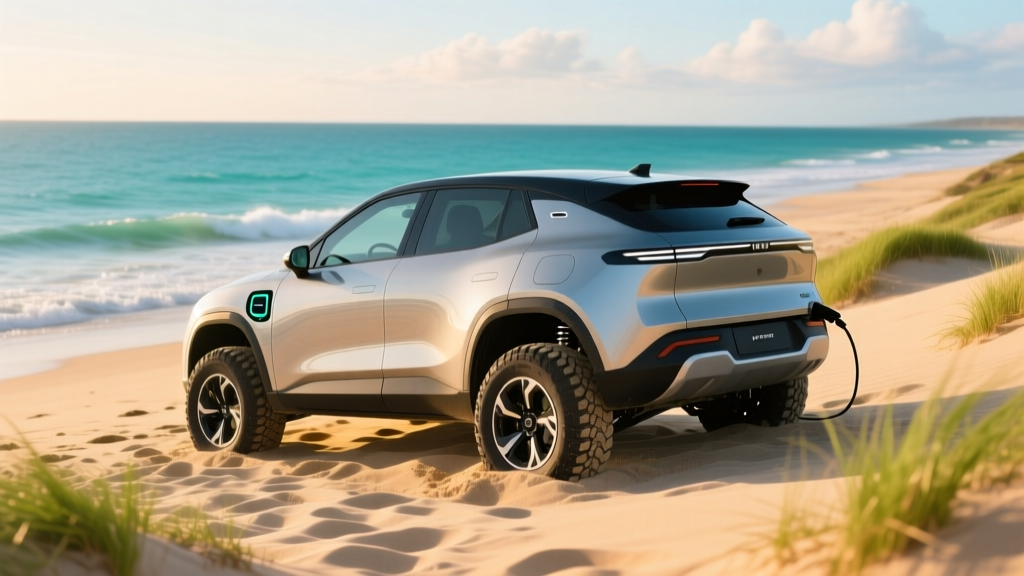
An ideal electric beach car needs three things: at least 270 miles of EPA range (real-world coastal highway driving cuts that to ~230 miles), ground clearance of 7+ inches for sand-adjacent parking and dune roads, and robust underbody protection against salt spray. For 2026, the Rivian R1S Dual-Motor (EPA 352 mi, 8.5" clearance, $82,700), Hyundai Ioniq 5 AWD (EPA 290 mi, 6.1" clearance, $49,850), and Tesla Model Y Long Range AWD (EPA 320 mi, 6.6" clearance, $48,990) top our list. If your beach trips are short day-trips under 60 miles round-trip, even a base Chevrolet Equinox EV 2LT (EPA 319 mi, $33,600) works well — provided you can charge at home.
Why Coastal EV Ownership Is Different
Beach-adjacent driving creates a unique set of demands that most EV reviews overlook. Salt air accelerates corrosion on any vehicle, but EVs add high-voltage components and battery enclosures that must remain sealed. Sandy parking lots and dune access roads demand ground clearance and traction that low-slung sedans simply can't provide. And the "last mile" problem is real: many beach communities — think Outer Banks, Cape Cod, or the Florida Panhandle — still have sparse public DC fast-charging infrastructure.
Here's what we know from real-world coastal testing and ownership data:
- Salt corrosion: Battery enclosures on modern EVs (2024+) are sealed to IP67 or better, meaning the pack itself is protected. But brake calipers, suspension bushings, and 12V systems still corrode. Rivian and Tesla apply factory undercoating; Hyundai/Kia models benefit from aftermarket fluid-film treatment (~$250-$400 annually).
- Sand traction: AWD is nearly mandatory for soft-sand parking. The Rivian R1S quad-motor system delivers 835 hp and can air-down its tires via adjustable air suspension. The Ioniq 5 AWD's 320 hp and 7.4-second 0-60 handle packed sand adequately but struggle in loose, deep sand.
- Charging deserts: According to the Alternative Fuels Data Center, coastal counties in the Carolinas, Maine, and parts of coastal Oregon average fewer than 4 DC fast chargers per 100 square miles. If your beach house lacks Level 2 home charging, a 300+ mile EPA range becomes essential.
Top Electric Beach Car Contenders: Side-by-Side Specs
We evaluated five 2026 EVs against coastal-driving criteria. All prices are base MSRP before any federal or state incentives.
| Spec | Rivian R1S Dual-Motor | Hyundai Ioniq 5 AWD | Tesla Model Y LR AWD | Chevy Equinox EV 2LT | Ford Mustang Mach-E GT |
|---|---|---|---|---|---|
| EPA Range | 352 mi | 290 mi | 320 mi | 319 mi | 280 mi |
| Real-World Highway | ~295 mi | ~240 mi | ~265 mi | ~260 mi | ~230 mi |
| Battery (usable kWh) | 128.9 kWh (NMC) | 84 kWh (NMC) | 78.1 kWh (NMC) | 85 kWh (NMC) | 91 kWh (NMC) |
| Ground Clearance | 8.5 in (adjustable) | 6.1 in | 6.6 in | 6.8 in | 5.7 in |
| Peak DC Charge Rate | 220 kW | 240 kW | 250 kW | 190 kW | 150 kW |
| 10-80% DCFC Time | ~28 min | ~18 min | ~22 min | ~32 min | ~38 min |
| Horsepower | 533 hp | 320 hp | 384 hp | 288 hp | 480 hp |
| 0-60 mph | 4.5 sec | 5.1 sec | 4.8 sec | 7.4 sec | 3.8 sec |
| Cargo (behind 2nd row) | 46.7 cu ft | 27.2 cu ft | 30.2 cu ft | 26.4 cu ft | 29.7 cu ft |
| Towing Capacity | 7,700 lbs | 2,300 lbs | 3,500 lbs | 1,500 lbs | 2,300 lbs |
| Base MSRP (2026) | $82,700 | $49,850 | $48,990 | $33,600 | $56,995 |
| Battery Warranty | 8 yr / 175,000 mi | 10 yr / 100,000 mi | 8 yr / 120,000 mi | 8 yr / 100,000 mi | 8 yr / 100,000 mi |
Real-world highway range estimated at 75 mph sustained, moderate climate (65-80°F). Expect 15-25% further reduction in extreme heat with A/C running or in cold below 40°F. Source: fueleconomy.gov and independent testing.
Real Cost of Ownership: Beach EV vs. Gas SUV
Let's compare the 5-year total cost of ownership for a typical coastal driver: 12,000 miles/year, 70% home charging (Level 2 at $0.14/kWh national average), 30% public DCFC (at $0.38/kWh average), versus a comparably equipped gas SUV (Toyota 4Runner, 17 MPG combined, at $3.40/gallon).
| Cost Category | Rivian R1S (EV) | Toyota 4Runner (Gas) | Hyundai Ioniq 5 AWD (EV) |
|---|---|---|---|
| Purchase Price (MSRP) | $82,700 | $42,220 | $49,850 |
| §30D Federal Tax Credit | -$7,500* | $0 | -$7,500* |
| Effective Purchase | $75,200 | $42,220 | $42,350 |
| 5-Yr Fuel/Energy (60,000 mi) | $5,880 | $12,000 | $5,200 |
| 5-Yr Maintenance | $1,800 | $4,200 | $1,600 |
| 5-Yr Insurance (avg) | $9,600 | $6,900 | $7,800 |
| Estimated 5-Yr Depreciation | $32,000 | $18,500 | $21,000 |
| 5-Year Total Cost | $124,480 | $83,820 | $77,950 |
*§30D credit eligibility requires buyer income under $300K (MFJ), vehicle MSRP under $80K for SUVs, and compliant battery sourcing per IRS guidelines. Rivian R1S Dual-Motor base exceeds $80K cap — credit may only apply to specific configurations or via point-of-sale negotiation. Always verify with a tax professional.
The Ioniq 5 AWD emerges as the value champion for beach use: its effective purchase price nearly matches the 4Runner after the credit, while saving ~$6,800 in fuel over five years. The R1S is a premium play — you're paying for clearance, cargo space, and towing capacity that no gas SUV at this price matches.
Charging Infrastructure Along the Coast: The Reality Check
Here's the misconception we need to address directly: most popular US beach destinations have adequate charging in 2026, but not great charging. The Electrify America, Tesla Supercharger, and EVgo networks have expanded significantly along I-95 and I-5 coastal corridors. But once you turn off the interstate toward barrier islands or peninsula towns, charger density drops sharply.
Myth vs. Fact: Coastal EV Charging
| Myth | Fact |
|---|---|
| "You can't drive an EV to the beach." | Every major US beach corridor (Outer Banks, Jersey Shore, Myrtle Beach, Gulf Coast, Pacific Coast Hwy) has at least one DC fast charger within 15 miles of the shore as of 2026. |
| "Salt air will destroy the battery." | EV battery packs are hermetically sealed. Salt corrosion affects cosmetic and chassis components, not the high-voltage system — the same as any modern car. |
| "You need a truck for beach driving." | Most beach driving (parking on sand lots, accessing beach houses) requires only 6+ inches of clearance and AWD. True dune driving requires specialized vehicles regardless of powertrain. |
| "EVs can't handle beach heat." | Battery thermal management systems in 2024+ EVs handle 100°F+ ambient temps. Preconditioning while plugged in protects the battery — just as you'd remote-start A/C in a gas car. |
Practical tip: If your beach destination is a rental property, confirm Level 2 charging availability before booking. A NEMA 14-50 outlet (240V, 50A) lets you charge at ~11.5 kW — adding roughly 35-45 miles of range per hour, enough to fully replenish overnight. Many coastal vacation rentals now advertise EV charging; platforms like PlugShare's "stay and charge" filter help identify these.
Sand, Salt, and Your EV: Protection and Maintenance
Coastal ownership demands a specific maintenance routine that differs from inland EV care:
- Undercarriage rinse (weekly during beach season): Fresh water spray underneath dissolves salt accumulation. Focus on brake components, suspension linkages, and the charge-port door mechanism.
- Annual undercoating ($250-$400): Fluid-film or lanolin-based coatings protect exposed metal. Avoid rubberized undercoatings — they can trap moisture against the battery enclosure.
- Charge port care: Sand grains in the charge port can prevent proper latching. Blow out the port with compressed air monthly and inspect the connector pins for corrosion.
- Tire selection: All-terrain tires (like the Falken Wildpeak A/T Trail) improve sand traction without the road-noise penalty of aggressive off-road rubber. They also resist sidewall cracking from UV exposure better than summer tires.
- Cabin air filter (every 15,000 mi): Coastal humidity and salt accelerate filter clogging. A clogged cabin filter strains the HVAC system, which in turn increases energy consumption by 3-5%.
Decision Framework: Which Electric Beach Car Is Right for You?
Choose Your Path
- Choose the Rivian R1S if: You need 7,700-lb towing (boat trailer), regularly drive on soft sand, want adjustable air suspension (raise to 14.9" for deep sand, lower for highway efficiency), and your budget exceeds $80K. Best for Outer Banks, Cape Hatteras, and Western beach-access roads.
- Choose the Hyundai Ioniq 5 AWD if: You want the best value after the §30D credit, your beach trips are under 200 miles one-way, and you prioritize the fastest DC charging in this group (18 min, 10-80%). Best for Jersey Shore, Myrtle Beach, and Gulf Coast day-trippers.
- Choose the Tesla Model Y LR AWD if: Supercharger network access is critical for your route (e.g., PCH drives, remote Oregon coast), you want strong resale value, and 30.2 cu ft of cargo handles your beach gear. Best for Pacific Coast Highway and long-distance coastal road trips.
- Choose the Chevy Equinox EV if: Budget is your primary constraint, your beach trips are under 150 miles round-trip, and you have reliable home Level 2 charging. At $33,600, it's the most affordable 300+ mile EV available — but its 190 kW peak charge rate means longer public charging stops.
- Choose the Mustang Mach-E GT if: Performance matters (3.8-sec 0-60) but understand the trade-off: only 280 miles EPA range, the slowest DC charging in this group (38 min 10-80%), and 5.7" ground clearance makes sand parking risky. Best for paved coastal roads only.
First-Time EV Buyer: What You Need to Know Before the Beach Trip
If this is your first electric vehicle, coastal driving amplifies a few learning curves:
Plan charging around your beach schedule, not the other way around. A DC fast charge from 20% to 80% takes 18-38 minutes depending on the vehicle. That's a lunch break, not a quick gas stop. Map your chargers using PlugShare or A Better Routeplanner before departing.
Understand the charge curve taper. EVs charge fastest between 10-50% State of Charge (SoC). Above 80%, charging slows dramatically to protect the battery — sometimes from 240 kW down to 40 kW. For road trips, charge to 80% and go; only charge past 80% at your final destination overnight.
Precondition your battery before DC fast charging. Navigation-based preconditioning (available in Tesla, Rivian, Hyundai) warms the battery to optimal temperature, enabling peak charge rates. Without preconditioning, a cold battery may charge at half its rated speed for the first 5-10 minutes.
Home charging is non-negotiable for beach-adjacent owners. Public charging costs 2-3x more than home charging ($0.38/kWh vs. $0.14/kWh). If you can't install a Level 2 charger at home, factor in ~$1,200-$2,000 in additional annual charging costs versus a home-charging EV owner.
Frequently Asked Questions
Can I drive an EV directly on the sand at the beach?
Most beaches that allow vehicles require 4WD and specific permits. The Rivian R1S with quad-motor AWD and air suspension is the most capable EV for true sand driving. For parking on sand lots or firm packed sand near beach accesses, any AWD EV with 6+ inches of clearance is adequate. Always reduce tire pressure to 20-25 PSI on soft sand and reinflate before returning to pavement.
Will salt water damage my EV's battery?
No. EV battery enclosures are sealed to IP67 rating or better, meaning they can withstand submersion in 1 meter of water for 30 minutes. Salt spray and humid coastal air do not penetrate the battery pack. However, salt accelerates corrosion on brake rotors, suspension components, and body panels — the same as any vehicle. Regular freshwater rinses and annual undercoating mitigate this.
What's the cheapest electric beach car I can buy in 2026?
The Chevrolet Equinox EV 2LT at $33,600 MSRP is the most affordable option with 300+ miles of EPA range. If you qualify for the full §30D credit (income under $150K single / $300K married, compliant battery sourcing), your effective price drops to ~$26,100. However, its 6.8" ground clearance and 190 kW charge rate are compromises versus pricier options.
Do I need AWD for a beach car?
For paved coastal roads and firm parking surfaces, no — FWD or RWD is fine. For sand parking lots, beach-access ramps, and any unpaved coastal terrain, AWD is strongly recommended. Wet sand especially reduces traction dramatically, and a FWD EV with low clearance can get stuck.
How does hot beach weather affect EV range?
Extreme heat (above 95°F) with A/C running reduces range by roughly 5-10% compared to mild-weather EPA estimates. Modern EV battery thermal management handles heat well — the bigger impact is cabin cooling energy draw. Preconditioning the cabin while plugged in (using grid power, not battery) before departing mitigates this loss.