Quick Answer: Which Electric 4x4 Off-Road Vehicle Should You Buy?
If you need a serious electric 4x4 off-road vehicle in 2026, the shortlist comes down to three production models and one emerging contender. The Rivian R1S Tri Motor offers the best blend of EPA range (up to 410 miles with the Max Pack), 14.9 inches of ground clearance, and 850 hp for $99,900. The Jeep Wrangler 4xe (PHEV, not BEV) remains the only electrified solid-axle trail rig, with 22 miles of electric-only range and proven Rubicon hardware. The Hummer EV SUV delivers the most extreme capability (13.5 inches of clearance, CrabWalk, 830 hp) but starts around $104,500 and weighs over 9,000 lbs. The Ford Bronco EV is announced for late 2026/2027 — specs remain preliminary.
For most buyers who need daily drivability and weekend trail use, the Rivian R1S is the default pick. For hardcore rock-crawling where articulation matters most, the Wrangler 4xe still holds the crown. Below, we break down exact specs, real-world costs, and the ownership realities that spec sheets don't show.
The 2026 Electric Off-Road Lineup: Spec-by-Spec Breakdown
Before we get to costs and ownership, here's how the main electrified off-road contenders stack up on paper. All figures reflect 2026 model-year data from manufacturer specifications and fueleconomy.gov.
| Spec | Rivian R1S Tri Motor (Max Pack) | Jeep Wrangler 4xe Rubicon | GMC Hummer EV SUV 3X |
|---|---|---|---|
| Powertrain | BEV (Tri Motor AWD) | PHEV (2.0L Turbo + 2 motors) | BEV (Tri Motor AWD) |
| Horsepower | 850 hp | 375 hp combined | 830 hp |
| 0–60 mph | ~2.9 sec | ~6.0 sec | ~3.5 sec |
| Battery (usable) | ~149 kWh (NMC) | 17.3 kWh (NMC) | ~212 kWh (NMC, Ultium) |
| EPA Electric Range | 410 mi (Max Pack) | 22 mi (EV only) / 370 mi total | 314 mi |
| MPGe / MPG | 70 MPGe combined | 49 MPGe (EV) / 20 MPG (gas) | 47 MPGe combined |
| Ground Clearance | 14.9 in (max) | 12.9 in (Rubicon) | 13.5 in (Adaptive Ride) |
| Max DC Fast Charge | ~220 kW peak | Level 2 only (no DCFC) | ~350 kW peak (800V) |
| 10–80% DCFC Time | ~30 min | N/A (L2: ~2.5 hrs) | ~22 min (est.) |
| Wading Depth | ~36 in | ~33.5 in | ~32.2 in |
| Towing Capacity | 7,700 lbs | 3,500 lbs | 7,500 lbs |
| Curb Weight | ~7,150 lbs | ~5,360 lbs | ~9,046 lbs |
| Base MSRP (2026) | $99,900 (Tri/Max) | $60,990 (4xe Rubicon) | $104,500 (3X) |
| Battery Warranty | 8 yr / 175,000 mi | 8 yr / 100,000 mi | 8 yr / 100,000 mi |
Real-World Range on the Trail and Highway
EPA range stickers tell only part of the story — especially when you add mud-terrain tires, roof racks, and 4,000 feet of elevation gain. Here's what to actually expect.
Rivian R1S Max Pack — Real-World Range
EPA: 410 miles | Highway (75 mph): ~320–340 miles | Trail day (low-speed, high-torque): ~250–280 miles equivalent | Cold weather (20°F): ~290–320 miles
The R1S's large 149 kWh pack gives it a buffer most off-road EVs lack. However, aggressive all-terrain or mud-terrain tires can knock 10–15% off range versus the factory All-Season spec. Rivian's heat pump helps mitigate cold-weather losses compared to older EV architectures.
GMC Hummer EV SUV — Real-World Range
EPA: 314 miles | Highway (75 mph): ~240–260 miles | Trail day: ~180–210 miles equivalent | Cold weather: ~220–250 miles
At over 9,000 lbs, the Hummer EV's mass is its biggest efficiency enemy. On technical trails with constant low-range crawling, expect to burn through the 212 kWh pack faster than the EPA number implies. Plan charging stops conservatively on backcountry routes.
Jeep Wrangler 4xe — Real-World Electric Range
EPA EV-only: 22 miles | Real-world EV-only: 16–20 miles (highway or hilly terrain) | Total range with gas tank: ~350–370 miles
The 4xe's 17.3 kWh battery is small — it's a compliance-and-commute PHEV, not a trail-crawling EV. You'll burn through the electric range in under an hour of highway driving. The real value is electric-only commuting during the week and gas-powered trail runs on weekends.
Charging Off the Grid: What Trail Riders Need to Know
Charging infrastructure is the single biggest variable for off-road EV ownership. Most trailheads have zero charging. Here's the reality by power level:
| Level | Power (kW) | R1S Miles Added/Hour | Hummer EV Miles Added/Hour | Where You'll Find It |
|---|---|---|---|---|
| Level 1 (120V) | ~1.4 kW | ~3–4 mi/hr | ~2–3 mi/hr | Standard outlet (campground, cabin) |
| Level 2 (240V, 48A) | ~11.5 kW | ~28–32 mi/hr | ~20–24 mi/hr | Home charger, RV parks, some trailhead campgrounds |
| DC Fast Charge | 150–350 kW | ~300+ mi/hr (peak) | ~400+ mi/hr (peak) | Highway corridors — rarely near trails |
The charge-curve reality: Peak kW is not sustained kW. The R1S peaks at ~220 kW but tapers significantly above 80% State of Charge (SoC). Expect a 10–80% session to take roughly 30 minutes at a capable station, but the final 80–100% can add another 25–35 minutes. Never plan a trail day around a full charge at a public station — plan around 80%.
Trail charging strategy: If you're running remote trails (Moab, Rubicon Trail, Ouray), you need a plan. The most practical approach is:
- Charge to 90–100% at home the night before (using a Level 2 home charger)
- Identify the nearest DCFC to your trailhead — often 30–90 miles away
- Carry a portable Level 1 charger as emergency backup (adds ~3 miles/hour from any 120V outlet)
- For extended backcountry trips, a solar generator or portable power station (like a Jackery or EcoFlow) can trickle-charge at ~0.5–1 kW — enough to prevent stranding, not enough for real driving
Total Cost of Ownership: Electric Off-Roader vs. Gas Equivalent
Off-road vehicles are expensive to buy and operate. Here's how a BEV off-roader (Rivian R1S) stacks up against a comparable gas-powered SUV (Toyota Land Cruiser, 2026 model) over 5 years and 75,000 miles.
| Cost Category | Rivian R1S (Tri Motor) | Toyota Land Cruiser (Gas) |
|---|---|---|
| Base MSRP | $99,900 | $58,550 |
| Federal Tax Credit (§30D) | Up to $7,500 (if sourcing/income rules met) | $0 |
| Effective Purchase Price | ~$92,400 | $58,550 |
| Fuel/Energy (5 yr / 75k mi) | ~$4,800 (home L2 at $0.14/kWh) | ~$11,250 (gas at $3.50/gal, 21 MPG) |
| Maintenance (5 yr) | ~$1,200 (cabin filter, wipers, fluid top-offs) | ~$3,500 (oil, filters, plugs, transmission fluid) |
| Insurance (5 yr avg.) | ~$14,000 ($2,800/yr avg.) | ~$9,500 ($1,900/yr avg.) |
| Tires (5 yr, off-road use) | ~$3,200 (heavier vehicle eats tires faster) | ~$2,800 |
| Estimated Depreciation (5 yr) | ~$38,000 | ~$22,000 |
| Total 5-Year Cost | ~$153,600 | ~$107,600 |
| Cost Per Mile | ~$2.05/mi | ~$1.43/mi |
The honest takeaway: An electric 4x4 off-road vehicle costs significantly more to own over 5 years than a gas equivalent — primarily because of the higher purchase price, steeper depreciation, and higher insurance premiums. Where the EV saves money is fuel and maintenance. At current electricity and gas prices, you'd need to drive 150,000+ miles to close the total-cost gap. The EV makes financial sense if you prioritize fuel savings on long commutes, value instant torque for technical trails, or live in a state with strong EV incentives (California, Colorado, etc.).
Federal Tax Credits and Incentives for Electric Off-Roaders
The IRS §30D Clean Vehicle Credit applies to qualifying new EVs and PHEVs, but eligibility is complex. Here's the 2026 checklist:
- MSRP Cap: SUVs and trucks must be under $80,000 MSRP — this eliminates the Hummer EV and most R1S configurations from the new-vehicle credit
- Buyer Income Cap: AGI must not exceed $150,000 (single), $225,000 (head of household), or $300,000 (joint)
- Battery Sourcing: Critical minerals and battery components must meet escalating domestic-sourcing thresholds (phased in through 2026)
- Assembly: Vehicle must undergo final assembly in North America
- Point-of-Sale Transfer: Eligible buyers can transfer the credit to the dealer at purchase, reducing the purchase price directly
What qualifies in 2026? The Jeep Wrangler 4xe (under $80K MSRP, assembled in Toledo, OH) often qualifies for the full $3,750–$7,500 credit depending on battery sourcing compliance. The Rivian R1S Dual Motor Standard Pack (if MSRP stays under $80K) may qualify. The Hummer EV does not qualify due to its MSRP. Always verify current eligibility on fueleconomy.gov before purchasing — the IRS updates qualified vehicle lists regularly.
Used EV credit (§25E): If you buy a qualifying used electric off-roader for $25,000 or less, you may be eligible for up to $4,000 (30% of sale price). This is relevant for early-model Rivian R1S or used Wrangler 4xe units entering the secondary market.
Off-Road Capability: Where EVs Win and Where They Don't
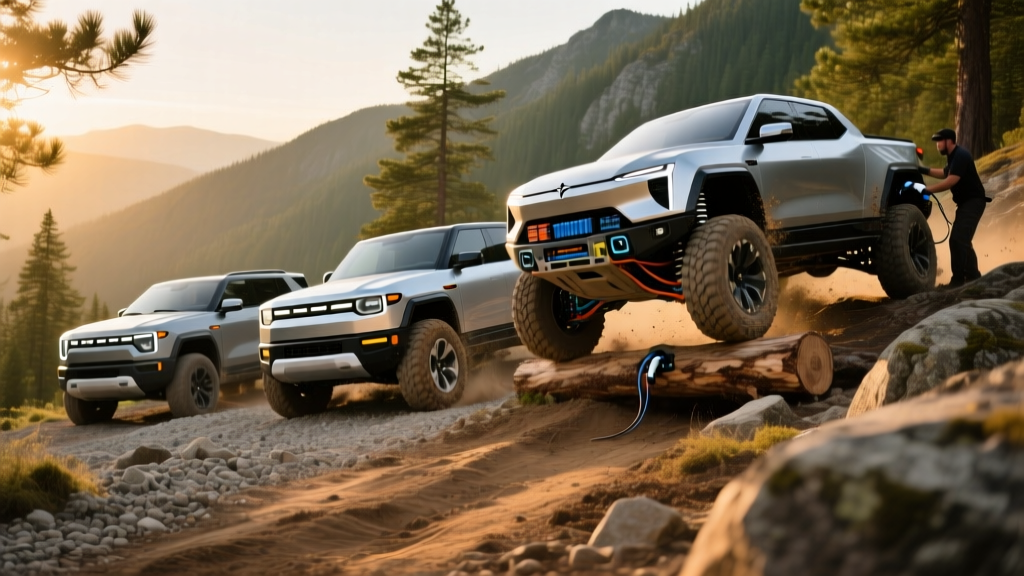
Electric motors deliver instant torque from zero RPM — a genuine advantage on technical rock-crawl sections where throttle precision matters. Rivian's quad-motor and tri-motor setups offer individual wheel torque vectoring that no mechanical locker can match in responsiveness. The Hummer EV's CrabWalk (four-wheel steering) allows diagonal movement on tight trails.
But EVs also carry real off-road disadvantages:
| Claim | Fact |
|---|---|
| "EVs can't rock crawl — no low range" | Rivian and Hummer EV use software-defined gear reduction simulating low range. It works well for most trails, but extreme rock crawling still favors a mechanical transfer case (Wrangler 4xe Rubicon). |
| "Battery weight makes EVs worse off-road" | Partly true. The Hummer EV's 9,046-lb curb weight increases sink risk in soft sand and mud. The R1S at ~7,150 lbs is heavy but manageable. Low center of gravity from the floor-mounted pack improves rollover resistance. |
| "You'll get stranded on the trail" | Possible if you don't plan. A 410-mile EPA range (R1S Max Pack) covers most out-and-back trail days with margin. The real risk is multi-day overlanding in areas without charging — here, a PHEV (Wrangler 4xe) or gas vehicle is safer. |
| "EVs can't be winched or towed" | False. Rivian and Hummer EV both support recovery points and flat-tow procedures. Check your owner's manual — regenerative braking must be disabled during flat-towing to avoid motor damage. |
| "Water fording is dangerous with a battery" | EV battery packs are sealed to IP67 or IP6K9K standards. The R1S is rated for ~36 inches of wading. However, saltwater submersion can cause long-term corrosion — rinse thoroughly after any water crossing. |
Decision Framework: Which Electric Off-Roader Fits Your Use Case?
Choose the Rivian R1S if:
- You want a daily-drivable luxury SUV that can handle moderate-to-difficult trails on weekends
- You have home Level 2 charging and commute under 80 miles/day
- You value instant torque, air suspension adjustability, and over-the-air updates
- Your budget allows $90,000–$110,000 after options
- You don't need solid-axle articulation for extreme rock crawling
Choose the Jeep Wrangler 4xe Rubicon if:
- Rock crawling and trail articulation are your top priorities (solid front/rear axles, locking differentials, sway-bar disconnect)
- You want electric commuting during the week (22 mi EV range covers most commutes) but need unlimited gas range for remote trails
- You want to stay under $65,000 and potentially qualify for the §30D tax credit
- You're comfortable with a rougher ride, louder cabin, and lower refinement on pavement
- You plan to modify heavily (the aftermarket for Wrangler is unmatched)
Choose the GMC Hummer EV SUV if:
- You want maximum power (830 hp) and presence, and budget is not a primary concern
- You value 800V architecture for the fastest DC charging in the segment
- You want unique features like CrabWalk and Extract Mode
- You accept the weight penalty (9,000+ lbs) and its effect on tire wear, energy consumption, and trail impact
- You primarily drive wide, established trails (Hummer's 86.7-inch width is problematic on narrow forest roads)
Wait for the Ford Bronco EV if:
- You want a mid-size electric off-roader with removable doors/roof (announced, expected late 2026 or 2027)
- You prefer Ford's dealer network and service infrastructure
- Specs and pricing are still preliminary — don't delay a purchase decision if you need a vehicle now
Frequently Asked Questions
Can I use an electric 4x4 off-road vehicle for multi-day overlanding?
It's possible but requires careful planning. The Rivian R1S Max Pack's 410-mile EPA range (~300 miles real-world on trails with cargo) can cover a day of overlanding, but you'll need overnight Level 2 charging at campsites or DCFC access within driving distance. For multi-day trips in areas without charging infrastructure (Bureau of Land Management routes, remote national forests), a PHEV like the Wrangler 4xe or a gas vehicle is the pragmatic choice. Portable solar panels and power stations can supplement but won't replace real charging.
Do electric off-road vehicles hold up to trail abuse?
Early data is encouraging. Rivian has logged millions of off-road miles through its delivery fleet and owner community. Battery packs are armored with skid plates and sealed against water and dust ingress. The main wear items are suspension components, tires, and underbody protection — same as any off-road vehicle. One advantage: no oil pans, exhaust systems, or catalytic converters to damage on rocks. The main risk: if the battery pack casing is punctured (extremely rare with proper skid plates), replacement costs $15,000–$25,000.
How does cold weather affect off-road EV range?
Expect 20–30% range loss at 20°F compared to EPA estimates, and up to 40% loss at 0°F or below. The battery's internal resistance increases in cold temperatures, and cabin heating draws significant energy. Both the R1S and Hummer EV use heat pumps, which are more efficient than resistive heaters but still consume energy. Preconditioning the battery while plugged in (warming it to optimal temperature before departure) recovers some of this loss. On cold trail days, seat heaters and heated steering wheels are more energy-efficient than cabin air heating.
Is home charging necessary to own an electric off-roader?
Nearly essential. Public DC fast charging alone is expensive ($0.35–$0.50/kWh vs. $0.12–$0.16/kWh at home), time-consuming, and unreliable in rural areas where most trails are. A Level 2 home charger (240V, 48A) costs $500–$1,500 for equipment and $800–$2,500 for professional installation depending on your electrical panel capacity. If you can't install home charging (apartment, no garage), a PHEV like the Wrangler 4xe is a far more practical electrified off-roader — you can gas up anywhere and use the small battery for short commutes.
What about the Rivian R1S Dual Motor vs. Tri Motor for off-road use?
The Dual Motor (665 hp, ~$75,900 base) is fully capable on moderate trails and saves $20,000+ over the Tri Motor. The Tri Motor's extra power matters most for dune running, high-speed desert whoops, and towing heavy trailers to the trailhead. For technical rock crawling, both are equally capable — low-speed precision doesn't require 850 hp. The Dual Motor Standard Pack (270-mile EPA range) is the most affordable R1S that may qualify for the §30D tax credit, bringing its effective price to ~$68,400.
Are there any electric UTVs or side-by-sides for off-road use?
Yes, but they're a different category. Polaris offers the Ranger XP Kinetic (electric UTV, ~110 hp, ~45-mile range, ~$29,999) and the Sportsman EV (electric ATV). These are purpose-built off-road vehicles not legal for street use in most states. They're excellent for ranch work, trail riding, and hunting — but they don't replace a street-legal electric 4x4 for daily driving and trail access.
Bottom Line: The Electric Off-Roader Market in 2026
The electric 4x4 off-road vehicle segment has matured from concept to real product — but it's still a premium niche. You'll pay $60,000–$110,000 for one, accept trade-offs in weight and remote charging access, and gain instant torque, lower trail maintenance, and (with home charging) dramatically lower per-mile energy costs. The Rivian R1S is the most well-rounded choice for buyers who split time between pavement and trail. The Wrangler 4xe remains the hardcore crawler's electrified option. And the Hummer EV exists for those who want maximum capability and don't mind the mass.
Before buying, honestly assess your trail frequency, home charging access, and budget. If you hit trails monthly and charge at home, an electric off-roader delivers a unique combination of silent trail running, precise throttle control, and daily practicality. If you're a weekend warrior who drives 200 miles to remote trails twice a year, a gas or PHEV vehicle is still the lower-risk choice.