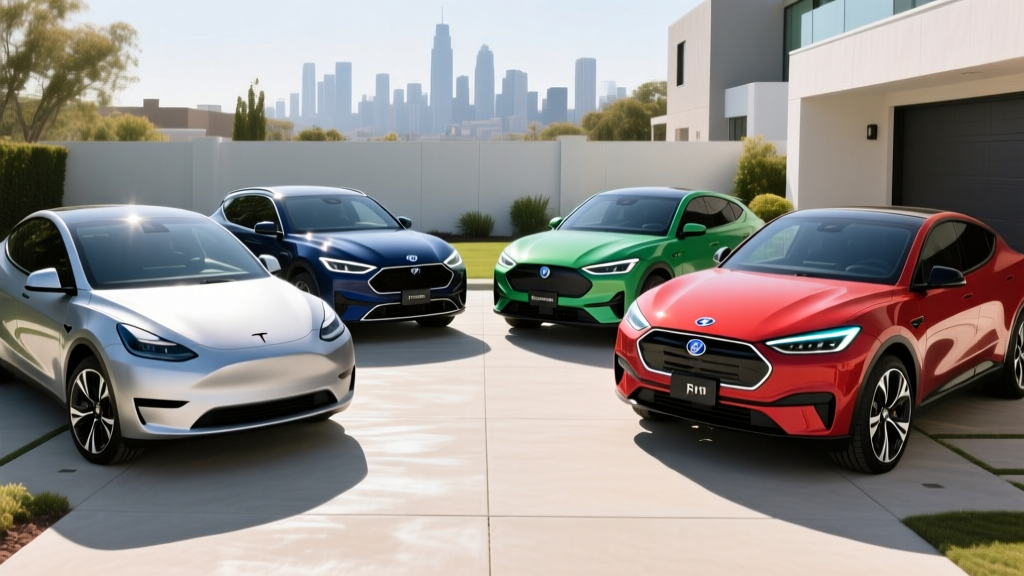
The Short Answer: Should You Buy a Coupe Electric Car?
The best electric coupes in 2026 combine striking design with practical range exceeding 300 miles EPA. The Tesla Model 3 Performance ($52,990) offers the best value-to-performance ratio with 315 miles EPA and a 10–80% DC fast charge in roughly 18 minutes. The BMW i4 M50 ($68,795) delivers premium build and 271 miles EPA, while the Hyundai Ioniq 6 Limited ($46,850) leads in efficiency at 140 MPGe combined and 361 miles EPA. All three qualify for at least partial federal tax credits under current IRS §30D rules, though eligibility depends on your income, the vehicle's battery sourcing, and MSRP caps. If you have access to Level 2 home charging and drive fewer than 250 miles daily, an electric coupe will cost significantly less per mile to operate than a gas equivalent — typically $0.04–$0.06 per mile on home electricity versus $0.14–$0.18 per mile for a comparable gas coupe on $3.50/gallon fuel.
What Exactly Is a Coupe Electric Vehicle?
The term "coupe electric" encompasses several body styles that prioritize sleek, low-slung design over the upright practicality of crossovers. In the current market, this includes traditional two-door coupes, four-door "coupe-like" sedans with sloping rooflines (such as the Ioniq 6 and Mercedes EQE), and performance-oriented fastbacks. What unites them is an emphasis on aerodynamic efficiency — which directly translates to more real-world range per kWh of battery capacity.
Aerodynamics matter enormously in electric vehicles. A car's drag coefficient (Cd) determines how much energy it wastes pushing air at highway speeds. The Hyundai Ioniq 6 achieves a remarkably low 0.21 Cd, which is why it extracts 361 EPA miles from a 77.4 kWh (usable) battery. By comparison, a boxy electric SUV with a 0.28 Cd and the same battery might deliver only 280–290 miles. When you're shopping for a coupe electric car, you're partly paying for that aero advantage.
2026 Coupe Electric Models: Spec-by-Spec Comparison
| Spec | Tesla Model 3 Performance (AWD) | BMW i4 M50 | Hyundai Ioniq 6 Limited (LR AWD) | Mercedes-Benz EQE 350+ |
|---|---|---|---|---|
| Base MSRP | $52,990 | $68,795 | $46,850 | $76,050 |
| EPA Range | 315 mi | 271 mi | 320 mi (RWD) / 270 mi (AWD Limited) | 308 mi |
| Battery (usable) | ~75 kWh (NMC) | 81.5 kWh (NMC) | 77.4 kWh (NMC) | 90.6 kWh (NMC) |
| Peak DC Charge Rate | 250 kW | 205 kW | 240 kW | 170 kW |
| 10–80% DC Charge | ~18 min | ~31 min | ~18 min | ~32 min |
| Level 2 Rate (kW) | 11.5 kW | 11 kW | 10.9 kW | 9.6 kW |
| Efficiency (MPGe combined) | 113 MPGe | 97 MPGe | 140 MPGe (RWD) / 111 MPGe (AWD) | 99 MPGe |
| 0–60 mph | 2.9 sec | 3.7 sec | 5.1 sec (AWD) | 6.2 sec |
| Horsepower | 510 hp | 536 hp | 320 hp (AWD) | 288 hp |
| Battery Warranty | 8 yr / 120,000 mi | 8 yr / 80,000 mi | 10 yr / 100,000 mi | 8 yr / 100,000 mi |
| Federal Tax Credit (§30D) | Partial eligibility — verify sourcing | Partial eligibility — verify sourcing | Partial eligibility — verify sourcing | Exceeds MSRP cap ($55k sedan limit) |
Sources: fueleconomy.gov, manufacturer press sites. Tax credit eligibility per IRS §30D — confirm current-year battery sourcing and income limits before purchasing.
Real-World Range vs. EPA Sticker
EPA range estimates are achieved under controlled lab conditions. Here's what to actually expect from these coupe electric vehicles:
- Highway driving at 75 mph: Expect 85–90% of EPA range. A Model 3 Performance rated at 315 miles will deliver roughly 265–285 miles at sustained highway speed.
- Cold weather (below 32°F): Plan for 20–30% range reduction. The Ioniq 6 AWD's 270-mile EPA rating may drop to 190–215 miles in a 20°F winter commute without preconditioning.
- Optimal conditions (55–65°F, 55 mph, flat terrain): Some drivers exceed EPA estimates by 5–10%, particularly in the Ioniq 6 RWD thanks to its extreme aero efficiency.
Key insight: Preconditioning your battery (warming it via the car's thermal management system while still plugged in) recovers much of the cold-weather loss and enables faster DC charging. Always precondition before a fast-charge stop.
Electric Coupe vs. Gas Coupe: 5-Year Cost Breakdown
The purchase price of a coupe electric car is typically higher than a gas equivalent, but operating costs tell a different story. Here's a realistic 5-year/75,000-mile ownership comparison between the Hyundai Ioniq 6 Limited AWD ($46,850) and a comparably equipped gas coupe — the 2026 Lexus RC 350 F Sport (~$49,000 MSRP).
| Cost Category (5 yr / 75,000 mi) | Hyundai Ioniq 6 Limited AWD | Lexus RC 350 F Sport (Gas) |
|---|---|---|
| Purchase Price (MSRP) | $46,850 | $49,000 |
| Estimated Federal Tax Credit | –$3,750 (partial, varies by sourcing) | $0 |
| Effective Purchase Price | $43,100 | $49,000 |
| Fuel / Electricity (75k mi) | $3,750 (home L2 @ $0.14/kWh avg) | $9,375 (25 MPG avg @ $3.75/gal) |
| Maintenance (5 yr) | $1,200 (tire rotations, cabin filter, brake fluid) | $3,800 (oil changes, spark plugs, brakes, transmission fluid) |
| Insurance (5 yr avg) | $10,500 ($2,100/yr — EVs often 10–15% higher) | $9,000 ($1,800/yr) |
| Estimated Depreciation | $18,500 (~40% over 5 yr) | $19,600 (~40% over 5 yr) |
| Total 5-Year Cost | $77,050 | $90,775 |
Net 5-year savings with the electric coupe: approximately $13,725. The largest savings come from fuel ($5,625) and maintenance ($2,600). Insurance is the one area where the EV costs more — a persistent reality driven by higher repair costs for battery-adjacent damage and elevated parts pricing.
Important caveat: These savings assume reliable access to home Level 2 charging at residential electricity rates. If you rely entirely on public DC fast charging at $0.35–$0.50/kWh, your fuel cost jumps to roughly $7,500–$9,500 over 75,000 miles — erasing much of the advantage. Home charging access is the single biggest determinant of EV ownership economics.
Charging a Coupe Electric Car: What You Actually Need
| Charging Level | Power (kW) | Miles Added per Hour | Typical Use Case | Cost to Install / Use |
|---|---|---|---|---|
| Level 1 (120V) | 1.2–1.4 kW | 3–5 mi/hr | Overnight top-up, low-mileage drivers | $0 (standard outlet) |
| Level 2 (240V) | 7.2–11.5 kW | 25–45 mi/hr | Primary home charging — full overnight refill | $500–$2,500 installed (varies by panel) |
| DC Fast Charge | 50–350 kW | 150–1,000+ mi/hr (peak) | Road trips, quick top-ups | $0.30–$0.50/kWh public; free at some networks |
For coupe electric cars, the charge curve matters more than the peak kW number. The Hyundai Ioniq 6 and Tesla Model 3 both peak above 240 kW, but they sustain that rate only between roughly 10–55% state of charge (SoC). Above 80%, charging slows dramatically to protect the NMC battery cells — often dropping below 40 kW. This is why manufacturers quote 10–80% times rather than 0–100%.
Home Level 2 installation reality check: A 48-amp (11.5 kW) hardwired charger requires a dedicated 60-amp circuit. If your home's electrical panel is already near capacity (common in older homes with 100-amp service), you may need a panel upgrade costing $1,500–$3,000 before the charger can be installed. Always get a quote from a licensed electrician before committing to a vehicle. Many buyers install a 32-amp (7.7 kW) charger on an existing 40-amp circuit as a cost-effective alternative — it still adds roughly 25–30 miles per hour, which covers most overnight needs.
Federal Tax Credit: Does a Coupe Electric Car Qualify?
The federal §30D clean vehicle credit can reduce your effective purchase price by up to $7,500, but the rules are complex and change as battery supply chains evolve. Here's the current framework for 2026:
§30D Eligibility Requirements
- MSRP cap: Sedans and coupes must have an MSRP of $55,000 or less (SUVs/pickups: $80,000). This immediately disqualifies the Mercedes EQE 350+ ($76,050) and makes the BMW i4 M50 ($68,795) ineligible as a sedan.
- Buyer income cap: Modified adjusted gross income must not exceed $150,000 (single), $225,000 (head of household), or $300,000 (joint filing).
- Battery sourcing: The vehicle must meet escalating critical-mineral and battery-component requirements that favor North American and free-trade-agreement partners. Many Asian-manufactured battery cells do not yet fully qualify, which is why several models receive only a partial $3,750 credit rather than the full $7,500.
- Point-of-sale transfer: You can transfer the credit to the dealer at purchase, reducing your out-of-pocket cost immediately rather than waiting to claim it on your tax return.
- Final assembly: Vehicle must undergo final assembly in North America (check the VIN at NHTSA.gov).
Practical tip: The Hyundai Ioniq 6 is built in Georgia (since late 2024), which satisfies the final-assembly requirement. However, the battery cell sourcing determines whether you receive $3,750 or $7,500. Always check the IRS's current qualified-vehicle list at irs.gov in the month you plan to purchase — the list updates periodically as manufacturers re-source battery components. Consult a tax professional for your specific situation.
Common Misconceptions About Coupe Electric Cars
| Myth | Fact (with data) |
|---|---|
| "Electric coupes are impractical — no cargo space." | The Tesla Model 3 offers 23 cu ft of trunk space plus a 3.1 cu ft frunk. The Ioniq 6 provides 11.2 cu ft of trunk (limited by its sloping roofline), which is tighter — pack light for road trips. Real trade-off, not a dealbreaker. |
| "The battery will need replacement in 5 years." | Modern NMC batteries in these vehicles are warrantied for 8–10 years / 80,000–100,000 miles against dropping below 70% capacity. Industry data from Tesla's 2025 impact report shows median battery degradation of roughly 12% after 150,000 miles. Replacement is rare and typically covered if premature. |
| "You'll be stranded — charging takes too long." | A 10–80% DC fast charge on the Model 3 or Ioniq 6 takes approximately 18 minutes at a functioning 250 kW charger. That's a bathroom break and a coffee. The real issue is charger reliability on some networks — plan routes using Tesla Superchargers or Electrify America and always have a backup stop. |
| "Electric coupes can't handle winter." | All four models above offer AWD variants with heat pumps (standard on Ioniq 6, Model 3). Range drops 20–30% in deep cold, but preconditioning while plugged in mitigates much of this. A 270-mile AWD Ioniq 6 still delivers ~190 miles in 20°F weather — plenty for most commutes. |
| "EVs are worse for the environment because of electricity generation." | The US grid averages ~0.85 lbs CO₂/kWh (EPA). An Ioniq 6 using 28 kWh/100mi emits roughly 238 g CO₂/mi. A comparable gas coupe at 25 MPG emits ~356 g CO₂/mi. Even on coal-heavy grids, EVs break even within 1–2 years of driving and grow cleaner as the grid decarbonizes. |
Decision Framework: Which Coupe Electric Car Is Right for You?
Choose Based on Your Priority
Choose the Tesla Model 3 Performance if:
- You want the best performance-per-dollar (2.9-sec 0–60, 510 hp, $52,990)
- You value the Supercharger network for hassle-free road trips (20,000+ stalls nationwide with near-universal reliability)
- You're comfortable with Tesla's minimalist interior and touchscreen-centric controls
- You want access to Tesla's FSD (Supervised) — remember this is SAE Level 2, meaning you must remain fully engaged as the driver at all times
Choose the Hyundai Ioniq 6 Limited if:
- Efficiency is your top priority (140 MPGe RWD, the most efficient non-Tesla sedan on the market)
- You want the lowest effective price after tax credits (~$43,100 or less)
- You prefer a 10-year/100,000-mile battery warranty — the best in this segment
- You value Hyundai's physical buttons, V2L (vehicle-to-load) capability for powering devices, and a more traditional cockpit layout
Choose the BMW i4 M50 if:
- Build quality, cabin materials, and driving dynamics are non-negotiable
- You're willing to pay a premium ($68,795) and accept likely tax-credit ineligibility due to the $55k sedan MSRP cap
- You want 536 hp with BMW's chassis tuning and adaptive suspension
- You already own BMWs and value dealer familiarity
Skip the coupe electric segment entirely if:
- You have no access to home or workplace Level 2 charging and your area has sparse public DC infrastructure — a PHEV like the Toyota Prius Prime (44 miles electric-only, 52 MPG combined after battery depletion) may be a smarter bridge
- You regularly tow over 2,000 lbs or need more than 25 cu ft of cargo — consider the Tesla Model Y or Hyundai Ioniq 5 instead
- You live in a region with extreme cold (regular sub-0°F temps) and no garage — range loss and charging slowdowns become significant daily friction
First-Time EV Buyer Checklist
If this is your first coupe electric car, work through these items before signing:
- Audit your charging access. Can you install a Level 2 charger at home? Get an electrician quote. If you're in an apartment or condo, check whether your building has EV charging or plans to add it. Workplace charging is a viable supplement.
- Map your real driving patterns. What's your actual longest regular drive? If it's under 200 miles round-trip, any of these cars handle it easily. If you do 400-mile road trips monthly, prioritize DC fast-charge speed (Model 3 or Ioniq 6) over total range.
- Check your electrical panel. A 200-amp panel can usually support a 48-amp charger. A 100-amp panel may require an upgrade or a lower-amperage charger. Budget $0–$3,000 for this variable.
- Verify tax credit eligibility. Check the IRS qualified vehicle list, confirm your income is below the cap, and verify the specific VIN's final assembly location. Don't assume — the rules shift.
- Get an insurance quote before buying. EV insurance premiums run 10–20% higher than comparable gas vehicles. The Model 3 and i4 M50, with their high repair costs, tend to be on the higher end. Shop multiple carriers.
- Test-drive in your actual conditions. Drive the car on your commute route, in the weather you'll actually encounter. Pay attention to regenerative braking feel (most coupes offer adjustable regen or one-pedal driving modes), visibility (sloping rooflines can compromise rear sightlines), and ride comfort on rough roads.
Frequently Asked Questions
Are electric coupes less practical than electric SUVs?
For cargo, yes — an electric SUV like the Tesla Model Y offers 76 cu ft with seats folded versus the Model 3's 23 cu ft trunk. But coupes are more energy-efficient due to lower weight and better aerodynamics, giving you more range per kWh. If you rarely haul more than two people and a few bags, the efficiency and driving dynamics of a coupe electric car outweigh the cargo trade-off.
How long will the battery last in a coupe electric car?
Based on current industry data, NMC batteries in modern EVs retain roughly 85–90% of original capacity after 100,000 miles and 8+ years. All vehicles listed here carry battery warranties guaranteeing at least 70% capacity retention for 8–10 years. Full battery replacement costs range from $10,000–$18,000 out of warranty, but premature failure is statistically rare — most batteries outlast the car's useful life.
Can I charge a coupe electric car on a road trip?
Yes, and it's easier than most first-time buyers expect. The Tesla Model 3 benefits from the Supercharger network (250 kW V3 stalls, now with NACS connectors accessible to other brands via adapters). The Ioniq 6 and i4 M50 use CCS connectors and can access Electrify America, EVgo, and ChargePoint DC stations. Plan stops using the car's built-in route planner or A Better Routeplanner (ABRP). Budget 18–35 minutes per stop for a 10–80% charge depending on the vehicle's peak charge rate.
Is an electric coupe a good first EV?
Absolutely — provided you can charge at home. The lower center of gravity, instant torque, and reduced maintenance make electric coupes compelling daily drivers. The Hyundai Ioniq 6 is arguably the best first EV in this segment due to its combination of low price, high efficiency, long warranty, and straightforward controls. Skip the coupe if you need frequent backseat passenger access (the sloping rooflines compromise rear headroom) or if you lack reliable charging.
What happens if the power goes out — can my electric coupe power my home?
The Hyundai Ioniq 6 supports V2L (vehicle-to-load), which lets you power devices up to 3.6 kW through an interior or exterior outlet — enough for laptops, a refrigerator, or power tools during an outage. However, V2L is not V2H (vehicle-to-home), which would power your entire house through a bidirectional charger. V2H is available on the Ford F-150 Lightning and GM Silverado EV but is not yet offered on any coupe electric car as of 2026.