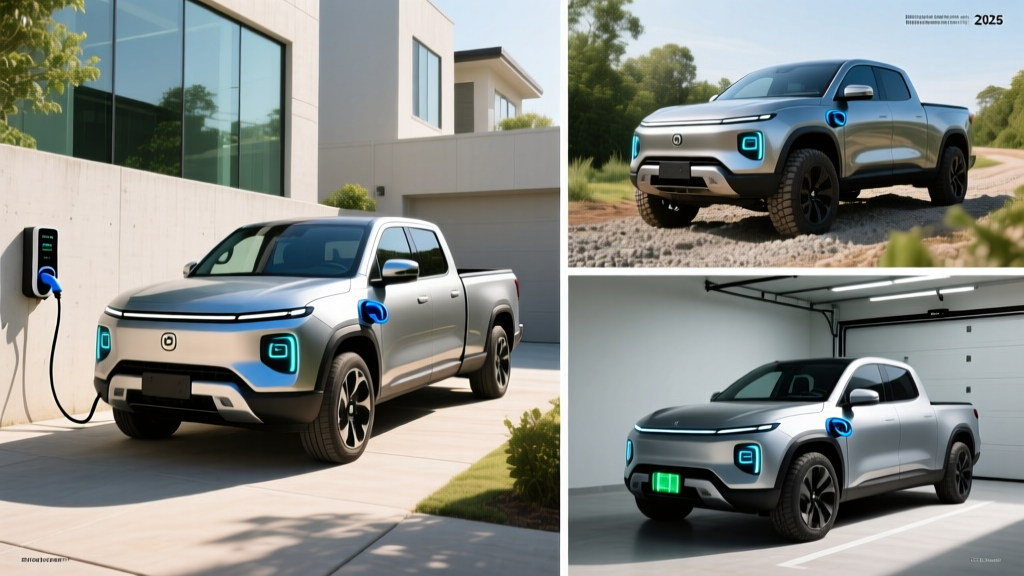
The short answer: The compact electric truck segment in 2026 is led by the Ford Maverick EV (EPA est. 270 mi, ~$38,000 base), Hyundai Santa Cruz EV (EPA est. 255 mi, ~$40,000), and the upcoming Rivian R2T (announced, est. 300+ mi, ~$45,000). Expect real-world highway range of 200–230 miles, home Level 2 charging in 7–9 hours, and annual fuel savings of $800–$1,400 versus a gas compact truck depending on your electricity rate and mileage. Federal tax credit eligibility (up to $7,500 under IRS §30D) varies by battery sourcing, MSRP caps, and buyer income — verify before purchasing.
The Compact Electric Truck Landscape in 2026
After years of full-size electric pickups dominating headlines — the F-150 Lightning, Rivian R1T, Silverado EV — the market has finally turned toward trucks people actually park in their garages. Compact electric trucks borrow the unibody, car-based architecture of crossovers, add a short bed (typically 4.5 feet), and target buyers who need occasional hauling without full-size bulk or fuel bills.
As of early 2026, two production models are available for purchase, with a third expected by late 2026:
| Specification | Ford Maverick EV | Hyundai Santa Cruz EV | Rivian R2T (Announced) |
|---|---|---|---|
| EPA Range (est.) | 270 mi | 255 mi | ~310 mi (preliminary) |
| Battery Capacity | ~75 kWh usable, NMC | ~72 kWh usable, NMC | ~85 kWh (est.), LFP/NMC TBD |
| Peak DC Fast Charge | 150 kW | 175 kW | ~200 kW (est.) |
| 10–80% DC Charge Time | ~32 min | ~28 min | ~25 min (est.) |
| Level 2 (240V) Rate | 10.5 kW | 10.9 kW | 11.5 kW (est.) |
| Horsepower | 238 hp (FWD) / 290 hp (AWD) | 265 hp (AWD) | ~350 hp (AWD, est.) |
| 0–60 mph | 7.8s (FWD) / 6.2s (AWD) | 6.8s (AWD) | ~5.5s (est.) |
| Payload / Towing | 1,200 lb / 2,000 lb | 1,100 lb / 2,500 lb | ~1,400 lb / 5,000 lb (est.) |
| Base MSRP | $37,995 | $39,990 | ~$45,000 (est.) |
| Battery Warranty | 8 yr / 100,000 mi | 10 yr / 100,000 mi | 8 yr / 120,000 mi (est.) |
Sources: fueleconomy.gov, Ford and Hyundai manufacturer spec sheets. Rivian R2T specs are preliminary and subject to change before production.
Real-World Range: What the EPA Sticker Doesn't Tell You
EPA range estimates are tested under controlled conditions that don't fully capture highway driving, cold weather, or loaded beds. Here's what to actually expect from a compact electric truck:
Ford Maverick EV (EPA 270 mi): Expect 230–245 mi in mixed suburban/highway driving at moderate temperatures. Sustained 75 mph highway driving drops this to roughly 200–215 mi. In freezing weather (below 32°F), plan for 175–200 mi without preconditioning, or 200–220 mi with cabin and battery preconditioning enabled.
Hyundai Santa Cruz EV (EPA 255 mi): Real-world mixed driving yields 215–235 mi. Highway-only at 75 mph: ~190–205 mi. Cold weather: 165–195 mi depending on preconditioning.
Why the gap? Three physics-driven factors:
- Aerodynamic drag increases with the square of speed. At 75 mph, a truck-shaped vehicle uses roughly 30% more energy per mile than at 55 mph.
- Cold temperatures increase battery internal resistance and require cabin heating. Without a heat pump (standard on Santa Cruz EV, optional on Maverick EV), resistive heating can consume 3–5 kW continuously — the equivalent of losing 10–15 miles of range per hour of operation.
- Payload and towing add mass and rolling resistance. A 1,000-lb payload typically reduces range by 8–12%. Towing a 2,000-lb trailer can cut range by 25–35%.
Charging at Home and on the Road
Compact electric trucks charge on the same infrastructure as every other EV, but their battery sizes (72–85 kWh) mean charge sessions take longer than a compact car's.
| Charging Level | Power (kW) | Typical Miles Added per Hour | Full Charge Time (75 kWh) | Where |
|---|---|---|---|---|
| Level 1 (120V outlet) | 1.2–1.4 kW | 3–5 mi/hr | ~55–65 hours | Standard household outlet |
| Level 2 (240V, 32A) | 7.7 kW | 22–28 mi/hr | ~10 hours | Home wall charger, public L2 |
| Level 2 (240V, 48A) | 11.5 kW | 33–40 mi/hr | ~7 hours | Home hardwired, some public L2 |
| DC Fast Charge | 150–200 kW (peak) | ~450–600 mi/hr (peak) | 10–80% in 25–32 min | Public DCFC stations |
The charge curve reality: That "150 kW peak" rating doesn't mean 150 kW sustained. A Maverick EV hitting a DC fast charger at 10% SoC may pull 145–150 kW initially, but by 50% SoC it tapers to ~100 kW, and above 80% it drops to 40–50 kW to protect battery longevity. This is why the 10–80% time (32 min for Maverick) is the meaningful metric — not the peak number.
Connector note: Both the Maverick EV and Santa Cruz EV use the NACS (North American Charging Standard) connector as of 2025, giving them native access to Tesla Supercharger stations as well as Electrify America, EVgo, and other networks that have deployed NACS cables. CHAdeMO is effectively dead for new vehicles.
Home Charging Installation Costs
Most compact electric truck owners will want a Level 2 home charger. Here's what that actually costs:
| Component | Typical Cost Range | Notes |
|---|---|---|
| Level 2 charger (hardware) | $300–$700 | ChargePoint Home Flex, Wallbox Pulsar Plus, Tesla Wall Connector |
| Electrician (240V/50A circuit) | $500–$2,000 | Depends on panel proximity; longer runs cost more |
| Permit & inspection | $50–$300 | Varies by municipality |
| Electrical panel upgrade (if needed) | $1,500–$3,500 | Required if your panel is 100A or near capacity |
| Total (typical install) | $850–$3,000 | Without panel upgrade |
| Total (with panel upgrade) | $2,350–$6,500 | If 200A service upgrade is needed |
Always get a load calculation from a licensed electrician before assuming your panel can handle a 48A continuous draw. A 200-amp panel with existing heavy loads (electric range, dryer, HVAC) may need an upgrade.
Cost of Ownership: Electric Truck vs. Gas Truck
The headline advantage of a compact electric truck is operating cost. Let's compare the Maverick EV against the gas-powered Maverick (2.0L EcoBoost, AWD) over five years and 75,000 miles.
| Cost Category | Maverick EV (AWD) | Maverick Gas (2.0L EcoBoost AWD) | 5-Year Difference |
|---|---|---|---|
| Purchase Price (base MSRP) | $41,495 | $29,995 | +$11,500 (EV) |
| Federal Tax Credit (§30D) | –$3,750 to –$7,500* | $0 | –$3,750 to –$7,500 (EV) |
| Net Purchase (after credit) | $33,995–$37,745 | $29,995 | +$4,000 to +$7,750 (EV) |
| Fuel/Energy (75k mi) | $2,475** | $7,500*** | –$5,025 (EV saves) |
| Maintenance (5 yr) | $1,200 | $3,200 | –$2,000 (EV saves) |
| Insurance (5 yr avg.) | $8,500 | $7,000 | +$1,500 (EV) |
| Depreciation (est. 5 yr) | $16,000 | $12,000 | +$4,000 (EV) |
| Total 5-Year Cost | ~$62,170–$65,920 | ~$59,695 | +$2,475 to +$6,225 (EV) |
*§30D credit depends on battery sourcing, MSRP caps ($80,000 for trucks), and buyer income limits ($300k joint / $150k single). Verify at irs.gov. Figures assume point-of-sale transfer.
**Based on $0.14/kWh national average, 3.0 mi/kWh efficiency.
***Based on $3.50/gal, 25 MPG combined EPA for gas Maverick AWD.
The EV breaks even or costs slightly more over five years when you factor in higher depreciation and insurance. But the gap narrows significantly if you qualify for the full $7,500 credit, drive more than 15,000 miles annually, or live in a state with low electricity rates (under $0.12/kWh). Beyond five years, the EV's lower maintenance costs (no oil changes, no transmission fluid, fewer brake replacements due to regenerative braking) widen the savings.
Tax Credit Eligibility: What You Actually Qualify For
The federal §30D clean vehicle credit is not a guaranteed $7,500 for every buyer. Under current 2026 IRS rules, eligibility depends on a stack of requirements:
- MSRP cap: Truck MSRP must not exceed $80,000 (all compact electric trucks clear this easily).
- Buyer income limits: Modified adjusted gross income must be ≤$300,000 (joint filers), ≤$225,000 (head of household), or ≤$150,000 (single). Based on the tax year of delivery or the prior year — whichever is lower.
- Battery component sourcing: At least 60% of battery component value must be manufactured or assembled in North America (phases up annually). This is where credits get reduced — some trims may qualify for only $3,750 if critical minerals sourcing falls short.
- Critical minerals: A percentage of critical minerals must be sourced from the US or a free-trade-agreement country. This requirement tightens each year.
- FEOC exclusion: Vehicles with battery components from a "foreign entity of concern" (primarily Chinese supply chain) are disqualified entirely.
- Point-of-sale transfer: As of 2024, you can transfer the credit to the dealer at purchase, reducing your out-of-pocket cost immediately rather than waiting for a tax refund.
Check the official fueleconomy.gov tax credit page for the latest per-model eligibility, and consult a tax professional for your specific situation.
Common Misconceptions About Compact Electric Trucks
| Myth | Fact |
|---|---|
| "Electric trucks can't tow anything." | Compact EVs tow 2,000–2,500 lb — enough for a small utility trailer, jet ski, or light camper. That matches many gas compact trucks. Just expect 25–35% range reduction while towing. |
| "The battery will need replacing in 5 years." | Modern NMC batteries degrade roughly 1.5–2.5% per year under normal use. At year 8, expect 85–90% of original capacity. All three trucks carry 8–10 year / 100,000+ mile battery warranties with a 70% capacity retention threshold. |
| "You can't charge in the rain." | EV charging connectors and ports are weather-sealed to IP67 or equivalent. Charging in rain, snow, or at a car wash is safe and routine. |
| "I need a special electrical service." | A standard 200-amp residential panel usually supports a 48A Level 2 charger. Only older homes with 100A service or heavy existing loads need an upgrade. A licensed electrician's load calculation is the definitive answer. |
| "Electric trucks are worse in cold weather." | Range drops 15–30% in freezing temps — real and worth planning for. But EVs start instantly in cold (no cranking a frozen engine), and preconditioning while plugged in preserves range. A heat pump (standard or optional depending on model) recovers much of the heating loss. |
Decision Framework: Is a Compact Electric Truck Right for You?
Choose a compact electric truck if:
- You have access to Level 2 home charging (garage, driveway, or workplace) and drive under 200 miles on most days.
- Your typical hauling needs stay under 1,200 lb payload and 2,500 lb towing — weekend projects, not commercial contracting.
- You want to eliminate gas station visits and reduce per-mile fuel costs by 60–70%.
- You qualify for at least a partial federal (and possibly state) tax credit, narrowing the upfront price gap.
- You value instant torque, quiet operation, and the ability to "refuel" overnight at home.
Stick with a gas or hybrid compact truck if:
- You regularly drive 250+ miles in a single day without reliable DC fast charging along your route.
- You tow over 3,000 lb frequently — the range penalty on an EV becomes operationally frustrating.
- You live in an apartment or street-park with zero access to home or workplace charging.
- You live in an extremely cold climate (regular sub-zero temps) and cannot precondition while plugged in.
- Your budget is strictly under $30,000 — the gas Maverick starts nearly $8,000 lower before credits.
Consider a PHEV alternative if:
- You want electric-only commuting (30–40 mi) but gas flexibility for long hauls and heavy towing. As of 2026, no compact PHEV truck exists in the US market, but midsize options like the Toyota Tacoma PHEV (announced) may fill this gap.
What First-Time EV Truck Buyers Should Know
If this is your first electric vehicle, a few ownership realities differ from the gas-truck world:
One-pedal driving changes your habits. Regenerative braking on both the Maverick EV and Santa Cruz EV is strong enough to bring the truck to a stop without touching the brake pedal in most city driving. Expect a week of adjustment — then you'll prefer it.
Tire wear is higher. EVs are heavier and deliver instant torque, which accelerates tire wear by roughly 15–25% compared to equivalent gas vehicles. Budget for tire replacement at 30,000–40,000 miles rather than 50,000+. Consider EV-rated tires with low rolling resistance.
Insurance costs more. EV insurance premiums run 15–25% higher than gas equivalents due to higher repair costs and battery replacement risk. Shop quotes from EV-friendly insurers (Geico, Progressive, and Tesla Insurance tend to be competitive) before purchasing.
Preconditioning is your cold-weather secret weapon. Set your truck to warm the battery and cabin while it's still plugged in. This uses grid electricity rather than battery energy, so you leave home with a full charge and a warm truck — and the battery charges faster when you hit a DCFC because it's already at optimal temperature.
Public charging is improving but imperfect. Tesla's Supercharger network (now open to NACS-equipped non-Teslas) is the most reliable option. Electrify America and EVgo have expanded but still suffer occasional broken stalls. Apps like PlugShare and A Better Routeplanner are essential for trip planning.
Frequently Asked Questions
Can I charge a compact electric truck from a regular 120V outlet?
Yes, but slowly. Level 1 charging adds roughly 3–5 miles of range per hour. For a 75 kWh battery, a full charge from empty takes 55–65 hours. This works if you drive under 30 miles daily and can plug in overnight, but most owners install a 240V Level 2 charger for practical daily use.
How long will the battery last before needing replacement?
Based on degradation data from similar NMC packs, expect 85–90% capacity at 8 years and 100,000 miles. Full battery replacement costs $10,000–$16,000 out of warranty, but most packs last 200,000+ miles before falling below 70% capacity. The 8–10 year warranty covers premature degradation.
Does a compact electric truck qualify for the $7,500 tax credit?
It depends on the specific model, trim, your income, and current battery-sourcing compliance. The Maverick EV and Santa Cruz EV have qualified for partial or full credits at various points — check the latest at fueleconomy.gov and confirm with your dealer at the time of purchase.
Can I use a compact electric truck for worksite duties?
For light-duty tasks — carrying tools, lumber, equipment under 1,200 lb — yes. Both trucks offer a standard 120V bed outlet (the Maverick EV provides up to 2 kW V2L, enough to power a circular saw or job-site radio). For heavy commercial use with daily towing or 300+ mile routes, a full-size EV truck or a diesel remains more practical.
What happens if I run out of charge on the road?
The same thing as running out of gas: you call roadside assistance. Most EV roadside services (including those bundled with new-vehicle warranties) will either tow you to the nearest charger or bring a mobile charging unit. The navigation systems in both the Maverick EV and Santa Cruz EV include charge-point routing that warns you well before range becomes critical.