The Quick Answer
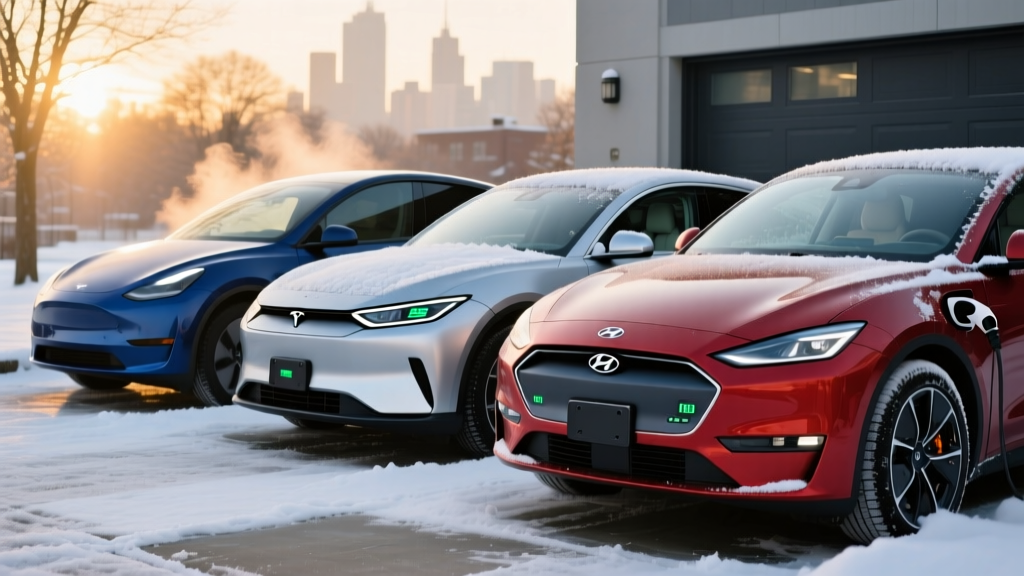
Cold weather electric cars typically lose 15% to 35% of their EPA-rated range at temperatures below 20°F (–7°C), with the worst losses hitting 40%+ in sub-zero conditions when cabin heat runs constantly. EVs equipped with a heat pump (like the Tesla Model Y, Hyundai Ioniq 5, and BMW iX) recover roughly 10–15 percentage points of that loss compared to resistive-heater EVs. If you live where winters regularly drop below freezing, plan for ~70% of your EPA range in daily winter driving and prioritize models with heat pumps, preconditioning, and battery thermal management.
Why Cold Weather Hits EVs Harder Than Gas Cars
Internal combustion engines waste enormous energy as heat — which is actually useful in winter because cabin warmth is essentially free. EVs convert ~85–90% of battery energy to motion, meaning there's very little waste heat to tap for the cabin. Running a resistive heater can draw 3–6 kW of continuous power from the traction battery, the equivalent of adding a second household appliance load while you drive.
But the physics go deeper than cabin heating:
- Lithium-ion chemistry slows down: Cold electrolyte increases internal resistance, reducing both discharge power and charge acceptance. Your battery literally cannot deliver or receive energy as quickly.
- Regenerative braking weakens: A cold battery can't absorb regen current at full rate, so one-pedal driving feels muted until the pack warms up — sometimes 15–30 minutes into a drive.
- Charging speed drops: DC fast charging a cold-soaked battery can cut peak kW rates in half. This is why preconditioning (warming the pack while navigating to a charger) matters enormously.
- Accessory load climbs: Heated seats, steering wheel, defrosters, and headlamps in dark winter months add 0.5–1.5 kW of continuous draw.
Real-World Range Loss: What the Data Shows
The EPA range sticker assumes a mix of city and highway driving at moderate temperatures (roughly 68–77°F). Real winter conditions tell a different story. Here's what controlled testing and owner data reveal:
| Condition | Typical Range Retention | Example: 300-mi EPA EV |
|---|---|---|
| Mild cold (32–45°F), city driving | 85–95% | ~255–285 mi |
| Cold (15–32°F), mixed driving | 70–85% | ~210–255 mi |
| Severe cold (0–15°F), highway + heat | 60–75% | ~180–225 mi |
| Sub-zero (below 0°F), short trips | 55–70% | ~165–210 mi |
Source data from Recurrent Auto's fleet analysis of over 7,000 EVs shows that range loss varies significantly by model. Vehicles with heat pumps consistently outperform those using PTC (positive temperature coefficient) resistive heaters. The Tesla Model Y with its octovalve heat pump system retains roughly 85% of range at 20°F, while older EVs without heat pumps (like early Nissan Leaf or base Bolt models) can drop to 60–65% in the same conditions.
Heat Pump vs. Resistive Heater: The Critical Difference
A heat pump works like a refrigerator in reverse — it moves heat rather than creating it. At 30°F, a heat pump delivers 2–4 kW of cabin heat while consuming only ~0.5–1.5 kW from the battery. A resistive heater delivering the same warmth draws 3–5 kW directly.
| Heating System | Energy Draw (at 25°F) | Range Impact (per hour of driving) | Models with It (2026) |
|---|---|---|---|
| Heat pump | ~1.0–1.5 kW | ~3–5% per hour | Tesla Model Y/3, Ioniq 5/6, BMW iX/i4, VW ID.4 (2024+), Rivian R1T/R1S |
| Resistive (PTC) heater | ~3.5–5.0 kW | ~8–14% per hour | Older Bolt, early Leaf, some base-trim EVs |
The takeaway: if you're shopping for cold weather electric cars in 2026, a heat pump should be non-negotiable. Most new EVs above $35,000 now include one, but always verify on the spec sheet — some manufacturers still use resistive heating on base trims.
Winter Charging: What Changes and How to Adapt
Cold batteries charge slower. This isn't a defect — it's chemistry. Lithium plating can occur if you force high current into a cold cell, so the battery management system (BMS) deliberately limits charge rate to protect the pack.
Here's what to expect at a DC fast charger in winter:
- Cold-soaked battery (parked overnight below 20°F): Peak charge rate may start at 40–60% of rated maximum. A vehicle rated for 250 kW peak might initially accept only 100–150 kW.
- Preconditioned battery: If you navigated to the charger using the vehicle's built-in nav (triggering thermal preconditioning), you'll typically hit 80–95% of rated peak rate within 3–5 minutes.
- 10–80% charge time: Expect 25–40 minutes in severe cold vs. 18–25 minutes in moderate temps for a typical 80 kWh pack at a 150+ kW station.
Pro tip: Always use your EV's native navigation to route to a DC fast charger, even if you know the way. Most modern EVs (Tesla, Hyundai/Kia, BMW, Ford, Rivian) begin warming the battery 10–20 minutes before arrival, dramatically improving charge speed. This single habit can shave 10–15 minutes off a winter fast-charge stop.
EV vs. Gas in Winter: The Honest Comparison
| Factor | EV (with heat pump) | Gas Car (AWD sedan) |
|---|---|---|
| Range loss at 15°F | 15–30% (255 → ~190–215 mi on 255-mi EPA) | 10–15% (400 → ~340–360 mi) |
| Cabin heat energy cost | ~1–1.5 kW (heat pump) / ~4 kW (resistive) | "Free" (waste engine heat) |
| Cold-start reliability | Excellent (no engine cranking) | Good, but 12V battery issues common |
| Fueling/charging in cold | Slower DC charging; home L2 unaffected | Gas station visit (5 min, any temp) |
| Fuel cost per winter mile | ~$0.04–0.06/mi (home L2 at $0.13/kWh) | ~$0.12–0.16/mi (25 MPG, $3.25/gal) |
| Maintenance (annual winter) | ~$50 (cabin filter, wipers, washer fluid) | ~$150–300 (oil, filter, coolant check) |
| Regen braking in cold | Reduced until pack warms (~15–30 min) | N/A (friction brakes always full) |
Gas cars lose some efficiency in cold too — shorter trip warm-ups, winter fuel blends, and increased idle time for defrosting reduce real-world MPG by 10–20% according to fueleconomy.gov. But because gas cars start with a larger range buffer (400+ miles), the absolute loss feels less dramatic.
Cost Breakdown: Winter EV Ownership
Here's what five years of cold-climate EV ownership actually costs versus a comparable gas AWD crossover, assuming 12,000 miles/year with 5,000 in winter months:
| Cost Category | EV (e.g., Ioniq 5 SEL, $47,500 MSRP) | Gas AWD Crossover (e.g., Toyota RAV4 AWD, $33,500 MSRP) |
|---|---|---|
| Purchase price (after §30D credit) | ~$40,000 (if eligible for full $7,500) | $33,500 |
| Home Level 2 charger install | $800–$2,000 (one-time) | $0 |
| Energy/fuel (5 years, 60,000 mi) | ~$2,800–$3,600 (home + public DC mix) | ~$8,100–$9,600 |
| Maintenance (5 years) | ~$600–$1,000 | ~$2,500–$3,500 |
| Insurance (5 years) | ~$9,000–$11,500 (typically 15–25% higher) | ~$7,200–$9,000 |
| Estimated depreciation (5 years) | ~$18,000–$22,000 | ~$14,000–$17,000 |
| Total 5-year cost | ~$71,200–$80,100 | ~$65,300–$72,600 |
The EV's fuel and maintenance savings ($5,000–$7,000 over 5 years) partially offset the higher purchase price, insurance, and depreciation. For buyers who qualify for the full §30D federal tax credit ($7,500 for eligible vehicles and income levels), the total cost gap narrows to near parity. Note: §30D eligibility depends on MSRP caps ($55,000 for cars, $80,000 for SUVs/trucks), buyer income limits ($150K single / $300K joint), and battery critical-mineral sourcing requirements — always verify current-year rules with a tax professional.
Common Cold-Weather EV Myths — Busted
| Myth | Fact |
|---|---|
| "EVs can't handle cold climates" | Norway — where EVs are over 80% of new car sales — has harsher winters than most of the US. Properly equipped EVs work fine in cold; you just plan for reduced range. |
| "The battery will freeze solid" | Lithium-ion electrolyte freezes around –40°F to –76°F. Your BMS actively protects the pack. Even in Minnesota or Alaska, traction batteries don't freeze in normal use. |
| "You can't charge in the cold" | You can always charge. Charge speed is reduced on a cold-soaked battery, but preconditioning and thermal management mitigate this significantly. |
| "Cold permanently damages the battery" | Cold temporarily reduces capacity; it doesn't accelerate long-term degradation. In fact, cold storage is easier on lithium-ion chemistry than hot storage. Heat is the real enemy of battery longevity. |
| "I need a 400-mile EV for winter" | If you charge at home nightly, a 250–300 mi EPA EV with a heat pump handles most winter commutes easily. You only need the range buffer for road trips. |
Decision Framework: Should You Buy an EV for Cold Climates?
Choose a cold-weather EV if:
- You have access to home Level 2 charging (garage or driveway) — this eliminates 90% of winter charging friction
- Your typical daily round-trip is under 80 miles (covers 85%+ of US commutes even with 30% winter range loss)
- You prioritize lower per-mile fuel cost and reduced maintenance
- You want remote preconditioning (warm cabin + defrosted windows from your phone, no idling a gas engine)
- You choose a model with a heat pump, battery preconditioning, and at least 270 mi EPA range
Consider a PHEV or hold off if:
- You lack any home charging access (apartment, street parking only) — public DC charging in winter is slower and less convenient
- Your daily commute exceeds 120 miles round-trip in sub-zero conditions
- You regularly tow in winter (towing + cold can cut range by 50%+)
- You take frequent 400+ mile winter road trips through areas with sparse charging infrastructure (rural Montana, northern Dakotas, parts of Alaska)
Best Cold Weather Electric Cars for 2026
Based on heat pump availability, thermal management sophistication, real-world winter range retention data, and charging infrastructure compatibility, these are the strongest winter EV picks:
- Tesla Model Y Long Range AWD: 315 mi EPA, ~85% retention at 20°F per Recurrent data. Octovalve heat pump is industry-leading. $47,990 MSRP (eligible for $7,500 §30D credit for qualifying buyers). Supercharger network reliability is unmatched in rural cold-weather corridors.
- Hyundai Ioniq 5 AWD: 290 mi EPA, heat pump standard on SEL and above. Preconditioning integrates with navigation for optimized DC charging. 800V architecture means faster charging even in cold (~18 min 10–80% when preconditioned). ~$47,500 MSRP.
- BMW iX xDrive50: 324 mi EPA, excellent thermal management and standard heat pump. Premium cabin insulation keeps heat draw low. Starts ~$87,250 — above §30D MSRP cap, so no federal credit.
- Rivian R1T Dual-Motor: 352 mi EPA (Max Pack), heat pump standard, robust battery thermal management. Ideal for cold-climate truck buyers who tow (though towing in cold still cuts range dramatically). ~$79,900 MSRP (within §30D truck cap).
- VW ID.4 AWD Pro S (2024+ refresh): 291 mi EPA, heat pump now standard (was omitted on early models — a key fix). Most affordable AWD EV with heat pump at ~$48,000 MSRP. §30D eligible.
FAQ: Cold Weather Electric Cars
Do EVs lose range permanently from cold weather driving?
No. Winter range loss is fully reversible — your capacity returns when temperatures rise. Long-term battery degradation is driven primarily by heat exposure, high state-of-charge storage, and total cycle count, not cold-weather use.
Should I charge my EV to 100% in winter?
If your EV uses an NMC/NCA battery, daily charging to 80% is still ideal for longevity. But for winter road trips or days when you need maximum range, charging to 100% right before departure is fine — just don't let it sit at 100% for extended periods. LFP batteries (found in some Tesla Model 3/Y RWD and standard-range vehicles) tolerate regular 100% charges better and are actually well-suited to winter top-ups.
How much does cabin heating cost in an EV?
At $0.13/kWh (US average residential rate), running a heat pump at 1.5 kW for a 30-minute commute costs about $0.10. A resistive heater at 4 kW for the same trip costs ~$0.26. Over a 5-month winter with daily commuting, total cabin heat energy cost is roughly $30–$80 depending on your heating system and climate severity.
Do I need winter tires on an EV?
Yes, if you regularly drive in temperatures below 45°F. EVs are heavy (4,500–6,500 lbs typical) and deliver instant torque, which demands good traction. Winter tires improve braking, cornering, and acceleration grip significantly. The range penalty from winter tires' higher rolling resistance is typically 3–5% — a small trade for safety. Brands like Michelin X-Ice and Nokian Hakkapeliitta offer EV-optimized winter tires with low noise and rolling resistance.
Can I precondition my EV while it's plugged in?
Absolutely — and you should. Preconditioning while plugged in draws cabin and battery heating energy from the grid rather than the battery, meaning you start your drive with a full charge and a warm pack. Most EVs allow scheduled preconditioning via their app, so your car is ready every morning without manual intervention.