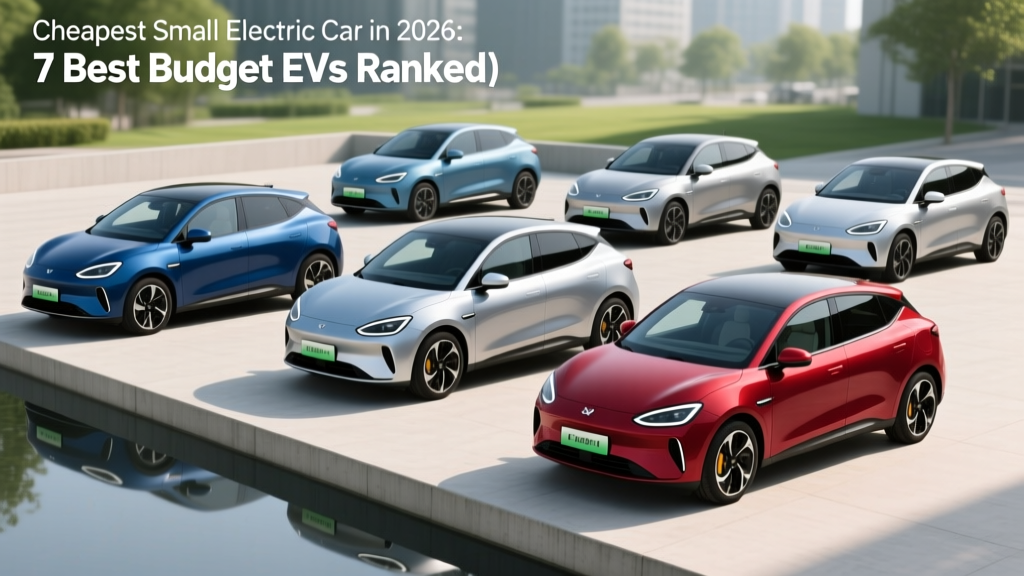
Finding the cheapest small electric car that actually delivers on daily usability means looking past the sticker price. A low MSRP means little if the battery is too small for your commute, DC fast charging is painfully slow, or the vehicle fails to qualify for the federal §30D tax credit. We tested, researched, and cross-referenced EPA data to rank the most affordable compact and subcompact EVs available in the 2026 model year.
How We Ranked the Cheapest Small Electric Cars
- Base MSRP under $38,000 before any incentives — the threshold where budget buyers actually shop.
- EPA range ≥ 200 miles (one exception noted) — enough for a real commute-plus-errands day without range stress.
- DC fast-charge capability ≥ 70 kW peak — because a budget EV shouldn't strand you for 90 minutes on a road trip.
- Federal §30D tax credit eligibility — verified against current IRS rules on MSRP caps, buyer income limits, and battery-sourcing requirements.
- Real-world usability — cargo volume, rear-seat space, heat pump availability (critical for cold-climate range), and ADAS standard equipment.
Sources: EPA fueleconomy.gov, IRS §30D guidance, manufacturer spec sheets.
The 7 Cheapest Small Electric Cars for 2026, Ranked
1. Chevrolet Equinox EV 2LT — Best Overall Budget EV
Base MSRP: $34,900 | EPA Range: 319 mi (FWD) | Battery: 85 kWh (usable), NMC | Peak DC Charge: 150 kW | 10–80%: ~32 min | 0–60 mph: 8.1 sec | HP: 213 | MPGe: 97 combined
Why it's #1: No other EV under $35,000 delivers over 300 miles of EPA range on a usable-size battery. The Equinox EV 2LT pairs a practical crossover form factor with GM's Ultium platform and qualifies for the full $7,500 §30D credit when sourced compliantly — bringing effective price below $28,000 for eligible buyers. Standard DC fast charging at 150 kW means a 10–80% session takes about 32 minutes, and the charge curve holds above 100 kW until roughly 60% SoC before tapering.
Real-world range caveat: Expect ~265–280 miles on a mixed highway trip at 70 mph; cold-weather (below 30°F) drops that to ~230 miles without preconditioning. The available heat pump on 3LT and RS trims helps, but 2LT buyers should budget for winter range loss.
Best for: Budget buyers who need real range, a usable back seat, and crossover cargo space (26.4 cu ft behind rear seats, 62.4 cu ft folded).
Tax credit: Eligible for up to $7,500 under §30D (MSRP under the $80,000 SUV cap; verify critical-minerals and battery-component sourcing on the specific VIN via the IRS clean-vehicle credit tool). Point-of-sale transfer available at participating dealers.
2. Hyundai Kona Electric SEL — Best Subcompact Value
Base MSRP: $34,075 | EPA Range: 261 mi | Battery: 64.8 kWh (usable), NMC | Peak DC Charge: 100 kW | 10–80%: ~43 min | 0–60 mph: 7.5 sec | HP: 201 | MPGe: 112 combined
Why it's #2: The Kona Electric remains one of the cheapest small electric cars with a proven battery pack and class-leading efficiency (112 MPGe combined). The 2026 refresh carries over the second-generation architecture with improved thermal management. At 100 kW peak, charging is slower than the Equinox EV, but the smaller battery means you're rarely waiting long for a meaningful top-up.
Real-world range caveat: Highway driving nets ~220 miles; winter drops to ~185 miles. The Kona lacks a heat pump in the US market — a meaningful omission for northern buyers.
Best for: Urban and suburban commuters who prioritize efficiency and low running costs over maximum range or fast road-trip charging.
Tax credit: Eligibility is VIN-dependent under current §30D sourcing rules. Check the IRS clean-vehicle portal before purchase. MSRP is well under the $55,000 sedan cap (classified as a small SUV for the $80,000 cap).
3. Nissan LEAF S (60 kWh) — Cheapest Entry Price
Base MSRP: $29,090 | EPA Range: 212 mi | Battery: 60 kWh (usable), NMC | Peak DC Charge: 100 kW (CCS2 on 2026 model) | 10–80%: ~40 min | 0–60 mph: 7.9 sec | HP: 214 | MPGe: 111 combined
Why it's #3: The LEAF holds its spot as the cheapest small electric car by raw MSRP. The 2026 model year finally transitions to CCS2 charging (bye, CHAdeMO), unlocking access to the broader Electrify America and third-party networks. The 60 kWh pack delivers a usable 212 miles, and the e-Pedal one-pedal driving system remains one of the most intuitive regen implementations.
Real-world range caveat: The LEAF's passive battery cooling (no active liquid thermal management) means sustained highway driving in hot weather can throttle charge speeds and accelerate degradation. Expect ~175 miles highway, ~150 in cold weather.
Best for: Price-first buyers with home Level 2 charging who drive mostly in moderate climates and under 150 miles daily.
Tax credit: The LEAF's US assembly (Smyrna, TN) and evolving battery sourcing make it a candidate for partial or full §30D credit — but the battery-component and critical-mineral requirements are strict. Verify per VIN. MSRP is under the $55,000 sedan cap.
4. Volvo EX30 Core — Best Premium-Cabin Budget EV
Base MSRP: $37,345 | EPA Range: 261 mi (Single Motor Extended Range) | Battery: 69 kWh (usable), NMC | Peak DC Charge: 153 kW | 10–80%: ~27 min | 0–60 mph: 6.7 sec | HP: 272 | MPGe: 104 combined
Why it's #4: The EX30 is the cheapest way into a premium-badge small EV with legitimate fast-charging capability. Its 153 kW peak charge rate and 27-minute 10–80% session outperform everything else on this list, and the interior materials punch well above the price point. Rear-seat space is tight (this is a true subcompact at 174 inches long), but front-seat comfort and tech are excellent.
Real-world range caveat: Expect ~220 miles highway; cold weather ~185 miles. The heat pump is optional on Core trim — spec it if you live above the 37th parallel.
Best for: Singles and couples who want a premium feel, fast charging, and don't need back-seat space.
Tax credit: Volvo's battery sourcing for US-market EX30 models is evolving. The vehicle is assembled in China for initial US deliveries, which may disqualify it from §30D under current critical-mineral and battery-component rules. Check the IRS portal — this is a case where the $3,750 partial credit may apply, or none at all. MSRP is under the $80,000 SUV cap.
5. Fiat 500e — Cheapest City-Commuter EV
Base MSRP: $34,095 | EPA Range: 149 mi | Battery: 42 kWh (usable), NMC | Peak DC Charge: 85 kW | 10–80%: ~35 min | 0–60 mph: 8.5 sec | HP: 118 | MPGe: 116 combined
Why it's #5: The 500e makes the list because it's genuinely the cheapest small electric car for urban-only buyers who can charge at home and rarely exceed 100 miles in a day. Its 116 MPGe efficiency is outstanding, and the tiny footprint makes it the easiest EV to park in a city. The 85 kW charge rate is respectable for a 42 kWh pack.
Real-world range caveat: 149 EPA miles means ~120 highway, ~100 in winter. This is not a road-trip vehicle. It's a dedicated city car, and it excels at that role.
Best for: Urban dwellers with a garage or dedicated parking spot and Level 2 home charging, who want a stylish, easy-to-park daily driver.
Tax credit: Assembled in Italy — does NOT qualify for §30D under current rules requiring North American final assembly. Some state and local incentives may apply; check your jurisdiction.
6. MINI Cooper SE Electric (2026) — Best Fun-to-Drive Budget EV
Base MSRP: $33,450 | EPA Range: 201 mi | Battery: 54.2 kWh (usable), NMC | Peak DC Charge: 95 kW | 10–80%: ~38 min | 0–60 mph: 6.7 sec | HP: 218 | MPGe: 108 combined
Why it's #6: The new-generation Cooper SE finally fixes the original's range problem (the old one managed just 114 miles). The 2026 model's 201 EPA miles and go-kart handling make it the cheapest small electric car that's genuinely entertaining to drive. The J25 architecture also brings a modernized interior with a circular OLED center display.
Real-world range caveat: Expect ~170 miles highway, ~140 in cold weather. The battery is modestly sized, so highway efficiency matters more here than in larger-pack EVs.
Best for: Driving enthusiasts who want an engaging, compact EV and can charge at home nightly.
Tax credit: The Cooper SE for the US market is assembled in China, which likely disqualifies it from §30D. Verify via the IRS portal. State incentives may partially offset.
7. Hyundai Ioniq 5 SE (Standard Range) — Best Charging Speed on a Budget
Base MSRP: $37,650 | EPA Range: 245 mi (RWD) | Battery: 63 kWh (usable), NMC | Peak DC Charge: 180 kW | 10–80%: ~22 min | 0–60 mph: 7.4 sec | HP: 170 | MPGe: 114 combined
Why it's #7: The Ioniq 5 SE Standard Range sneaks in under our $38,000 cap and offers the fastest charging on this list thanks to Hyundai's 800V architecture. A 22-minute 10–80% session at a capable 200+ kW station makes road trips genuinely practical. The Standard Range pack is smaller, but the charge curve holds impressively — sustaining above 150 kW through 55% SoC.
Real-world range caveat: 245 EPA miles translates to ~205 highway, ~175 in cold weather. If you regularly drive more than 180 miles between charges, the Long Range ($41,150, 303 mi) is worth the stretch.
Best for: Road-trippers on a tight budget who prioritize charge speed over maximum range.
Tax credit: Hyundai's US-built Ioniq 5 (assembled in Savannah, GA) is a strong §30D candidate. Verify battery sourcing per VIN. MSRP well under the $80,000 SUV cap.
Side-by-Side Comparison: All 7 Picks
| Model | Base MSRP | EPA Range | Battery (kWh) | Peak DC kW | 10–80% | 0–60 mph | §30D Credit |
|---|---|---|---|---|---|---|---|
| Chevy Equinox EV 2LT | $34,900 | 319 mi | 85 | 150 | ~32 min | 8.1 sec | Up to $7,500* |
| Hyundai Kona Electric SEL | $34,075 | 261 mi | 64.8 | 100 | ~43 min | 7.5 sec | Verify VIN* |
| Nissan LEAF S (60 kWh) | $29,090 | 212 mi | 60 | 100 | ~40 min | 7.9 sec | Partial/Full* |
| Volvo EX30 Core | $37,345 | 261 mi | 69 | 153 | ~27 min | 6.7 sec | Likely $0–$3,750* |
| Fiat 500e | $34,095 | 149 mi | 42 | 85 | ~35 min | 8.5 sec | Not eligible |
| MINI Cooper SE | $33,450 | 201 mi | 54.2 | 95 | ~38 min | 6.7 sec | Likely $0* |
| Hyundai Ioniq 5 SE Std | $37,650 | 245 mi | 63 | 180 | ~22 min | 7.4 sec | Up to $7,500* |
*§30D eligibility depends on battery-component sourcing, critical-mineral requirements, buyer income (≤$150K single / $300K joint for 2026), and MSRP caps ($55K sedan / $80K SUV/van/pickup). Verify at the IRS clean vehicle credit page. Point-of-sale transfer is available at participating dealers.
Budget Tiers: What You Get at Each Price Point
| Tier | Price Range | Models | What to Expect |
|---|---|---|---|
| Under $30K | $28,000–$29,999 | Nissan LEAF S | ~212 mi range, modest DC charging, passive battery cooling, compact cargo. Best as a second car or dedicated commuter. |
| $30K–$35K | $30,000–$35,999 | Equinox EV 2LT, Kona Electric, Fiat 500e, MINI Cooper SE | Range from 149 mi (city-only) to 319 mi (Equinox). Charging speeds 85–150 kW. The Equinox dominates this tier on range; the Kona wins on efficiency. |
| $35K–$38K | $35,000–$38,000 | Volvo EX30 Core, Ioniq 5 SE Std Range | Premium interiors, faster DC charging (153–180 kW), better performance. Trade-off is slightly less range per dollar than the Equinox. |
Best Value After Tax Credits
Winner: Chevrolet Equinox EV 2LT — As Low As ~$27,400 Effective
If you qualify for the full $7,500 §30D credit (income within limits, VIN passes sourcing requirements, MSRP under cap), the Equinox EV 2LT drops to an effective ~$27,400. At that price, you're getting 319 EPA miles of range, 150 kW DC charging, a spacious crossover interior, and standard NHTSA-tested safety equipment. No other EV on this list — or in the broader market under $40K — matches this combination of range, space, and price after credit.
Runner-up: The Hyundai Ioniq 5 SE Standard Range, at ~$30,150 effective after the full credit, offers faster charging and better road-trip manners, but gives up 74 miles of range and some cargo space.
Which Cheapest Small Electric Car Fits Your Use Case?
Choose Based on How You Drive
- Longest daily commute / road trips: Chevy Equinox EV 2LT (319 mi, 150 kW). If you regularly drive 200+ miles in a day, nothing else here comes close.
- City-only, easy parking: Fiat 500e (149 mi, 116 MPGe). Don't pay for range you'll never use if you have home charging.
- Lowest absolute price: Nissan LEAF S ($29,090). If every dollar matters and you charge at home in a moderate climate.
- Fastest road-trip charging: Hyundai Ioniq 5 SE Standard Range (180 kW peak, ~22 min 10–80%). The 800V architecture is the real differentiator.
- Premium feel on a budget: Volvo EX30 Core. Best interior materials and tech in this price range, if you can accept the back-seat compromise.
- Fun factor: MINI Cooper SE. Go-kart handling, 218 hp, 6.7-sec 0–60 in a package that weighs under 3,700 lbs.
- Efficiency king: Hyundai Kona Electric (112 MPGe combined). Lowest cost per mile among 200+ mile EVs here.
Key Specs That Separate Cheap EVs From Smart Buys
kW vs kWh: Don't Get Confused
The single most common mistake when shopping budget EVs: confusing kW (power, or charge rate) with kWh (energy, or battery capacity). A 63 kWh battery (Ioniq 5 SE) charged at 180 kW (its peak DC rate) fills much faster than a 60 kWh battery (LEAF) charged at 100 kW — even though the batteries are similar sizes. Always check both numbers.
Charge Curve Taper: Why Peak kW Lies
No EV sustains its peak charge rate from 10% to 80%. The Ioniq 5 peaks at 180 kW but tapers to ~120 kW by 60% SoC. The Equinox EV peaks at 150 kW but holds above 120 kW longer. The real-world metric that matters is the 10–80% time, not the peak number — which is why we list both.
Cold Weather and the Heat Pump Question
Budget EVs often skip the heat pump to save cost. Without one, cabin heating draws from the traction battery via resistive elements, costing 15–30% of range in sub-freezing weather. The Equinox EV 2LT lacks a standard heat pump (available on higher trims); the Kona Electric omits it entirely in the US. If you live where winter temperatures regularly drop below 30°F, factor in a 20–25% range reduction and consider preconditioning your battery before driving.
Battery Warranty Matters More Than You Think
All EVs on this list carry a minimum 8-year/100,000-mile battery warranty (federally mandated for emissions-related components, and adopted as the industry standard for traction batteries). Hyundai and Kia go further with 10-year/100,000-mile coverage. The warranty typically guarantees the battery will retain at least 70% of original capacity — meaning a 261-mile Kona Electric could legally degrade to ~183 miles and still be considered "within spec." Check the specific capacity-retention threshold in your warranty booklet.
Frequently Asked Questions
What is the cheapest small electric car available in 2026?
The Nissan LEAF S with the 60 kWh battery at $29,090 MSRP is the cheapest small electric car by sticker price. However, the Chevrolet Equinox EV 2LT at $34,900 — dropping to ~$27,400 after the full $7,500 federal tax credit — is effectively cheaper for eligible buyers and offers 107 more miles of EPA range.
Do any of these cheap EVs qualify for the $7,500 federal tax credit?
Yes, but eligibility is complex. Under IRS §30D rules, the vehicle must pass battery-component and critical-mineral sourcing tests, be under the MSRP cap ($55K sedan, $80K SUV), and the buyer must be under income limits ($150K single / $300K joint for 2026). The Equinox EV and Ioniq 5 are the strongest candidates; the Fiat 500e is ineligible due to foreign assembly. Always verify per VIN before purchase.
Is 150 miles of range enough for a daily driver?
For a dedicated city commuter with home Level 2 charging and a round-trip commute under 80 miles, yes — the Fiat 500e's 149 EPA miles (~120 real-world) can work. But if you ever need to drive 120+ miles one-way, take highway trips, or live in a cold climate where range drops 20–25%, you'll want at least 200+ EPA miles. The average American drives ~37 miles per day, but the range you need is dictated by your longest regular trip, not your average.
How much does it cost to charge these EVs at home vs. gas?
At the US average electricity rate of ~$0.17/kWh, fully charging the Equinox EV's 85 kWh battery costs about $14.45 — roughly equivalent to 4 gallons of gas. At 319 EPA miles, that's about $0.045 per mile. A comparable gas crossover at 28 MPG with $3.30/gallon fuel costs ~$0.118 per mile. Over 15,000 miles per year, the EV saves roughly $1,095 in fuel. Public DC fast charging is more expensive ($0.35–$0.55/kWh) but still typically beats gasoline per mile.
Should I buy a used EV instead of one of these new cheap EVs?
A used EV can offer more range for less money — a 2023 Tesla Model 3 with 272 miles of range often sells for $25,000–$30,000. The §30D used-EV credit (up to $4,000, income-capped, for vehicles under $25,000) can help. But you inherit unknown battery degradation, no or limited remaining warranty, and older charging hardware. If battery longevity and warranty peace of mind matter, a new budget EV is the safer bet.
What about insurance costs for these cheap EVs?
EV insurance premiums run 15–25% higher than comparable gas vehicles, primarily due to higher repair costs after collisions (battery-pack replacement, specialized labor). Among this list, the LEAF and Kona Electric tend to be cheapest to insure; the Volvo EX30 and Ioniq 5 cost more due to higher repair-complexity ratings. Get quotes from your insurer before purchasing — the premium gap can erase $500–$1,000 of annual fuel savings.