Why Lease an EV in 2026?
If you've searched "what is the cheapest EV to lease" and found conflicting answers, you're not alone. Lease pricing shifts monthly, manufacturer incentives rotate, and the federal tax credit landscape under IRS §30D continues to evolve. But leasing remains one of the smartest ways to drive an EV affordably — especially when automakers pass the $7,500 federal credit directly into the lease as a capitalized cost reduction, bypassing the income and MSRP caps that apply to purchases.
For 2026, several EVs can be leased for under $300/month with little or nothing down in many markets. The key is knowing which models deliver genuine value beyond the headline monthly payment — factoring in range, charging speed, real-world usability, and what happens at lease-end.
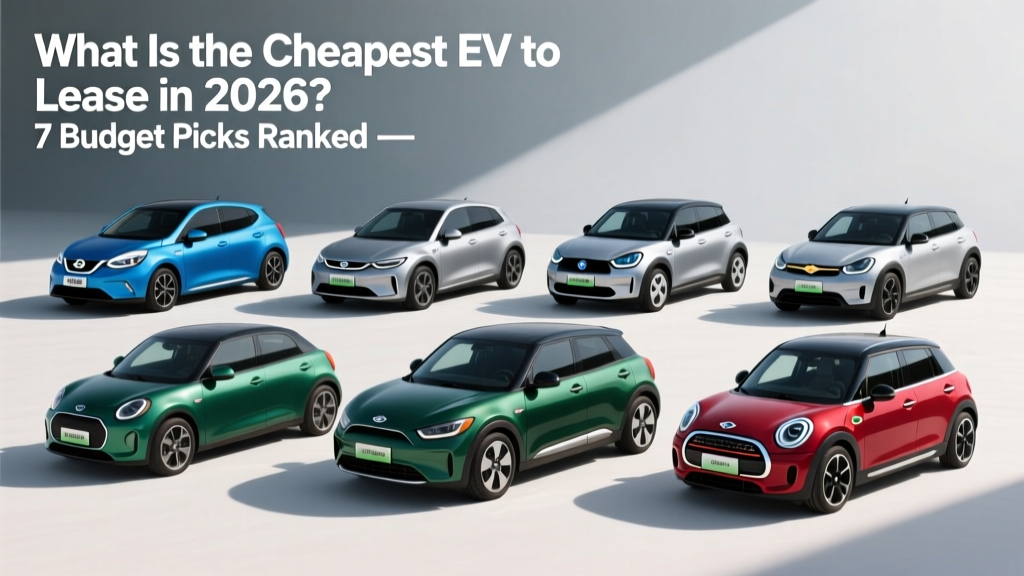
This guide ranks the seven cheapest EVs to lease right now, backed by manufacturer pricing, EPA data, and real-world ownership considerations. No discontinued models, no bait-and-switch teaser rates — just the actual numbers you need to decide.
How We Ranked the Cheapest EVs to Lease
Selection Criteria for Budget EV Lease Picks
- Base monthly lease cost: Advertised or widely available lease rates for the base trim, assuming 36-month term, 10,000 miles/year, with manufacturer incentives and available federal lease credit applied. We target sub-$350/month.
- EPA-estimated range: Minimum 200 miles to ensure daily usability without range anxiety. Real-world highway and cold-weather expectations noted for each pick.
- DC fast charging capability: Peak kW rate and 10-80% charge time — because a cheap EV that charges slowly costs you time and money on road trips.
- Practicality: Cargo volume, seating, and feature content at the base trim level.
- Federal lease credit applicability: Whether the $7,500 commercial clean vehicle credit (§45W) is being passed through to lessees, as allowed under current IRS guidance for leases structured as commercial financing.
Sources: fueleconomy.gov, manufacturer press sites, IRS §30D/§45W guidance.
The 7 Cheapest EVs to Lease in 2026, Ranked
#1 — Nissan LEAF S (2026)
Estimated Lease: $199–$239/month (36 mo, $2,999 due at signing with incentives)
Key Spec: 149 miles EPA range | 40 kWh battery (LMO chemistry) | 147 HP
DC Fast Charging: CHAdeMO connector, 50 kW peak — 10-80% in ~45 minutes
Why It Made the List: The LEAF remains the lowest barrier to EV ownership in America. Nissan aggressively subsidizes leases, and many dealers advertise sub-$200/month with the federal lease credit applied. The 2026 LEAF S includes ProPILOT Assist (SAE Level 2 driver-assist — not self-driving), an 8-inch touchscreen with wireless Apple CarPlay/Android Auto, and a heat pump for better cold-weather efficiency.
Best For: Urban commuters with home Level 2 charging who drive under 100 miles round-trip daily and want the absolute lowest monthly payment.
Real-World Range Caveat: EPA rates it at 149 miles, but highway driving at 70+ mph drops that to ~120 miles. In freezing temperatures, expect 100–110 miles. The 40 kWh battery has no active liquid cooling, which limits repeated fast-charging sessions.
Limitation: CHAdeMO connectors are increasingly rare on new public charging stations. The CCS and NACS ecosystems are where infrastructure investment is flowing. If you rely on public DC fast charging, this is a significant drawback.
#2 — Hyundai Kona Electric SE (2026)
Estimated Lease: $229–$279/month (36 mo, $2,499 due at signing)
Key Spec: 261 miles EPA range | 64.8 kWh battery (NMC) | 201 HP
DC Fast Charging: CCS1 connector, 100 kW peak — 10-80% in ~43 minutes
Why It Made the List: The redesigned Kona Electric delivers over 260 miles of EPA range at a lease price that undercuts many compact crossovers — gas or electric. The 2026 model gets a wider track, more rear-seat legroom (40.3 inches), and 25.8 cu ft of cargo space behind the rear seats. Hyundai's 10-year/100,000-mile powertrain and battery warranty adds long-term peace of mind.
Best For: Small families and commuters who need 250+ miles of range, crossover practicality, and strong warranty coverage at a budget price.
Real-World Range Caveat: Expect ~220–235 miles on the highway in moderate temps. Cold-weather range drops to roughly 190–200 miles without aggressive preconditioning. The Kona Electric's 100 kW charge ceiling means it won't win any charging-speed contests, but it's adequate for the price.
#3 — Chevrolet Equinox EV LT (2026)
Estimated Lease: $239–$299/month (36 mo, $1,999 due at signing with incentives)
Key Spec: 319 miles EPA range (LT FWD) | 85 kWh battery (NMC, Ultium platform) | 213 HP
DC Fast Charging: CCS1 (NACS adapter available), 150 kW peak — 10-80% in ~30 minutes
Why It Made the List: Over 300 miles of EPA range at this lease price is exceptional. GM's Ultium platform delivers a large, liquid-cooled battery with competitive charging speeds. The Equinox EV LT comes with a 17.7-inch infotainment screen, Super Cruise availability (SAE Level 2 hands-free on compatible highways — driver must remain attentive), and 26.4 cu ft of cargo volume.
Best For: Buyers who prioritize maximum range per dollar and want a mainstream compact SUV with modern tech and a proven fast-charging platform.
Real-World Range Caveat: Highway testing yields ~270–285 miles. In sub-freezing conditions, expect 230–250 miles. The 85 kWh usable capacity gives a meaningful buffer, and the liquid thermal management system handles repeated DC fast charging better than passively cooled packs.
Tax Credit Note: The Equinox EV is assembled in the US (Spring Hill, TN) and has historically qualified for the full $7,500 credit. Under lease structures, the commercial credit (§45W) is typically passed through by GM Financial. Confirm current eligibility with your dealer and review IRS guidance before signing.
#4 — Tesla Model 3 RWD (2026)
Estimated Lease: $279–$339/month (36 mo, $3,500 due at signing)
Key Spec: 272 miles EPA range | ~57.5 kWh usable battery (LFP) | 271 HP
DC Fast Charging: NACS (native Supercharger access), 170 kW peak — 10-80% in ~25 minutes
Why It Made the List: Tesla's lease pricing has become more competitive as the EV market has matured. The Model 3 RWD uses an LFP (lithium iron phosphate) battery, which tolerates daily 100% charging without the degradation concerns of NMC chemistry — a significant advantage for lessees who want to maximize range daily. Supercharger network access remains the gold standard for public charging reliability.
Best For: Tech-forward buyers who value the Supercharger ecosystem, over-the-air updates, and LFP battery longevity, and who are comfortable with Tesla's minimalist interior.
Real-World Range Caveat: Expect ~235–250 miles highway. LFP batteries are more resilient in cold weather than NMC but still lose 15–20% in freezing temps (~215–225 miles). The heat pump on the 2026 Model 3 helps mitigate cabin-heating energy draw.
LFP vs NMC Note: LFP offers longer cycle life and can be charged to 100% regularly without accelerated degradation. The trade-off is lower energy density (heavier pack for the same kWh) and slightly reduced range in extreme cold compared to NMC.
#5 — Hyundai Ioniq 6 SE Standard Range (2026)
Estimated Lease: $269–$329/month (36 mo, $2,999 due at signing)
Key Spec: 240 miles EPA range | 53 kWh battery (NMC) | 149 HP (RWD)
DC Fast Charging: CCS1 (NACS adapter available), 150 kW peak — 10-80% in ~28 minutes
Why It Made the List: The Ioniq 6's aerodynamic efficiency (0.21 Cd drag coefficient) translates to some of the best MPGe numbers in the EV market — 140 MPGe combined for the SE Standard Range. Hyundai's lease incentives on this model have been consistently strong, and the 800V architecture enables fast charging that punches above its price class.
Best For: Efficiency-focused commuters who want a sleek sedan with rapid charging capability and class-leading MPGe.
Real-World Range Caveat: The 240-mile EPA figure holds up well in mixed driving (~220–230 miles highway). Cold weather drops this to ~185–200 miles. The smaller 53 kWh battery means less absolute buffer, so route planning matters more on longer trips.
#6 — Kia Niro EV Wind (2026)
Estimated Lease: $259–$319/month (36 mo, $2,499 due at signing)
Key Spec: 239 miles EPA range | 64.8 kWh battery (NMC) | 201 HP
DC Fast Charging: CCS1, 85 kW peak — 10-80% in ~45 minutes
Why It Made the List: The Niro EV is a practical, no-surprises compact crossover with excellent visibility, comfortable ride quality, and Kia's 10-year/100,000-mile powertrain warranty. Lease pricing frequently includes the federal credit passthrough, and the Wind trim adds heated seats, a power driver's seat, and a 10.25-inch infotainment display.
Best For: Practical buyers who want a comfortable daily driver with strong warranty coverage and don't need cutting-edge charging speeds.
Real-World Range Caveat: Expect ~200–215 miles highway, ~175–190 miles in freezing weather. The 85 kW DC fast-charge ceiling is the Niro EV's weakest point — plan for longer charging stops on road trips.
#7 — Volkswagen ID.4 Standard (2026)
Estimated Lease: $249–$309/month (36 mo, $2,999 due at signing with incentives)
Key Spec: 206 miles EPA range (RWD Standard) | 62 kWh usable battery (NMC) | 201 HP
DC Fast Charging: CCS1 (NACS adapter available), 140 kW peak — 10-80% in ~30 minutes
Why It Made the List: VW has been one of the most aggressive lease subsidizers in the EV market. The ID.4 is assembled in Chattanooga, TN, making it eligible for the federal credit under current sourcing rules. It offers a spacious interior (30.3 cu ft cargo), a comfortable ride, and VW's 4-year/50,000-mile bumper-to-bumper plus 8-year/100,000-mile battery warranty.
Best For: Families who need interior space and cargo volume at a budget lease price, primarily for suburban commuting with home charging.
Real-World Range Caveat: The 206-mile EPA rating is conservative — mixed driving often yields 210–220 miles. But highway-only at 75 mph drops it to ~175–185 miles, and cold weather can push it below 160 miles. The smaller standard-range battery demands more charging discipline.
Side-by-Side Comparison: Cheapest EVs to Lease
| Model | Est. Lease ($/mo) | EPA Range | Battery (kWh) | Peak DC kW | 10-80% Time | Cargo (cu ft) |
|---|---|---|---|---|---|---|
| Nissan LEAF S | $199–$239 | 149 mi | 40 kWh | 50 kW | ~45 min | 23.6 |
| Hyundai Kona Electric SE | $229–$279 | 261 mi | 64.8 kWh | 100 kW | ~43 min | 25.8 |
| Chevrolet Equinox EV LT | $239–$299 | 319 mi | 85 kWh | 150 kW | ~30 min | 26.4 |
| Tesla Model 3 RWD | $279–$339 | 272 mi | 57.5 kWh | 170 kW | ~25 min | 23.0 |
| Hyundai Ioniq 6 SE Std Range | $269–$329 | 240 mi | 53 kWh | 150 kW | ~28 min | 12.3 |
| Kia Niro EV Wind | $259–$319 | 239 mi | 64.8 kWh | 85 kW | ~45 min | 22.8 |
| Volkswagen ID.4 Standard | $249–$309 | 206 mi | 62 kWh | 140 kW | ~30 min | 30.3 |
Lease Pricing by Budget Tier
| Budget Tier | Models | Monthly Range | Best For |
|---|---|---|---|
| Under $250/mo | Nissan LEAF S | $199–$239 | Urban commuting, lowest cost entry |
| $250–$299/mo | Kona Electric, Equinox EV, ID.4 | $229–$309 | Daily drivers needing 200+ mi range and cargo space |
| $300–$349/mo | Model 3 RWD, Ioniq 6 SE | $269–$339 | Tech-forward buyers, fast charging, efficiency |
Top Pick and Runner-Ups
🏆 Top Pick: Chevrolet Equinox EV LT
The Equinox EV LT earns our top spot because it delivers the most complete package at this price point: 319 miles of EPA range (the most on this list), 150 kW DC fast charging, a spacious cabin, and competitive lease pricing after incentives. For buyers asking "what is the cheapest EV to lease that I can actually live with long-term?" — the Equinox EV answers that question best. The Ultium platform's liquid-cooled battery and GM's growing Ultium charging network partnerships add infrastructure confidence.
Runner-Up (Best Value): Hyundai Kona Electric SE — 261 miles of range, excellent warranty, and sub-$280/month leases make it the best value-per-mile-of-range pick.
Runner-Up (Lowest Cost): Nissan LEAF S — If your commute is short and you charge at home, nothing beats sub-$200/month. Just understand the range and charging limitations before signing.
Tax Credits and Lease Economics: What You Need to Know
Under current IRS rules, when you lease an EV, the financing entity (the lessor, typically the automaker's finance arm) may claim the $7,500 commercial clean vehicle credit under §45W. Many automakers pass this credit directly into the lease as a capitalized cost reduction, effectively lowering your monthly payment. This is significant because:
- No buyer income cap applies to the lease credit passthrough (unlike the §30D purchase credit, which caps at $150,000 AGI for single filers, $300,000 for joint).
- MSRP caps are not enforced on the lessor's side the same way — though most budget EVs fall well under the $55,000 (sedan) / $80,000 (SUV/truck) caps anyway.
- Battery sourcing requirements still affect which vehicles qualify, but the commercial credit pathway has different compliance mechanics. Confirm with your dealer that the specific model and trim you're leasing is currently credit-eligible.
Always verify current eligibility on irs.gov and ask the dealer for the lease worksheet showing exactly how the credit is applied. Lease terms, incentives, and credit passthroughs change frequently — the rates cited here reflect widely available offers as of early 2026 but will vary by region, credit score, and dealer.
Frequently Asked Questions
What is the cheapest EV to lease with over 300 miles of range?
The Chevrolet Equinox EV LT is the most affordable lease option offering 300+ miles of EPA range, with estimated lease payments of $239–$299/month after incentives. No other EV on this list exceeds 300 miles.
Can I lease an EV with bad credit and still get the federal credit?
Lease approval depends on the financing entity's credit requirements. If approved, the federal commercial credit (§45W) is claimed by the lessor and may be passed through regardless of your credit tier. However, lower credit scores typically result in higher money factors (lease interest rates), which increase your monthly payment. Shop multiple dealers and ask about the money factor explicitly.
Is it better to lease or buy the cheapest EV?
Leasing makes sense if you want lower monthly payments, plan to upgrade in 3 years, and don't want to worry about battery degradation or resale value. Buying makes sense if you drive high miles (lease penalties apply over 10,000–15,000 mi/yr), want to keep the vehicle 5+ years, or qualify for the §30D purchase credit directly. Run both scenarios with your dealer before deciding.
What happens if the EV battery degrades during my lease?
All EVs on this list carry battery warranties of at least 8 years/100,000 miles, warranting a minimum of 70% capacity retention (per EPA and manufacturer disclosures). Since most leases run 36 months, you'll be well within warranty coverage. At lease-end, the vehicle is inspected for normal wear — battery degradation within warranty thresholds is not considered excess wear.
Do I need home charging to lease an EV?
You don't need it legally, but practically, home Level 2 charging (240V, 32–48A, 7.7–11.5 kW) is what makes EV ownership affordable and convenient. Relying solely on public DC fast charging costs 2–3x more per mile and adds time to your routine. If you can't install a Level 2 charger at home, a PHEV may be a better fit — or look into workplace and apartment charging options before signing a BEV lease.
Which of these EVs have the fastest charging?
The Tesla Model 3 RWD leads this group at 170 kW peak with a 10-80% time of ~25 minutes, aided by the Supercharger network's reliability. The Chevrolet Equinox EV and Hyundai Ioniq 6 both hit 150 kW peak. The Nissan LEAF and Kia Niro EV are the slowest at 50 kW and 85 kW respectively.