Why This Topic Matters — And How We Evaluated
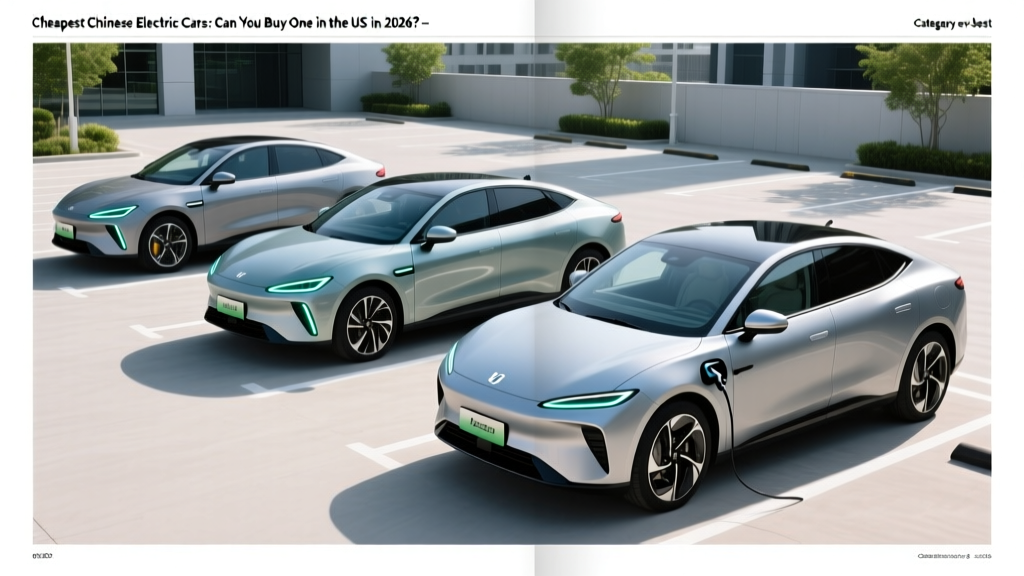
Searches for the cheapest Chinese electric car have surged as buyers look for sub-$20,000 EVs that dominate headlines in Europe, Southeast Asia, and South America. Models like the BYD Seagull, Wuling Bingo, and Changan Lumin offer 200+ miles of range for the price of a used Nissan LEAF. But here's the reality check most listicles skip: virtually none of these vehicles are available for US retail purchase in 2026.
Our evaluation criteria for this guide:
- US market availability: Can a US buyer actually purchase and register this vehicle today?
- True landed cost: MSRP plus the 100%+ Section 301 tariff on Chinese-origin EVs, plus dealer/importer fees
- EPA-certified range and efficiency: Not CLTC or WLTP figures, which overstate range by 20-35% vs EPA
- Charging compatibility: NACS/CCS connector access and DC fast-charge capability on US networks
- Safety certification: FMVSS compliance and NHTSA/IIHS crash-test status
- Federal §30D tax credit eligibility: Battery sourcing and critical-mineral rules that exclude China-sourced components
Below, we rank the cheapest Chinese electric cars by global price, explain which ones might reach US shores (and at what cost), and provide the best currently-available alternatives that actually deliver budget-EV pricing stateside.
The Cheapest Chinese Electric Cars: Global Market Rankings
These are the lowest-priced EVs produced by Chinese automakers as of early 2026, ranked by their domestic China MSRP. We include real-world context on whether each model is reachable for US buyers.
#1 — BYD Seagull (Dolphin Mini)
Key Spec: ~$9,700 China MSRP | 301 km CLTC (~187 mi) | 30.1 kWh LFP battery | 75 HP
Why it made the list: The Seagull is the single most-discussed budget EV globally. BYD's vertical integration — they build their own LFP "Blade" cells — allows pricing that undercuts every competitor. In Mexico, where BYD has entered the market, the Seagull starts around $20,000 USD equivalent.
US availability: Not available. BYD has confirmed no US passenger-vehicle plans. Even if imported, the 100% Section 301 tariff (raised in 2024 and maintained through 2026) would push the landed price above $25,000 before dealer markup, and it lacks FMVSS certification.
Best for: Buyers in Latin America, Southeast Asia, or Europe (where it's sold as the Dolphin Mini) seeking the absolute cheapest new EV.
#2 — Wuling Bingo (Baojun Yep Plus)
Key Spec: ~$12,500 China MSRP | 333 km CLTC (~207 mi) | 31.9 kWh LFP | 68 HP
Why it made the list: The Bingo offers a surprisingly spacious 4-door hatchback form factor at a price point that seems impossible. SAIC-GM-Wuling (a joint venture with GM) has exported variants to Indonesia and India.
US availability: Not available. GM has not announced plans to import the Bingo to the US, and the Chinese-manufactured version faces the full tariff wall. GM's US budget play remains the Chevrolet Bolt EV/EUV platform.
Best for: Urban commuters in export markets wanting 4-door practicality on a micro-budget.
#3 — Changan Lumin
Key Spec: ~$7,200 China MSRP | 210 km CLTC (~130 mi) | 17.7 kWh LFP | 41 HP
Why it made the list: At under $8,000 in China, the Lumin is among the cheapest 4-wheel EVs produced anywhere. It's a micro-car aimed at city commuting with minimal highway capability.
US availability: Not available. Changan has no US presence. The Lumin's low top speed (~100 km/h) and minimal crash structure make FMVSS certification unlikely.
Best for: Ultra-budget city-only driving in markets with micro-car regulations.
#4 — BYD Dolphin
Key Spec: ~$17,500 China MSRP | 420 km CLTC (~261 mi) | 44.9 kWh LFP | 130 HP
Why it made the list: The Dolphin is BYD's global volume play — a legitimate compact hatchback with competitive range and decent build quality. It's sold in Europe, Australia, Japan, and across Southeast Asia.
US availability: Not available. BYD has explored a Mexico plant, but vehicles manufactured there by a Chinese OEM still face complex rules of origin under USMCA. No US sales channel exists.
Best for: International buyers wanting a practical, globally-supported compact EV with LFP longevity.
#5 — MG4 EV (MG Mulan)
Key Spec: ~$21,000 China MSRP | 425 km WLTP (~264 mi) | 51 kWh NMC | 170 HP
Why it made the list: The MG4 is the closest thing to a Chinese EV with Western-market credibility. MG (owned by SAIC) sells it in the UK, Europe, and Australia with strong reviews for driving dynamics and value.
US availability: Not available in the US. MG has no US retail network. SAIC faces the same tariff and sourcing barriers as BYD.
Best for: UK/EU/Australian buyers wanting a sporty, affordable hatchback EV with established dealer support.
#6 — Neta V (Neta AYA)
Key Spec: ~$11,000 China MSRP | 301 km CLTC (~187 mi) | 31.9 kWh LFP | 95 HP
Why it made the list: Hozon Auto's Neta brand targets ASEAN and Latin American markets with aggressively priced crossovers. The Neta V offers SUV ride height at hatchback pricing.
US availability: Not available. Neta has no US homologation plans.
Best for: Budget buyers in Thailand, Indonesia, or Brazil wanting crossover styling.
#7 — GAC Aion Y Plus
Key Spec: ~$18,500 China MSRP | 430 km CLTC (~267 mi) | 51.9 kWh LFP | 136 HP
Why it made the list: The Aion Y Plus is a spacious compact crossover popular in Chinese ride-hailing fleets, known for rear-seat legroom that rivals midsize SUVs.
US availability: Not available. GAC attempted a US entry years ago and withdrew; no current plans exist.
Best for: Fleet operators and families in export markets prioritizing interior volume.
Comparison: Cheapest Chinese EVs at a Glance
| Model | China MSRP | Battery (kWh / Chemistry) | Range (CLTC/WLTP) | Est. EPA Range | Power (HP) | US Available? |
|---|---|---|---|---|---|---|
| Changan Lumin | ~$7,200 | 17.7 / LFP | 210 km CLTC | ~80 mi | 41 | No |
| BYD Seagull | ~$9,700 | 30.1 / LFP | 301 km CLTC | ~140 mi | 75 | No |
| Neta V | ~$11,000 | 31.9 / LFP | 301 km CLTC | ~140 mi | 95 | No |
| Wuling Bingo | ~$12,500 | 31.9 / LFP | 333 km CLTC | ~155 mi | 68 | No |
| BYD Dolphin | ~$17,500 | 44.9 / LFP | 420 km CLTC | ~200 mi | 130 | No |
| GAC Aion Y Plus | ~$18,500 | 51.9 / LFP | 430 km CLTC | ~200 mi | 136 | No |
| MG4 EV | ~$21,000 | 51 / NMC | 425 km WLTP | ~220 mi | 170 | No |
Note: EPA range estimates are approximations. CLTC (China) overstates range by roughly 25-35% vs EPA; WLTP (Europe) overstates by roughly 15-20%. Source: fueleconomy.gov methodology comparisons.
The Tariff Wall: Why Chinese EVs Cost Double in the US
In May 2024, the US government raised Section 301 tariffs on Chinese-origin electric vehicles to 100%, effective through 2026. This means a BYD Seagull with a $9,700 factory price would incur approximately $9,700 in tariff alone, plus shipping ($1,500-$2,500), importer compliance costs ($2,000-$4,000 for FMVSS modifications), and dealer margin. The realistic US showroom floor price: $28,000-$35,000 — eliminating the entire cost advantage.
Even Chinese-owned brands manufacturing outside China face scrutiny. Vehicles assembled in Thailand, Brazil, or Mexico by BYD or SAIC may still use China-sourced battery cells and critical minerals, which triggers two consequences:
- Tariff exposure depending on rules-of-origin determinations under trade agreements
- §30D federal tax credit ineligibility — the IRS clean vehicle credit excludes any vehicle with battery components from a "foreign entity of concern" (FEOC), which includes Chinese companies. This disqualifies virtually every Chinese-supply-chain EV from the up-to-$7,500 credit.
Bottom line: there is no legal pathway in 2026 for a US buyer to purchase a cheap Chinese EV at anything resembling its home-market price.
What You CAN Buy: Budget EV Alternatives Available in the US
If your goal is the cheapest possible new electric car in the US market, these are the models that actually work — with real pricing, EPA range, and tax-credit eligibility.
| Model (2025-2026 MY) | Base MSRP | Est. After §30D Credit | EPA Range | Battery (kWh) | DC Fast Charge |
|---|---|---|---|---|---|
| Chevrolet Bolt EV | $26,500 | ~$19,000 | 259 mi | 65 / NMC | 55 kW (CCS) |
| Nissan LEAF S | $28,140 | ~$20,640 | 212 mi | 40 / NMC | 50 kW (CHAdeMO) |
| Hyundai Kona Electric | $32,675 | ~$25,175 | 261 mi | 65.4 / NMC | 100+ kW (NACS) |
| Tesla Model 3 RWD | $38,990 | ~$31,490 | 272 mi | 60 / LFP | 170 kW (NACS) |
§30D credit estimates assume buyer meets income caps ($150k single / $300k joint), vehicle MSRP is under the $55,000 sedan cap, and battery sourcing qualifies. Verify eligibility at IRS.gov before purchasing. Credit can now be transferred to the dealer at point of sale.
Top Pick for Budget US Buyers: Chevrolet Bolt EV
The Bolt EV remains the closest US-market equivalent to the "cheapest Chinese electric car" fantasy. At ~$19,000 after the federal credit, it delivers 259 miles of EPA range — more than a BYD Seagull would achieve under EPA testing — with a proven NMC battery, US dealer network, NHTSA safety certification, and widely available CCS charging. Its main drawback is slow DC fast charging (55 kW peak, meaning a 10-80% charge takes roughly 50 minutes). For daily commuting and home-charging owners, this is the best budget EV value in America in 2026.
Runner-up: The Nissan LEAF S undercuts the Bolt on price but offers less range and uses the aging CHAdeMO connector, which is increasingly rare on new US DC fast chargers. Choose the LEAF only if CHAdeMO infrastructure is confirmed in your area.
Range Translation: CLTC vs WLTP vs EPA Explained
One of the biggest sources of misinformation in "cheapest Chinese EV" coverage is range figures. Here's why the numbers you see online are misleading:
- CLTC (China Light-Duty Vehicle Test Cycle): Optimized for stop-and-go urban traffic at moderate speeds. Overstates real-world range by 25-35% compared to EPA. A "300 km CLTC" rating translates to roughly 195-225 km (120-140 mi) in mixed US driving.
- WLTP (Worldwide Harmonised Light Vehicles Test Procedure): Used in Europe. More realistic than CLTC but still 15-20% optimistic vs EPA. A "400 km WLTP" rating translates to roughly 320-340 km (200-210 mi) EPA.
- EPA (US Environmental Protection Agency): The most conservative and realistic test cycle. Includes highway speeds, AC load, and cold-weather adjustments. When we cite US-market range, we always use EPA figures.
This is why a BYD Seagull touted as having "187 miles of range" in Chinese marketing would likely earn an EPA sticker closer to 130-140 miles — a significant difference for highway-capable driving.
Decision Framework: Should You Wait for a Chinese EV?
Choose a current US-market budget EV (Bolt, LEAF, Kona) if:
- You need a vehicle in 2026 and want federal tax credit savings
- You require NHTSA crash-test ratings and established insurance rates
- You want access to the Tesla Supercharger network (via NACS adapter or native port)
- You need highway-capable range (200+ mi EPA) for road trips
Consider importing a Chinese EV (via gray market) only if:
- You are in a market where BYD, MG, or Neta officially sell (Latin America, ASEAN, Europe, Australia)
- You accept zero federal tax credit eligibility and limited warranty support
- You understand FMVSS non-compliance may prevent US registration in most states
Wait for future developments if:
- You are tracking BYD's potential Mexico or Brazil manufacturing for USMCA-compliant exports (no confirmed timeline as of 2026)
- You are watching for tariff policy changes under future trade negotiations
Frequently Asked Questions
What is the cheapest Chinese electric car available globally?
The Changan Lumin, starting at approximately $7,200 in China, is among the cheapest production EVs worldwide. However, its 130 km (80 mi) real-world range and micro-car form factor limit practicality. The BYD Seagull at ~$9,700 offers more capability and is widely exported to non-US markets.
Can I buy a BYD Seagull in the United States?
No. BYD does not sell passenger vehicles in the US as of 2026. Even if privately imported, the 100% Section 301 tariff, lack of FMVSS certification, and absence of a dealer/service network make it impractical and likely illegal to register for road use in most states.
Why are Chinese EVs so much cheaper than US-market EVs?
Three main factors: (1) China's massive domestic scale drives battery costs down — LFP cells from CATL and BYD are 30-40% cheaper than equivalent Western-sourced cells. (2) Chinese OEMs vertically integrate battery, motor, and software production. (3) Labor and regulatory compliance costs are lower. These advantages disappear when tariffs, shipping, and US safety certification are added.
Do Chinese EVs qualify for the US $7,500 federal tax credit?
No. Under current IRS §30D rules, any vehicle with battery components or critical minerals sourced from a "foreign entity of concern" (FEOC) — which includes Chinese companies — is disqualified from the clean vehicle credit, regardless of where the vehicle is assembled.
What's the cheapest new EV I can actually buy in the US in 2026?
The Chevrolet Bolt EV at $26,500 MSRP, dropping to approximately $19,000 after the $7,500 federal tax credit (if you qualify based on income and the vehicle meets sourcing requirements). It offers 259 miles of EPA range — more than any Chinese-market budget EV would achieve under EPA testing.
Will Chinese EV tariffs change in the future?
Tariff policy is subject to executive and legislative action. As of 2026, the 100% Section 301 tariff on Chinese EVs remains in effect. Any changes would likely be announced through the Office of the US Trade Representative. We recommend monitoring ustr.gov for updates.