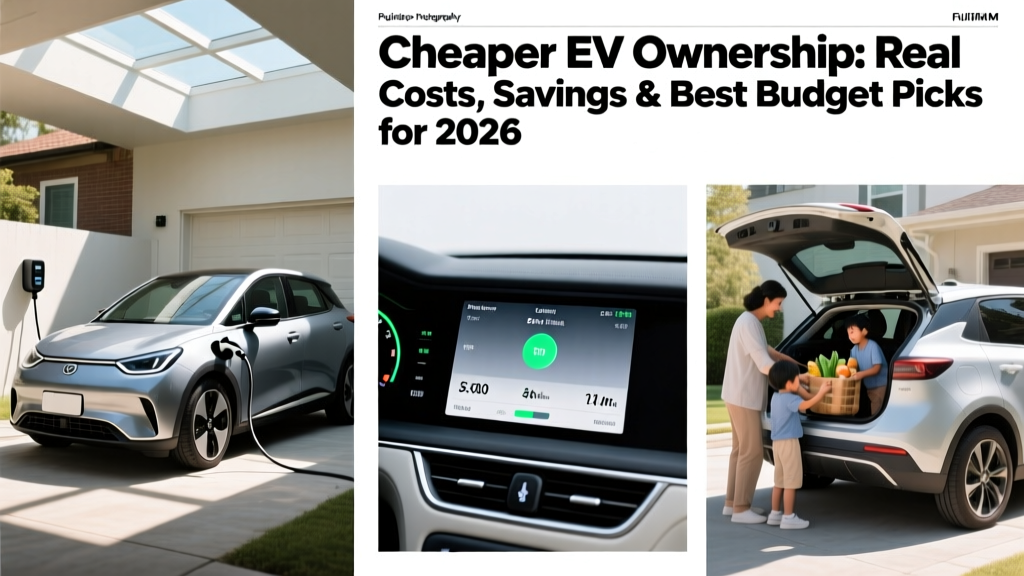
Buying a cheaper EV in 2026 means targeting models with an MSRP under $35,000 before incentives — but the real question is whether that lower sticker price translates to genuine long-term savings. The short answer: yes, but only if you can charge at home and your daily driving stays under 80 miles. A budget EV like the 2026 Chevrolet Equinox EV (starting around $33,600) or Nissan LEAF (from $28,140) can save you $1,200–$1,800 annually on fuel and maintenance compared to a comparable gas compact SUV, but those savings evaporate if you're forced to rely exclusively on public DC fast charging at $0.35–$0.48/kWh. Add the federal §30D tax credit — up to $7,500 if the vehicle meets battery sourcing, MSRP, and buyer income requirements — and a cheaper EV can undercut a gas car on total cost of ownership (TCO) within three to four years.
Quick Answer: Is a Cheaper EV Worth It in 2026?
Affordable EVs (under $35K MSRP) make financial sense if: you have Level 2 home charging access, drive fewer than 250 miles per week, and qualify for at least a partial federal or state incentive. Expect 200–315 miles of EPA range in this segment. If you lack home charging or regularly drive 400+ miles in a single day, a hybrid or PHEV will likely cost you less over five years.
The 2026 Budget EV Landscape: What "Cheaper" Actually Gets You
The sub-$35,000 EV market has matured significantly. Here's what the main contenders offer as of the 2026 model year:
| Model | Base MSRP | EPA Range | Battery (kWh) | DC Fast Charge (Peak kW) | 10–80% Time | 0–60 mph |
|---|---|---|---|---|---|---|
| 2026 Nissan LEAF S | $28,140 | 212 mi | 60 kWh (NMC) | 100 kW | ~40 min | 7.4 sec |
| 2026 Chevy Equinox EV 2LT | $33,600 | 315 mi | 85 kWh (NMC) | 150 kW | ~28 min | 8.1 sec |
| 2026 Hyundai Kona Electric SE | $32,975 | 261 mi | 65.4 kWh (NMC) | 100 kW | ~43 min | |
| 2026 Volvo EX30 Core | $34,950 | 265 mi | 69 kWh (NMC) | 153 kW | ~26 min |
Real-world caveat: EPA range assumes moderate temperatures and mixed driving. On a 75-mph highway run in 35°F weather, expect to lose 20–30% of that sticker range. The Equinox EV's 315 EPA miles drops to roughly 220–250 miles in winter highway conditions — still usable for most commutes, but something to plan around on road trips.
Cheaper EV vs Gas Car: The True Cost Breakdown
Sticker price is only the entry fee. Here's a five-year ownership comparison between a 2026 Chevy Equinox EV 2LT ($33,600) and a similarly equipped 2026 Honda CR-V EX ($34,500), assuming 12,000 miles/year, home charging at $0.14/kWh, and gas at $3.40/gallon.
| Cost Category (5-Year) | Chevy Equinox EV | Honda CR-V (Gas) |
|---|---|---|
| Purchase Price (after $7,500 credit) | $26,100* | $34,500 |
| Fuel/Energy (60,000 mi) | $2,520 | $7,286 |
| Maintenance | $1,200 | $3,100 |
| Insurance (avg) | $8,400 | $6,900 |
| Estimated Depreciation | $11,500 | $13,200 |
| Total 5-Year Cost | $49,720 | $64,986 |
*Assumes full §30D credit eligibility. Per the IRS, eligibility requires the buyer's AGI to fall under $150K (single) or $300K (joint), the vehicle MSRP to be under $55K (cars) or $80K (SUVs/trucks), and the battery to meet critical-mineral and component sourcing thresholds that shift annually. Always confirm eligibility at the point of sale with your dealer and consult a tax professional.
The EV saves roughly $15,266 over five years in this scenario, but notice where it loses: insurance premiums run 15–25% higher for EVs across most carriers, and if you can't access home charging, that $2,520 energy cost could triple to $7,500+ using public DC fast chargers.
Charging Costs: Home vs Public Makes or Breaks the Math
This is the single biggest variable in whether a cheaper EV actually saves you money. Let's break down the per-mile energy cost across charging scenarios, using the Equinox EV's efficiency of roughly 3.0 miles/kWh (about 33 kWh/100 miles) as our baseline:
| Charging Method | Cost per kWh | Cost per Mile | Annual Cost (12K mi) |
|---|---|---|---|
| Level 1 (120V home outlet) | $0.14 | $0.047 | $560 |
| Level 2 (240V home, installed) | $0.14 | $0.047 | $560 |
| Level 2 (public, e.g., workplace) | $0.20–$0.30 | $0.067–$0.10 | $800–$1,200 |
| DC Fast (Electrify America, EVgo) | $0.35–$0.48 | $0.117–$0.16 | $1,400–$1,920 |
At home rates, the EV costs about $0.047/mile to "fuel." A gas CR-V getting 30 MPG combined at $3.40/gallon costs $0.113/mile. That's a clear win. But if you're exclusively DC fast charging at $0.45/kWh, your cost per mile jumps to $0.15 — more expensive than the gas car. Home charging access is non-negotiable for budget EV economics.
Level 2 home charger installation typically runs $800–$2,200 (equipment + licensed electrician + permit), depending on your panel capacity and the distance from your electrical panel to the garage. If your home has a 200-amp panel with spare capacity, expect the lower end. A panel upgrade to 200A adds $1,500–$3,000.
Common Misconceptions About Cheaper EVs
| Myth | Fact |
|---|---|
| "Cheap EVs have terrible range" | The 2026 Equinox EV delivers 315 EPA miles for $33,600. Even the $28K LEAF gets 212 miles — enough for 90% of daily commutes. |
| "The battery will need replacing and cost $20K" | Federal law mandates battery warranties of at least 8 years/100,000 miles. Modern NMC packs lose roughly 10–15% capacity over 150K miles. Full replacements are rare; most degradation is gradual. |
| "EVs are worse in winter" | Range drops 20–30% in freezing temps — real and worth planning for. But EVs start instantly in cold weather (no cranking), and preconditioning while plugged in mitigates much of the range loss. |
| "I'll save money no matter how I charge" | Public DC fast charging at $0.40+/kWh can exceed gas costs per mile. Savings depend on home charging access. |
| "The tax credit is guaranteed $7,500" | Per IRS §30D rules, the credit depends on battery sourcing, MSRP caps, and buyer income. Many vehicles qualify for $3,750 or nothing. Always verify before purchasing. |
First-Time EV Buyer: What You Need to Know Before Signing
If you're considering a cheaper EV as your first electric vehicle, these practical realities don't always show up in spec sheets:
1. Charging speed matters more than peak kW claims. A vehicle advertising "150 kW DC fast charging" doesn't sustain that rate. Charging curves taper significantly above 80% state of charge to protect the battery. The Equinox EV peaks near 150 kW but averages closer to 85–100 kW over a 10–80% session. That 28-minute 10–80% figure assumes optimal battery preconditioning and a capable charger.
2. Your driving pattern determines whether EV or PHEV wins. If you regularly drive 300+ miles in a single day or live in a charging desert (rural stretches of I-70, I-10, or I-90 still have sparse coverage), a plug-in hybrid like the Toyota RAV4 Prime (42 miles electric-only, 38 MPG gas) may cost less in both money and time.
3. Insurance costs more — shop before you buy. EV insurance premiums average 15–25% higher than equivalent gas vehicles due to higher repair costs and battery replacement risk. Get quotes from your carrier before committing.
4. Used EVs offer steeper discounts, but check battery health. A 2–3-year-old EV can be 30–40% cheaper than new, but request a battery State of Health (SoH) report. If SoH is below 90%, factor in reduced range.
5. kW is power, kWh is energy. Kilowatts (kW) measure the rate of charging — like water pressure. Kilowatt-hours (kWh) measure battery capacity — like tank size. A 60 kWh battery charged at 10 kW takes 6 hours from empty. This distinction matters when evaluating home charger specs and vehicle charge rates.
Decision Framework: Should You Buy a Cheaper EV, a Hybrid, or Stick with Gas?
Use This to Decide
Choose a cheaper BEV (battery EV) if:
- You have reliable Level 2 home charging (or can install it for under $2,500)
- Your typical daily driving is under 80 miles round-trip
- You rarely drive more than 250 miles in a single day without an overnight stop
- You qualify for at least a $3,750 federal or state incentive
- You want the lowest per-mile fuel and maintenance cost
Choose a PHEV (plug-in hybrid) if:
- You can charge at home but regularly take 300+ mile trips
- You live in an area with limited DC fast charging infrastructure
- You want electric-only commuting (25–42 miles) with gas backup for road trips
- You're not ready to plan trips around charging stops
Stick with a gas HEV (standard hybrid) if:
- You cannot install or access any home/work charging
- You live in extreme cold climates (below 0°F regularly) where EV range loss exceeds 30%
- Your budget is under $25,000 and you need maximum vehicle selection
- You drive 500+ miles per week and don't want to manage charging logistics
The Bottom Line on Going Cheap with an EV
A cheaper EV in 2026 is a genuinely smart financial move — for the right buyer. The 2026 Equinox EV at $33,600 (potentially $26,100 after the federal credit) with 315 miles of range is a compelling daily driver that will save most home-charging owners $10,000–$15,000 over five years versus a gas equivalent. But "cheaper" only works if the ownership ecosystem supports it: home charging, moderate daily mileage, and realistic expectations about road-trip charging logistics.
If your situation checks those boxes, the budget EV segment has never offered more range, faster charging, and better value. If it doesn't, a PHEV gives you electric commuting without the range planning — and that's a perfectly valid choice too.
Frequently Asked Questions
What is the cheapest new EV available in 2026?
The 2026 Nissan LEAF S starts at $28,140 with 212 miles of EPA range. However, it uses a CHAdeMO DC fast charging connector, which has limited public infrastructure compared to CCS or NACS. The 2026 Chevy Equinox EV at $33,600 with 315 miles and CCS/NACS compatibility offers better long-term value for most buyers.
Do cheaper EVs qualify for the $7,500 federal tax credit?
It depends on the specific model's battery sourcing, your income, and the vehicle's MSRP. Under current IRS §30D rules, buyer AGI must not exceed $150K (single) or $300K (joint), and the battery must meet critical-mineral and component sourcing thresholds. Some budget EVs qualify for the full $7,500, others for $3,750, and some for nothing. Your dealer can run a point-of-sale eligibility check, and the credit can be transferred to the dealer at purchase to reduce your out-of-pocket cost.
How much does home charging installation cost?
A Level 2 (240V) home charger installation typically costs $800–$2,200 including the charger unit ($300–$700), electrician labor, and permits — assuming your electrical panel has sufficient capacity. If you need a panel upgrade from 100A to 200A, add $1,500–$3,000. Always get a quote from a licensed electrician before purchasing a charger.
Will a cheaper EV's battery need expensive replacement?
Federal law requires EV battery warranties of at least 8 years/100,000 miles (10 years/150,000 miles in CARB states). Modern NMC lithium-ion batteries typically degrade 10–15% over 150,000 miles. A full battery replacement outside warranty runs $8,000–$15,000 depending on the pack, but complete failures within the first decade are uncommon. Most owners will sell or trade the vehicle before significant battery replacement becomes necessary.
Is a cheaper EV good for road trips?
Yes, with planning. A 315-mile-range EV like the Equinox EV requires one 25–30 minute DC fast charging stop every 200–250 real-world highway miles (accounting for speed and temperature). Apps like A Better Routeplanner and PlugShare make this manageable on major corridors. For frequent 500+ mile road trips, a PHEV eliminates charging-stop logistics entirely.