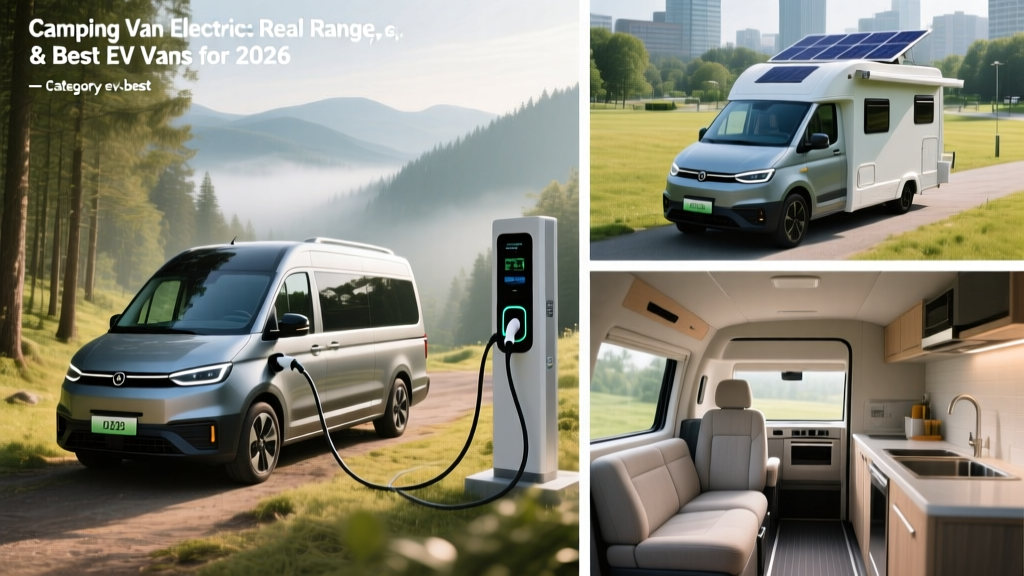
The Short Answer: Can You Go Camping in an Electric Van?
Yes — but with strict planning. The best electric camping vans in 2026 (Ford E-Transit, Mercedes-Benz eSprinter, and the upcoming VW ID. Buzz Cargo) offer between 108 and 200+ miles of EPA-estimated range. In real-world camping conditions — loaded with 500–1,000 lbs of gear, driving at highway speeds, and in cold or mountainous terrain — expect to lose 25–40% of that sticker range. That puts practical one-charge camping range at roughly 70–150 miles depending on the model and conditions. If your campsite is within 80 miles of home and you can install a Level 2 charger, an electric van works well. For boondocking or cross-country overlanding, a gas or diesel van remains the more practical choice in 2026.
Top Electric Vans for Camping in 2026: Specs at a Glance
Not every electric van is built for camping conversion, but three models dominate the conversation. Here's how they stack up with the exact numbers you need to plan a trip.
| Spec | Ford E-Transit (2026) | Mercedes-Benz eSprinter (2026) | VW ID. Buzz (LWB, 2026) |
|---|---|---|---|
| Battery (usable kWh) | 68 kWh (NMC) | 113 kWh (NMC) | 91 kWh (NMC) |
| EPA Est. Range | ~126 mi (low-roof cargo) | ~203 mi (standard cargo) | ~234 mi (passenger) |
| Real-World Camping Range* | ~75–95 mi | ~125–155 mi | ~150–180 mi |
| Peak DC Fast Charge | 115 kW | 115 kW | 175 kW |
| 10–80% DC Charge | ~45 min | ~42 min | ~26 min |
| Level 2 Rate (kW) | 10.5 kW | 9.6 kW | 11 kW |
| Horsepower / Torque | 266 hp / 317 lb-ft | 201 hp / 332 lb-ft | 282 hp / 413 lb-ft |
| Max Payload | ~3,880 lbs | ~2,624 lbs | ~1,609 lbs |
| Cargo Volume | 246.7 cu ft (low-roof) | 325 cu ft (standard) | ~172 cu ft (behind 2nd row) |
| Base MSRP | ~$46,500 | ~$72,000 | ~$54,000 |
| Battery Warranty | 8 yr / 100,000 mi | 8 yr / 100,000 mi | 8 yr / 100,000 mi |
*Real-world camping range assumes 600+ lbs of conversion/gear weight, mixed highway and mountain driving at 60–70 mph, and moderate climate (50–75°F). Cold weather (below 32°F) can reduce range an additional 15–25%.
EV Van vs. Gas Van: The Camping Cost Comparison
The sticker price of an electric van is higher than its gas equivalent, but fuel and maintenance savings can narrow the gap — especially if you charge at home. Here's a 5-year ownership comparison between the Ford E-Transit and the gas Ford Transit 250, assuming 12,000 miles/year, a home Level 2 charger, and a national average electricity rate of $0.16/kWh.
| Cost Category (5 Years) | Ford E-Transit (EV) | Ford Transit 250 (Gas) |
|---|---|---|
| Purchase Price (base MSRP) | $46,500 | $44,700 |
| Federal Tax Credit (§30D, if eligible) | Up to –$7,500 | $0 |
| Effective Purchase Price | $39,000 | $44,700 |
| Fuel/Energy (60,000 mi total) | ~$2,900 (home charging) | ~$7,200 (gas at $3.40/gal, 16 MPG) |
| Maintenance (oil, filters, brakes) | ~$800 | ~$2,800 |
| Insurance (avg. annual premium) | ~$9,500 ($1,900/yr) | ~$7,500 ($1,500/yr) |
| Camping Electrical (V2L/auxiliary) | $0 (uses traction battery) | ~$1,500 (portable generator + fuel) |
| 5-Year Total Cost | ~$52,200 | ~$63,700 |
Key takeaways: The E-Transit saves roughly $11,500 over five years when you qualify for the full federal credit and charge primarily at home. But insurance premiums run 20–30% higher on average for EVs, and the savings depend heavily on your electricity rate and tax-credit eligibility. If you rely exclusively on DC fast charging at $0.40–$0.50/kWh, your energy cost jumps to ~$6,500 — nearly erasing the fuel savings.
The Range Reality Check: What Camping Does to Your Battery
EPA range estimates are measured under controlled conditions that don't reflect how you'll actually use a camping van. Here's what happens to your range in common camping scenarios:
- Weight penalty: A basic campervan conversion adds 400–800 lbs (plywood platform, mattress, kitchen box, water, gear). Every 100 lbs of added weight reduces range by approximately 2–3%. A 700-lb conversion costs you roughly 15–20% of EPA range.
- Highway speeds: Driving 70 mph instead of 55 mph increases aerodynamic drag significantly on a boxy van. Expect a 15–20% range reduction at sustained highway speeds.
- Cold weather: Lithium-ion NMC batteries lose efficiency below 40°F, and running cabin heat draws from the traction battery. At 20°F, expect 25–35% range loss. At 0°F, losses can reach 40% or more.
- Mountain passes: Climbing a 5,000-ft elevation pass can consume 2–3x the energy per mile compared to flat terrain. Regenerative braking recovers some energy on descents, but not all.
- Accessories: Running a 12V fridge, LED lights, and device charging from the van's traction battery via a DC-DC converter or V2L (Vehicle-to-Load) system draws roughly 1–3 kWh overnight — equivalent to 3–8 miles of range.
Real-World Camping Range Formula: Take the EPA range, subtract 15% for cargo weight, 15% for highway driving, and 20% if temperatures drop below freezing. A Ford E-Transit with 126 EPA miles becomes roughly 65–75 miles on a loaded winter camping trip. A Mercedes eSprinter at 203 EPA miles becomes roughly 120–140 miles under the same conditions.
Charging Logistics: The Make-or-Break Factor
An electric camping van lives or dies by your charging strategy. Here's what each charging level delivers for a van-sized battery:
| Charging Level | Power (kW) | Miles Added/Hour | Full Charge Time (eSprinter 113 kWh) | Availability |
|---|---|---|---|---|
| Level 1 (120V outlet) | 1.2–1.4 kW | ~3–4 mi/hr | ~80+ hours | Any standard outlet; campground 120V |
| Level 2 (240V home) | 9.6–11.5 kW | ~25–32 mi/hr | ~10–12 hours | Home garage, some campgrounds (NEMA 14-50) |
| DC Fast Charge | 115–175 kW (peak) | ~150–200 mi/hr (to 80%) | 10–80% in ~42 min | Public networks (Electrify America, EVgo, ChargePoint) |
Home charging is nearly essential for an electric camping van. A 240V Level 2 installation (NEMA 14-50 outlet or hardwired wall connector) costs between $800 and $2,500 depending on your electrical panel capacity. If your panel needs an upgrade from 100A to 200A, add $1,500–$3,000. Always get a quote from a licensed electrician before committing.
Campground charging remains a serious limitation in 2026. Most RV parks and campgrounds offer 30A or 50A 240V hookups (NEMA 14-50), which can deliver Level 2 speeds — but you'll need the correct adapter, and not all campgrounds allow EV charging from RV pedestals. DC fast chargers are virtually nonexistent at campgrounds, state parks, or national forests. Plan routes around public charging corridors, not around remote wilderness.
Federal Tax Credits and Incentives for Electric Vans
Under IRS §30D rules, the federal EV tax credit can reduce your effective purchase price by up to $7,500 — but eligibility depends on several requirements that change frequently. As of 2026:
- MSRP cap: Vans classified as SUVs or trucks must have an MSRP below $80,000; passenger vans classified as cars must be below $55,000. The Ford E-Transit and VW ID. Buzz qualify; the eSprinter's higher trims may exceed the cap.
- Buyer income limits: Adjusted gross income must not exceed $150,000 (single), $225,000 (head of household), or $300,000 (married filing jointly).
- Battery sourcing: A percentage of critical minerals and battery components must be sourced from the U.S. or free-trade-agreement countries. This requirement tightens annually — check the IRS qualified vehicle list before purchasing.
- Point-of-sale transfer: You can transfer the credit to the dealer at purchase, reducing your out-of-pocket cost immediately rather than waiting for tax filing.
- Commercial credit (§45W): If you register the van as a commercial vehicle (for a business), a separate credit of up to $7,500 (under 14,000 lbs GVWR) may apply with different rules.
Always verify current eligibility on IRS.gov and consult a tax professional. Rules and qualified-vehicle lists are updated regularly.
Common EV Camping Van Myths — Fact-Checked
| Myth | Fact |
|---|---|
| "You can't tow with an electric van." | The E-Transit is rated for up to 4,200 lbs towing; the eSprinter can tow up to 5,000 lbs. However, towing a loaded trailer cuts range by 30–50%. |
| "The battery will die in the cold." | Cold reduces range but doesn't damage the battery. Modern thermal management systems precondition the pack. You'll lose range, not the battery itself. EPA data confirms cold-weather EV operation is safe. |
| "You can run a campsite entirely off the van's battery." | Partially true. With V2L (available on the ID. Buzz and some E-Transit trims), you can power a small fridge, lights, and laptops. But running high-draw appliances (microwave, electric heater, induction cooktop) will deplete 5–15 kWh overnight — up to 13% of the eSprinter's battery. |
| "Charging at a campground is easy." | Most campgrounds lack dedicated EV chargers. You may use a 50A RV pedestal with an adapter for Level 2 charging, but availability is not guaranteed, and some parks prohibit it. Always call ahead. |
| "Electric vans are cheaper to own." | Lower fuel and maintenance costs are real, but higher insurance premiums (20–30% more on average), potentially higher registration fees in some states, and the risk of expensive battery replacement after warranty (est. $15,000–$25,000) must be factored in. |
Decision Framework: Is an Electric Camping Van Right for You?
Choose an electric camping van if:
- Your typical camping trips are within 80–100 miles of home (one-way) or along well-served DC fast-charge corridors.
- You can install a Level 2 charger at home (garage or driveway with 240V access).
- You camp mostly in mild-to-warm climates (above 40°F) or accept significant winter range loss.
- You want silent, emission-free campsite operation without a generator.
- You qualify for the federal tax credit, bringing the effective price competitive with gas vans.
- You drive the van regularly for commuting or errands, not just weekend camping — maximizing fuel savings.
Stick with a gas or diesel van if:
- You regularly camp more than 150 miles from home in remote areas without DC fast charging.
- You boondock on BLM land or national forest roads far from any charging infrastructure.
- You need to tow a heavy trailer (boat, utility, horse) over long distances.
- You camp in sub-freezing temperatures for extended periods and need maximum range reliability.
- You don't have access to home or workplace Level 2 charging.
- You need the van to be a single-vehicle solution for both daily driving and long-distance adventure without route-planning overhead.
First-Time EV Van Buyer Checklist
If you're considering your first electric camping van, here's what to verify before signing:
- Get an electrician quote for a 240V/40A–50A circuit in your garage or driveway. Budget $800–$4,000 depending on panel capacity and run length.
- Map your most common camping route using PlugShare or the DOE's Alternative Fuels Data Center to confirm DC fast-charger availability along the way.
- Check IRS eligibility for the specific VIN you're buying — not just the model name — at IRS.gov.
- Request an insurance quote before purchase. EV insurance premiums can be 20–30% higher than equivalent gas vans.
- Test the cargo space with your actual conversion plan. Wheel wells, battery placement, and interior height vary significantly between models and directly affect bed-platform and storage builds.
- Confirm V2L or auxiliary power capability if you plan to power campsite devices from the van's traction battery. Not all trims include this feature.
- Budget for the conversion separately. A professional campervan conversion adds $10,000–$40,000+ on top of the van's purchase price. DIY builds start around $2,000–$5,000 for basic setups.
Can I charge an electric van at a regular campground?
Maybe. Many campgrounds offer 30A or 50A 240V outlets at RV pedestals (NEMA 14-50). With the correct adapter cable, you can charge at Level 2 speeds (~25–30 miles per hour). However, not all parks allow EV charging from RV hookups, and availability varies. Always call the campground ahead of time and bring a portable Level 2 EVSE with a NEMA 14-50 plug.
How long does it take to fully charge an electric camping van at home?
On a 240V Level 2 charger delivering 10–11.5 kW, a full charge from near-empty takes approximately 7–8 hours for the Ford E-Transit (68 kWh), 10–12 hours for the Mercedes eSprinter (113 kWh), and 8–9 hours for the VW ID. Buzz (91 kWh). Plug in overnight and you'll wake up to a full battery.
Is the VW ID. Buzz a practical camping van?
The long-wheelbase ID. Buzz offers the best EPA range (~234 miles) and fastest charging (175 kW peak, 10–80% in ~26 min) of the three, but it has the smallest cargo volume (~172 cu ft behind the second row) and lowest payload (~1,609 lbs). It works for minimalist camper builds for one or two people but isn't suitable for full-height standing conversions or heavy builds. Think of it as a compact weekend camper, not a full-size Sprinter replacement.
What happens if I run out of charge in a remote area?
Unlike a gas van where you can carry a spare fuel can, a depleted EV requires a flatbed tow to the nearest charger. Roadside assistance plans (AAA, manufacturer programs) typically cover this, but wait times in remote areas can be hours. Always plan routes with a 20–30% range buffer and identify chargers before entering areas with poor coverage.
Do electric van batteries degrade quickly?
Modern NMC batteries in commercial vans are warranted for 8 years or 100,000 miles at a minimum of 70% capacity retention. Real-world data from fleet operators suggests typical degradation of 8–15% over the first 100,000 miles. To maximize longevity, avoid routinely charging to 100% or draining to 0%, and use preconditioning before DC fast charging in cold weather.