Quick Answer: Is an Electric Camper Van Practical?
An electric camper van is viable for weekend trips within 150–200 miles of home where you can camp at sites with Level 2 charging or use a DC fast-charger corridor. Current production electric vans — the Mercedes-Benz eSprinter (2026 EPA est. ~200 miles, 113 kWh battery) and the Ford E-Transit (2026 EPA est. ~126 miles, 68 kWh battery) — can be converted into camper builds, but they carry real trade-offs: higher upfront cost ($55,000–$75,000+ before conversion), reduced range when loaded with 1,500–3,000 lbs of camper gear, and sparse DC fast-charging infrastructure on rural and BLM camping routes. If your camping style involves boondocking off-grid for days, a gas or diesel Sprinter remains the pragmatic choice. If you stick to developed campgrounds with shore power and drive mostly highway corridors with fast chargers, an electric camper van can cut your fuel cost from ~$0.18/mile to ~$0.05/mile and eliminate generator noise.
The Current Electric Van Landscape for Camper Conversions
The electric commercial van market has matured enough that two platforms dominate the camper-conversion conversation. Here's what's actually available to buy and build on as of the 2026 model year:
| Spec | Mercedes-Benz eSprinter (2026) | Ford E-Transit (2026) |
|---|---|---|
| Battery (usable) | 113 kWh (NMC) | 68 kWh (NMC) |
| EPA Range (cargo van) | ~200 mi | ~126 mi |
| Real-World Range (loaded camper) | ~140–170 mi | ~85–105 mi |
| DC Fast Charge (peak) | 115 kW | 115 kW |
| 10–80% DC Charge Time | ~42 min | ~45 min |
| Level 2 Charge Rate | 9.6 kW | 10.5 kW |
| Horsepower / Torque | 201 hp / 295 lb-ft | 266 hp / 317 lb-ft |
| Payload Capacity | ~2,600 lbs | ~3,300 lbs |
| Base MSRP (cargo van) | ~$58,000 | ~$50,000 |
| Battery Warranty | 8 yr / 100,000 mi | 8 yr / 100,000 mi |
Neither vehicle ships as a factory camper. The conversion is done by aftermarket outfitters (e.g., Outside Van, Cascade Vans, or custom DIY builds), adding $30,000–$80,000 on top of the chassis cost. That puts a finished electric camper van in the $85,000–$135,000 range — significantly more than a comparable gas Sprinter 2500 build.
A notable wildcard: the Volkswagen ID. Buzz (long-wheelbase, US-spec) offers a factory passenger van with available camper-adjacent configurations, but its 2026 EPA range of ~234 miles from a 91 kWh battery and compact interior make it better suited as a weekend day-tripper than a full live-in camper. Its starting MSRP around $61,000 is also steep for its size.
Electric Camper Van vs. Gas Van: Real Cost Comparison
The purchase price gap is the first shock. But ownership economics shift when you account for fuel, maintenance, and potential tax credits. Here's a five-year, 60,000-mile ownership comparison between a gas Mercedes Sprinter 2500 camper and an eSprinter camper build:
| Cost Category (5 yr / 60k mi) | Gas Sprinter 2500 Camper | eSprinter Camper |
|---|---|---|
| Vehicle + Conversion Purchase | $75,000–$110,000 | $90,000–$140,000 |
| Federal Tax Credit (§30D) | $0 | Up to $7,500* |
| Fuel / Electricity | ~$10,800 (15 mpg, $3.50/gal avg) | ~$3,000 (2.0 kWh/mi, $0.14/kWh home avg) |
| Maintenance (oil, filters, brakes) | ~$3,500 | ~$1,200 |
| Insurance (avg annual × 5) | ~$9,000 | ~$10,500 |
| Estimated 5-Year Total Cost | $98,300–$133,300 | $104,700–$151,700 |
*The IRS §30D credit has income caps ($300K joint / $150K single), MSRP caps ($80K for vans classified as SUVs/trucks — verify classification with your dealer), and battery sourcing/critical-mineral requirements that change annually. Consult a tax professional. Point-of-sale transfer is available at participating dealers.
The fuel savings are real — roughly $7,800 over five years — but they don't close the purchase-price gap for most builds. The electric camper van makes financial sense primarily if you drive it frequently as a daily vehicle too, maximizing those per-mile savings, or if you place a high value on silent, emission-free campground operation (no generator hum, no exhaust).
Range Reality: What Happens When You Load a Camper Build
This is where most electric camper van research hits a wall. EPA range figures are measured on cargo vans at regulated payloads. A finished camper conversion adds 1,500–3,000 lbs of insulation, cabinetry, water tanks, batteries, and gear. Physics is unforgiving here:
eSprinter EPA: ~200 miles empty
eSprinter Real-World (loaded camper, highway 65–70 mph): 140–170 miles in mild weather; 110–140 miles in freezing temps or mountain passes
E-Transit EPA: ~126 miles empty
E-Transit Real-World (loaded camper, highway 65–70 mph): 85–105 miles in mild weather; 65–85 miles in cold/mountainous conditions
Cold weather hits electric vans especially hard. At 20°F, expect 25–35% range reduction from the EPA figure due to battery chemistry resistance and cabin/camper heating load. Unlike a gas van, which generates waste heat from the engine, an electric van must use battery energy to run a heat pump or resistive heater — energy that directly subtracts from your driving range.
For context, a gas Sprinter 2500 with a 24.5-gallon tank and 15–18 mpg loaded gives you 365–440 miles of real-world range, refuels in 5 minutes at any rural gas station, and loses only ~10% efficiency in cold weather. This gap is the central tension of electric camper van ownership.
Charging Logistics on the Road and at the Campsite
Charging an electric camper van requires planning that a gas van simply doesn't demand. Here's the practical breakdown:
| Charging Level | Power (kW) | Miles Added Per Hour | Where You'll Find It |
|---|---|---|---|
| Level 1 (120V outlet) | 1.2–1.4 kW | ~3–4 mi/hr | Standard campground pedestal, residential outlet |
| Level 2 (240V) | 7.2–9.6 kW | ~20–28 mi/hr | RV parks with 50-amp service, home wall charger |
| DC Fast Charge | 50–115 kW | ~150–250 mi/hr (peak) | Electrify America, EVgo, Tesla Supercharger (with NACS adapter) |
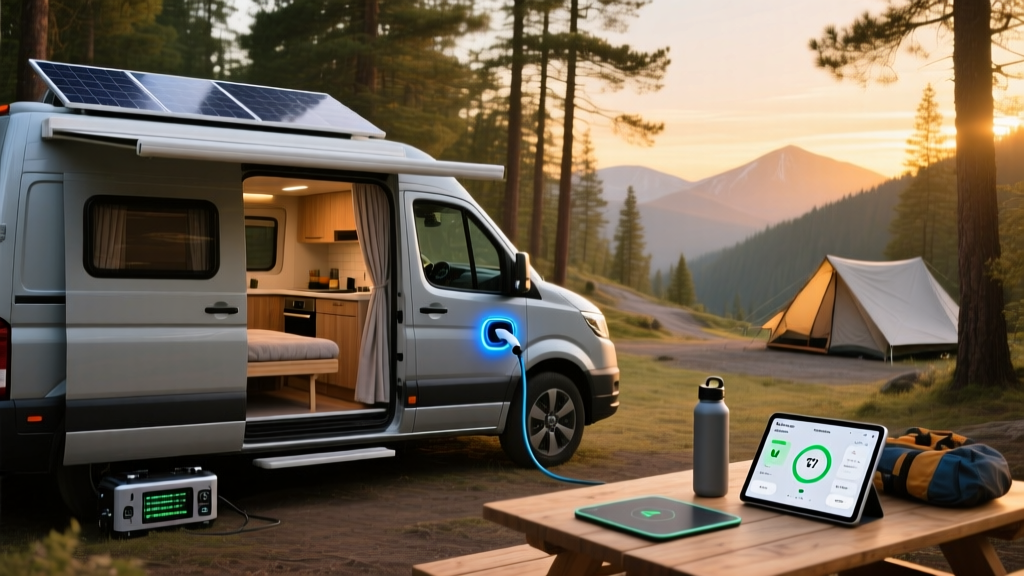
The campground charging problem: Most RV parks and campgrounds offer 30-amp or 50-amp 240V shore power — designed for running camper appliances, not charging a 113 kWh traction battery. A 50-amp RV pedestal delivers roughly 9.6 kW, meaning a full eSprinter charge from 10% to 100% takes about 10–11 hours. That works if you're parked overnight, but it ties up the pedestal and may violate campground policies about using RV hookups for vehicle charging.
DC fast charging on road trips: The eSprinter's 115 kW peak charge rate is adequate but not class-leading. The charge curve tapers significantly above 80% SoC — the 10–80% session takes ~42 minutes, but pushing from 80–100% can add another 35+ minutes. On a 400-mile camping road trip, plan for two 45-minute DC fast-charge stops, plus buffer for charger availability.
Charging infrastructure gaps: The best camping is often in rural areas — national forests, BLM land, remote state parks. These areas remain charging deserts for DC fast charging. If your camping style involves boondocking 50 miles off a highway corridor, an electric camper van will require you to drive back to a charger every 2–3 days or invest in a large solar array (which adds weight, further reducing range).
Tax Credits, Incentives, and the True Purchase Cost
The federal EV tax credit under IRS §30D can reduce the effective cost, but eligibility for a camper-van build is nuanced:
- Vehicle classification: The §30D MSRP cap is $80,000 for vans/SUVs/trucks and $55,000 for sedans. An eSprinter cargo van base (~$58,000) may qualify, but the camper conversion is done aftermarket — the credit applies to the OEM vehicle purchase, not the conversion cost.
- Buyer income caps: AGI must not exceed $300,000 (joint), $225,000 (head of household), or $150,000 (single).
- Battery sourcing requirements: Critical-mineral and battery-component sourcing thresholds increase annually. Verify current-year compliance with your dealer before purchase.
- Point-of-sale transfer: You can transfer the credit to the dealer at purchase for an immediate price reduction, rather than waiting to claim it on your tax return.
- Commercial clean vehicle credit (§45W): If you register the van under a business entity, you may qualify for the §45W credit — up to $7,500 for vehicles under 14,000 lbs GVWR — with different eligibility rules and no income cap.
Always consult a tax professional before relying on credit eligibility. Rules shift with legislation and IRS guidance.
Decision Framework: Should You Build an Electric Camper Van?
Choose an electric camper van if:
- You camp primarily within 150 miles of home at developed campgrounds with shore power
- You also use the van as a daily driver or commuter (maximizing fuel savings)
- You value silent, generator-free camping and zero tailpipe emissions at the campsite
- You have reliable home Level 2 charging (garage or driveway with 240V circuit)
- Your road trips follow interstate corridors with DC fast-charger coverage
- Budget allows $90,000+ for the total build
Stick with a gas or diesel camper van if:
- You boondock on BLM land or remote forest roads far from charging infrastructure
- You regularly drive 300+ mile one-way trips to reach camping destinations
- You camp in cold climates (below 30°F) for extended periods
- You need maximum range flexibility and 5-minute refueling
- Your budget is under $80,000 for the complete build
- You tow a trailer (electric van range drops dramatically under tow load)
Common Misconceptions About Electric Camper Vans
| Myth | Fact |
|---|---|
| "You can run all your camper appliances off the van's traction battery." | The 12V/120V camper house system is typically separate from the high-voltage traction battery. Running a microwave, induction cooktop, or AC off the traction battery requires a dedicated DC-DC converter/inverter setup, which adds cost and weight. Most builds use a separate house battery bank (lithium, 200–400 Ah) charged via DC-DC from the van or solar. |
| "An electric van can charge from a campground solar panel." | A typical 400W rooftop solar array produces ~1.5–2 kWh per day in good sun. That adds roughly 4–6 miles of range — essentially negligible for the 113 kWh eSprinter battery. Solar on a camper van is best reserved for the house battery system. |
| "The $7,500 tax credit makes it cost the same as a gas van." | The credit applies to the OEM chassis only, not the conversion. Combined with the higher base MSRP of the electric van, the total build cost remains $10,000–$25,000 more than a comparable gas build even after incentives. |
| "Electric vans have no maintenance costs." | You save on oil changes, transmission fluid, and exhaust repairs. But tire wear is higher (heavier vehicle, instant torque), cabin air filters still need replacing, brake fluid needs periodic flushing, and the 12V auxiliary battery still dies every 3–5 years. Budget ~$200–$300/year, not zero. |
| "You can V2L (vehicle-to-load) to power your campsite." | As of 2026, neither the eSprinter nor E-Transit offers factory V2L capability in the US market. The Ford F-150 Lightning and Hyundai Ioniq 5 do, but the van platforms haven't adopted this feature yet. Aftermarket inverter solutions exist but void portions of the warranty. |
What First-Time EV Camper Buyers Must Know
If you're considering an electric camper van as your first EV, understand these ownership realities before committing:
Home charging is nearly mandatory. Public DC fast charging at $0.35–$0.50/kWh makes the per-mile cost approach that of a fuel-efficient gas van. The economics only work with home Level 2 charging at residential electricity rates ($0.10–$0.18/kWh depending on your utility). A home Level 2 charger installation typically costs $800–$2,500 (equipment + licensed electrician + permit), assuming your electrical panel has capacity. A 200-amp panel upgrade adds $1,500–$3,500.
Insurance premiums run 10–20% higher for electric vans compared to gas equivalents, driven by higher repair costs for battery and high-voltage components. Get quotes from multiple insurers (GEICO, Progressive, State Farm, and specialty RV insurers like Good Sam or National General) before purchasing.
Battery degradation is slow but real. NMC batteries in the eSprinter and E-Transit are expected to retain roughly 80–85% of original capacity after 100,000 miles based on current degradation data from commercial fleet use. Both manufacturers warrant the battery at 8 years/100,000 miles for capacity above a defined threshold (typically 70–80% retention). Out-of-warranty replacement for a 113 kWh pack could cost $20,000–$30,000 — a significant long-term ownership risk for a camper build you plan to keep 10+ years.
Resale value is uncertain. The EV camper conversion market is nascent. A gas Sprinter camper has an established resale market with predictable depreciation (~40–50% over 5 years). Electric camper vans have limited sales history, and battery health will heavily influence resale value. This is a buy-and-hold proposition, not a flip.
Frequently Asked Questions
Can I tow a trailer with an electric camper van?
The eSprinter is rated to tow up to 5,000 lbs, but towing severely impacts range. Expect a 35–50% range reduction when towing a loaded trailer — dropping a 170-mile real-world range to roughly 85–110 miles. For any camping style that involves towing, a gas or diesel van is far more practical.
How long does it take to fully charge an electric camper van at a campground?
On a 50-amp RV pedestal (~9.6 kW), a fully depleted eSprinter (113 kWh) takes roughly 11–12 hours from near-empty to full. On a standard 30-amp pedestal (~3.6 kW), it would take 30+ hours — essentially impractical. Always confirm campground electrical capacity before relying on shore power for charging.
Is the VW ID. Buzz a viable camper van option?
The ID. Buzz (long-wheelbase US version) offers ~234 miles EPA range and a starting price around $61,000. However, its interior volume is significantly smaller than a Sprinter or Transit — roughly comparable to a short-wheelbase minivan. It works as a weekend camper with a pop-top roof and minimal build-out, but it cannot accommodate a full standing-height camper interior with bathroom, kitchen, and fixed bed. Think of it as an electric VW Westfalia successor, not a Sprinter replacement.
Do electric camper vans qualify for RV registration and insurance?
Registration as a motorhome (RV plates) typically requires a permanently installed living space with specific features (bed, cooking, 110V power, etc.) — the powertrain type doesn't disqualify you. However, some insurers are still developing actuarial models for electric camper conversions. Expect higher premiums and shop multiple specialty RV insurers for coverage.
What's the best electric van for a camper conversion in 2026?
For range and interior volume, the Mercedes-Benz eSprinter (113 kWh, ~200 mi EPA) is the stronger platform for a full camper build. For budget and payload, the Ford E-Transit (~$50,000 base, ~3,300 lb payload) works if your trips are shorter and charging-accessible. Neither is perfect — the eSprinter's higher cost and the E-Transit's shorter range are the key trade-offs.