BYD has quietly become the world's largest plug-in-electric vehicle manufacturer by volume, but for enthusiasts and spec-driven buyers, the question isn't about sales volume — it's about performance. If you're searching for the BYD fastest car, the answer in 2026 spans from a 1,287-horsepower electric supercar to a surprisingly quick family sedan, each built on BYD's vertically integrated battery and motor technology.
This guide ranks every current BYD performance model by acceleration, top speed, and real-world drivability. We'll cover the headline-grabbing Yangwang U9, the globally available Seal, the Han EV, and the emerging performance variants — with exact 0-60 times, battery specs, charging speeds, and honest notes on which of these you can actually buy in the United States.
How We Ranked BYD's Fastest Cars
Performance means different things on a spec sheet versus a public road. Our ranking weights the following criteria:
- Acceleration (0-60 mph / 0-100 km/h): Manufacturer-claimed and independently verified times where available.
- Top speed: Electronically limited or drag-limited maximum velocity.
- Powertrain output: Combined system horsepower and torque across all driven axles.
- Real-world usability: Range, charging speed, ride quality, and daily-driver practicality alongside straight-line speed.
- Availability: Whether the model is currently on sale or announced for a specific market, with US import reality clearly noted.
Models are ranked primarily by 0-60 mph acceleration, with secondary consideration for top speed and overall performance capability.
The BYD Fastest Car Lineup: 2026 Ranked Picks
#1 — Yangwang U9
Key Spec: 0-60 mph in 2.02 seconds | 1,287 HP | 186 mph top speed
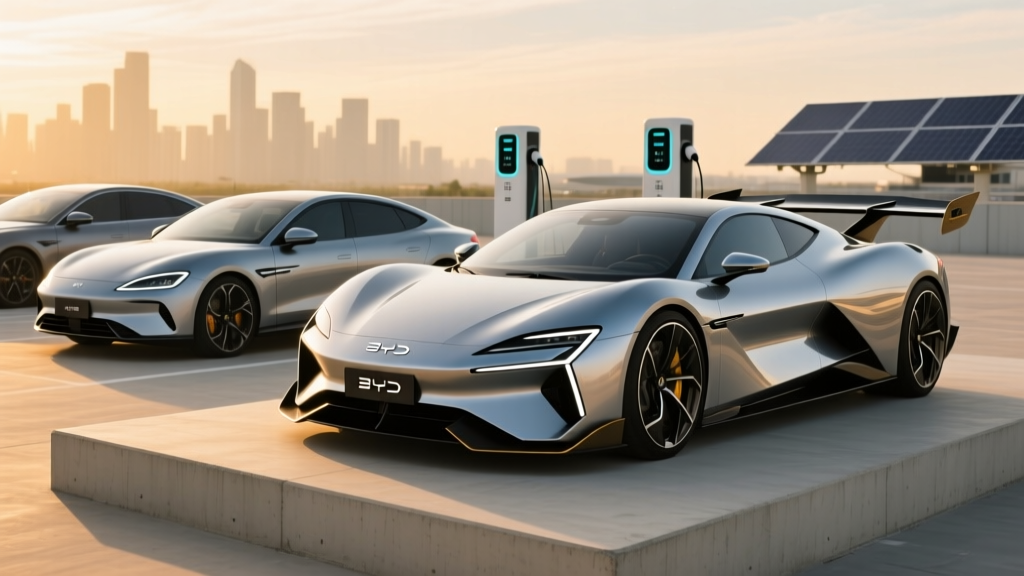
Why it made the list: The Yangwang U9 is not just BYD's fastest car — it's one of the quickest production vehicles on Earth, regardless of powertrain. Four independent electric motors (one per wheel) deliver 1,287 horsepower through BYD's e4 platform, with torque vectoring that can rotate the car through corners with surgical precision. The 80 kWh Blade Battery (LFP chemistry) provides an estimated 280 miles of CLTC range, though real-world performance driving will cut that significantly.
Best for: Hypercar collectors and technology demonstrators. This is a halo vehicle proving BYD's engineering ceiling — not a daily commuter.
Price & availability: Approximately ¥1.68 million (~$233,000 USD) in China. Not sold in the US and not eligible for any US federal tax credit. US import would face 100%+ tariffs on Chinese EVs under current trade policy.
#2 — BYD Seal (AWD Performance)
Key Spec: 0-60 mph in 3.8 seconds | 523 HP | 295-mile WLTP range
Why it made the list: The Seal AWD Excellence is BYD's global performance sedan and the most accessible model on this list. Dual motors produce a combined 523 horsepower, launching the Seal to 60 mph in 3.8 seconds — territory occupied by the Tesla Model 3 Performance and BMW i4 M50. The 82.5 kWh Blade Battery (LFP) delivers up to 295 miles on the WLTP cycle; expect roughly 240-260 miles in real-world mixed driving, and approximately 200-220 miles at sustained highway speeds or in cold weather.
Best for: Performance-sedan buyers who want Tesla-rivaling acceleration without the Tesla ecosystem. Strong value proposition in European, Australian, and Southeast Asian markets.
Price & availability: Starting around €50,000 (~$54,000 USD) in Europe; varies by market. Not available in the US market as of 2026. No US federal §30D tax credit eligibility due to Chinese manufacturing origin.
#3 — BYD Han EV (AWD Flagship)
Key Spec: 0-60 mph in 3.9 seconds | 510 HP | 310-mile CLTC range
Why it made the list: The Han EV is BYD's flagship sedan and was the brand's first model to break the 4-second 0-100 km/h barrier. The 2025-2026 refresh pairs dual motors for 510 horsepower with an 85.4 kWh Blade Battery. The Han rides on a longer wheelbase than the Seal, trading a fraction of agility for superior rear-seat comfort and a more executive character. At 3.9 seconds to 60 mph, it remains seriously quick while offering a more refined, less aggressive driving experience than the Seal.
Best for: Executive sedan buyers prioritizing rear-seat space and ride comfort alongside strong acceleration. Think Mercedes EQE territory at a lower price point.
Price & availability: Starting around ¥270,000 (~$37,500 USD) in China; European pricing around €55,000. Not sold in the US.
#4 — BYD Seal U (DM-p AWD PHEV)
Key Spec: 0-60 mph in 5.0 seconds | 469 HP combined | 62-mile EV-only range
Why it made the list: The Seal U DM-p is a plug-in hybrid SUV that proves BYD's performance engineering extends beyond pure electric. The DM-p (Dual Mode performance) powertrain pairs a 1.5-liter turbo engine with front and rear electric motors for 469 combined horsepower. The 18.3 kWh Blade Battery provides approximately 62 miles of electric-only driving (WLTP), making it a legitimate daily EV commuter that can also hit 60 mph in 5.0 seconds when all power sources combine.
Best for: Buyers who want performance SUV acceleration with the range security of a gasoline engine for road trips. Ideal for those without reliable home charging who still want electric daily driving.
Price & availability: Starting around €42,000 in Europe. Not available in the US. PHEVs from Chinese manufacturers face additional scrutiny under US trade policy.
#5 — BYD Atto 3 / Yuan Plus (AWD variant)
Key Spec: 0-60 mph in 5.8 seconds | 308 HP | 260-mile WLTP range
Why it made the list: The Atto 3 (sold as Yuan Plus in China) is BYD's global compact SUV, and the AWD variant adds a rear motor for 308 combined horsepower and a 5.8-second sprint. While not a performance car in the traditional sense, it represents the entry point to BYD's faster models and offers genuine hot-hatch acceleration in a practical crossover body with a 60.5 kWh Blade Battery.
Best for: Budget-conscious buyers in international markets wanting a quick, practical compact SUV with BYD's proven LFP battery technology and competitive pricing.
Price & availability: Starting around €38,000 in Europe; various pricing in Asia-Pacific markets. Not available in the US.
#6 — BYD Dolphin (Sport variant)
Key Spec: 0-60 mph in 7.0 seconds | 201 HP | 265-mile WLTP range
Why it made the list: The Dolphin Sport is the warm-hatch end of BYD's performance spectrum. Its 201-horsepower front motor and 60.5 kWh Blade Battery deliver adequate quickness for urban merging and passing, with a focus on efficiency over outright speed. It earns its place here as the most affordable model in BYD's lineup that offers genuinely engaging acceleration.
Best for: Urban commuters and first-time EV buyers who want peppy city performance without paying a performance premium.
Price & availability: Starting around €30,000 in Europe. Not available in the US.
BYD Fastest Cars: Side-by-Side Comparison
| Model | 0-60 mph | Horsepower | Battery (kWh) | Range (est.) | DC Fast Charge | Price (USD est.) |
|---|---|---|---|---|---|---|
| Yangwang U9 | 2.02 sec | 1,287 HP | 80 kWh (LFP) | ~280 mi CLTC | ~180 kW peak | ~$233,000 |
| Seal AWD | 3.8 sec | 523 HP | 82.5 kWh (LFP) | ~240-260 mi real | 150 kW peak | ~$54,000 |
| Han EV AWD | 3.9 sec | 510 HP | 85.4 kWh (LFP) | ~250-270 mi real | 120 kW peak | ~$37,500 (China) |
| Seal U DM-p | 5.0 sec | 469 HP | 18.3 kWh (LFP) | 62 mi EV + gas | N/A (PHEV) | ~$46,000 |
| Atto 3 AWD | 5.8 sec | 308 HP | 60.5 kWh (LFP) | ~220-240 mi real | 88 kW peak | ~$41,000 |
| Dolphin Sport | 7.0 sec | 201 HP | 60.5 kWh (LFP) | ~220-240 mi real | 88 kW peak | ~$32,500 |
US Availability: The Hard Reality for American Buyers
If you're reading this from the United States, the most critical data point is this: no BYD passenger vehicle is currently sold in the US market. BYD has no US dealer network, no US-spec models, and no announced timeline for passenger car entry.
The barriers are structural:
- Tariffs: Chinese-manufactured EVs face a 100% tariff under current US trade policy, effectively doubling the landed cost of any BYD model.
- Federal tax credit: Under IRS §30D rules, vehicles must meet North American assembly, battery-component sourcing, and critical-mineral requirements to qualify for the up-to-$7,500 credit. BYD's vertically integrated Chinese supply chain does not meet these requirements. See IRS clean vehicle credit guidelines for current eligibility rules.
- Homologation: BYD has not pursued US FMVSS certification for any passenger model, a process requiring significant engineering changes for crash safety, lighting, and software compliance.
BYD does operate in the US in limited commercial segments — electric buses manufactured at a Lancaster, California facility — but this does not translate to consumer vehicle availability.
What this means for US buyers: If you want BYD-rivaling performance in a US-available vehicle, your practical alternatives include the Tesla Model 3 Performance (3.1 sec 0-60, ~$52,990, eligible for §30D credit), Hyundai Ioniq 5 N (3.4 sec, ~$66,000), or BMW i4 M50 (3.7 sec, ~$67,000).
Battery Technology: Why Every BYD Uses LFP
Every model in BYD's performance lineup uses the company's proprietary Blade Battery, which employs lithium iron phosphate (LFP) cell chemistry arranged in a cell-to-pack structural design. This is a deliberate engineering choice with specific trade-offs:
| Attribute | LFP (BYD Blade) | NMC/NCA (Tesla, Hyundai, BMW) |
|---|---|---|
| Energy density | Lower (~160 Wh/kg cell-level) | Higher (~250-300 Wh/kg cell-level) |
| Cycle life | 3,000+ cycles to 80% capacity | 1,000-2,000 cycles to 80% capacity |
| Thermal stability | Excellent — no thermal runaway in nail-penetration tests | Good — requires active thermal management |
| Cost per kWh | Lower — no cobalt or nickel | Higher — commodity-sensitive materials |
| Cold-weather performance | Greater range loss below 32°F / 0°C | Better cold-weather retention |
| State of Charge accuracy | Flatter voltage curve — SoC estimation less precise | Steeper voltage curve — easier SoC estimation |
The LFP choice means BYD's batteries are exceptionally durable and safe, but they sacrifice some energy density (requiring larger, heavier packs for equivalent range) and suffer more in cold climates. If you're evaluating a BYD model for a cold-weather market, plan for 25-35% range reduction in sub-freezing conditions — more than you'd experience with an NMC-based competitor.
Charging Performance: What BYD Owners Actually Experience
Peak charge rate alone doesn't tell the full story. BYD's LFP Blade Batteries charge conservatively compared to NMC competitors, prioritizing battery longevity over charging speed:
| Model | Peak DC kW | 10-80% Time | Level 2 AC kW | Miles/Hour (L2) |
|---|---|---|---|---|
| Yangwang U9 | ~180 kW | ~25 min (est.) | 7 kW | ~20 mi/hr |
| Seal AWD | 150 kW | ~26 min | 11 kW | ~32 mi/hr |
| Han EV AWD | 120 kW | ~30 min | 7 kW | ~20 mi/hr |
| Atto 3 AWD | 88 kW | ~35 min | 11 kW | ~32 mi/hr |
| Dolphin Sport | 88 kW | ~35 min | 7 kW | ~20 mi/hr |
Real-world charging note: BYD's charge curves taper significantly above 80% state of charge — a characteristic of LFP chemistry. If you're road-tripping, plan to charge from 10-80% and drive on rather than waiting for a full charge. The Seal AWD's 150 kW peak is competitive, but sustained rates average closer to 100-110 kW across the 10-80% window, meaning actual charging stops take roughly 26-30 minutes at a sufficiently powerful DC fast charger (150 kW+ rated).
Decision Framework: Which BYD Performance Model Fits?
Choose the Yangwang U9 if: You are a collector or investor in the Chinese market seeking a technology showcase. This is a low-volume halo car, not a practical vehicle.
Choose the Seal AWD if: You're in Europe, Australia, or Southeast Asia and want the best balance of performance (3.8 sec 0-60), range (~250 real-world miles), and value in BYD's lineup. This is the performance sweet spot.
Choose the Han EV AWD if: You prioritize rear-seat comfort and executive presence over outright sportiness. The 0.1-second difference to 60 mph is negligible; the wheelbase and ride-quality difference is not.
Choose the Seal U DM-p if: You need SUV practicality, can charge at home for daily EV commuting (62 miles covers most commutes), and want the security of a gas engine for longer trips.
Choose the Atto 3 AWD or Dolphin Sport if: Budget is the primary constraint and you want adequate (not extreme) performance in a practical package.
Choose a US-available alternative if: You are an American buyer. The tariffs, lack of dealer support, and §30D ineligibility make importing a BYD impractical. Consider the Tesla Model 3 Performance, Hyundai Ioniq 5 N, or BMW i4 M50 for comparable or superior performance with full US support and tax-credit eligibility.
Frequently Asked Questions
What is the fastest BYD car in 2026?
The Yangwang U9 is BYD's fastest car, reaching 0-60 mph in 2.02 seconds with 1,287 horsepower from four independent electric motors. It is priced at approximately $233,000 in China and is not available in the United States.
Can I buy a BYD in the United States?
No. BYD does not sell passenger vehicles in the US market. Chinese-manufactured EVs face 100% tariffs, and BYD vehicles do not qualify for the federal §30D clean vehicle tax credit due to assembly and battery-sourcing requirements.
How does the BYD Seal compare to the Tesla Model 3 Performance?
The BYD Seal AWD reaches 0-60 mph in 3.8 seconds versus the Tesla Model 3 Performance's 3.1 seconds. The Tesla offers a more mature Supercharger network, US availability, and potential §30D tax credit eligibility. The Seal offers competitive build quality, LFP battery durability, and lower pricing in markets where both are available.
Why does BYD use LFP batteries instead of NMC?
LFP (lithium iron phosphate) chemistry offers superior cycle life (3,000+ cycles), better thermal stability, and lower cost because it avoids cobalt and nickel. The trade-off is lower energy density and worse cold-weather range retention. BYD manufactures its own cells, making LFP a strategic cost advantage.
What is BYD's Blade Battery technology?
The Blade Battery is BYD's proprietary LFP cell design where long, thin prismatic cells are arranged structurally within the pack, eliminating modular grouping. This increases pack-level energy density, improves structural rigidity, and enhances thermal safety — the cells pass nail-penetration tests without thermal runaway.
Does BYD plan to enter the US market?
As of 2026, BYD has not announced any plans to sell passenger vehicles in the United States. The company has focused US operations on commercial electric buses. Geopolitical trade barriers and tariff structures make near-term US passenger vehicle entry unlikely.
What US-available EV matches BYD Seal performance?
The closest US-available alternatives are the Tesla Model 3 Performance (3.1 sec 0-60, ~$52,990 MSRP before incentives), Hyundai Ioniq 5 N (3.4 sec, ~$66,000), and BMW i4 M50 (3.7 sec, ~$67,000). The Tesla Model 3 Performance may qualify for partial or full §30D credit depending on current battery-sourcing compliance — verify at fueleconomy.gov.