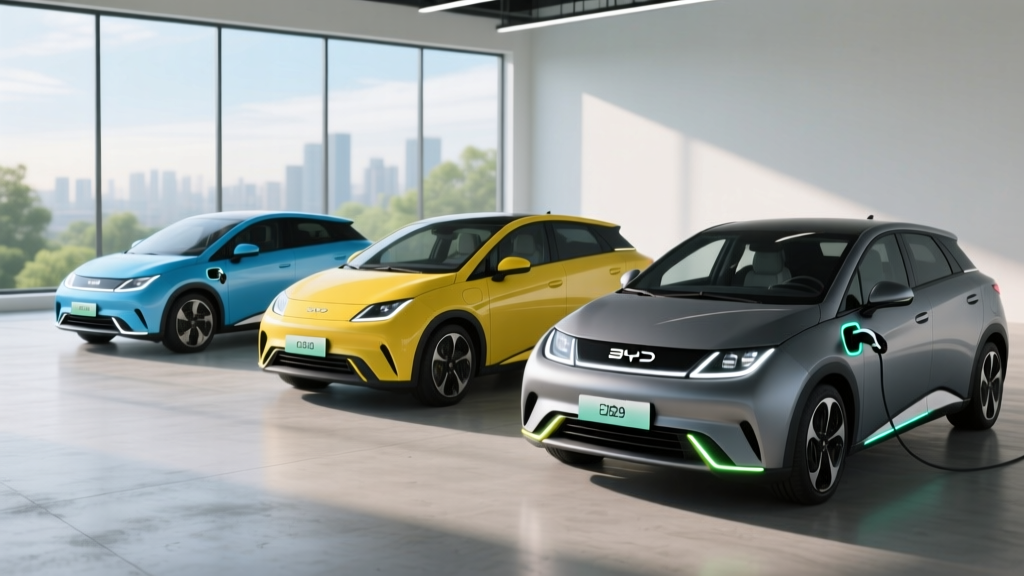
If you have been following global EV headlines, you already know BYD is selling some of the most affordable electric cars on the planet. The question for US-based buyers is whether the BYD cheapest car options are actually attainable — and how they compare to budget EVs you can buy stateside today. This guide ranks BYD's most affordable models by real-world value, pairs them with the closest US-market alternatives, and gives you exact specs so you can decide what to buy (or wait for).
How We Ranked These Picks
Value in an EV is not just the sticker price. Our ranking weights five factors, each backed by data rather than marketing:
- Effective range (30%): WLTP-to-EPA adjusted range in miles, with real-world highway and cold-weather caveats.
- Price-to-range ratio (25%): MSRP divided by usable range — the true value metric.
- Charging practicality (20%): Peak DC fast-charge rate (kW), 10-80% time, and Level 2 speed.
- Battery longevity & chemistry (15%): LFP vs NMC, cycle-life expectations, and warranty terms.
- Market availability (10%): Whether US buyers can actually purchase the vehicle today, with service infrastructure.
We evaluated seven BYD models sold globally and matched each with the nearest US-market equivalent for head-to-head comparison.
The BYD Cheapest Car Options Ranked for 2026
1. BYD Seagull (Dolphin Mini) — The Global Price King
Key spec: ~252 miles WLTP range (~210 miles EPA-equivalent) | ~$12,000–$15,000 (global MSRP)
Why it made the list: The Seagull is the definitive answer to "what is the BYD cheapest car?" It undercuts virtually every production EV on Earth while offering a usable Blade Battery (LFP), four seats, and reasonable highway capability.
Best for: Urban commuters in markets where it is sold (China, Latin America, Southeast Asia). US buyers: not currently available due to 100%+ tariffs on Chinese-manufactured EVs.
Battery: ~38.9 kWh usable, LFP Blade | DC charging: ~40 kW peak, 30-80% in ~30 min | Level 2: 6.6 kW | 0-60: ~11.0 sec
2. BYD Dolphin — The Practical Compact Hatchback
Key spec: ~265 miles WLTP (~220 EPA-est.) | ~$18,000–$22,000 (global MSRP)
Why it made the list: The Dolphin steps up to a more spacious hatchback form factor with a larger 60.4 kWh Blade Battery, better DC charging speeds, and a more refined interior. It is the BYD cheapest car you could call a legitimate family vehicle.
Best for: Small families and daily commuters in export markets (Europe, Australia, Southeast Asia).
Battery: 60.4 kWh usable, LFP Blade | DC charging: 88 kW peak, 10-80% in ~34 min | Level 2: 7 kW | 0-60: ~7.0 sec
3. BYD Yuan Plus (Atto 3) — The Budget Crossover
Key spec: ~260 miles WLTP (~215 EPA-est.) | ~$24,000–$28,000 (global MSRP)
Why it made the list: The Atto 3 (sold as Yuan Plus in some markets) gives crossover utility — raised ride height, 15.7 cu ft cargo — at a price that undercuts US compact EV crossovers by thousands.
Best for: Buyers wanting SUV ergonomics without SUV pricing, in markets with BYD dealerships.
Battery: 58.56 kWh usable, LFP Blade | DC charging: 88 kW peak, 10-80% in ~33 min | Level 2: 7 kW | 0-60: ~7.3 sec
4. BYD Dolphin Mini (Seagull Extended) — The Range Upgrade
Key spec: ~280 miles WLTP (~235 EPA-est.) | ~$15,000–$18,000 (global MSRP)
Why it made the list: An extended-range version of the Seagull with a slightly larger battery pack, offering the best price-per-mile ratio in BYD's lineup for those willing to stretch the budget modestly.
Best for: Budget-focused buyers who need a bit more highway range for occasional longer trips.
Battery: ~44 kWh usable, LFP Blade | DC charging: ~45 kW peak, 30-80% in ~35 min | Level 2: 6.6 kW
5. Chevrolet Equinox EV 2LT — The US Budget Benchmark
Key spec: 319 miles EPA range | $33,600 MSRP (before incentives)
Why it made the list: If you are a US buyer researching the BYD cheapest car and realizing import barriers, the Equinox EV is the closest domestic equivalent in spirit — a practical, affordable, long-range crossover.
Best for: US-based buyers wanting maximum range per dollar with full warranty and service support.
Battery: ~85 kWh usable, NMC | DC charging: 150 kW peak, 10-80% in ~28 min | Level 2: 11.5 kW | 0-60: ~8.0 sec | Tax credit: Potentially eligible for up to $7,500 under IRS §30D, subject to MSRP, income, and battery-sourcing requirements.
6. Nissan Leaf (2026) — The Legacy Budget EV
Key spec: 212 miles EPA range (SV Plus) | $28,140 MSRP
Why it made the list: The Leaf remains one of the cheapest new EVs sold in the US. It uses CHAdeMO (not CCS/NACS), which limits future fast-charging access, but for home-charging commuters, it still works.
Best for: Price-sensitive US buyers who charge at home and drive under 150 miles daily.
Battery: 62 kWh usable (SV Plus), NMC | DC charging: 100 kW peak (CHAdeMO), 10-80% in ~35 min | Level 2: 6.6 kW | 0-60: ~7.4 sec
7. Hyundai Kona Electric (2026) — The All-Rounder
Key spec: 261 miles EPA range | $32,975 MSRP
Why it made the list: The redesigned Kona Electric offers NACS charging access (Tesla Supercharger network), strong efficiency (129 MPGe combined per fueleconomy.gov), and practical cargo space.
Best for: US buyers who want road-trip charging flexibility via the NACS/Supercharger network.
Battery: 64.8 kWh usable, NMC | DC charging: 100 kW peak, 10-80% in ~43 min | Level 2: 10.9 kW | 0-60: ~7.6 sec
Side-by-Side: How the Top Picks Compare
| Model | Range (EPA / adj.) | Battery (kWh) | Peak DC kW | 10-80% Time | MSRP (Global/US) |
|---|---|---|---|---|---|
| BYD Seagull | ~210 mi (est.) | 38.9 LFP | 40 kW | ~30 min (30-80%) | ~$12,000–$15,000 |
| BYD Dolphin Mini (ext.) | ~235 mi (est.) | 44 LFP | 45 kW | ~35 min (30-80%) | ~$15,000–$18,000 |
| BYD Dolphin | ~220 mi (est.) | 60.4 LFP | 88 kW | ~34 min | ~$18,000–$22,000 |
| BYD Atto 3 (Yuan Plus) | ~215 mi (est.) | 58.6 LFP | 88 kW | ~33 min | ~$24,000–$28,000 |
| Chevrolet Equinox EV | 319 mi (EPA) | ~85 NMC | 150 kW | ~28 min | $33,600 |
| Nissan Leaf SV Plus | 212 mi (EPA) | 62 NMC | 100 kW | ~35 min | $28,140 |
| Hyundai Kona Electric | 261 mi (EPA) | 64.8 NMC | 100 kW | ~43 min | $32,975 |
US Availability: The Hard Truth About BYD Imports
As of 2026, BYD does not sell passenger vehicles in the United States. The company has publicly stated it is evaluating a US entry, but current trade policy imposes tariffs exceeding 100% on Chinese-manufactured EVs under Section 301 and additional duties. That means a $12,000 BYD Seagull would cost well over $24,000 if imported — eliminating its primary advantage.
BYD's Blade Battery (LFP) technology is genuinely impressive for longevity and safety. LFP chemistry avoids cobalt and nickel, offering 3,000+ charge cycles with minimal degradation — meaning a Seagull battery could theoretically outlast the car itself. But without a US dealer network, service infrastructure, and NHTSA crash-test validation, these vehicles remain irrelevant to American buyers for now.
If you are shopping today in the US, the budget EVs that actually compete on the value metrics BYD dominates globally are the Equinox EV, Kona Electric, and Leaf. Each has trade-offs compared to BYD's pricing, but all come with warranties, service centers, and federal tax-credit eligibility.
Budget Tiers: What You Can Actually Buy
| Tier | Price Range (After Credits) | Top Pick | Runner-Up |
|---|---|---|---|
| Under $25K | Used EV market / Leaf with incentives | Nissan Leaf S ($28,140 MSRP, potentially lower with state incentives) | Used Chevy Bolt EV (2023, ~$18,000–$22,000 used) |
| $25K–$30K | After §30D credit on eligible models | Chevrolet Equinox EV (if eligible for full $7,500 credit → ~$26,100 effective) | Hyundai Kona Electric SE ($32,975 MSRP) |
| $30K–$35K | MSRP range, pre-incentive | Hyundai Kona Electric (NACS charging, 261 mi range) | Chevrolet Equinox EV 3RS (~$35,000) |
Federal Tax Credit Reality for Budget EVs
Under IRS §30D rules for 2026, the federal clean vehicle credit offers up to $7,500 — split between a $3,750 critical-minerals component and a $3,750 battery-component component. Eligibility depends on:
- MSRP caps: $55,000 for sedans/hatchbacks; $80,000 for SUVs/pickups/trucks.
- Income caps: AGI ≤ $150,000 single / $225,000 head of household / $300,000 joint.
- Battery sourcing: Increasingly strict critical-mineral and battery-component requirements that favor North American or FTA-partner supply chains.
- Point-of-sale transfer: Eligible buyers can transfer the credit to the dealer at purchase, reducing the out-of-pocket price immediately.
The Chevrolet Equinox EV, assembled in Mexico with a GM Ultium battery, has fluctuated in eligibility as sourcing rules tighten. Always verify current eligibility on the fueleconomy.gov tax credit page before purchasing. Consult a tax professional for your specific situation.
Which Should You Pick for Your Use Case?
Choose the BYD Seagull if: You live in a market where BYD sells directly (Mexico, Brazil, Thailand, parts of Europe) and need the absolute lowest-cost EV for city commuting under 100 miles daily.
Choose the BYD Dolphin if: You need five-door hatchback practicality and ~220 miles of real-world range at a sub-$22K price point, in an export market.
Choose the Chevrolet Equinox EV if: You are a US buyer wanting 300+ miles of EPA range, DC fast charging at 150 kW, and eligibility for the $7,500 federal credit — the best price-per-mile ratio available domestically.
Choose the Hyundai Kona Electric if: You prioritize Tesla Supercharger (NACS) access for road trips and want a well-rounded compact EV with strong efficiency.
Choose the Nissan Leaf if: You are strictly budget-driven, charge at home overnight, and accept CHAdeMO's declining public-charging relevance.
Top Pick: BYD Seagull (Global) / Chevrolet Equinox EV (US)
Globally, the BYD Seagull is the undisputed cheapest car from BYD and one of the cheapest EVs period — a genuine sub-$15,000 electric vehicle with LFP longevity. For US buyers who cannot access BYD, the Chevrolet Equinox EV delivers the best value equation: 319 miles EPA range, 150 kW DC charging, and potential §30D credit eligibility bringing effective cost near $26,000. It is not a $12,000 Seagull, but it is the closest thing to that value proposition on American soil.
Frequently Asked Questions
What is the cheapest BYD car available in 2026?
The BYD Seagull (also called Dolphin Mini in some markets) is the cheapest BYD car, starting around $12,000–$15,000 in global markets. It features a 38.9 kWh LFP Blade Battery, approximately 252 miles of WLTP range (~210 EPA-adjusted), and 40 kW DC fast charging.
Can I buy a BYD in the United States?
No. As of 2026, BYD does not sell passenger vehicles in the US. Tariffs exceeding 100% on Chinese-manufactured EVs make importing economically unviable. BYD has discussed potential US entry but has announced no timeline or dealer network.
Is the BYD Seagull's LFP battery better than NMC?
For longevity and safety, yes — LFP (lithium iron phosphate) chemistry in BYD's Blade Battery offers 3,000+ charge cycles, excellent thermal stability, and no cobalt. The trade-off is lower energy density, meaning more weight and volume for the same kWh compared to NMC. For a budget city car like the Seagull, LFP is the ideal chemistry.
What US EV comes closest to BYD pricing?
The Nissan Leaf S at $28,140 MSRP is the cheapest new EV sold in the US. After the §30D federal credit (if eligible), the Chevrolet Equinox EV can approach ~$26,100 effective cost with 319 miles of range — dramatically better value per mile than the Leaf.
Does the BYD Dolphin support fast charging?
Yes. The BYD Dolphin supports up to 88 kW DC fast charging, achieving a 10-80% charge in approximately 34 minutes. Level 2 AC charging runs at 7 kW. Note that BYD vehicles in most export markets use CCS2 or GB/T connectors, not the NACS standard now dominant in North America.
Will BYD ever sell cars in the US?
BYD executives have indicated interest in the US market, but current tariff structures and geopolitical trade tensions make near-term entry unlikely. If policy shifts, BYD's most plausible US entry vehicle would be the Atto 3 (Yuan Plus) crossover or a future model built in a non-China factory to avoid Section 301 tariffs.