The Core EV Apps You Actually Need
If you're buying or owning an EV in 2026, the three app categories that matter most are: charging-network apps (Tesla, Electrify America, ChargePoint), route planners (A Better Routeplanner, PlugShare), and cost-tracking tools (your utility's app + a kWh monitor). Together, these replace the gas-station habit with data-driven charging decisions. Expect to spend $0 on most of these — they're free — but they're the difference between confident ownership and range anxiety.
The transition from a gas car to an electric vehicle is as much a software shift as a mechanical one. Where you once relied on a fuel gauge and a mental map of gas stations, EV ownership runs on apps that show real-time charger availability, battery preconditioning status, and electricity pricing. Getting the app ecosystem right is what separates EV owners who save thousands annually from those who get stranded at a broken charger on a road trip.
What Does an EV Owner Actually Need to Decide?
Before downloading anything, frame the decision correctly. A first-time EV buyer needs answers to four questions:
- Where can I charge? — Home Level 2, workplace, or public DC fast chargers along your routes.
- How much will it cost? — Electricity rates, public charging premiums, and how that compares to gasoline.
- Will the range hold up? — EPA sticker vs. real-world highway and cold-weather performance.
- How do I plan trips? — Route planning with charging stops factored in.
Each of these maps to a specific app category. Here's the breakdown.
The Charging-Network Apps: Your Fuel Stations, Digitized
Unlike gas stations where any pump works with any car, EV charging is fragmented across networks with proprietary connectors, payment systems, and reliability records. In 2026, the major networks and their apps include:
- Tesla Supercharger (via Tesla app): 250 kW V3 stalls, now open to NACS-equipped non-Tesla EVs. ~15-25 min for 10-80% on compatible vehicles.
- Electrify America: Up to 350 kW CCS/NACS stalls. Reliability has improved but still inconsistent — check station status in-app before driving there.
- ChargePoint: Dominates Level 2 destination charging (workplaces, malls). App shows real-time port availability.
- EVgo: Growing DC fast network, 350 kW stalls in metro areas. Strong partnership with automakers for included charging credits.
The critical app feature to look for: real-time charger status. A station showing 4/4 stalls available is very different from one showing 0/4 with a maintenance note. According to J.D. Power's EVX Public Charging Study, public charger reliability remains the top pain point for EV owners, making pre-trip app checks essential.
Route Planners: The EV Trip Computer
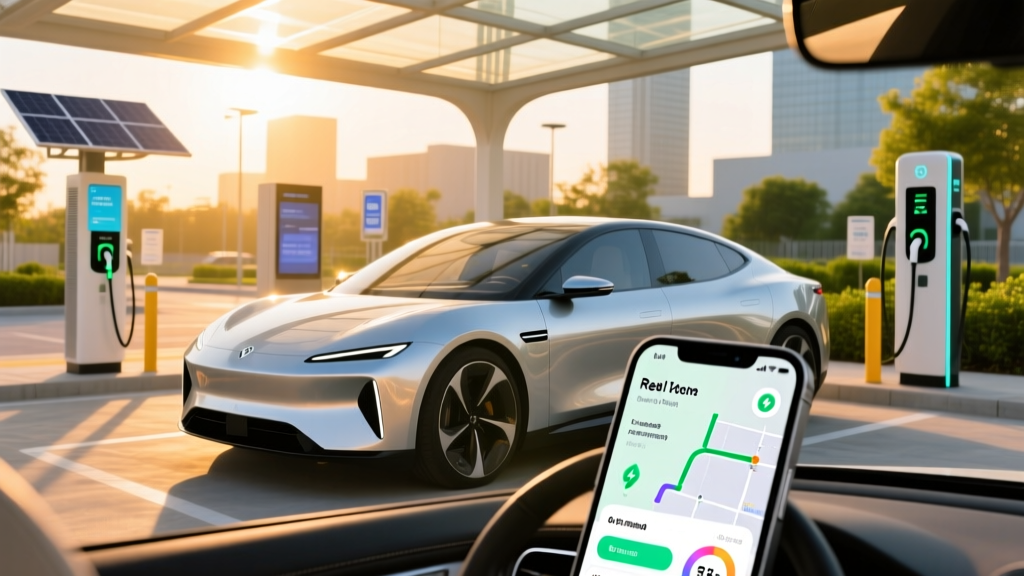
A route planner built for EVs factors in battery state of charge, elevation changes, temperature, and charging-station locations — something Google Maps only partially handles. The two leaders:
- A Better Routeplanner (ABRP): Enter your exact EV model, starting SoC, and destination. It calculates optimal charging stops, accounting for charge-curve taper (charging slows significantly above 80% SoC). Free tier is robust; premium ($4.99/mo) adds live vehicle data integration.
- PlugShare: Crowdsourced charger reviews and photos. Essential for verifying whether a listed charger actually works — user check-in data is often more reliable than the network's own status feed.
ABRP's key insight for new owners: highway driving at 75 mph consumes 20-30% more energy than the EPA combined cycle. A car rated at 310 miles EPA might deliver 230-250 miles at sustained highway speeds in 40°F weather. Plan stops accordingly.
Cost Tracking: What EV Ownership Actually Costs vs. Gas
The financial case for an EV hinges on the cost-per-mile comparison. Here's a realistic 2026 breakdown based on a mid-size EV (e.g., Hyundai Ioniq 5, 84 kWh battery, 303 mi EPA range, ~$42,500 MSRP) versus a comparable gas sedan (e.g., Toyota Camry, ~$28,000 MSRP, 32 MPG combined).
| Scenario | EV (Ioniq 5) | Gas (Camry 32 MPG) |
|---|---|---|
| Home charging @ $0.14/kWh | $504/yr (3.0 kWh/mi × 12,000 mi × $0.14) | — |
| Gasoline @ $3.40/gal | — | $1,275/yr (12,000 ÷ 32 × $3.40) |
| 50% public DC fast charging @ $0.38/kWh | $1,368/yr | — |
| Annual maintenance | ~$300 (tire rotation, cabin filter) | ~$800 (oil, filters, belts) |
| Annual energy + maintenance | $804 – $1,668 | $2,075 |
The takeaway: Home charging is where the savings live. If you charge 80%+ at home, you save $1,000-$1,500/year over gas. If you rely entirely on public DC fast charging at premium rates, the EV can actually cost more to "fuel" than a gas car. This is the single most important ownership variable — and it's why your utility's app (showing time-of-use rates) is a must-have.
EV vs. Gas vs. Hybrid: Total Cost of Ownership (5 Years, 60,000 Miles)
| Category | EV (Ioniq 5 SEL) | PHEV (Toyota RAV4 Prime) | Gas (Camry LE) |
|---|---|---|---|
| Purchase price (MSRP) | $42,500 | $43,690 | $28,400 |
| Federal tax credit (§30D) | Up to $7,500* | Up to $7,500* | $0 |
| Effective purchase | ~$35,000 | ~$36,190 | $28,400 |
| 5-yr fuel cost | $2,520 – $6,840 | $3,200 (mixed gas + electric) | $6,375 |
| 5-yr maintenance | $1,500 | $3,000 | $4,000 |
| 5-yr insurance (avg) | $9,500 | $7,800 | $7,200 |
| 5-yr total | $48,520 – $52,840 | $50,190 | $45,975 |
*§30D credit eligibility depends on MSRP caps, buyer income limits, and battery-sourcing requirements per current IRS rules. Consult a tax professional.
Real-World Ownership Considerations Most Guides Skip
Apps can only help if you understand the physical constraints they're reporting on. Here are the ownership realities that app data helps you navigate:
Home Charging Access Is the Make-or-Break Variable
If you can install a Level 2 charger (240V, 32-48A, delivering 7-11 kW), you'll wake up to a full battery daily and rarely need public charging. Installation costs range from $500 (simple outlet near the panel) to $3,000+ (panel upgrade, long wire run). According to fueleconomy.gov, Level 2 home charging adds roughly 25-44 miles of range per hour — more than enough for overnight replenishment.
If you live in an apartment without charging access, your app strategy shifts: you'll rely on PlugShare and network apps to identify reliable workplace or neighborhood chargers, and you'll pay public-charging premiums. This can erase the fuel-cost advantage entirely.
Cold Weather Cuts Range 20-40%
In sub-freezing temperatures, battery chemistry slows and cabin heating draws significant power. A 310-mile EPA EV may deliver 190-240 real-world miles in 20°F weather. ABRP lets you input temperature to adjust route planning. EVs with heat pumps (standard on Hyundai/Kia E-GMP, Tesla, and most 2025+ models) recover 10-15% of that loss compared to resistive heating.
Charging Curves Are Not Flat
A charger rated at 250 kW does not deliver 250 kW for the entire session. Most EVs peak at 10-30% SoC and taper significantly above 80%. A realistic session on a 250 kW stall: 10-80% in 18-25 minutes, but 80-100% can take another 20+ minutes. Apps like ABRP show the expected curve so you don't plan a 15-minute stop and end up waiting 40.
Common EV App Misconceptions — Corrected
| Myth | Fact |
|---|---|
| "I need 10 different charging apps" | Most networks now support Plug & Charge or RFID interoperability. You typically need 2-3 network apps plus PlugShare/ABRP for planning. |
| "Google Maps handles EV routing perfectly" | Google Maps shows chargers but doesn't model SoC, temperature, or charge-curve taper. ABRP is more precise for trip planning. |
| "EV apps tell you exact range" | Range estimates in-app are models based on recent driving. Real range varies with speed, temperature, terrain, and HVAC use. Always plan with a 15-20% buffer. |
| "Public charging apps show accurate pricing" | Pricing can lag — idle fees, session fees, and time-of-use rates may not display until you plug in. Verify in-network app before committing to a stop. |
| "My car's built-in nav replaces all apps" | OEM navigation is often 6-12 months behind on new charger locations. Third-party apps update faster via crowdsourcing. |
The Federal Tax Credit: What the Apps Won't Tell You
No app calculates your §30D tax credit eligibility — that requires understanding IRS rules that change frequently. Key 2026 parameters:
- MSRP caps: $80,000 for SUVs/pickups/trucks; $55,000 for sedans.
- Buyer income caps: $150,000 single / $300,000 joint MAGI.
- Battery sourcing: Critical minerals and battery components must meet increasing domestic-content thresholds — the list of qualifying vehicles narrows each year.
- Point-of-sale transfer: You can transfer the credit to the dealer at purchase, reducing the sale price directly rather than waiting for a tax refund.
Check fueleconomy.gov's tax credit tool for the current qualifying vehicle list before relying on any third-party app's credit estimate.
Decision Framework: Which Apps Do You Actually Need?
If-Then App Guide for EV Buyers
- If you have home Level 2 charging: You need ABRP for road trips, your utility app for time-of-use rate optimization, and one network app (Tesla/Electrify America) as a backup for longer drives. Total apps: 3-4.
- If you rely on public charging: Add PlugShare for reliability reviews, EVgo or ChargePoint for daily top-ups, and your car's OEM app for remote preconditioning before you walk to the charger. Total apps: 5-6.
- If you're an apartment dweller considering an EV: Before buying, map every charger within 1 mile of home and work on PlugShare. If fewer than 3 reliable Level 2 options exist, consider a PHEV instead — it eliminates the charging-access risk.
- If you drive 40+ miles one-way for commute: ABRP premium is worth the $4.99/mo for live SoC integration and automated charge planning.
- If you live in a cold climate (sub-30°F winters): Use your OEM app to precondition the battery while plugged in — this preserves 10-15% range that would otherwise be lost to heating a cold battery on the road.
First-Time EV Buyer: What to Know Before You Download Anything
The app ecosystem is a tool, not a solution. Before committing to an EV purchase, answer these honestly:
- Can I charge at home? If no, your ownership experience and costs change dramatically. A PHEV may be the better choice.
- What's my realistic daily range need? Most Americans drive under 40 miles/day (fueleconomy.gov). A 250-mile EPA EV covers this easily — but add 30% buffer for highway/cold weather.
- What's my budget including insurance? EV insurance premiums run 15-30% higher than comparable gas cars due to repair costs. Get a quote before buying.
- Am I buying for the tax credit? Don't. Buy because the total cost of ownership and driving experience justify it. The credit is a bonus that may or may not apply to your situation.
Frequently Asked Questions
Do I need a separate app for every charging network?
Not always. Many networks now support Plug & Charge (authentication via the car itself) or accept a universal RFID card. However, having the native app for your two most-used networks is smart for real-time status and payment management. Tesla Superchargers, Electrify America, and EVgo each require their own app for full functionality.
Which app shows the most accurate charger availability?
PlugShare's crowdsourced check-ins often reflect ground truth better than network-reported status, which can lag by hours. For real-time port status, the network's own app (Tesla, EA, ChargePoint) is authoritative — but verify with a recent PlugShare review before driving to an unfamiliar station.
Can I use my EV's built-in navigation instead of ABRP?
OEM navigation handles basic routing and charger suggestions but typically doesn't model charge-curve taper, temperature effects, or elevation changes as precisely as ABRP. For daily commuting, built-in nav is fine. For road trips over 200 miles, ABRP's modeling saves time and prevents undercharging.
What app helps me track electricity costs for my EV?
Your utility provider's app (PG&E, ConEd, Duke Energy, etc.) shows time-of-use rates and monthly kWh consumption. Pair it with your EV's odometer readings to calculate cost-per-mile. Most EV OEM apps also show total kWh consumed per charging session, which you can multiply by your rate.
Is there an app that tells me if I qualify for the EV tax credit?
No app reliably calculates §30D eligibility. The rules involve MSRP caps, buyer income thresholds, battery critical-mineral sourcing, and point-of-sale transfer options that change annually. Use the fueleconomy.gov tax credit lookup and consult a tax professional for your specific situation.
How do apps help with cold-weather EV ownership?
Your OEM app enables remote preconditioning — warming the battery and cabin while the car is still plugged in. This preserves range that would otherwise be consumed by heating on the road. ABRP also factors ambient temperature into route planning, giving more conservative (and accurate) range estimates for winter trips.