The Short Answer: Which EV App Do You Actually Need?
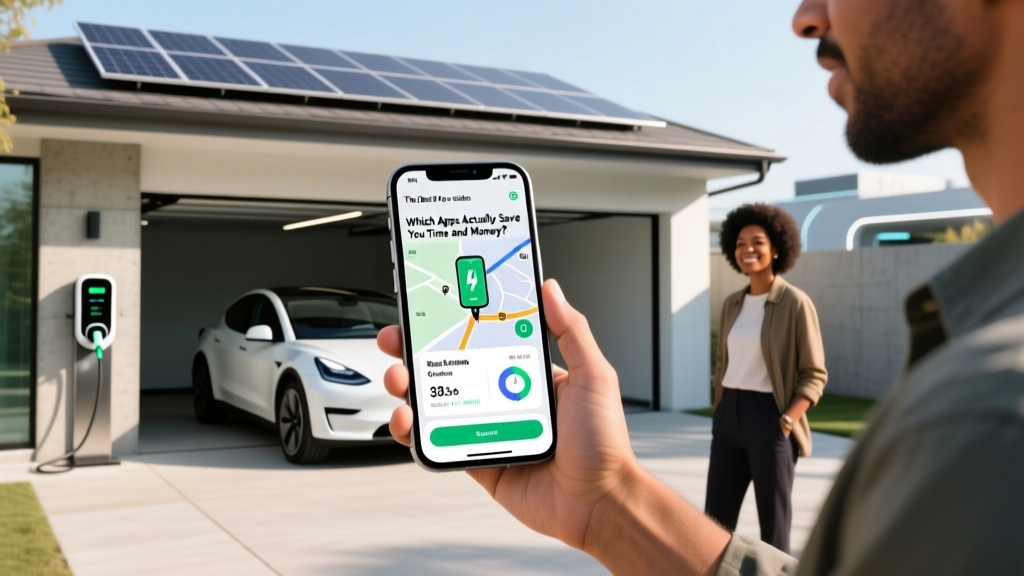
For most EV owners in 2026, the essential app stack is A Better Routeplanner (ABRP) for trip planning, PlugShare for finding and vetting chargers, and your vehicle's native app (Tesla, Hyundai Bluelink, FordPass, etc.) for preconditioning and charge monitoring. If you rely heavily on a single network, add ChargePoint or EVgo for seamless plug-and-charge activation. Skip downloading every network app — most now support Plug & Charge via your car's built-in telematics or a single RFID card.
Owning an electric vehicle in 2026 means managing a digital ecosystem almost as complex as the car itself. Between route planning, charger availability checks, battery preconditioning, and cost tracking, the right EV app can shave hours off road trips and dollars off your monthly energy bill. The wrong one wastes your time with outdated station data and clunky interfaces. After testing dozens of EV apps across multiple vehicles — from a Tesla Model Y to a Hyundai Ioniq 5 to a Ford F-150 Lightning — here's what actually works in real-world ownership.
Why a Dedicated EV App Matters More Than You Think
Gas car drivers pull up to any station, swipe a card, and leave in five minutes. EV charging introduces variables that demand better tools: connector compatibility (NACS vs. CCS vs. CHAdeMO), real-time stall availability, charge curve behavior, pricing tiers, and battery preconditioning. A good EV app consolidates these into actionable information before you arrive.
Consider a real scenario: you're driving a 2026 Chevrolet Equinox EV (EPA 319 miles, 85 kWh usable battery) from Denver to Kansas City — roughly 600 miles. Without route planning, you might arrive at a 150 kW DC fast charger only to find it occupied, out of service, or incompatible with your vehicle's NACS port. With ABRP, you'd know to stop 40 miles earlier at a Tesla Supercharger (now open to NACS-equipped vehicles) where you can add 180 miles of range in 18 minutes at a peak 170 kW.
The difference between an informed stop and a stranded one often comes down to which EV app you opened before leaving home.
The Essential EV App Stack for 2026
Not every driver needs every app, but here's how the major players break down by use case:
A Better Routeplanner (ABRP) — Best for Trip Planning
ABRP remains the gold standard for multi-stop EV route planning. You input your exact vehicle model, current state of charge, cargo weight, and outside temperature, and it generates a route with optimized charging stops. The app accounts for elevation changes, headwinds, and cold-weather range loss — factors that can reduce your real-world range by 15-30% compared to the EPA sticker.
Key feature: Live data integration with your car's OBD-II dongle or native telematics (supported on Tesla, Hyundai/Kia, Ford, and others) for real-time SoC updates mid-route.
PlugShare — Best for Charger Discovery and Reviews
PlugShare aggregates virtually every public charging network in North America into one map. Its crowd-sourced reliability reviews are invaluable — you'll see recent check-ins noting whether a specific Electrify America stall is delivering its rated 350 kW or limping along at 45 kW. Filter by connector type, network, power level, and amenities (restrooms, food, Wi-Fi).
Key feature: The "score" system, where community check-ins rate station reliability from 1-10. Anything below a 7 deserves scrutiny before you commit to a stop.
ChargePoint / EVgo / Electrify America — Network-Specific Apps
While Plug & Charge (where your car authenticates automatically upon plugging in) has reduced the need for network-specific apps, you'll still want at least one for activating older stalls, checking pricing, and reserving chargers at busy locations. ChargePoint dominates Level 2 workplace and retail charging; EVgo and Electrify America lead DC fast charging along highways.
Your Vehicle's Native App — Best for Preconditioning and Monitoring
Every major automaker offers a companion app — Tesla, Hyundai Bluelink, Kia Connect, FordPass, myChevrolet, BMW Connected, Mercedes me. These handle the tasks no third-party app can: remote battery preconditioning (warming the battery to ~95°F for optimal DC fast charging speeds), cabin preheating/cooling on grid power, scheduled charging during off-peak utility rates, and charge-limit settings.
Critical function: Battery preconditioning. Without it, a cold battery at a DC fast charger might accept only 50 kW instead of its peak 235 kW — turning a 20-minute stop into a 50-minute stop.
Real Costs: EV App-Assisted Charging vs. Gas
One of the most common questions first-time EV buyers ask is whether the savings are real. Let's compare with concrete numbers, using a 2026 Tesla Model Y Long Range (EPA 320 miles, 75 kWh battery) versus a comparable 2026 Toyota RAV4 gas AWD (29 MPG combined) over 15,000 miles/year.
| Scenario | Tesla Model Y | Toyota RAV4 AWD |
|---|---|---|
| Home charging (Level 2, $0.13/kWh avg) | $390/year | — |
| Public DCFC (avg $0.40/kWh, 20% of miles) | $120/year | — |
| Gas ($3.40/gal national avg) | — | $1,759/year |
| Total annual fuel cost | $510 | $1,759 |
| Annual savings (EV) | $1,249 | |
Source: fueleconomy.gov for EPA efficiency data; electricity rates from EIA average residential pricing.
A good EV app amplifies these savings by routing you to cheaper chargers, scheduling home charging during off-peak hours (many utilities offer $0.06-$0.09/kWh overnight), and avoiding expensive airport or convenience-store DC fast chargers that can charge $0.55-$0.70/kWh.
EV vs. Gas vs. Hybrid: What the Apps Can't Change
Apps optimize your EV experience, but they don't alter the fundamental ownership equation. Here's how the three powertrains stack up for a buyer considering a compact SUV:
| Factor | EV (Model Y LR) | PHEV (RAV4 Prime) | Gas (RAV4 AWD) |
|---|---|---|---|
| Base MSRP | $44,990 | $43,690 | $32,350 |
| Federal tax credit (§30D) | Up to $7,500* | Up to $7,500* | $0 |
| Net purchase price | ~$37,490 | ~$36,190 | $32,350 |
| 5-year fuel cost | ~$2,550 | ~$4,200 | ~$8,795 |
| 5-year maintenance | ~$1,500 | ~$3,000 | ~$3,500 |
| 5-year total cost | ~$41,540 | ~$43,390 | ~$44,645 |
*Federal §30D credit eligibility depends on MSRP caps ($80,000 SUVs), buyer income limits ($150K single / $300K joint), battery critical-mineral sourcing, and assembly requirements. Verify current rules at IRS.gov. Point-of-sale transfer is available at participating dealers.
The EV wins on 5-year total cost despite a higher sticker — but only if you can charge at home. Without home charging access, public DC fast charging costs roughly 3-4x more per kWh, eroding the fuel savings significantly.
Common EV App Misconceptions — Fact-Checked
| Myth | Fact |
|---|---|
| "I need a separate app for every charging network." | Plug & Charge (ISO 15118) lets most 2024+ EVs authenticate automatically on Electrify America, EVgo, and Tesla Superchargers. One RFID card or your car's native system handles billing. |
| "EV apps show the real range I'll get." | Most apps display EPA range. Real-world highway range at 75 mph is typically 85-90% of EPA; cold-weather (below 25°F) range drops 20-35%. ABRP adjusts for these when you enter temperature and speed. |
| "The app will tell me if a charger is broken." | Real-time status data is improving but still unreliable on some networks. Always check PlugShare's recent check-ins (last 48 hours) before committing to a remote charger. |
| "I can't plan a road trip without five different apps." | ABRP + PlugShare covers 95% of trip-planning needs. Add your vehicle's native app for preconditioning and you're set. |
| "EV apps work perfectly offline." | Most require a data connection for real-time station status and pricing. Download offline maps in ABRP before entering known dead zones (rural Nevada, parts of Montana, etc.). |
Decision Framework: Which EV App Setup Is Right for You?
If-Then EV App Guide
- If you mostly drive locally with home Level 2 charging: Your vehicle's native app is sufficient. Add PlugShare for occasional public charging.
- If you take road trips 3+ times per year: ABRP (free tier or $4.99/month premium) is essential. Pair with PlugShare for charger vetting.
- If you live in an apartment without home charging: You'll need ChargePoint, EVgo, or Electrify America apps for daily public charging — plus your utility's time-of-use rate schedule loaded into your vehicle's scheduled charging feature.
- If you own a Tesla: The Tesla app handles Supercharger routing natively. Add PlugShare only for non-Tesla destination charging.
- If you tow frequently (F-150 Lightning, Rivian R1T): ABRP's towing mode accounts for the 40-50% range reduction when pulling 5,000+ lbs — critical for accurate route planning.
- If you drive in extreme cold (below 10°F regularly): Use your vehicle's native app to precondition the battery 30-45 minutes before every DC fast charge stop. Without this, expect charge rates 50-70% below peak.
First-Time EV Buyer: What No App Can Teach You
Apps are tools, but EV ownership has fundamentals that require human judgment:
Home charging is non-negotiable for most owners. A Level 2 home charger (240V, 32-48A) adds 25-40 miles of range per hour and costs $500-$2,000 installed depending on panel capacity and run length. Without it, you're dependent on public infrastructure that may be unreliable, expensive, or unavailable in your area. Budget for a 200-amp panel upgrade ($1,500-$3,500) if your home has older 100-amp service.
Insurance costs 15-25% more for EVs. Higher repair costs (battery pack protection, aluminum body panels, sensor recalibration) drive premiums up. Get quotes before purchasing — a $1,200/year gas car policy might become $1,500-$1,700 for the EV equivalent.
Battery degradation is real but slow. Most 2026 EVs use NMC or LFP chemistries with warranties guaranteeing 70% capacity retention at 8 years/100,000 miles. Real-world data from Recurrent and owner forums shows typical degradation of 5-8% over the first 100,000 miles — meaning a 320-mile EPA vehicle might deliver ~295-305 miles after five years.
The §30D tax credit is not guaranteed. Battery sourcing requirements (critical minerals and components from FTA-partner countries) have disqualified several popular models. Always verify eligibility at fueleconomy.gov and consult a tax professional before counting on the credit.
Frequently Asked Questions
Are EV apps free to use?
Most core features are free. ABRP offers a premium tier ($4.99/month) with live vehicle data integration and offline maps. PlugShare is free with optional premium features. Network apps (ChargePoint, EVgo) are free — you only pay for the electricity you use.
Do I need an EV app if my car has built-in navigation?
Built-in navigation (Tesla, BMW, Mercedes) handles route planning well for its own network but often lacks cross-network comparison. ABRP shows all networks simultaneously, helping you find the cheapest or fastest option regardless of brand. Use both — your car's nav for turn-by-turn, ABRP for planning.
Which EV app is best for finding free charging?
PlugShare lets you filter by "free" stations. Common free-charging locations include some shopping centers, hotels, and workplace chargers. Be aware that free Level 2 chargers typically add only 20-30 miles per hour — useful for topping off, not for primary charging.
Can EV apps help me save money on home charging?
Yes — indirectly. Your vehicle's native app (not a third-party app) controls scheduled charging, which lets you charge only during off-peak utility hours. If your utility offers $0.07/kWh overnight vs. $0.18/kWh peak, scheduling saves roughly $250/year on 15,000 miles of driving.
What if I'm driving through an area with no cell service?
Download offline maps in ABRP before departure. Keep a physical note of backup chargers along your route. In remote areas (parts of I-10 in West Texas, US-50 in Nevada), plan extra range buffer — aim to arrive at each charging stop with 15-20% SoC remaining rather than the 5-10% you'd risk in well-connected areas.