The Short Answer: What Makes a Good EV for a Teen?
The best electric cars for teens in 2026 share four traits: a starting price under $35,000, an EPA-rated range of at least 230 miles, a Top Safety Pick rating from IIHS, and low insurance premiums relative to other EVs. The Chevrolet Equinox EV (from ~$33,600), Hyundai Kona Electric (from ~$32,975), and Volvo EX30 (from ~$36,450) lead our shortlist. However, an EV only makes financial sense if you have reliable home charging access. Without it, a hybrid like the Toyota Prius may be the smarter first car.
Handing a teenager the keys to any car is a milestone loaded with variables — safety, cost, reliability, and the learning curve of ownership. Add high-voltage batteries and charging logistics to the mix, and the decision gets more complex. This guide cuts through the noise with hard numbers on purchase price, insurance, fueling, and maintenance so you can evaluate whether an EV or a gas/hybrid vehicle is the right call for your household's newest driver.
What Parents Actually Need to Decide About a Teen's First EV
The core question isn't "which EV is best?" — it's "does an EV fit this teen's driving life and our household infrastructure?" Before browsing models, answer these four practical questions:
- Home charging: Can you install a Level 2 (240V) charger at home? A typical install runs $800–$2,200 depending on panel capacity and conduit length. Without it, daily EV ownership becomes a chore.
- Driving pattern: Is the teen's daily driving under 80 miles round-trip (school, activities, part-time job)? If yes, even a modest-range EV covers it with margin.
- Climate: Do you live where winters drop below freezing? Expect 20–30% range loss in cold weather — a 250-mile EPA sticker becomes roughly 175–200 real-world miles at 25°F.
- Budget reality: Can you absorb a higher upfront price ($30K–$38K) in exchange for lower fueling and maintenance costs over 4–5 years?
Top Electric Cars for Teens: Spec-by-Spec Breakdown
Here's how the strongest 2026 candidates compare on the numbers that matter for a first car.
| Model | Base MSRP | EPA Range | Battery (kWh) | DC Fast Charge (Peak kW) | 10–80% Time | 0–60 mph | IIHS Rating |
|---|---|---|---|---|---|---|---|
| Chevrolet Equinox EV 2LT | $33,600 | 315 mi | 85 kWh (NMC) | 150 kW | ~28 min | 7.7 sec | Top Safety Pick |
| Hyundai Kona Electric SEL | $32,975 | 261 mi | 64.8 kWh (NMC) | 100 kW | ~43 min | 7.8 sec | Top Safety Pick+ |
| Volvo EX30 Core | $36,450 | 265 mi | 69 kWh (NMC) | 153 kW | ~26 min | 6.3 sec | Top Safety Pick |
| Nissan Leaf SV Plus | $31,670 | 212 mi | 60 kWh (NMC) | 100 kW (CHAdeMO) | ~45 min | 7.4 sec | Top Safety Pick |
| Tesla Model 3 RWD | $38,990 | 272 mi | 60 kWh (LFP) | 170 kW | ~25 min | 5.8 sec | Top Safety Pick+ |
Real-World Range Reality Check: EPA estimates assume mixed driving at moderate temperatures. For a teen commuting in stop-and-go traffic in a Sun Belt summer, expect to hit close to EPA numbers. For cold-climate highway driving in January, subtract 20–30%. A Kona Electric rated at 261 miles EPA may deliver ~185 miles at 20°F on the highway.
EV vs. Gas vs. Hybrid: The Real Cost Comparison for a Teen's Car
The sticker price tells only part of the story. Below is a 5-year total cost of ownership (TCO) comparison assuming 12,000 miles/year, home Level 2 charging at $0.14/kWh (national average), and gas at $3.40/gallon.
| Cost Category | Hyundai Kona Electric ($32,975) | Toyota Corolla LE Gas (~$23,500) | Toyota Prius LE Hybrid (~$28,550) |
|---|---|---|---|
| Purchase Price | $32,975 | $23,500 | $28,550 |
| Fuel / Energy (5 yr) | $2,520 | $7,140 | $4,284 |
| Maintenance (5 yr) | $1,100 | $2,800 | $2,400 |
| Insurance (avg teen driver, 5 yr) | $11,500 | $8,200 | $8,900 |
| Depreciation (est.) | $14,800 | $10,500 | $11,900 |
| Total 5-Year Cost | $62,895 | $52,140 | $56,034 |
| Cost Per Mile | $1.05 | $0.87 | $0.93 |
The EV saves roughly $4,620 in fuel and maintenance over five years compared to the gas car, but higher insurance premiums and steeper depreciation narrow the gap. The Kona Electric still costs approximately $10,755 more to own over five years than the Corolla gas model. This is the honest math — EVs save on operating costs but don't yet win TCO for budget-conscious first-car buyers in most scenarios.
| Vehicle | Efficiency | Cost Per Mile |
|---|---|---|
| Kona Electric (home L2 at $0.14/kWh) | 30 kWh/100mi | $0.042 |
| Kona Electric (DC fast charge avg $0.40/kWh) | 30 kWh/100mi | $0.120 |
| Prius Hybrid | 57 MPG combined | $0.060 |
| Corolla Gas (35 MPG combined) | 35 MPG | $0.097 |
Home charging is the critical variable. If a teen relies solely on public DC fast charging at $0.35–$0.48/kWh, the per-mile energy cost can actually exceed a fuel-efficient hybrid. This is why we recommend EVs for teens only in households with Level 2 home charging.
Insurance Reality: The Hidden Cost of Putting a Teen in an EV
Insurance companies price teen drivers aggressively regardless of vehicle, but EVs carry an additional premium. According to industry data, EV insurance costs average 15–25% more than comparable gas vehicles due to higher repair costs for battery and structural components, specialized labor requirements, and elevated total-loss thresholds.
For a 17-year-old driver, expect annual premiums of $2,100–$2,800 for an EV versus $1,500–$1,900 for a gas compact. That's $600–$900 more per year, or $3,000–$4,500 over five years. Before committing to an EV, get an actual insurance quote for your teen in your ZIP code — this single step prevents costly surprises.
Models with lower repair complexity and wider parts availability (Hyundai, Chevrolet) tend to be cheaper to insure than premium brands (Tesla, Volvo) for young drivers.
Safety Ratings and Driver-Assist Tech: What Matters for New Drivers
Safety is non-negotiable for a teen's first car. Every model on our shortlist holds an IIHS Top Safety Pick or Top Safety Pick+ award and earns at least a 4-star overall NHTSA rating. Beyond crash-test scores, modern EVs include standard automatic emergency braking (AEB), lane-keeping assist, and blind-spot monitoring — features that were optional or unavailable on budget cars just five years ago.
ADAS Is Not Self-Driving: Features like Hyundai SmartSense, Chevy's Super Cruise (available on higher trims), and Tesla Autopilot are all SAE Level 2 driver-assistance systems. The driver must remain fully engaged — hands on or near the wheel, eyes on the road. These systems assist with steering and speed but do not handle construction zones, erratic drivers, or adverse weather independently. For a teen still building road awareness, over-reliance on Level 2 assist can be counterproductive. We recommend parents enable speed-limiting and geofencing features (Hyundai's Digital Key, Chevy's Teen Driver mode) to set boundaries while the driver develops skills.
SAE Automation Levels — Quick Reference: Level 0 = no automation. Level 1 = single-feature assist (adaptive cruise OR lane centering). Level 2 = combined steering + speed assist (what all current consumer EVs offer — driver must supervise). Level 3 = conditional automation (driver can disengage in limited scenarios — available in very few markets). Level 4 = driverless in defined areas (Waymo robotaxis only). No consumer vehicle sold in 2026 is Level 3 or above in general use.
Common Misconceptions About EVs for Teen Drivers
| Myth | Fact |
|---|---|
| "EVs are too expensive for a first car." | Base MSRPs now start at ~$31,670 (Nissan Leaf). The used EV market offers models like a 2023 Bolt EV for $18,000–$22,000 with the §25E used-EV tax credit potentially reducing cost by up to $4,000 for eligible buyers. |
| "My teen will get stranded with a dead battery." | The average American drives 37 miles/day (fueleconomy.gov). Even the shortest-range EV on our list (Leaf at 212 mi EPA) covers nearly six days of average driving on a single charge. Teens who plug in nightly at home are no more likely to "run out" than a gas-car driver who ignores their fuel gauge. |
| "EV batteries need replacing every few years — that's a huge cost." | All EVs on this list carry 8-year/100,000-mile battery warranties guaranteeing at least 70% capacity retention. Real-world degradation data shows modern NMC and LFP packs losing only 8–12% capacity over 100,000 miles. Replacement is rare and covered under warranty during the ownership period most families keep a teen's first car. |
| "The $7,500 federal tax credit makes any EV affordable." | The §30D clean vehicle credit has strict requirements: buyer income caps ($150K single / $300K joint), MSRP caps ($55K cars / $80K SUVs/trucks), and battery critical-mineral and component sourcing rules that disqualify some trims. A teen's parent must have sufficient tax liability to use the credit, or transfer it at point of sale to a participating dealer. Always verify current-year eligibility on IRS.gov before counting on the credit. |
| "EVs are slow and boring — teens won't like them." | Even the base Kona Electric hits 0–60 in 7.8 seconds — quicker than most gas compact crossovers. Instant torque makes EVs feel responsive in city driving. The concern isn't boredom; it's that quick acceleration requires mature judgment from a new driver. |
Decision Framework: Should Your Teen Drive an EV, Hybrid, or Gas Car?
Choose an EV if:
- You have (or can install) Level 2 home charging — a 240V outlet or hardwired charger in your garage or driveway.
- The teen's daily driving is under 80 miles and rarely involves remote rural routes.
- Your household budget can absorb $30K–$38K upfront, even with potential tax credits.
- You live in a region with moderate winters, or you accept 20–30% winter range reduction.
- You value lower fuel/maintenance costs and tailpipe-emission-free driving around your community.
Choose a Hybrid (PHEV or HEV) if:
- Home charging is not available or installation is cost-prohibitive (older panel, long conduit run).
- The teen drives long distances regularly (rural area, commuting over 50 miles one-way).
- Upfront budget is under $30,000.
- You want EV-like city efficiency (a PHEV like the Prius Prime offers 44 miles of electric-only range) without range limitations.
Choose a Gas Car if:
- Total 5-year cost is the overriding priority — a used or new gas compact remains the cheapest total-cost option in most scenarios.
- The teen will drive in extreme cold frequently and cover long distances.
- You live in an area with limited public charging infrastructure and no home charging option.
First-Time EV Buyer Checklist: What to Know Before Signing
- Get an insurance quote first. Before falling in love with a model, call your insurer. The premium difference between a Kona Electric and a Tesla Model 3 for a 17-year-old can be $1,000+/year.
- Verify tax credit eligibility. Check the specific VIN's §30D eligibility on the IRS clean vehicle credit portal. Battery sourcing rules change periodically, and not every trim qualifies.
- Assess your electrical panel. A Level 2 charger typically requires a 40–50 amp dedicated circuit. If your panel is at capacity (common in older homes), a panel upgrade adds $1,500–$3,500 to installation costs. Get an electrician's quote before buying.
- Test the teen's actual route. Drive the teen's school commute, activity routes, and weekend patterns. Note the total daily mileage. If it's under 60 miles, any EV on this list works comfortably.
- Download the charging apps. PlugShare, ChargePoint, EVgo, and Electrify America — show your teen how to find and use public chargers before they need one alone.
- Set up parental controls. Chevy's Teen Driver mode, Hyundai's Digital Key, and Tesla's Speed Limit Mode let you cap top speed, mute audio until seatbelts are fastened, and receive driving reports.
Frequently Asked Questions
Is a Tesla Model 3 a good first car for a teenager?
The Model 3 is an excellent EV — strong safety ratings, Supercharger network access, and quick charging. However, at $38,990+ base MSRP, insurance premiums that run 20–30% higher than mainstream brands for young drivers, and rapid acceleration (5.8 sec 0–60) that demands restraint from an inexperienced driver, it's a premium choice rather than a practical one. Most families are better served by a Kona Electric or Equinox EV for a teen's first car, reserving the Model 3 for when the driver has 2–3 years of experience.
Can a teen charge an EV at home without help?
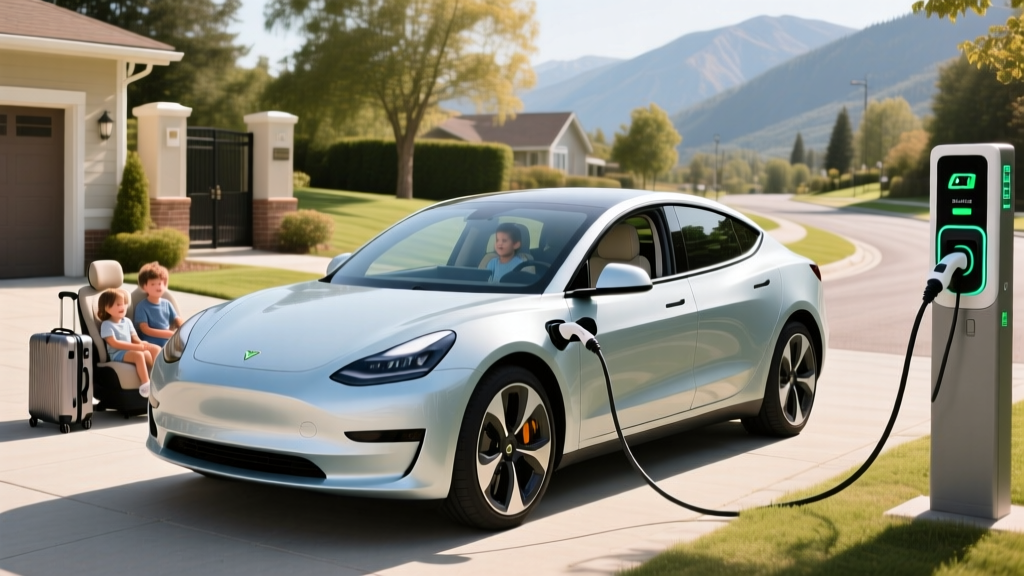
Yes. Level 2 home charging is as simple as plugging in a phone — insert the J1772 or NACS connector, and the car handles the rest. Most EVs allow scheduling charges via the infotainment screen or app so the car charges during off-peak electricity hours overnight. Teens adapt to this routine within days.
What happens if my teen forgets to plug in overnight?
For a teen driving 30–40 miles daily, a single missed charge is inconsequential — the car still has 150+ miles of range remaining. The real risk is a pattern of forgetting, which is why we recommend setting a phone alarm or using the car's scheduled charging feature that activates when plugged in, regardless of time.
Are used EVs a good option for teen drivers?
Used EVs can be outstanding first cars. A 2022–2024 Chevrolet Bolt EV or EUV offers 247–259 miles of EPA range, strong safety scores, and used prices of $17,000–$23,000. Buyers may qualify for the §25E used clean vehicle credit — up to $4,000 or 30% of the sale price (whichever is less), subject to income caps and a $25,000 maximum vehicle sale price. Verify that the specific used EV qualifies before purchasing, as battery sourcing and dealer registration requirements apply.
How does cold weather affect an EV teen driver in northern states?
In sustained temperatures below 30°F, expect 20–30% range reduction due to battery chemistry limitations and cabin heating demand. A Kona Electric rated at 261 miles EPA may deliver 185–210 real-world miles in a Minnesota January. This still covers typical teen driving needs, but it eliminates the buffer for unexpected detours. Preconditioning the battery while plugged in (available on most modern EVs) mitigates some loss. For families in extreme cold climates, an EV with 300+ miles EPA range or a PHEV is the safer choice.
Do EVs require less maintenance than gas cars?
Significantly less. No oil changes, no spark plugs, no transmission fluid, no exhaust system repairs. Brake pads last 80,000–120,000+ miles thanks to regenerative braking doing most of the deceleration work. The primary maintenance items are tire rotation (every 6,000–8,000 miles — EVs are heavier and wear tires faster), cabin air filter replacement, and windshield washer fluid. Expect annual maintenance costs of $200–$300 versus $500–$700 for a gas compact.