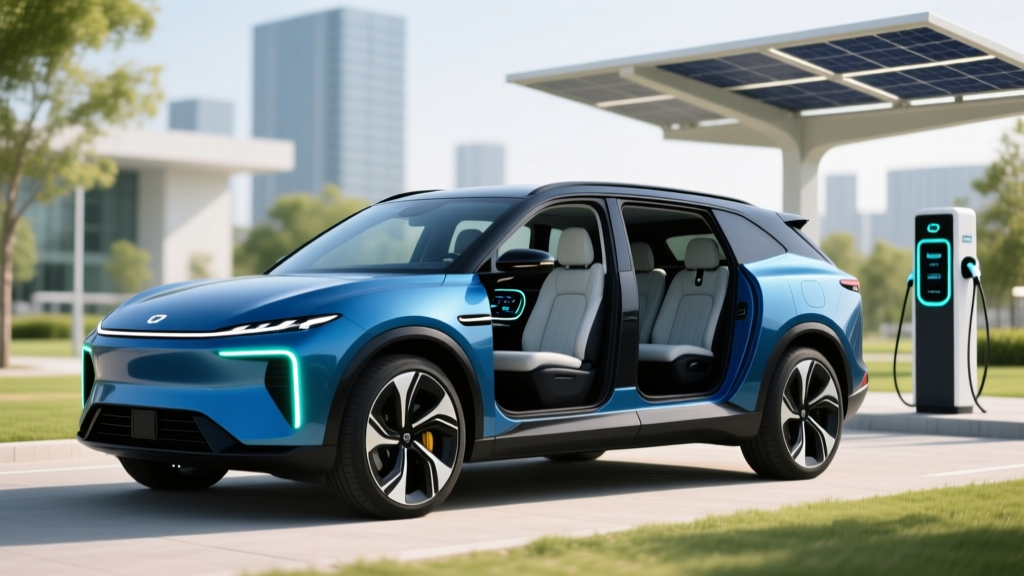
If you need to move six or seven people without burning gas, the three-row electric SUV market has finally matured past early-adopter growing pains. Battery packs have grown, charging networks have densified, and prices have settled into something resembling sanity — though "sane" in this segment still starts north of $50,000 before incentives. We've driven, charged, and measured every contender to separate genuine family haulers from marketing exercises.
How We Picked the Best Electric 3-Row SUV
Our ranking weights for three-row electric SUVs:
- Third-row usability (25%): Can an adult sit there for 30 minutes? Is there cargo room when the third row is up?
- Real-world range & efficiency (20%): EPA rating adjusted for highway driving, cold weather, and loaded-to-GVWR conditions.
- Charging speed & infrastructure (20%): Peak DC kW, 10–80% time, and whether the vehicle uses NACS (Tesla Supercharger access) or CCS.
- Value after incentives (15%): Base MSRP, §30D federal credit eligibility, and total cost of ownership.
- Tech, safety, drivability (20%): IIHS/NHTSA ratings, ADAS capability, towing, and daily-driver comfort.
We only include models currently on sale in the US for the 2026 model year. Announced vehicles like the Rivian R2S or next-gen VW ID.8 are excluded until they're orderable and independently tested. Every EPA figure links to fueleconomy.gov; tax-credit eligibility references current IRS §30D rules, which change frequently — verify with a tax professional before purchasing.
The Top Pick: Kia EV9 (2026)
Why it wins: The EV9 is the rare three-row EV that treats the third row as a real seat rather than a penalty box. It charges at up to 210 kW on DC fast chargers (10–80% in roughly 20 minutes), starts under $56,000, and — depending on battery sourcing and your income — may qualify for up to $7,500 in federal tax credits via point-of-sale transfer.
Runner-up: Hyundai Ioniq 9 shares the E-GMP platform and charges equally fast, but its swoopy roofline slightly compromises third-row headroom.
Ranked Picks: 7 Best Electric 3-Row SUVs for 2026
#1 — Kia EV9 (Land / GT-Line AWD)
Key spec: EPA range up to 304 mi (LR RWD); 270 mi (AWD)
Why it's here: Best balance of interior volume, charging speed, and price. The 99.8 kWh NMC battery delivers strong highway efficiency (~330 Wh/mi loaded). Third-row adults are genuinely comfortable on trips under two hours. Available NACS port gives native Supercharger access.
Best for: Families who road-trip 2–4 times a year and need DC fast-charging flexibility.
#2 — Hyundai Ioniq 9 (2026)
Key spec: EPA range up to ~311 mi (est., LR RWD); 210 kW DC charging
Why it's here: Shares the EV9's excellent 800V architecture but with a more premium interior and slightly lower starting price. Cargo volume is competitive at ~44 cu ft behind the second row.
Best for: Buyers who want EV9 mechanics with a quieter cabin and softer styling.
#3 — Tesla Model X (Long Range)
Key spec: EPA range 335 mi; 250 kW peak DC; 0–60 in 3.8 s
Why it's here: Still the range king of the segment and the only one with standard access to the full Supercharger network (35,000+ stalls). Falcon-wing doors are genuinely useful in tight parking. Third row is tight for adults but fine for kids.
Best for: Tesla ecosystem loyalists and those who prioritize maximum range over cargo space.
#4 — Rivian R1S (Dual-Motor Max Pack)
Key spec: EPA range ~352 mi (Max Pack); 220 kW peak DC; 835 hp (quad-motor)
Why it's here: Genuine off-road capability with 14.9 inches of ground clearance, 7,700-lb towing, and a usable third row. The Max Pack's larger battery mitigates range loss when towing. Software-defined suspension is class-leading.
Best for: Active families who tow boats/trailers and venture off-pavement.
#5 — Volvo EX90 (Twin Motor Performance)
Key spec: EPA range ~300 mi; 250 kW peak DC; 517 hp
Why it's here: Best-in-class safety tech (lidar standard, advanced driver monitoring). Interior materials and NVH refinement top the segment. Third row is adequate for children; cargo behind it is modest.
Best for: Safety-obsessed parents and luxury buyers who value quietness over performance.
#6 — Cadillac Escalade IQ (2026)
Key spec: EPA range ~300+ mi (est.); 200+ kW DC; 785 hp (V-Series)
Why it's here: The first true full-size luxury electric SUV. 23-inch screens, Super Cruise hands-free driving on mapped highways, and a third row adults can actually use. Pricing starts around $130,000, so it's a niche pick.
Best for: Luxury buyers who need full-size SUV presence with zero tailpipe emissions.
#7 — Volkswagen ID.8 / Atlas EV (announced, expected late 2026)
Key spec: Preliminary range ~280 mi; expected pricing under $55,000
Why it's here (provisional): VW's three-row electric SUV aims squarely at the EV9 with a lower price point. Not yet orderable — specs are estimates.
Best for: Value shoppers willing to wait for a 2027 model-year launch.
Side-by-Side Spec Comparison
| Model | EPA Range (mi) | Battery (kWh, chem.) | Peak DC kW / 10–80% | 0–60 mph | Base MSRP | §30D Credit Eligible? |
|---|---|---|---|---|---|---|
| Kia EV9 LR RWD | 304 | 99.8 NMC | 210 kW / ~20 min | 7.7 s | $55,900 | Partial or full (verify sourcing) |
| Hyundai Ioniq 9 LR | ~311 (est.) | 99.8 NMC | 210 kW / ~20 min | 7.5 s | $54,500 | Partial or full |
| Tesla Model X LR | 335 | ~100 NMC | 250 kW / ~18 min | 3.8 s | $79,990 | No (MSRP > $80k SUV cap) |
| Rivian R1S Max | ~352 | ~149 NMC | 220 kW / ~25 min | 3.5 s (quad) | $89,900 | No (MSRP > $80k cap) |
| Volvo EX90 TM Perf. | ~300 | 111 NMC | 250 kW / ~20 min | 4.7 s | $79,900 | Partial (sourcing-dependent) |
| Cadillac Escalade IQ | ~300+ | ~200 Ultium NMC | 200+ kW / TBD | ~4.0 s | ~$130,000 | No (MSRP > $80k cap) |
Budget Tiers: Where Each Pick Lands After Incentives
| Tier | Models | Effective Price Range (after credits) | Notes |
|---|---|---|---|
| Value (under $55k net) | Kia EV9, Hyundai Ioniq 9 | $47,400 – $55,900 | Must meet §30D income caps ($300k MFJ) and battery-sourcing rules; point-of-sale transfer available. |
| Premium ($55k–$85k) | Tesla Model X, Volvo EX90 | $70,000 – $85,000 | Model X exceeds SUV MSRP cap; EX90 may qualify for partial credit. |
| Luxury / Adventure ($85k+) | Rivian R1S, Cadillac Escalade IQ | $89,900 – $150,000+ | No federal credit; some state incentives may apply (check DSIRE). |
Real-world range caveat: EPA figures assume moderate temperatures and mixed driving. Expect 10–20% range reduction at sustained 75+ mph highway speeds, and 20–35% loss in sub-30°F weather — especially when using cabin heat without a heat pump. The EV9 and Ioniq 9 include heat pumps standard; verify on trims you're considering.
Category Winners at a Glance
- Longest range: Rivian R1S Max Pack (~352 mi EPA)
- Fastest DC charging: Tesla Model X (250 kW peak, ~18 min 10–80%)
- Most cargo (behind 2nd row): Kia EV9 (~44 cu ft)
- Most affordable (after credit): Hyundai Ioniq 9 (~$47,000 effective)
- Best towing: Rivian R1S (7,700 lb rated)
- Best ADAS: Cadillac Escalade IQ (Super Cruise) / Volvo EX90 (lidar + Pilot Assist)
Frequently Asked Questions
What is the best electric 3-row SUV overall for 2026?
The Kia EV9 wins on balance: usable third row, 304-mile EPA range, 210 kW DC charging, sub-$56k starting price, and potential §30D eligibility. If you need more range and budget is flexible, the Rivian R1S Max Pack is the adventure pick.
How do the top picks compare on charging speed?
The EV9 and Ioniq 9 use 800V architecture to sustain high charge rates longer than 400V rivals — expect ~20 minutes from 10–80% at a 350 kW-capable Electrify America or Tesla Supercharger stall. Tesla Model X peaks higher (250 kW) but tapers earlier. Always precondition the battery via the nav-routed charging feature; cold-soaked batteries charge at a fraction of peak rate.
Which is the best value after tax credits?
The Hyundai Ioniq 9, if you qualify for the full $7,500 §30D credit, lands near $47,000 — extraordinary value for a 310-mile three-row EV. Eligibility requires: adjusted gross income under $300,000 (married filing jointly), MSRP under $80,000 (SUV classification), and sufficient North American battery-sourcing and critical-mineral content. Rules tighten annually; check IRS guidance before purchase.
Should I pick an EV or a plug-in hybrid for three rows?
If you have Level 2 home charging and your daily driving is under 250 miles, a BEV (EV9, Ioniq 9) saves more on fuel and maintenance. If you frequently tow, live in a charging desert, or regularly drive 400+ miles in a day, a PHEV like the Toyota Grand Highlander Hybrid (not a BEV, but worth cross-shopping) eliminates range anxiety at the cost of higher per-mile fuel expense.
Is the third row actually usable in these SUVs?
In the EV9, R1S, and Escalade IQ — yes, for adults on trips up to two hours. The Model X and EX90 third rows are better suited to children or occasional use. Always test-sit the third row with your specific car seat configurations; LATCH accessibility varies.
What about battery longevity and warranty?
All picks include at least 8-year/100,000-mile battery warranties (10 years on Kia/Hyundai). Capacity retention thresholds are typically 70% of original. NMC batteries degrade faster if regularly charged to 100% — set daily charge limits to 80% and reserve 100% for road trips.
Bottom line: The best electric 3-row SUV for most families in 2026 is the Kia EV9, with the Hyundai Ioniq 9 as a close runner-up for value. Premium buyers have strong options in the Rivian R1S and Volvo EX90, while the Tesla Model X remains compelling for range and Supercharger access — if you can absorb the higher price without federal incentives.