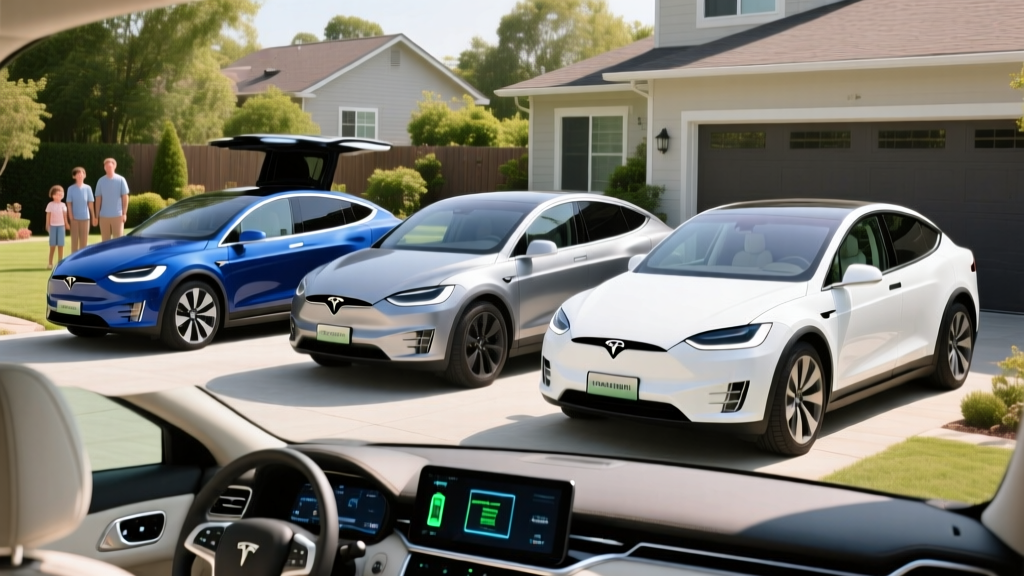
Finding a three-row electric SUV that actually works for family life means juggling EPA range, cargo volume behind the third row, DC fast-charging speed, and whether you can claim the §30D federal tax credit. Most buyers in this segment need 280+ miles of real-world range, usable third-row seating for kids or teens, and enough cargo space for a week's groceries or hockey gear. We've ranked the top seven 3-row EV SUVs available for the 2026 model year against those exact criteria.
How We Ranked the Best 3-Row EV SUVs
Selection criteria (weighted):
- EPA range & real-world efficiency (25%) — Sticker range plus expected highway/cold-weather reduction
- Cargo volume behind 3rd row (20%) — Minimum 14 cu ft to be practical for a family
- DC fast-charging speed (20%) — Peak kW, 10-80% time, and sustained charge-curve behavior
- Third-row usability (15%) — Legroom, access ease, and LATCH anchor availability
- Price & tax-credit eligibility (10%) — MSRP after §30D point-of-sale transfer where applicable
- Powertrain & battery warranty (10%) — Years/miles and capacity-retention threshold
All figures sourced from fueleconomy.gov and manufacturer 2026 spec sheets unless noted.
The Top 7 Three-Row Electric SUVs Ranked
#1 — Kia EV9 (2026)
Key spec: EPA 304 mi (LR RWD) | 99.8 kWh NMC | 235 kW peak DC
Why it made the list: The EV9 remains the benchmark for 3-row EV families. The Long Range RWD trim delivers an EPA-estimated 304 miles, and real-world highway testing at 70 mph typically yields 255-275 miles depending on temperature. Its 800V architecture enables a 10-80% DC fast charge in approximately 20 minutes at a 350 kW station, though sustained rate tapers noticeably past 70% SoC. Behind the third row you get 20.2 cu ft of cargo — enough for four carry-on suitcases. The 3rd-row legroom of 32.0 inches fits children and teens comfortably; adults will want shorter trips. The GT-Line AWD bumps HP from 201 to 379 and drops 0-60 to 4.9 seconds, at the cost of roughly 30 miles of range.
Best for: Families wanting the best balance of range, charging speed, and interior flexibility under $60K.
Price & tax credit: Light LR starts at $54,900. Land AWD at $63,900. Eligible for up to $7,500 §30D credit depending on buyer income (AGI ≤ $150K single / $300K joint) and battery-sourcing compliance — verify current-year sourcing on the IRS clean vehicle list before purchase.
#2 — Hyundai Ioniq 9 (2026)
Key spec: EPA 311 mi (est., RWD) | 110.3 kWh NMC | 350 kW peak DC
Why it made the list: Hyundai's E-GMP platform scales up to the Ioniq 9 with the largest battery in this segment. Preliminary EPA estimates suggest 311 miles for the RWD Long Range variant. The 800V system supports a claimed 10-80% charge in roughly 18 minutes at a capable 350 kW charger — the fastest in this roundup. Cargo volume behind the third row measures approximately 21 cu ft. Interior materials and dual 12-inch displays feel a half-step above the EV9, and Hyundai includes 10-year/100,000-mile powertrain coverage. Real-world highway range will likely settle around 260-280 miles in mild weather.
Best for: Road-trip families who prioritize fastest possible DC charging and maximum range.
Price & tax credit: Base SE starts around $56,000; Limited AWD near $70,000. §30D eligibility subject to IRS battery-sourcing rules — check before signing.
#3 — Tesla Model X (2026 Refresh)
Key spec: EPA 335 mi (Long Range) | ~100 kWh NMC | 250 kW peak DC
Why it made the list: The Model X Long Range still posts the highest EPA range of any 3-row EV SUV at 335 miles, and the Supercharger network remains the most reliable public charging ecosystem in North America. Falcon-wing doors ease child-seat loading in tight parking spots. The 2026 refresh adds a revised interior with improved second-row seat comfort. Third-row space is tight — 32.7 inches of legroom — best for children. Peak DC charging at 250 kW means a 10-80% session takes roughly 28-32 minutes, slower than the Hyundai/Kia 800V platforms. Cargo behind the third row is just 12.6 cu ft, the smallest here, but fold the third row and you unlock 37.1 cu ft.
Best for: Tesla ecosystem loyalists who value Supercharger access and industry-leading range above cargo space.
Price & tax credit: Long Range starts at $79,990 — above the §30D MSRP cap of $80,000 for SUVs, leaving little room for options while staying eligible. Income caps apply.
#4 — Rivian R1S (Dual-Motor, 2026)
Key spec: EPA 316 mi (Large Pack) | ~106 kWh NMC | 220 kW peak DC
Why it made the list: The R1S is the only body-on-frame adventure-oriented 3-row EV SUV. Ground clearance of 14.9 inches (max) and a wading depth of 43 inches set it apart. The Large Pack delivers 316 miles EPA in Dual-Motor configuration, with real-world highway figures around 265-285 miles. Third-row legroom of 30.4 inches is the tightest in this list — strictly for kids. Cargo behind row three is just 9.2 cu ft, but the frunk adds 11.1 cu ft. The R1S can tow up to 7,700 pounds — double most competitors. Peak DC charging at roughly 220 kW yields a 10-80% time near 27 minutes.
Best for: Outdoor families who tow, overland, or need genuine off-road capability.
Price & tax credit: Dual-Motor Standard starts around $75,900. §30D eligibility depends on MSRP cap compliance and battery-sourcing rules; Rivian's credit availability has fluctuated — confirm at point of sale.
#5 — Volvo EX90 (2026)
Key spec: EPA 310 mi (Twin Motor Performance) | 111 kWh NMC | 250 kW peak DC
Why it made the list: Volvo's flagship pairs a 111 kWh battery with Scandinavian interior design and one of the most advanced safety suites in the segment, including LiDAR as standard equipment. The Twin Motor Performance variant produces 510 HP and hits 0-60 in 4.7 seconds. EPA range for the Twin Motor sits at 310 miles; expect 260-280 real-world. Third-row legroom is 31.0 inches — adequate for children. Cargo behind row three is approximately 13.0 cu ft. DC fast charging peaks at 250 kW with a 10-80% time near 28 minutes. Build quality and sound insulation are a step above mass-market competitors.
Best for: Safety-conscious families who want premium build quality and standard LiDAR-backed ADAS.
Price & tax credit: Core trim starts at $76,695 — near the §30D SUV cap. Credit eligibility varies by sourcing; check IRS §30D guidance.
#6 — Volkswagen ID. Buzz (3-Row, 2026)
Key spec: EPA 234 mi (RWD) | 91 kWh NMC | 175 kW peak DC
Why it made the list: The ID. Buzz earns its spot on interior flexibility and charm rather than range. The long-wheelbase 3-row version offers 234 miles EPA — the lowest in this roundup, with real-world highway figures around 190-210 miles. However, the boxy shape yields an impressive 18.0 cu ft behind the third row and a flat load floor when rows are folded. The sliding second row and walk-through front seats make it uniquely practical for carpool duty. DC charging at 175 kW means a 10-80% session takes about 30 minutes. It's the only EV minivan alternative in the US market.
Best for: Carpool-heavy suburban families who prioritize interior space and flexibility over long road-trip range.
Price & tax credit: Pro S starts at $59,995. §30D eligibility subject to sourcing rules; confirm current-year status on the IRS qualified vehicle list.
#7 — Mercedes-Benz EQS SUV (2026)
Key spec: EPA 305 mi (EQS 580 4MATIC) | 108.4 kWh NMC | 200 kW peak DC
Why it made the list: The EQS SUV is the luxury benchmark: 305 miles EPA, 536 HP in 580 guise, 0-60 in 4.3 seconds, and a Hyperscreen dashboard spanning 56 inches. Ride quality and cabin isolation are unmatched. Third-row legroom of 30.5 inches is tight, and cargo behind row three is just 10.0 cu ft. DC charging at 200 kW yields a 10-80% time near 32 minutes — the slowest here. This is a luxury choice, not a value play.
Best for: Luxury buyers who want a premium 3-row EV with best-in-class ride comfort and quiet.
Price & tax credit: EQS 450+ starts at $104,400 — well above the §30D MSRP cap of $80,000, making it ineligible for the federal credit.
Spec Comparison: All 7 Picks Side by Side
| Model | EPA Range (mi) | Battery (kWh) | Peak DC (kW) / 10-80% min | Cargo behind 3rd row (cu ft) | 3rd-Row Legroom (in) | Base MSRP |
|---|---|---|---|---|---|---|
| Kia EV9 LR RWD | 304 | 99.8 | 235 / ~20 | 20.2 | 32.0 | $54,900 |
| Hyundai Ioniq 9 RWD | 311* | 110.3 | 350 / ~18 | 21.0 | 32.5 | $56,000 |
| Tesla Model X LR | 335 | ~100 | 250 / ~30 | 12.6 | 32.7 | $79,990 |
| Rivian R1S Dual | 316 | ~106 | 220 / ~27 | 9.2 | 30.4 | $75,900 |
| Volvo EX90 TM | 310 | 111 | 250 / ~28 | 13.0 | 31.0 | $76,695 |
| VW ID. Buzz | 234 | 91 | 175 / ~30 | 18.0 | 34.1 | $59,995 |
| Mercedes EQS SUV | 305 | 108.4 | 200 / ~32 | 10.0 | 30.5 | $104,400 |
*Preliminary EPA estimate for Ioniq 9; final figures pending EPA certification.
Category Winners: Longest Range, Fastest Charge, Most Cargo
| Category | Winner | Key Figure |
|---|---|---|
| Longest EPA Range | Tesla Model X LR | 335 mi |
| Fastest 10-80% DC Charge | Hyundai Ioniq 9 | ~18 min at 350 kW |
| Most Cargo Behind 3rd Row | Hyundai Ioniq 9 | 21.0 cu ft |
| Best Towing Capacity | Rivian R1S | 7,700 lbs |
| Lowest Starting Price | Kia EV9 LR | $54,900 |
| Most 3rd-Row Legroom | VW ID. Buzz | 34.1 in |
| Fastest 0-60 mph | Mercedes EQS 580 | 4.3 sec |
Budget Tiers & Tax-Credit Value
| Tier | Models | Price Range | §30D Credit Potential |
|---|---|---|---|
| Under $60K | Kia EV9, VW ID. Buzz | $54,900–$59,995 | Up to $7,500 (sourcing-dependent) |
| $60K–$80K | Hyundai Ioniq 9, Rivian R1S, Volvo EX90, Tesla Model X | $56,000–$79,990 | Varies; verify IRS sourcing list |
| Over $80K | Mercedes EQS SUV | $104,400+ | Ineligible (above MSRP cap) |
§30D eligibility checklist: The federal clean vehicle credit under IRS §30D requires buyer AGI within limits ($300K joint / $150K single), SUV MSRP ≤ $80,000, and compliance with critical-mineral and battery-component sourcing rules. Credits can be transferred to the dealer at point of sale as of 2024 onward. Always confirm your specific vehicle VIN on the IRS qualified list before purchase — sourcing compliance changes periodically.
Which 3-Row EV SUV Should You Pick?
Top Pick: Kia EV9 — For most families, the EV9 Land AWD at $63,900 (potentially $56,400 after §30D) offers the best combination of 282 miles EPA (AWD), 235 kW DC charging, 20.2 cu ft cargo, and genuine third-row usability. It's the most complete package at a price point that can still qualify for the full credit.
Runner-up: Hyundai Ioniq 9 — Choose this if you road-trip frequently and want the fastest charging and longest range in the segment. The 800V architecture and 110.3 kWh battery are hard to beat for highway-heavy families.
Adventure pick: Rivian R1S — No other 3-row EV can tow 7,700 lbs or ford 43 inches of water. If your weekends involve boats, trailers, or trails, the R1S is the only real option.
Real-World Ownership Notes
Cold-weather range loss: Expect 15-25% range reduction at 20°F across all models in this list. The EV9 and Ioniq 9 benefit from heat-pump standard equipment, which reduces HVAC-related range loss compared to resistive heating systems. Tesla's heat pump is similarly efficient.
Charging-curve reality: Peak kW figures are not sustained. A 235 kW peak on the EV9 holds from roughly 10-55% SoC before tapering to ~150 kW, then dropping further past 80%. Plan road-trip stops to charge from 10-80%, not 10-100%, to minimize total charging time.
Home charging: All models here accept Level 2 AC at 11.5 kW (EV9/Ioniq 9) or 11.5-19.2 kW (Tesla, Rivian). At 11.5 kW, expect roughly 30-36 miles of range added per hour — sufficient for overnight replenishment. A 60-amp circuit with a 48-amp charger is the practical minimum for daily 3-row SUV use.
Frequently Asked Questions
Is a 3-row EV SUV practical for road trips?
Yes, with planning. Models with 300+ miles EPA (Model X, Ioniq 9, EV9, R1S, EX90) handle 250-mile highway legs comfortably in mild weather. In winter or at sustained 80 mph speeds, plan for 200-230 mile legs. Use A Better Routeplanner or the vehicle's built-in nav to pre-condition the battery before DC stops.
Do any 3-row EVs qualify for the full $7,500 tax credit?
Eligibility depends on three factors: your AGI, the vehicle MSRP (must be ≤ $80,000 for SUVs), and whether the battery meets critical-mineral and component-sourcing thresholds. The Kia EV9 and Hyundai Ioniq 9 have been eligible for partial or full credit depending on the production quarter — always check the IRS qualified vehicle list for the specific VIN.
Which 3-row EV has the most usable third row?
The VW ID. Buzz offers 34.1 inches of third-row legroom — enough for adults on shorter trips. The Tesla Model X (32.7 in) and Kia EV9 (32.0 in) are comfortable for teens. The Rivian R1S (30.4 in) and Mercedes EQS SUV (30.5 in) are strictly for children.
Should I consider a 3-row PHEV instead?
If you lack home charging access or frequently drive 400+ miles without stops, a PHEV like the Mazda CX-90 PHEV (26 mi electric-only, then 25 mpg gas) may be more practical. But if you can charge at home, a BEV's lower per-mile energy cost (~$0.04/mi vs $0.12/mi for gas) and reduced maintenance make it the stronger long-term value.
What about battery warranty?
All manufacturers here provide a minimum 8-year/100,000-mile battery warranty with a capacity-retention threshold (typically 70% of original capacity). Hyundai/Kia cover 10 years/100,000 miles. Tesla covers 8 years/150,000 miles on the Model X. Replacement costs for batteries in this class range from $15,000 to $30,000 out of warranty — a risk that diminishes as degradation data on NMC packs shows most retaining 85-90% capacity at 100,000 miles.