The Short Answer on All-Electric Campers
As of 2026, a true all-electric camper (a self-propelled Class A/B/C motorhome running purely on battery power) does not exist at production scale from any major manufacturer. What does exist is a rapidly maturing ecosystem of electric trucks towing travel trailers and electric vans with camper conversions — the practical path to all-electric camping. Expect an EV truck towing a mid-size camper to lose 40–55% of its solo EPA range, putting real-world towing range between 120 and 190 miles depending on the truck, trailer weight, terrain, and temperature. Home charging a 100–130 kWh truck battery costs $12–$20 on a residential rate, while DC fast charging on the road runs $35–$65 per session. If you camp within a 150-mile radius of home and can charge overnight at your campsite or at home, an all-electric camper setup works today. If you regularly tow cross-country through charging deserts, a hybrid or diesel truck remains more practical.
What "All-Electric Camper" Actually Means in 2026
The term "all-electric camper" gets used three different ways in EV forums and search results, and the distinction matters enormously for your buying decision:
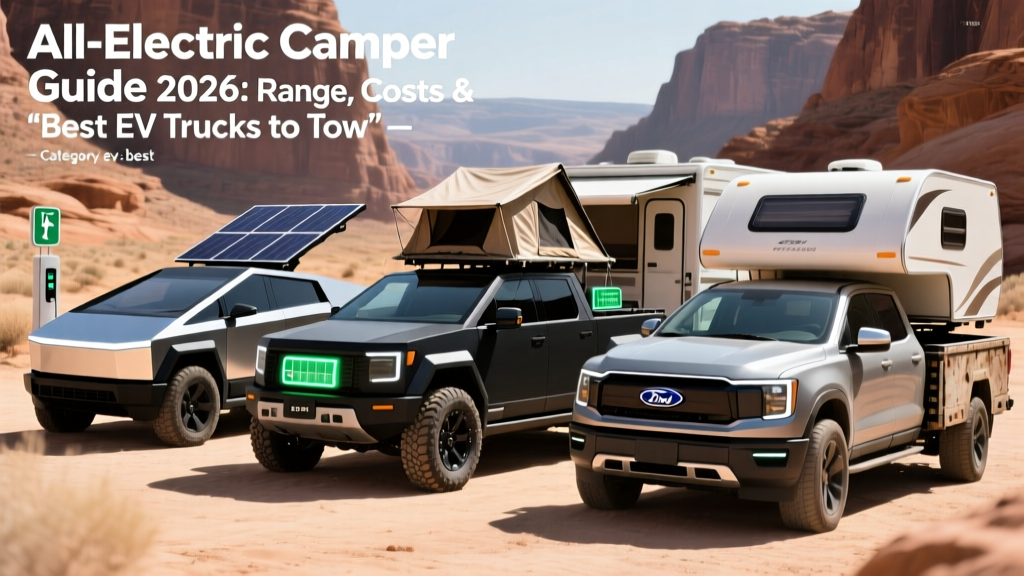
1. Electric truck + travel trailer (most common): You pair a battery-electric pickup — Ford F-150 Lightning, Rivian R1T, Chevrolet Silverado EV, or Tesla Cybertruck — with a conventional or lightweight travel trailer. This is the most accessible path today and where most real-world data exists.
2. Electric van camper conversion: An electric commercial van (Ford E-Transit, Mercedes-Benz eSprinter) gets converted into a Class B camper with a sleeping area, basic galley, and auxiliary house battery. Range is limited (typically 100–150 miles loaded) but works for weekend trips near home.
3. Dedicated electric motorhome (not yet available): Companies like Lightship (formerly Winnebago's EV concept partner) and Thor Industries have announced purpose-built electric travel trailers with solar and battery assist, and concepts for electric Class A motorhomes exist, but none are in volume production as of early 2026. Lightship's AE.1 travel trailer, featuring an integrated battery and solar roof to reduce tow-vehicle range loss, is slated for late-2026 deliveries with an announced starting price around $75,000.
For this guide, we focus primarily on the electric-truck-plus-trailer approach, because that's what you can actually buy and drive this year.
EV Truck Towing Range: Real Numbers vs. EPA Stickers
The single biggest question for anyone considering an all-electric camper setup is: how far can I actually tow? The EPA range figures on EV truck window stickers are measured with an empty bed and no trailer. Towing changes the math drastically.
| Truck | Battery (kWh usable) | EPA Range Solo | Est. Towing Range | Max Tow Rating | Base MSRP |
|---|---|---|---|---|---|
| Ford F-150 Lightning Extended Range | 131 kWh (NMC) | 320 mi | ~140–160 mi | 10,000 lbs | $79,990 |
| Rivian R1T Dual-Motor Max Pack | 141 kWh (NMC) | 410 mi | ~180–210 mi | 11,000 lbs | $93,900 |
| Chevrolet Silverado EV 4WT | 200 kWh (NMC) | 440 mi | ~190–220 mi | 10,000 lbs | $77,900 |
| Tesla Cybertruck AWD | 123 kWh (NMC) | 340 mi | ~130–160 mi | 11,000 lbs | $79,990 |
| GMC Sierra EV Denali | 200 kWh (NMC) | 440 mi | ~190–220 mi | 12,000 lbs | $99,495 |
Real-World Towing Range Reality: These estimates assume flat-to-rolling terrain at highway speeds (60–65 mph) in moderate temperatures (55–80°F). Add a 15–25% range penalty for sustained mountain grades, a 20–30% penalty in sub-30°F weather, and another 5–10% for headwinds or fully loaded trailers. A Rivian R1T Max Pack towing 7,000 lbs through the Rockies in January might realistically deliver 110–130 miles between charges. Plan your routes around charging infrastructure, not around the sticker number.
Charging an All-Electric Camper Setup: At Home, On the Road, At the Campsite
Understanding charging logistics is where most aspiring all-electric campers either succeed or abandon the idea. Here's the practical breakdown.
| Charging Level | Power (kW) | Miles of Tow Range Added/Hour | Cost (Full Charge) | Time to 80% |
|---|---|---|---|---|
| Level 1 (120V household) | ~1.4 kW | ~2–3 mi/hr | $13–$18 | 75+ hours |
| Level 2 (240V home, 48A) | ~11.5 kW | ~18–22 mi/hr | $13–$18 | ~10 hours |
| DC Fast Charge (150 kW) | 150 kW peak | ~120–150 mi/hr (to 80%) | $35–$50 | ~45 min |
| DC Fast Charge (350 kW capable) | 250–320 kW peak* | ~200–250 mi/hr (to 80%) | $45–$65 | ~25–35 min |
*Note: Peak kW is not sustained kW. Most EV truck batteries begin tapering charge rate significantly above 60–70% State of Charge (SoC). A truck that peaks at 320 kW may sustain that rate for only 10–15 minutes before dropping to 150 kW or below. The 10–80% time is the meaningful metric, not the peak number.
Home charging is essential. If you're towing a camper on weekends and charging overnight at home on a Level 2 station, your "fuel" cost is roughly $0.04–$0.06 per mile of solo driving (at $0.13/kWh national average, per EIA data). That compares to $0.15–$0.20 per mile for a gas truck getting 15–18 mpg at $3.50/gallon.
Campsite charging is the frontier. Most RV parks offer 30-amp or 50-amp shore power. A 50-amp, 240V hookup delivers up to 12 kW — essentially Level 2 speed. If your campsite has a 50-amp pedestal, you can add 120–150 miles of solo range overnight (10–12 hours). The catch: many parks use 50-amp pedestals for the RV's house systems, and sharing that circuit with your truck may require a smart splitter or coordination. Always call ahead and confirm the amperage and plug type (NEMA 14-50 is standard for 50-amp RV pedestals).
Public DC fast charging while towing requires planning. Not all Electrify America, EVgo, or Tesla Supercharger stalls are pull-through (designed for vehicles with trailers). You may need to unhitch the trailer in a parking space and drive the truck to the charger. The PlugShare app lets you filter for pull-through charging stations — a critical tool for all-electric camper trips.
Cost Breakdown: All-Electric Camper vs. Gas Truck Camper Setup
Let's model a realistic 5-year ownership scenario comparing an electric truck towing setup against a comparable gas truck. We'll use the Ford F-150 Lightning Extended Range vs. a Ford F-150 3.5L EcoBoost (gas), both towing a 5,000-lb travel trailer for 12 weekend trips per year (2,400 towing miles) plus 10,000 miles of solo daily driving.
| Cost Category | F-150 Lightning (EV) | F-150 EcoBoost (Gas) |
|---|---|---|
| Purchase Price (base MSRP) | $79,990 | $55,000 |
| Estimated §30D Federal Tax Credit | –$3,750 to $7,500* | $0 |
| Home Level 2 Charger Install | $1,200–$2,500 | $0 |
| Fuel/Energy (5 years, 62,000 mi total) | $4,800–$6,500 | $12,500–$15,000 |
| Maintenance (5 years) | $1,500–$2,000 | $3,500–$5,000 |
| Insurance (5 years) | $12,000–$15,000 | $8,000–$10,000 |
| Estimated Depreciation (5 years) | $30,000–$38,000 | $20,000–$25,000 |
| Estimated 5-Year Total | $66,000–$82,000 | $59,000–$70,000 |
*§30D tax credit eligibility depends on MSRP caps ($80,000 for trucks/vans), buyer AGI limits ($150K single / $300K joint), and battery critical-mineral and component sourcing requirements that tighten annually. Check the latest rules at IRS.gov and confirm with a tax professional. As of 2026, several trucks qualify for partial or full credit at point of sale.
The takeaway: The EV truck setup costs more upfront and depreciates faster (a persistent issue with electric trucks as battery tech evolves), but saves meaningfully on fuel and maintenance. If you drive high daily solo miles and tow infrequently, the EV math improves. If you tow long distances frequently and rely on DC fast charging at $0.40–$0.50/kWh, the fuel savings narrow considerably.
Common All-Electric Camper Misconceptions
| Myth | Fact |
|---|---|
| "EVs can't tow — they'll run out of battery in 50 miles." | Modern electric trucks with 130–200 kWh batteries deliver 120–220 miles of real-world towing range with a 5,000-lb trailer. That's enough for many campground trips, though not cross-country without careful planning. |
| "Towing will destroy the battery." | Towing increases cycle count and thermal load, but modern NMC batteries with active liquid thermal management handle the stress well. Ford warranties the Lightning battery for 8 years/100,000 miles with a 70% capacity retention floor. Expect normal degradation of 10–15% over 100,000 miles, slightly more if you frequently tow in extreme heat and DC fast charge to 100%. |
| "You can't charge at RV parks." | Most RV parks with 50-amp service deliver 240V/12 kW — equivalent to a home Level 2 charger. You can fully recharge overnight at your campsite. The limitation is 30-amp parks (3.6 kW), which add only ~30–40 miles of tow range overnight. |
| "Electric trucks are all over $100,000." | While fully loaded models push past $100K, the Ford F-150 Lightning Pro starts at ~$55,000 (smaller battery, 240 mi range), and the Chevy Silverado EV 4WT starts around $77,900 with 440 miles of range. Used electric trucks are also entering the market at meaningful discounts. |
| "The §30D tax credit gives everyone $7,500." | The credit phases based on battery sourcing requirements that tighten each year. In 2026, qualifying vehicles must meet both critical-mineral and battery-component thresholds, and buyer income and MSRP caps apply. Many trucks qualify for $3,750 (partial) or $7,500 (full), but always verify current eligibility at IRS.gov before purchasing. |
Decision Framework: Is an All-Electric Camper Setup Right for You?
Choose an Electric Truck + Camper Setup If:
- You camp within 150 miles of home (round-trip towing range fits comfortably within one charge, or you can charge at the campsite overnight).
- You have Level 2 home charging (a 240V/48A station that fully recharges your truck overnight, costing $13–$18 per fill-up).
- You drive 10,000+ solo miles per year (the daily-driving fuel savings offset the higher purchase price within 4–6 years).
- You value quiet, emission-free campgrounds — no generator noise, no exhaust fumes, and the truck can power campsite appliances via its Pro Power Onboard or vehicle-to-load (V2L) capability (up to 9.6 kW on the F-150 Lightning).
- You're willing to plan charging stops on longer trips using tools like PlugShare, A Better Routeplanner (ABRP), or the truck's built-in route planner with trailer integration.
Stick with a Gas or Hybrid Truck If:
- You regularly tow more than 200 miles one-way through areas with sparse DC fast charging infrastructure (rural West, parts of the Great Plains).
- You cannot install a Level 2 home charger (apartment living, no garage, landlord restrictions, or a 100-amp electrical panel that can't support a 60-amp circuit without a $3,000–$5,000 panel upgrade).
- You tow in extreme cold frequently (sub-20°F conditions can reduce towing range by an additional 20–30% beyond the baseline towing penalty).
- You need to tow 8,000+ lbs over long distances — the range penalty at heavy loads is severe, and charging infrastructure for heavy-duty towing corridors remains limited.
- Your budget is under $55,000 and you need a truck now — the most affordable new electric trucks still start in the mid-$50Ks before incentives.
What First-Time EV Buyers Should Know Before Towing a Camper
If you're considering an all-electric camper setup and this is your first EV, internalize these points before signing a purchase agreement:
kW vs. kWh — know the difference. kW (kilowatts) measures power — how fast you can charge or how hard the motors pull. kWh (kilowatt-hours) measures energy — the size of your "fuel tank." A 131 kWh battery holds 131 units of energy; charging at 150 kW means you're adding energy at that rate. Confusing these is the most common EV beginner mistake.
The charge curve matters more than peak speed. A truck that advertises "320 kW peak DC fast charging" may only sustain that rate between 10–40% SoC. From 40–80%, it might drop to 150 kW. From 80–100%, it could crawl at 40 kW. Plan your road-trip charging stops to stay in the 10–80% sweet spot and never plan to charge past 80% on a road trip — the time penalty is enormous.
Preconditioning is non-negotiable for fast charging. Modern EV trucks warm or cool the battery to optimal temperature before a DC fast charge. If you navigate to a charger using the truck's built-in route planner, it will precondition automatically. If you just pull up cold, your charge speed may be cut in half for the first 10–15 minutes. Always use the truck's navigation to route to a charger, even if you know the way.
Trailer weight is everything. A 3,500-lb teardrop trailer might leave you with 190 miles of towing range in a Max Pack R1T. A 7,500-lb fifth-wheel could cut that to 110 miles. Before buying any trailer, check the truck's Gross Combined Weight Rating (GCWR) and model your expected range using ABRP with the specific trailer weight and your typical route elevation profile.
Insurance costs more. Electric trucks carry 20–40% higher insurance premiums than equivalent gas trucks, driven by higher repair costs, battery replacement risk, and specialized labor. Get quotes from at least three insurers before purchasing. Some manufacturers (Tesla, Rivian) offer their own insurance products that may be competitive in certain states.
The Near Future: Battery-Assisted Trailers and Purpose-Built Electric Campers
The all-electric camper landscape will shift meaningfully by 2027–2028. The most promising development is the battery-assisted travel trailer — a trailer with its own battery pack and motors that contribute propulsion during towing, reducing the load on the truck and recovering range.
Lightship AE.1: Announced for late-2026 delivery, the AE.1 is an aerodynamic travel trailer with an 80 kWh battery pack, integrated solar roof (up to 3 kW), and a proprietary propulsion system that activates during highway towing to reduce the tow vehicle's energy consumption by an estimated 30–40%. With an announced starting price of ~$75,000 and a target weight under 5,000 lbs, it's designed specifically for electric truck owners. If the range-assist claims hold in independent testing, this could effectively add 50–80 miles of real-world towing range to any EV truck.
Thor Industries / Harbinger: Thor (parent of Airstream, Jayco, and others) has invested heavily in electrified RV platforms. The Harbinger chassis, developed with a skateboard-style battery and drive system, underpins concepts for electric Class A and Class C motorhomes. Production timelines remain unconfirmed, but Thor has signaled 2027–2028 for initial models.
Until these products reach driveways, the electric-truck-plus-travel-trailer combination remains the practical, available path to all-electric camping — and for most weekend warriors within 150 miles of home, it works today.
Can I tow a camper with a Tesla Cybertruck?
Yes. The Cybertruck AWD has an 11,000-lb tow rating and 340 miles of EPA range (solo). Expect 130–160 miles of real-world towing range with a 5,000-lb trailer. The Cybertruck's NACS connector gives access to the Tesla Supercharger network (20,000+ stalls), but many Supercharger stalls are not pull-through, meaning you'll likely need to unhitch at most stops. Tesla's built-in route planner accounts for trailer weight when estimating range and suggesting charge stops.
What size travel trailer is practical for an electric truck?
For the best balance of range and livability, target a travel trailer between 3,000 and 5,000 lbs — typically a 16–24 foot model. Lighter trailers (under 3,500 lbs) like teardrops and pop-ups preserve the most range. Aerodynamic designs (rounded front caps, low profile) matter as much as weight — a boxy 4,000-lb trailer can consume more energy than a streamlined 5,000-lb model at highway speeds.
Do I need a special charger at home for an EV truck?
You need a Level 2 (240V) home charging station rated for at least 48 amps, installed on a dedicated 60-amp circuit by a licensed electrician. Expect $500–$1,200 for the charger hardware (ChargePoint Home Flex, WallConnector, or Ford Charge Station Pro) and $600–$1,800 for professional installation, depending on the distance from your electrical panel and whether a panel upgrade is needed. A standard 120V outlet (Level 1) adds only 2–3 miles of towing range per hour — impractical as a primary charging method for a 130+ kWh battery.
How does cold weather affect electric truck towing range?
Cold weather reduces EV range through two mechanisms: battery chemistry becomes less efficient (internal resistance increases), and cabin/trailer heating draws significant energy. At 20°F, expect a solo range reduction of 15–25% and a compounding towing range reduction of 20–30%. A truck that delivers 160 miles of towing range at 70°F might deliver only 110–130 miles at 20°F. Preconditioning the battery while plugged in and using seat heaters instead of cabin heat can recover 5–10% of that loss. Trucks with heat pumps (Rivian R1T, newer F-150 Lightnings) perform better in cold than those with resistive heaters.
Will towing a camper void my EV truck's battery warranty?
No. Towing within the manufacturer's rated tow capacity is a normal, warranted use of the vehicle. Ford, Rivian, Chevrolet, and Tesla all cover their battery packs for 8 years and 100,000–175,000 miles (varies by brand) with a minimum capacity retention of 65–70%. However, if battery degradation is accelerated by consistent use patterns like daily DC fast charging to 100% while towing in extreme heat, warranty claim adjudication can become contentious. Best practice: charge to 80% daily, use DC fast charging only when necessary, and precondition the battery before every fast-charge session.