The Short Answer: Which 7 Seater EV Should You Buy?
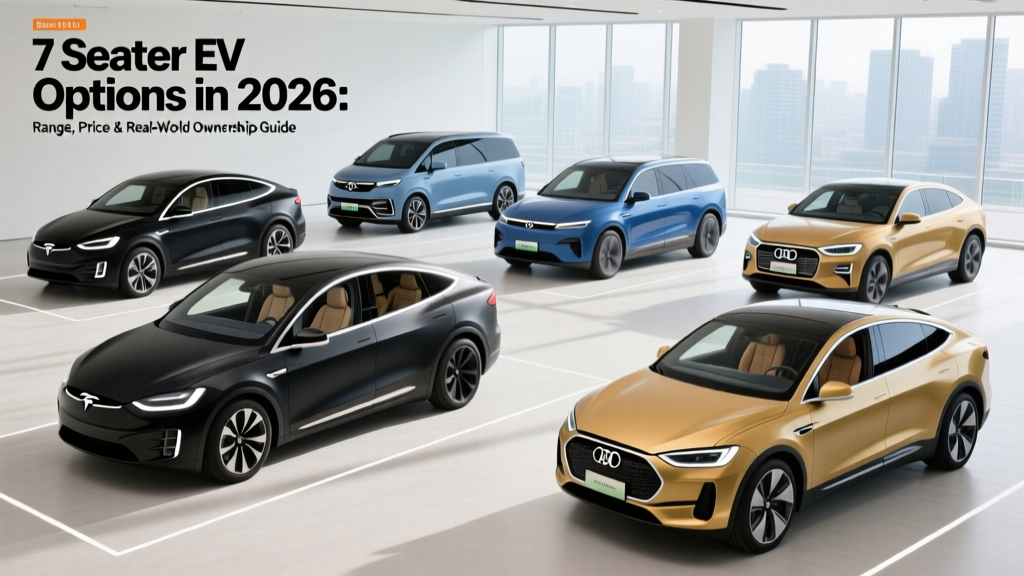
If you need three usable rows and 300+ miles of range today, the Kia EV9 (EPA 304 mi, starting ~$54,900) offers the best balance of space, charging speed, and price. The Tesla Model X (EPA 348 mi, ~$79,990) leads on range and Supercharger access but costs significantly more. The Rivian R1S (EPA 352 mi Dual-Motor, ~$79,900) excels off-road and towing. Families prioritizing budget should also cross-shop the Hyundai Ioniq 9 (announced for 2026, estimated 300+ mi, ~$50,000 starting). Plug-in hybrid alternatives like the Toyota Grand Highlander Hybrid remain worth considering if home charging isn't available.
Why the 7 Seater EV Market Matters Now
Through 2025, buyers wanting three rows and a battery faced a near-empty showroom. That changed with the Kia EV9's arrival and a wave of new platforms entering for the 2026 model year. The midsize and large electric SUV segment is finally addressing the core family-hauler use case: school runs, road trips, cargo flexibility, and a third row that adults can tolerate for short drives.
But the math is different from buying a gas SUV. Upfront MSRPs remain higher, charging logistics matter more with kids in the car, and the federal §30D tax credit has strict MSRP caps ($80,000 for SUVs/vans), buyer income limits ($300,000 joint / $150,000 single), and battery-sourcing requirements that disqualify some trims. This guide cuts through the marketing with real numbers.
The 2026 Contenders: Spec-by-Spec Breakdown
| Model | EPA Range | Battery (kWh usable) | Peak DC Charge | 10–80% Time | 0–60 mph | Starting MSRP |
|---|---|---|---|---|---|---|
| Kia EV9 (LR RWD) | 304 mi | 99.8 kWh NMC | 236 kW | ~24 min | 8.2 sec | $54,900 |
| Kia EV9 (AWD GT-Line) | 270 mi | 99.8 kWh NMC | 236 kW | ~24 min | 5.0 sec | $63,900 |
| Hyundai Ioniq 9 (est.) | ~310 mi* | ~110 kWh NMC* | ~350 kW* | ~18 min* | TBD | ~$50,000* |
| Tesla Model X (LR) | 348 mi | 100 kWh NMC | 250 kW | ~27 min | 3.8 sec | $79,990 |
| Rivian R1S (Dual-Motor) | 352 mi | 149 kWh NMC (Max Pack) | 220 kW | ~42 min | 5.0 sec | $79,900 |
| Cadillac Escalade IQ | ~450 mi* | ~200 kWh Ultium | ~350 kW | TBD | <5.0 sec* | ~$130,000* |
*Announced/preliminary — verify with manufacturer before purchase. Source: fueleconomy.gov, manufacturer spec sheets.
Real-World Range: What the EPA Sticker Doesn't Tell You
EPA vs Reality: A Kia EV9 rated at 304 miles EPA will typically deliver 250–270 miles on sustained 75 mph highway driving. In freezing temperatures (below 32°F), expect 20–30% range loss, dropping usable range to roughly 210–240 miles. The Tesla Model X holds up better in cold thanks to its heat pump and efficient thermal management, but still loses ~15–20% in deep winter.
Charging-curve taper matters on road trips. The EV9's 236 kW peak is sustained only between roughly 15–55% state of charge; above 80%, speed drops below 60 kW. Plan stops to 80%, not 100%, or add 25+ minutes to your charging time. Rivian's larger Max Pack battery sacrifices peak charge speed for total capacity — great for range, slower on the road.
Cost of Ownership: EV vs Gas 3-Row SUV
| Category | Kia EV9 LR RWD | Grand Highlander Gas V6 |
|---|---|---|
| Base MSRP | $54,900 | $43,000 |
| Fed. Tax Credit (§30D) | Up to $7,500 (eligibility varies) | $0 |
| Effective Purchase | ~$47,400 | $43,000 |
| Energy/Fuel (5 yrs) | ~$4,100 (home L2 @ $0.14/kWh) | ~$14,600 (22 MPG @ $3.40/gal) |
| Maintenance (5 yrs) | ~$1,800 | ~$4,200 |
| Insurance (avg 5 yrs) | ~$11,500 | ~$9,200 |
| Total 5-Yr Cash Cost | ~$64,800 | ~$71,000 |
Savings hinge on home charging at residential rates. Public DC fast charging at $0.40–$0.60/kWh closes the gap fast — a road-trip-heavy EV9 owner could spend $7,000+ on electricity over five years. Per the IRS §30D rules, the credit now requires point-of-sale transfer, North American final assembly, and critical-mineral/battery-component sourcing thresholds that shift annually. Confirm eligibility with your dealer and a tax professional before signing.
Charging Logistics for Families
A 99.8 kWh battery like the EV9's is a double-edged sword. Level 1 (120V) charging adds only ~3 miles per hour — effectively useless for daily replenishment. A Level 2 home charger at 11.5 kW (48A circuit, 60A breaker) adds roughly 33 miles per hour, meaning a 20–80% top-up takes about 6 hours overnight. Installation typically runs $800–$2,200 depending on panel proximity; a 200A panel upgrade can add $1,500–$3,500.
Families without home charging access face a real friction point. Relying on public DC fast chargers for a 100 kWh battery means 30–45 minute stops, often with kids in tow. Cross-shop a PHEV like the Grand Highlander Hybrid (36 MPG combined, no charging needed) if your housing situation doesn't support a Level 2 install.
Common Misconceptions, Corrected
| Myth | Fact |
|---|---|
| "7 seater EVs have no cargo room." | The EV9 offers 20.2 cu ft behind the third row, 43.5 cu ft with row 3 folded — competitive with gas 3-row SUVs. |
| "Batteries need replacing every 5 years." | Modern NMC packs are warrantied 8 yr/100,000 mi (10 yr/150,000 mi in CARB states) for 70% capacity retention. Most lose 8–12% over 100k miles based on fleet data. |
| "Autopilot and FSD drive the car for you." | Tesla FSD (Supervised), Kia Highway Driving Assist, and similar systems are SAE Level 2 — you must remain engaged, hands on or eyes on, at all times. No consumer EV is self-driving. |
| "Towing destroys range." | It does reduce range — typically 40–55% when towing near max capacity. The R1S (7,700 lb rating) can tow a camper but plan for ~150-mile range between stops. |
Decision Framework: Which 7 Seater EV Fits Your Life?
- Choose the Kia EV9 if: You want the best value in a 3-row EV, have home Level 2 charging, drive under 300 miles daily, and want a mainstream dealer network for service.
- Choose the Tesla Model X if: Range is paramount, you road-trip frequently (Supercharger reliability remains best-in-class), and budget allows a $80k+ purchase.
- Choose the Rivian R1S if: You need serious off-road capability, tow regularly, or want the Max Pack's class-leading 352-mile EPA range and don't mind longer charge times.
- Wait for the Hyundai Ioniq 9 if: You want EV9-rivaling space with a next-gen 800V+ architecture and potentially faster charging — but accept delivery-timeline uncertainty.
- Choose a PHEV (Grand Highlander Hybrid) if: You lack reliable home charging, regularly drive in extreme cold, or want 3-row flexibility without upfront EV premiums.
What First-Time 7 Seater EV Buyers Must Know
Budget for a Level 2 home charger installation before taking delivery — it's the single biggest ownership-experience variable. Verify the specific trim's §30D eligibility; not all trims of the same model qualify due to battery-sourcing rules. Factor in higher insurance premiums (typically 15–25% above equivalent gas SUVs per IIHS industry data). And test the third row yourself — many "7 seaters" have a third row suitable only for children under 12 on longer drives.
Finally, check your state's EV incentives separately from federal credits. States like California, Colorado, and Massachusetts offer additional rebates that stack with §30D, but rules and funding pools change frequently. Always confirm via your state's energy or DMV website.
FAQ: 7 Seater EV Ownership
Do any 7 seater EVs qualify for the full $7,500 federal tax credit?
Eligibility depends on the trim's battery sourcing, your income, and the MSRP cap ($80,000 for SUVs). As of early 2026, some Kia EV9 and Rivian R1S configurations qualify, but critical-mineral thresholds tighten annually. Confirm with your dealer and review the IRS clean vehicle credit page before committing.
How long does it take to charge a 100 kWh battery at home?
From 10% to 80% on an 11.5 kW Level 2 home charger: roughly 6–7 hours. Overnight charging is the practical norm. Never plan around Level 1 (120V) for a battery this size — it adds ~3 miles per hour.
Is a 7 seater EV practical for road trips?
Yes, with planning. A 300-mile EPA range means 220–250 real-world highway miles between 25-minute fast-charge stops. Apps like A Better Routeplanner factor in elevation, temperature, and charging-curve taper. Families who road-trip monthly should prioritize models with access to reliable DC networks (Tesla Supercharger via native port or adapter).
What happens if the battery degrades?
Federal law mandates a minimum 8 yr / 100,000 mi warranty on EV batteries (10 yr / 150,000 mi in CARB states) covering capacity below ~70%. Replacement out of warranty for a 100 kWh pack currently runs $15,000–$22,000 — a real but unlikely expense within typical ownership horizons.