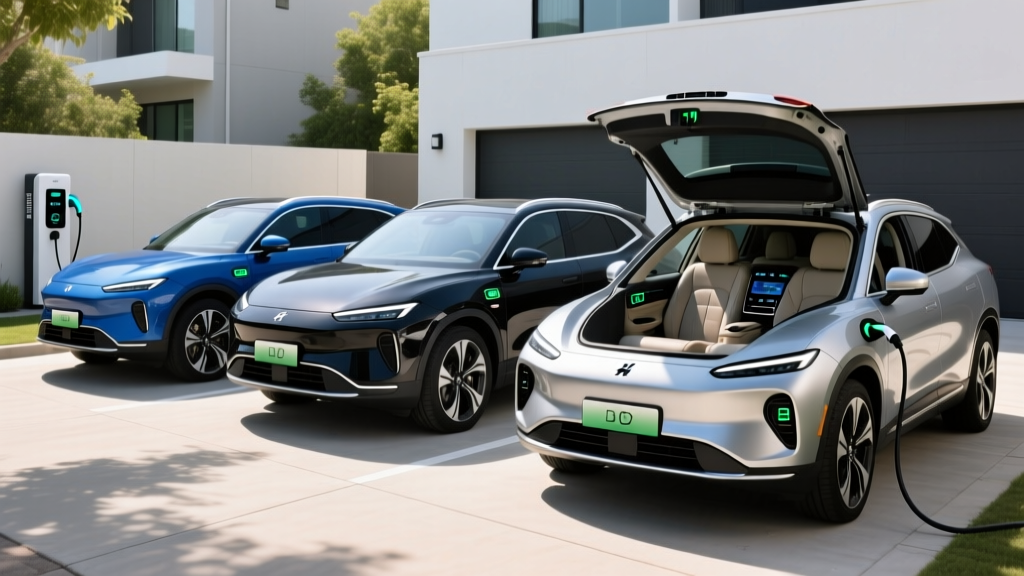
The Quick Answer: Which 3rd Row EV Should You Consider?
If you need a 3rd row EV in 2026, your realistic shortlist comes down to a handful of production models with genuinely usable third rows — not token emergency seats. The Kia EV9 (EPA range up to 304 miles, starting ~$54,900) offers the best value-to-space ratio. The Rivian R1S (EPA up to 410 miles with the Max Pack, starting ~$79,900) leads on range and off-road capability. The Tesla Model X (EPA up to 335 miles, starting ~$79,990) remains the performance benchmark. The Mercedes EQB (EPA 232 miles, starting ~$54,550) is the most compact and affordable but has a very tight third row best suited for small children.
Families covering under 250 miles between home charges and with access to Level 2 home charging will find these EVs dramatically cheaper to run than gas three-row SUVs. Those without home charging or who frequently tow or drive in extreme cold should carefully weigh the trade-offs before committing.
The 2026 3rd Row EV Lineup: Spec-by-Spec Breakdown
Not all third rows are created equal. Some accommodate adults on longer trips; others are strictly for children or short errands. Below is a spec comparison of the major 3rd row EV options currently available for the 2026 model year. All figures reflect EPA estimates and manufacturer-published data as of early 2026.
| Spec | Kia EV9 (LR RWD) | Rivian R1S (Dual Max) | Tesla Model X (LR) | Mercedes EQB 350 |
|---|---|---|---|---|
| EPA Range | 304 mi | 410 mi | 335 mi | 232 mi |
| Battery (usable) | 99.8 kWh (NMC) | ~149 kWh (NMC) | ~100 kWh (NMC) | 66.5 kWh (NMC) |
| Peak DC Fast Charge | 236 kW | ~220 kW | 250 kW | 100 kW |
| 10–80% DCFC Time | ~24 min | ~30 min | ~25 min | ~32 min |
| Level 2 Charge Rate | 10.9 kW | 11.5 kW | 11.5 kW | 7.2 kW |
| 0–60 mph | 8.2 sec (RWD) / 4.5 sec (GT AWD) | ~5.0 sec | 3.8 sec | 6.2 sec |
| Horsepower | 215 (RWD) / 379 (GT) | 533 | 670 | 288 |
| 3rd Row Headroom | 37.8 in | 37.3 in | 37.1 in | 34.8 in |
| Cargo (behind 3rd row) | 20.2 cu ft | ~10 cu ft | ~15 cu ft (frunk adds more) | ~10 cu ft |
| Base MSRP | $54,900 | $79,900 | $79,990 | $54,550 |
| Battery Warranty | 10 yr / 100,000 mi | 8 yr / 120,000 mi | 8 yr / 120,000 mi | 8 yr / 100,000 mi |
Real-World Range Reality Check: EPA estimates assume mixed driving at moderate temperatures. On highway-heavy road trips at 75+ mph, expect to lose 15–20% from the EPA sticker — so a Kia EV9 LR RWD delivers roughly 245–260 highway miles before needing a charge. In sub-freezing winter conditions, plan for 25–35% range loss depending on cabin heating use. The Rivian R1S Max Pack's large battery provides a bigger buffer, making it the strongest road-trip pick in this group.
3rd Row EV vs. Gas and Hybrid Three-Row SUVs: The Cost Data
The most common question from families cross-shopping a 3rd row EV is straightforward: does the math work compared to a gas or hybrid three-row SUV? Let's run the numbers using the Kia EV9 LR AWD ($59,900 MSRP) against two popular gas/hybrid benchmarks — the Toyota Grand Highlander Hybrid ($47,000) and the Kia Telluride gas model ($39,500).
| 5-Year Cost Factor | Kia EV9 LR AWD | Toyota Grand Highlander Hybrid | Kia Telluride (Gas) |
|---|---|---|---|
| Purchase Price (MSRP) | $59,900 | $47,000 | $39,500 |
| Estimated §30D Tax Credit | Up to $7,500* | $0 | $0 |
| Effective Purchase Price | ~$52,400 | $47,000 | $39,500 |
| Fuel/Energy (5 yr, 75k mi) | ~$3,750 (home L2) | ~$7,200 | ~$10,500 |
| Maintenance (5 yr) | ~$1,200 | ~$3,500 | ~$4,000 |
| Insurance (5 yr est.) | ~$11,500 | ~$9,500 | ~$9,000 |
| Total 5-Year Cost | ~$68,850 | ~$67,200 | ~$63,000 |
*Federal §30D tax credit eligibility depends on buyer income caps ($150K single / $300K joint), MSRP limits ($80K for SUVs), and battery critical-mineral sourcing requirements. Verify current-year rules at IRS.gov. Point-of-sale transfer is available through registered dealers.
The EV9's fuel and maintenance savings of roughly $10,000 over five years nearly close the gap with the Grand Highlander Hybrid, but insurance premiums on EVs run 15–25% higher on average according to industry data. Against the gas Telluride, the EV9 pulls ahead on running costs but still carries a higher total cost due to the steeper purchase price. The break-even point typically arrives around year 6–7 for most drivers, sooner if you have cheap electricity or solar.
Real-World Ownership: What First-Time EV Buyers Must Know
Buying a 3rd row EV isn't just about the vehicle — it's about whether your daily life and driving patterns support electric ownership. Here are the practical realities that spec sheets don't show.
Home Charging Is the Foundation
Over 80% of EV charging happens at home. For a large-battery 3rd row EV like the Kia EV9 (99.8 kWh usable), a standard Level 2 home charger at 10.9 kW replenishes the battery from 10% to 100% in about 9 hours — easily done overnight. Expect to spend $800–$2,500 on a quality Level 2 charger and professional installation, depending on whether your electrical panel needs an upgrade to 200A. Without home charging, you'll rely on public DC fast chargers, where costs run $0.35–$0.55/kWh and convenience drops significantly. If you cannot install home charging, a plug-in hybrid like the Toyota Grand Highlander PHEV may be a more practical bridge.
Charging Speed Matters on Road Trips
Peak DC fast-charge rates (measured in kW — the power flow rate) are not sustained across the entire session. The Kia EV9 peaks at 236 kW but tapers significantly above 70% state of charge (SoC). A realistic 10–80% session takes about 24 minutes at a capable 350 kW charger. The Rivian R1S Max Pack's enormous battery means longer absolute charge times despite respectable peak rates. Plan road-trip stops around 20–30 minute breaks every 200–250 miles.
Connector compatibility is shifting rapidly. Tesla's North American Charging Standard (NACS) is becoming the dominant connector for 2025–2026 models. The Rivian R1S ships with NACS. The Kia EV9 uses CCS1 but is compatible with Tesla Superchargers via adapter. Always verify your vehicle's native connector and the networks available on your typical routes.
Cold Weather Cuts Range — Plan For It
Lithium-ion batteries lose efficiency in cold temperatures, and cabin heating draws significant energy. In sustained sub-30°F driving, expect 25–35% range reduction across all 3rd row EVs. The Kia EV9's heat pump (standard on most trims) mitigates this somewhat compared to resistance heating, but physics wins. If you live in northern climates, a larger battery pack isn't a luxury — it's a buffer. The Rivian R1S Max Pack's 410-mile EPA rating becomes roughly 280–300 miles in deep winter, which is still workable for most families.
Common Misconceptions About 3rd Row EVs
| Myth | Fact |
|---|---|
| "EV batteries need replacing every few years and cost $20,000+." | Modern NMC and LFP batteries degrade slowly — typically 10–15% over 100,000 miles. All models listed here carry 8–10 year battery warranties guaranteeing at least 70% capacity retention. Full replacements are rare and usually covered under warranty within the coverage period. |
| "There's no charging infrastructure for family road trips." | The U.S. now has over 70,000 public charging ports. Tesla's Supercharger network — open to NACS-equipped and adapter-equipped EVs — covers major interstate corridors with 150–350 kW stalls. Electrify America and EVgo fill additional gaps. Rural routes remain a weak point; plan ahead using A Better Routeplanner or PlugShare. |
| "A 3rd row EV can't tow or haul like a gas SUV." | The Rivian R1S tows up to 7,700 lbs; the Tesla Model X tows 5,000 lbs. However, towing slashes range by 30–50%. For frequent heavy towing, a gas or hybrid SUV still has a practical range advantage on long hauls. |
| "I'll save money immediately by going electric." | Upfront costs for 3rd row EVs remain higher than gas equivalents. Savings accrue over time through lower fuel and maintenance costs. The break-even window is typically 5–7 years depending on mileage, electricity rates, and whether you qualify for the federal tax credit. |
| "All 3rd row EVs qualify for the $7,500 tax credit." | §30D credit eligibility is complex. The vehicle must meet MSRP caps ($80,000 for SUVs), the buyer must fall under income limits, and battery components/critical minerals must meet domestic sourcing thresholds that tighten yearly. Check the latest eligible vehicle list at fueleconomy.gov and verify with a tax professional. |
Decision Framework: Which 3rd Row EV Fits Your Family?
Choose the Kia EV9 if: You want the best balance of interior space, range, and value in a 3rd row EV. The 304-mile EPA range, usable adult-friendly third row, and 20.2 cu ft of cargo space behind the third row make it the strongest all-around family pick. Best for suburban families with home charging and road trips under 300 miles between stops.
Choose the Rivian R1S if: Range is your top priority, you need genuine off-road capability, or you tow regularly. The Max Pack's 410-mile EPA rating provides the largest buffer for cold weather and highway driving. The trade-off is a higher starting price and a tighter third row/cargo area than the EV9.
Choose the Tesla Model X if: Performance matters and you want the most mature Supercharger network access. The Model X's 3.8-second 0–60 time and 335-mile range are compelling, and its falcon-wing doors ease third-row access in tight parking spots. However, it's the most expensive option and the interior materials don't match its price point.
Choose the Mercedes EQB if: You need a compact, premium-badged 3rd row EV primarily for city and suburban use, and your third-row passengers are small children. The 232-mile EPA range and 100 kW peak DC charging make it less suited for frequent road trips.
Consider a hybrid alternative (Toyota Grand Highlander Hybrid/PHEV) if: You lack home charging access, frequently tow heavy loads over long distances, live in an area with limited public charging infrastructure, or need to minimize upfront cost. The Grand Highlander Hybrid delivers 36 MPG combined with no range anxiety, and the PHEV variant adds roughly 30 miles of electric-only range for daily commuting.
Tax Credits, Incentives, and the Bottom Line
The federal §30D clean vehicle credit can reduce your effective purchase price by up to $7,500, but eligibility is not guaranteed. For 2026, the key requirements include:
- MSRP Cap: Vehicle must have an MSRP at or below $80,000 for SUVs/vans/pickups.
- Buyer Income Cap: Modified adjusted gross income must not exceed $150,000 (single), $225,000 (head of household), or $300,000 (joint filers).
- Battery Sourcing: Increasingly strict percentages of battery critical minerals and components must be sourced from the U.S. or free-trade-agreement countries. These thresholds tighten each year and can disqualify previously eligible models.
- Point-of-Sale Transfer: You can transfer the credit to the dealer at purchase, reducing your out-of-pocket cost immediately — even if you have no tax liability.
- Final Assembly: Vehicle must undergo final assembly in North America.
Many states and utilities offer additional rebates — California's CVRP, Colorado's state credit, and various utility company incentives for home charger installation can stack with federal credits. Always check your state's energy office and your utility provider's EV programs.
According to EPA data at fueleconomy.gov, the Kia EV9 achieves 89 MPGe combined (LR RWD), translating to roughly $0.05–$0.07 per mile on residential electricity at the national average of $0.17/kWh. Compare that to the gas Telluride at roughly $0.14–$0.16 per mile at $3.40/gallon. Over 15,000 annual miles, that's $1,050–$1,350 in annual fuel savings.
Frequently Asked Questions
Is the third row in the Kia EV9 actually comfortable for adults?
Yes, for trips under two hours. The EV9's 37.8 inches of third-row headroom and relatively flat floor make it one of the most usable third rows in this segment. Adults over 6 feet will find knee room tight on longer journeys, but it's genuinely functional — not a token add-on. For comparison, it's noticeably roomier than the EQB or R1S third rows.
Can I charge a 3rd row EV on a standard household outlet?
Technically yes, but it's impractical for daily use. A Level 1 outlet (120V, 12A) delivers roughly 1.4 kW — adding about 3–5 miles of range per hour. Fully recharging a 100 kWh battery from empty would take over 70 hours. For a large family EV, a 240V Level 2 home charger (typically $500–$1,200 for equipment, plus $500–$2,000 for electrician installation) is strongly recommended.
How much does insurance cost for a 3rd row EV compared to a gas SUV?
EV insurance premiums typically run 15–25% higher than comparable gas vehicles due to higher repair costs (especially battery-related claims) and greater total-loss valuations. For a Kia EV9, expect annual premiums of roughly $2,000–$2,600 depending on your state, driving record, and coverage level. Shop quotes from multiple insurers — some now offer EV-specific policies with battery coverage included.
What happens to a 3rd row EV's battery after the warranty expires?
Data from NHTSA and long-term fleet studies show that modern liquid-cooled NMC batteries retain 85–90% of original capacity at 100,000 miles. Degradation curves flatten after the initial 10–15% loss, meaning most batteries outlast the vehicle's useful life. Out-of-warranty replacement for a large pack currently costs $12,000–$20,000, but prices continue to decline as battery manufacturing scales. Module-level repairs (replacing individual degraded cells or modules rather than the full pack) are increasingly available for $3,000–$7,000.
Are there more 3rd row EVs coming soon?
Several are announced or in early production stages for 2026–2027, including the Volvo EX90 (announced, EPA specs preliminary — expected 300+ mile range, ~$77,000 starting) and refreshed variants of existing models. However, announced vehicles often face production delays and spec changes. We recommend making purchase decisions based on vehicles currently available and testable, not future promises.