Quick Answer: Is a 3 Wheel Electric Car Worth It?
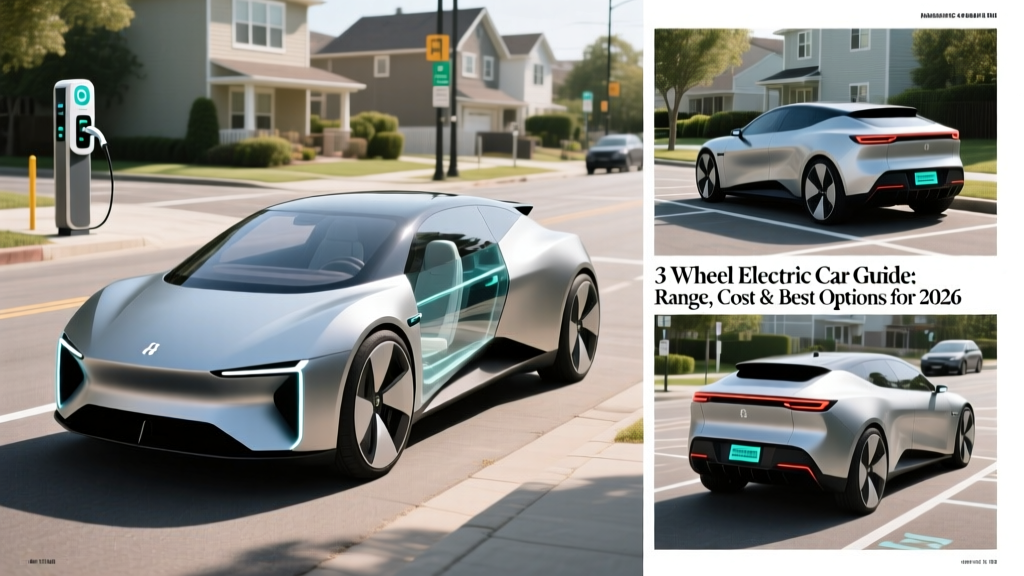
A 3 wheel electric car in 2026 falls into two distinct categories: Neighborhood Electric Vehicles (NEVs) like the Arcimoto FUV and autocycles like the Polaris Slingshot (which remains gas-only). For urban commuters with trips under 30 miles, a 3 wheel EV can cut fueling costs by 70-80% versus a gas car. However, these vehicles typically offer 50-100 miles of EPA range, limited highway capability, and reduced crash protection compared to a four-wheel EV. They are best suited as secondary vehicles for warm-climate, low-speed commuting — not primary family transportation.
What Qualifies as a 3 Wheel Electric Car?
The term "3 wheel electric car" covers a legally fragmented category. The National Highway Traffic Safety Administration (NHTSA) classifies three-wheeled vehicles differently depending on weight, speed, and enclosure:
- Neighborhood Electric Vehicles (NEVs) / Low-Speed Vehicles (LSVs): Limited to 20-25 mph top speed by federal regulation. Street-legal only on roads with speed limits up to 35 mph in most states. Examples include the Arcimoto FUV and various Chinese-market imports.
- Motorcycle-Class Autocycles: Titling and licensing as motorcycles, these can reach highway speeds. The Arcimoto FUV's "Delivery" variant and the Aptera (announced, not yet in production) target this segment. A motorcycle endorsement or waiver is typically required.
- Enclosed vs. Open: Most 3 wheel EVs lack full crash structures, airbags beyond basic provisions, and climate control. This fundamentally limits their use case.
If you're searching for a Tesla-like experience with three wheels, it doesn't exist at scale in 2026. What does exist are niche commuter vehicles with real trade-offs.
Current 3 Wheel Electric Car Models and Specs
The market for street-legal 3 wheel electric vehicles available in the United States remains narrow. Below are the most relevant options with confirmed specifications:
| Model | Status | Battery (kWh) | EPA Range | Top Speed | Peak Charge kW | Base MSRP |
|---|---|---|---|---|---|---|
| Arcimoto FUV (Standard) | Available (limited) | 12.6 kWh (NMC) | ~66 mi | 75 mph | ~3.3 kW (L2) | ~$21,900 |
| Arcimoto FUV (Extended) | Available (limited) | 20.8 kWh (NMC) | ~102 mi | 75 mph | ~3.3 kW (L2) | ~$27,900 |
| Aptera Launch Edition | Announced / Pre-order | ~42 kWh (est.) | ~250 mi (est.) | 110 mph | TBD | ~$29,800 (est.) |
| Elio Motors E1C | Announced (delayed) | ~14 kWh (est.) | ~55 mi (est.) | 70 mph | TBD | ~$12,000 (est.) |
Real-world range caveat: NEV and autocycle range figures are particularly sensitive to speed and temperature. The Arcimoto FUV's 66-mile EPA figure can drop to roughly 45-50 miles at sustained 60-70 mph speeds, and cold-weather losses of 25-35% are common for small-battery vehicles without active thermal management or heat pumps. The Aptera's claimed 250-mile range relies heavily on its ultra-low drag coefficient (Cd ~0.13) and solar integration — real-world highway range will likely be 180-200 miles based on efficiency modeling, assuming the vehicle ships as specified.
⚡ Range Reality Check: Small battery packs (12-20 kWh) in 3 wheel EVs have no buffer for detours, HVAC use, or cold weather. Plan for 60-70% of EPA range in winter and 75-85% at sustained highway speeds.
3 Wheel EV vs Gas Car: Cost and Efficiency Comparison
The primary appeal of a 3 wheel electric car is operating cost. Let's compare the Arcimoto FUV (Extended battery) against a fuel-efficient gas commuter like the Toyota Corolla (32 MPG combined) over a 12,000-mile year.
| Cost Factor | Arcimoto FUV Extended (EV) | Toyota Corolla LE (Gas) |
|---|---|---|
| Purchase Price (MSRP) | $27,900 | $22,050 |
| Fuel / Energy Cost per Mile | ~$0.04 (home L2 at $0.13/kWh) | ~$0.11 (gas at $3.50/gal, 32 MPG) |
| Annual Fueling Cost | ~$480 | ~$1,313 |
| Annual Maintenance | ~$100-150 | ~$400-600 |
| Insurance (est. annual) | ~$1,200-1,800 (motorcycle-class) | ~$1,400-1,700 |
| 5-Year Total Operating Cost | ~$8,900-$10,750 | ~$8,565-$9,565 |
The FUV saves roughly $600-$800 per year in fueling and maintenance, but its higher purchase price means the break-even point against a Corolla is approximately 7-9 years — longer than most four-wheel EVs versus their gas counterparts. If you can secure the §30D federal tax credit (up to $7,500, subject to eligibility), the economics shift dramatically. However, most NEVs and autocycles face challenges meeting the battery-sourcing and critical-mineral requirements outlined by the IRS under §30D.
Federal Tax Credit Eligibility for 3 Wheel EVs
The §30D Clean Vehicle Credit applies to vehicles classified as four-wheeled vehicles under the tax code. This is where 3 wheel electric cars hit a regulatory wall:
- Four-wheel requirement: §30D defines a qualified vehicle as having four wheels. Three-wheeled vehicles generally do NOT qualify for the new-vehicle credit.
- Alternative: §25D or state incentives: Some states offer separate NEV or electric motorcycle rebates (e.g., California's CVRP previously included NEV incentives). Check your state energy office.
- Used EV credit (§25E): The up-to-$4,000 used-vehicle credit also requires four wheels, so it does not apply.
- Commercial clean vehicle credit (§45W): Businesses using 3 wheel EVs for delivery fleets may qualify under different commercial rules — consult a tax professional.
Bottom line: Do not purchase a 3 wheel electric car expecting the $7,500 federal tax credit. Budget the full MSRP and research state-specific NEV incentives instead.
Charging a 3 Wheel Electric Car: What to Expect
Most 3 wheel EVs have small battery packs (12-20 kWh) and limited onboard chargers, which changes the charging calculus significantly compared to a full-size EV:
| Charging Level | Power (kW) | Time 0-100% (12.6 kWh) | Miles Added per Hour | Connector |
|---|---|---|---|---|
| Level 1 (120V outlet) | ~1.2-1.4 kW | 9-11 hours | ~5-7 mi/hr | NEMA 5-15 (standard outlet) |
| Level 2 (240V) | ~3.3 kW | 3.5-4 hours | ~16-20 mi/hr | J1772 |
| DC Fast Charge | Not available on most models | N/A | N/A | N/A |
Key charging realities:
- Most 3 wheel EVs do not support DC fast charging. A 12.6 kWh battery charges fully overnight on a standard 120V outlet — a genuine advantage for home charging simplicity.
- You likely do not need a dedicated 240V Level 2 circuit for a 3 wheel EV. A standard garage outlet handles daily top-ups. This saves $500-$2,000 in electrician installation costs versus a four-wheel EV.
- Public charging networks (Electrify America, EVgo, ChargePoint) are designed for CCS/NACS-equipped four-wheel vehicles. You will almost never use a public DC fast charger.
Common Misconceptions About 3 Wheel EVs
| Myth | Fact |
|---|---|
| "They qualify for the $7,500 federal tax credit" | §30D requires four wheels. Most 3 wheel EVs are ineligible. |
| "They're as safe as a regular car" | NEVs lack federal crash-test ratings from NHTSA. Motorcycle-class autocycles offer minimal crash protection. |
| "I can drive them on the highway" | NEVs/LSVs are restricted to roads with speed limits ≤35 mph. Autocycle-class vehicles can reach highways but lack stability at high speed. |
| "I need a special charger" | Most charge on a standard 120V household outlet at ~1.4 kW. |
| "Range is the same year-round" | Small NMC packs without thermal management lose 25-35% range in freezing temperatures. |
Real-World Ownership: Who Should Buy a 3 Wheel EV?
After evaluating the specs, costs, and limitations, here's a practical decision framework:
Choose a 3 Wheel Electric Car If:
- Your daily commute is under 30 miles round-trip on roads with speed limits ≤35 mph
- You live in a warm climate (minimal cold-weather range loss)
- You already own a primary vehicle for highway trips, groceries, and passengers
- You have access to a standard 120V outlet for overnight charging
- You're comfortable with motorcycle-style visibility and limited crash protection
- You want to minimize fueling costs for a secondary commuter
Choose a Four-Wheel EV or PHEV Instead If:
- You need highway-capable transportation as your primary vehicle
- You regularly carry passengers or cargo
- You live in a region with harsh winters (below 30°F regularly)
- You want NHTSA crash-test ratings and modern ADAS (automatic emergency braking, lane-keep)
- You want to qualify for the §30D federal tax credit (up to $7,500)
- You need DC fast charging for road trips
First-Time Buyer Checklist: 3 Wheel EV Ownership
If you've decided a 3 wheel electric car fits your use case, verify these items before purchase:
- State registration and licensing: Confirm your state's requirements. NEVs may need a special title; autocycle-class vehicles typically require a motorcycle endorsement. Check with your state DMV.
- Insurance classification: Get quotes before purchasing. Motorcycle-classified 3 wheel EVs can carry premiums 20-40% higher than a standard sedan.
- Local road legality: Even if state-legal, some municipalities restrict NEVs from certain roads. Verify with local ordinances.
- Dealer/service availability: Companies like Arcimoto have limited service networks. Confirm who can perform warranty repairs in your area.
- Battery warranty: Arcimoto offers a 3-year/36,000-mile limited battery warranty. Compare this to the 8-year/100,000-mile standard for mainstream four-wheel EVs. Smaller manufacturers carry higher business-continuity risk.
- Resale value: Niche 3 wheel EVs depreciate heavily. Expect 50-60% value loss within three years, versus 35-45% for mainstream EVs like the Tesla Model 3 or Hyundai Ioniq 5.
Frequently Asked Questions
What is the best 3 wheel electric car available in 2026?
The Arcimoto FUV with the Extended Range battery (20.8 kWh, ~102 miles EPA) is the most widely available street-legal option in the US. The Aptera promises 250 miles of range with solar integration but remains in pre-production. For pure urban use under 25 mph, various imported NEVs offer lower prices but limited parts and service support.
Can I drive a 3 wheel electric car on the highway?
It depends on the vehicle class. NEVs/LSVs are federally restricted to roads with speed limits of 35 mph or less. Autocycle-class vehicles (like certain FUV configurations) can reach 75 mph and are highway-legal, but stability, noise, and crash protection make highway driving inadvisable for most owners.
Do 3 wheel electric cars qualify for the federal EV tax credit?
Generally, no. The IRS §30D Clean Vehicle Credit requires a vehicle to have four wheels. Three-wheeled vehicles are excluded. Some states offer separate NEV rebates — check your state's energy or environmental agency website.
How much does it cost to charge a 3 wheel electric car?
With a 12.6 kWh battery and a national average electricity rate of ~$0.16/kWh (per the EIA), a full charge costs approximately $2.00. For a 66-mile range, that's roughly $0.03-$0.04 per mile — about one-third the fueling cost of a 30 MPG gas car at $3.50/gallon.
Are 3 wheel EVs safe?
Three-wheeled vehicles do not undergo the same NHTSA crash testing as four-wheeled passenger cars. They lack advanced ADAS features like automatic emergency braking and blind-spot monitoring. Rollover risk is higher than four-wheeled vehicles, particularly during evasive maneuvers. Treat them like motorcycles in terms of personal protective equipment and defensive driving.
What about the Aptera — is it available?
As of early 2026, the Aptera remains in pre-production with reservations open but no confirmed delivery timeline. Its claimed 250-mile EPA range and integrated solar panels (adding up to ~40 miles/day in optimal conditions) are promising but unverified by independent testing. We recommend treating all Aptera specifications as preliminary until EPA certification and third-party reviews are published.
Bottom Line
A 3 wheel electric car is a specialized tool, not a car replacement. If your daily driving is short, slow, and in fair weather, the Arcimoto FUV or a comparable NEV can deliver genuine fuel savings with zero home-charging infrastructure investment. But the lack of federal tax credits, limited crash protection, cold-weather range loss, and poor resale value make these vehicles a tough recommendation as a primary car. For most buyers, a used four-wheel EV like a Chevrolet Bolt EV ($15,000-$20,000 used, eligible for the $4,000 used-EV credit) delivers more range, safety, and versatility for a similar budget. Evaluate your actual driving patterns honestly before committing to three wheels.