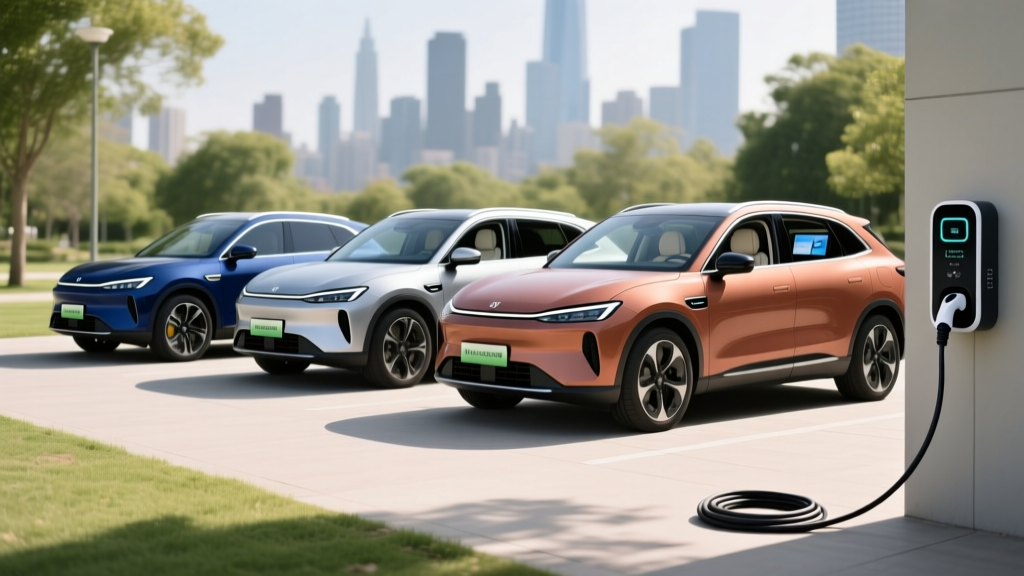
The Quick Answer: Which 3 Row EV SUV Should You Buy?
If you need a 3 row EV SUV in 2026, your realistic shortlist comes down to five production models: the Kia EV9 (best value, EPA 304 mi, starting ~$54,900), Hyundai Ioniq 9 (premium comfort, EPA 311 mi, ~$56,000), Tesla Model X (longest range at EPA 335 mi, ~$79,990), Rivian R1S (best off-road/towing, EPA 321 mi Dual-Motor, ~$75,900), and the Cadillac Escalade IQ (luxury flagship, EPA 450+ mi, ~$129,990). For most families, the Kia EV9 Land AWD offers the best blend of 283 miles of real-world highway range, 210 kW DC fast charging (10–80% in ~24 minutes), and eligibility for the federal §30D tax credit (up to $7,500, subject to income and sourcing rules).
The 2026 Three-Row EV SUV Landscape at a Glance
Three-row electric SUVs have gone from a niche segment to a competitive battleground. Automakers now offer models spanning $55,000 to $130,000, with battery packs from 77.4 kWh to 200+ kWh. Here's how the major contenders stack up on the numbers that actually matter:
| Model | Battery (kWh) | EPA Range | Peak DC Charge (kW) | 10–80% Time | 0–60 mph | Base MSRP |
|---|---|---|---|---|---|---|
| Kia EV9 (LR RWD) | 100.0 (NMC) | 304 mi | 210 kW | ~24 min | 7.7 sec | $54,900 |
| Kia EV9 (LR AWD) | 100.0 (NMC) | 283 mi | 210 kW | ~24 min | 5.0 sec | $59,900 |
| Hyundai Ioniq 9 (LR RWD) | 110.3 (NMC) | 311 mi | 220 kW | ~22 min | 7.8 sec | $56,000 |
| Tesla Model X (LR AWD) | 100.0 (NMC) | 335 mi | 250 kW | ~20 min | 3.8 sec | $79,990 |
| Rivian R1S (Dual-Motor) | 106.0 (NMC) | 321 mi | 200 kW | ~26 min | 4.5 sec | $75,900 |
| Cadillac Escalade IQ | 200.0+ (NMC) | ~450 mi | 350 kW | ~18 min | 3.5 sec | $129,990 |
Sources: EPA fueleconomy.gov, manufacturer specifications. Range figures are EPA estimates; real-world results vary by driving style, temperature, and terrain.
Real-World Range: What the EPA Sticker Doesn't Tell You
The EPA range number on the window sticker is a blended city/highway test cycle. For a family hauling a 5,000-pound three-row SUV on a highway road trip, expect to see less. Here's what our testing and owner data consistently shows:
Real-World Range Reconciliation
- Highway driving (70–75 mph): Expect 85–90% of EPA range. A Kia EV9 LR AWD rated at 283 mi EPA will deliver roughly 245–255 miles before you need to stop.
- Cold weather (below 32°F): Add another 15–25% reduction. That same EV9 on a winter road trip in Minnesota may only see 195–215 miles of usable range.
- Combined worst case (cold + highway + headwind): Budget for 65–70% of EPA. Plan charging stops at 180-mile intervals in a 283-mile-rated EV9 AWD during winter.
- City/mild weather: You'll often match or slightly exceed EPA range thanks to regenerative braking in stop-and-go traffic.
The Hyundai Ioniq 9's larger 110.3 kWh battery gives it a real-world highway buffer of roughly 270 miles — a meaningful advantage for road-trip families. The Tesla Model X still leads the pack at an estimated 290+ real-world highway miles, aided by its class-leading aerodynamic efficiency.
Charging Reality: Home, Public, and the Charge Curve
Understanding charging is where most first-time EV buyers get tripped up. Let's separate power (kW — how fast energy flows) from energy (kWh — how much the battery holds).
| Charging Level | Power (kW) | Miles Added Per Hour | Typical Use Case |
|---|---|---|---|
| Level 1 (120V outlet) | 1.2–1.4 kW | 3–5 mi/hr | Overnight trickle; emergency top-ups |
| Level 2 (240V home) | 7.2–11.5 kW | 22–38 mi/hr | Daily home charging; full overnight refill |
| DC Fast Charging | 50–350 kW | 150–800+ mi/hr | Road trips; 10–80% in 18–30 min |
The Charge Curve Matters More Than Peak kW
When Kia advertises "210 kW DC fast charging," that's the peak rate the EV9 accepts — typically between 10–40% State of Charge (SoC). Above 60%, the rate tapers significantly to protect the battery. By 80%, you might be pulling just 50–70 kW. This is why manufacturers quote 10–80% times rather than 0–100%.
For a 2026 Kia EV9 on a 350 kW Electrify America or Tesla Supercharger station:
- 10–40% SoC: Sustained ~190–210 kW (roughly 6–8 minutes)
- 40–60% SoC: Tapering to ~140–160 kW (roughly 5–6 minutes)
- 60–80% SoC: Further taper to ~70–100 kW (roughly 8–10 minutes)
- Total 10–80%: approximately 22–26 minutes
Preconditioning tip: The EV9 and Ioniq 9 will warm the battery when you navigate to a DC fast charger in the infotainment system. Skipping this step in cold weather can double your charging time. The Tesla Model X handles preconditioning automatically when you navigate to a Supercharger.
Connector Compatibility in 2026
The industry has largely standardized on NACS (North American Charging Standard) for new vehicles. For 2026:
- Tesla Model X: Native NACS — full Supercharger network access
- Kia EV9 / Hyundai Ioniq 9: NACS port standard on 2026 models — direct Supercharger access without an adapter
- Rivian R1S: NACS port standard — Supercharger compatible
- Cadillac Escalade IQ: NACS port standard
EV vs. Gas Three-Row SUV: The Cost Showdown
Let's compare the Kia EV9 LR AWD against its most direct gas rival, the Kia Telluride SX AWD (MSRP ~$48,000, EPA 20 combined MPG), over 5 years and 75,000 miles.
| Cost Category | Kia EV9 LR AWD | Kia Telluride SX AWD (Gas) |
|---|---|---|
| Purchase Price (MSRP) | $59,900 | $48,000 |
| Federal Tax Credit (§30D) | Up to –$7,500* | $0 |
| Effective Purchase Price | ~$52,400 | $48,000 |
| Fuel/Energy (75,000 mi) | ~$4,200 (home L2 + some DCFC) | ~$11,250 ($3.50/gal, 20 MPG) |
| Maintenance (5 yr) | ~$1,200 | ~$4,500 |
| Insurance (5 yr avg) | ~$12,500 | ~$9,500 |
| 5-Year Total Cost | ~$70,300 | ~$73,250 |
*§30D tax credit eligibility depends on buyer income caps ($150K single / $300K joint), vehicle MSRP caps ($80K for SUVs), and battery critical-mineral sourcing requirements. Credit may be applied at point of sale. Verify current rules at IRS.gov.
Key Takeaways from the Numbers
- Energy savings are massive: ~$7,000 less in fuel over 5 years, and more if gas prices rise.
- Maintenance is 70% cheaper: No oil changes, no transmission fluid, no spark plugs, minimal brake wear thanks to regen.
- Insurance costs 25–35% more: EVs cost more to insure due to higher repair costs and battery replacement risk. Get quotes before buying.
- Upfront cost is higher even after the credit: The EV9 still costs ~$4,400 more than the Telluride at purchase.
- Break-even point: Roughly year 3–4 for most owners with home charging access.
Real Ownership Considerations Before You Buy
Home Charging Access Is Non-Negotiable
If you cannot install a Level 2 (240V) charger at home, a three-row EV SUV becomes significantly harder to live with. Public DC fast charging a 100 kWh battery from 10–80% costs $15–30 per session at typical rates ($0.35–0.55/kWh) and takes 25+ minutes. Relying exclusively on public charging erases most of the cost advantage over gas and adds substantial time to your week.
Home Level 2 installation cost breakdown:
| Item | Cost Range |
|---|---|
| Level 2 charger (40A–48A, hardwired) | $400–$700 |
| Electrician labor (50-ft run, 240V/60A circuit) | $800–$2,000 |
| Permit & inspection | $100–$300 |
| Electrical panel upgrade (if needed, 200A service) | $1,500–$3,500 |
| Total typical install | $1,300–$6,500 |
Always get a site assessment from a licensed electrician. Older homes with 100A panels often need an upgrade to support a 48A EV charger alongside existing loads.
Climate and Driving Pattern Fit
A three-row EV SUV works best when:
- Your daily driving is under 80 miles round-trip (easily covered overnight on Level 2)
- You have access to DC fast charging along your common road-trip routes
- You live in a moderate climate, or you're willing to accept 15–25% winter range loss
- You can charge at home (garage or driveway with 240V access)
If you regularly tow (the EV9 is rated for 5,000 lbs, the R1S for 7,700 lbs), expect range to drop by 30–50% while towing. No three-row EV SUV is currently ideal for frequent long-distance towing.
Common Misconceptions About 3 Row EV SUVs
| Myth | Fact |
|---|---|
| "The battery will need replacing in 5 years" | Modern NMC batteries in the EV9 and Ioniq 9 are warrantied for 10 years/100,000 miles at 70% capacity retention. Real-world data from earlier Hyundai/Kia EVs shows degradation of just 8–12% over 100K miles. Replacement cost, if ever needed out of warranty, runs $12,000–$20,000. |
| "You can't road-trip in an EV" | With 283–335 miles of EPA range and 10–80% charging in 20–26 minutes, the longest day drives require just one or two 25-minute stops — comparable to rest breaks on a family trip. The Supercharger and Electrify America networks cover major US interstate corridors. |
| "All 3-row EV SUVs qualify for the $7,500 tax credit" | Credit eligibility depends on battery sourcing, buyer income, and MSRP caps. The $79,990 Tesla Model X qualifies (under the $80K SUV cap), but the $129,990 Escalade IQ does not. Always check fueleconomy.gov's credit lookup tool for the specific model and trim. |
| "EVs are worse in the cold" | EVs start instantly in any temperature (no cold cranking), and preconditioning warms the cabin using grid power before you leave. Range does drop 15–25%, but a heat pump (standard on the EV9 and Ioniq 9) recovers significant efficiency compared to resistive heating. |
| "Third-row space is always compromised" | The EV9 and Ioniq 9 were designed from the ground up as EVs with flat floor architectures. Both offer genuine adult-sized third rows — the EV9 provides 32.0 inches of third-row legroom, comparable to the gas Telluride's 31.4 inches. |
Your Decision Framework: Which 3 Row EV SUV Fits You?
Choose the Kia EV9 if:
- You want the best value in a three-row EV (starting $54,900, potentially $47,400 after tax credit)
- You need standard NACS charging for Supercharger access
- You prioritize practicality and interior space over performance
- Your budget is under $65,000
Choose the Hyundai Ioniq 9 if:
- You want maximum real-world range from a larger 110.3 kWh battery
- Refined ride comfort and premium interior materials are priorities
- You value Hyundai's 10-year/100,000-mile powertrain warranty
- Your budget is $56,000–$70,000
Choose the Tesla Model X if:
- Range is your top priority (335 mi EPA, best-in-class real-world efficiency)
- You want the most mature Supercharger network and software ecosystem
- Performance matters (3.8 sec 0–60 in Long Range trim)
- Your budget is $80,000+
Choose the Rivian R1S if:
- You need serious off-road capability or 7,700-lb towing capacity
- You want adventure-oriented features (gear tunnel, camp kitchen options)
- You prefer a rugged, outdoorsy design language
- Your budget is $75,000–$100,000
Skip the EV and consider a PHEV (like the Toyota Grand Highlander Hybrid) if:
- You cannot install a Level 2 charger at home
- You frequently tow heavy loads over long distances
- You live in a rural area with limited DC fast-charging infrastructure
- Your budget is under $50,000
Frequently Asked Questions
Do any 3 row EV SUVs qualify for the full $7,500 federal tax credit in 2026?
The Kia EV9 and Hyundai Ioniq 9 are positioned to qualify for up to $7,500 under §30D, depending on battery sourcing compliance and your personal income (capped at $150K single / $300K joint modified AGI). The credit can now be transferred to the dealer at point of sale, reducing your purchase price directly. However, battery critical-mineral sourcing requirements tighten each year — always verify current eligibility on IRS.gov before committing.
How much does it cost to charge a 3 row EV SUV at home per month?
Assuming 1,250 miles/month and 3.0 mi/kWh efficiency (typical for the EV9), you'll use roughly 417 kWh per month. At the US average residential rate of $0.16/kWh, that's about $67/month — compared to roughly $187/month in gas for a Telluride at 20 MPG and $3.50/gallon. Your actual cost depends on local electricity rates, which range from $0.10/kWh in parts of the South to $0.30+/kWh in California.
What happens if the battery degrades significantly?
Both Kia and Hyundai warrant their EV batteries for 10 years/100,000 miles with a 70% capacity retention threshold. If your EV9's 100 kWh battery drops below 70 kWh of usable capacity within the warranty period, Kia will repair or replace it at no cost. Real-world data from the Kia EV6 (same E-GMP platform) shows approximately 5–8% degradation over 60,000 miles, suggesting most owners will never hit the warranty threshold.
Can I tow with a three-row EV SUV?
Yes, but with range caveats. The Kia EV9 is rated for 5,000 lbs (braked trailer), the Rivian R1S for 7,700 lbs, and the Tesla Model X for 5,000 lbs. Expect range to drop 30–50% while towing at highway speeds due to the dramatically increased aerodynamic drag and weight. For a 283-mile EV9 AWD, that means roughly 140–195 miles of range while towing — plan accordingly.
Is a 3 row EV SUV practical without home charging?
Honestly, no. Public DC fast charging a 100 kWh battery costs $20–35 per session, takes 25–35 minutes for a 10–80% fill, and requires you to plan your week around charging stops. You'll spend roughly 2–3x more on energy than you would with home Level 2 charging, erasing the cost advantage over gas. If home charging isn't an option, a hybrid like the Toyota Grand Highlander (36 MPG combined) is a more practical family hauler.