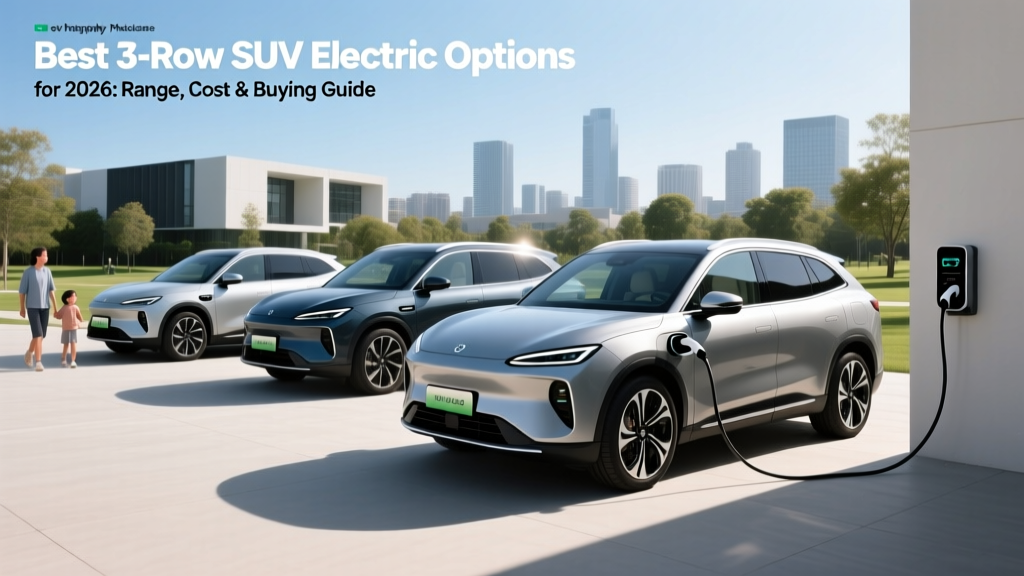
The Quick Answer: Which 3 Row SUV Electric Should You Buy?
If you need a three-row electric SUV in 2026, your top contenders are the Kia EV9 (EPA range up to 304 miles, starting ~$54,900), the Hyundai Ioniq 9 (up to 335 miles EPA, starting ~$56,000), and the Rivian R1S (up to 410 miles with the Max Pack, starting ~$79,900). The EV9 and Ioniq 9 share Hyundai Motor Group's E-GMP platform with 800V architecture enabling 10–80% DC fast charges in roughly 20 minutes. The Rivian R1S offers the longest range and most off-road capability but at a premium. If you need a budget option with tax-credit eligibility, the EV9 (assembled in Georgia) qualifies for up to $7,500 under IRS §30D rules for eligible buyers. For families prioritizing interior volume over maximum range, the Volkswagen ID. Buzz (234 miles EPA, ~$59,995) offers a unique minivan-style three-row layout.
What Defines the 3 Row SUV Electric Segment in 2026
The three-row electric SUV market has matured significantly. Buyers in this segment typically need seating for six or seven passengers, cargo flexibility, and enough range to handle family road trips without excessive charging stops. The current lineup spans from roughly $50,000 to over $100,000, covering mainstream and luxury tiers.
Every model in this segment uses a large battery pack — typically 77 to 149 kWh usable capacity — to move 5,000+ pounds of vehicle. That means efficiency varies widely, from around 2.0 to 3.5 miles per kWh depending on the model, driving conditions, and wheel size. Understanding these numbers is critical because the EPA range sticker doesn't tell the full story for a loaded family hauler on a highway trip in January.
Side-by-Side: Specs That Matter for Families
| Spec | Kia EV9 (LR RWD) | Hyundai Ioniq 9 (LR RWD) | Rivian R1S (Dual Max) | VW ID. Buzz (Pro S) |
|---|---|---|---|---|
| EPA Range | 304 mi | 335 mi | 410 mi | 234 mi |
| Battery (usable) | 99.8 kWh (NMC) | 110.3 kWh (NMC) | 149 kWh (NMC) | 86 kWh (NMC) |
| Peak DC Fast Charge | 239 kW | 240 kW | 220 kW | 175 kW |
| 10–80% DC Charge Time | ~20 min | ~20 min | ~30 min | ~26 min |
| Level 2 Charge Rate | 10.9 kW | 10.9 kW | 11.5 kW | 11 kW |
| Horsepower | 215 hp (RWD) | 215 hp (RWD) | 665 hp (Dual) | 282 hp (RWD) |
| 0–60 mph | 8.2 sec | 7.9 sec | 4.5 sec | 7.9 sec |
| Seating | 6 or 7 | 6 or 7 | 7 | 7 |
| Cargo (behind 3rd row) | 20.2 cu ft | 21.5 cu ft | 10.4 cu ft | 18.4 cu ft |
| Starting MSRP | $54,900 | $56,000 | $79,900 | $59,995 |
| Battery Warranty | 10 yr / 100,000 mi | 10 yr / 100,000 mi | 8 yr / 120,000 mi | 8 yr / 100,000 mi |
Sources: fueleconomy.gov, manufacturer specifications. Range figures are EPA estimates; real-world results vary with temperature, speed, and load.
Real-World Range Reality Check
EPA sticker vs. what you'll actually get: The EPA test cycle includes a mix of city and highway driving at moderate temperatures. For a three-row SUV loaded with passengers and cargo on a 75 mph highway run in 30°F weather, expect 20–35% less than the EPA number. The Kia EV9's 304-mile EPA rating translates to roughly 210–245 miles in those conditions. The Rivian R1S with its 149 kWh Max Pack still delivers an impressive 290–330 real-world miles in cold highway driving because of its oversized battery. Plan charging stops accordingly.
EV vs. Gas Three-Row SUV: The Real Cost Comparison
The most common question from family SUV shoppers is whether going electric actually saves money. The answer depends heavily on your driving patterns, electricity rates, and whether you qualify for incentives. Here's a five-year cost breakdown comparing the Kia EV9 against a comparably priced gas three-row SUV like the Kia Telluride.
| Category | Kia EV9 (LR RWD) | Kia Telluride (AWD V6) |
|---|---|---|
| Base MSRP | $54,900 | $43,000 |
| Federal Tax Credit (§30D) | −$7,500 (if eligible) | $0 |
| Effective Purchase Price | $47,400 | $43,000 |
| Fuel/Energy (60k mi) | $3,240 (home charging avg) | $9,000 ($3.50/gal, 22 MPG) |
| Maintenance (5 yr) | ~$1,200 | ~$3,500 |
| Insurance (5 yr avg) | ~$10,500 | ~$8,500 |
| Estimated Depreciation | ~$18,000 | ~$16,000 |
| 5-Year Total | ~$80,340 | ~$80,000 |
Assumptions: $0.14/kWh national average electricity, home Level 2 charging primarily, EV9 efficiency ~2.5 mi/kWh, Telluride combined 22 MPG. Insurance is higher for EVs due to repair costs. Depreciation estimates based on current market trends. Tax credit eligibility per IRS §30D requires income caps, MSRP limits, and battery sourcing compliance. Consult a tax professional.
The totals are remarkably close. The EV's higher sticker price is offset by the tax credit, dramatically lower energy costs, and reduced maintenance (no oil changes, fewer brake replacements thanks to regenerative braking). However, insurance premiums for electric SUVs run 15–25% higher on average, and depreciation remains a wildcard as the used EV market stabilizes.
Charging at Home and on the Road: What Families Need to Know
Home charging access is the single biggest factor in EV satisfaction. If you can install a Level 2 charger at home, a three-row electric SUV becomes remarkably convenient — you start every morning with a full "tank." Without home charging, public infrastructure dependency introduces friction that frustrates many first-time EV owners.
Home Charging Setup and Costs
All current three-row electric SUVs accept Level 2 charging at 10.9–11.5 kW via a 240V connection. At that rate, a fully depleted EV9 (99.8 kWh) takes about 9–10 hours to charge — perfect for overnight replenishment. Most owners never deplete fully; a typical day of 40–60 miles requires only 2–3 hours of Level 2 charging.
| Component | Cost Range |
|---|---|
| Level 2 Charger (48A, hardwired) | $400–$700 |
| Electrician labor (standard install) | $500–$1,500 |
| Electrical permit | $50–$200 |
| Panel upgrade (if needed, 100A→200A) | $1,500–$3,500 |
| Total (no panel upgrade) | $950–$2,400 |
| Total (with panel upgrade) | $2,450–$5,900 |
Always get a quote from a licensed electrician. Older homes with 100-amp panels may need an upgrade to support a 48-amp charger alongside existing loads. Some utilities offer rebates that offset $200–$500 of installation costs.
Road Trip Charging: The 800V Advantage
The Kia EV9 and Hyundai Ioniq 9 both use 800V electrical architecture, which enables DC fast charging at up to 240 kW on compatible stations (such as Electrify America's 350 kW chargers). In practice, you'll see peak charge rates of 230–240 kW between 10–40% state of charge, tapering to around 150 kW by 60% and dropping sharply above 80%. This charge curve is why manufacturers quote 10–80% times rather than 0–100%.
For a family road trip in the EV9, expect to add roughly 180–200 miles of range in a 20-minute stop at a high-power charger. The Rivian R1S charges at a lower peak rate (220 kW) but compensates with its massive 149 kWh battery, meaning fewer stops overall despite longer individual charge sessions.
Tax Credits and Incentives: The §30D Rules That Apply Now
Federal tax credit eligibility under IRS §30D has specific requirements that change the calculus for each model. As of 2026, the rules include:
§30D Clean Vehicle Credit Requirements
- MSRP Cap: SUVs must have an MSRP at or below $80,000 (the Rivian R1S base qualifies; higher trims may not)
- Buyer Income Cap: Modified AGI must not exceed $300,000 (joint), $225,000 (head of household), or $150,000 (single)
- Battery Sourcing: Critical minerals and battery components must meet phased-in domestic/free-trade-partner sourcing thresholds — this determines whether you receive $3,750 or the full $7,500
- Assembly: Vehicle must undergo final assembly in North America (the Kia EV9 is assembled in West Point, Georgia; the Hyundai Ioniq 9 in Ellabell, Georgia; the Rivian R1S in Normal, Illinois)
- Point-of-Sale Transfer: You can transfer the credit to the dealer at purchase, reducing your out-of-pocket cost immediately rather than waiting for tax filing
The VW ID. Buzz, assembled in Germany, does not qualify for the federal §30D credit. Always verify current eligibility on irs.gov before purchasing, as battery sourcing compliance can shift with supply chain changes.
Common Misconceptions About 3 Row Electric SUVs
| Myth | Fact |
|---|---|
| "The battery will need replacing in 5 years" | NMC batteries in these vehicles are warranted for 8–10 years / 100,000–120,000 miles at minimum 70% capacity retention. Data from older EVs shows typical degradation of 10–15% over 150,000 miles with proper charging habits. |
| "You can't tow with an electric SUV" | The Rivian R1S tows up to 7,700 lbs; the EV9 tows up to 5,000 lbs. However, towing cuts range by 30–50% — plan accordingly. |
| "Charging takes too long for road trips" | A 20-minute fast-charge stop every 2.5–3 hours aligns naturally with family rest stops. Total trip time increases roughly 15–20% vs. gas on a 500-mile journey. |
| "EVs don't work in cold climates" | Cold reduces range 20–35% due to battery chemistry and cabin heating demands. Preconditioning while plugged in and using a heat pump (standard on EV9 and Ioniq 9) mitigates this significantly. Owners in Minnesota and Maine drive EVs year-round. |
| "All 3 row EVs qualify for the $7,500 tax credit" | Only vehicles meeting North American assembly, MSRP caps, buyer income limits, and battery sourcing requirements qualify. The VW ID. Buzz, for example, does not qualify. |
Decision Framework: Which 3 Row SUV Electric Is Right for You?
If / Then Buying Guide
Choose the Kia EV9 if: You want the best value with federal tax credit eligibility, need 6- or 7-passenger seating, prioritize fast 800V charging for road trips, and your daily driving is under 80 miles round-trip. The EV9 Land trim at ~$63,900 offers the best feature-to-price ratio.
Choose the Hyundai Ioniq 9 if: Maximum range is your priority in the mainstream segment. The 335-mile EPA rating gives you the longest legs for highway trips among non-luxury three-row EVs, and the interior is slightly more spacious than the EV9.
Choose the Rivian R1S if: You need serious off-road capability, want the longest possible range (410 miles with Max Pack), value performance (4.5-second 0–60 in Dual Motor), and your budget extends above $80,000. The R1S also offers the most cargo versatility with its gear tunnel option.
Choose the VW ID. Buzz if: You prioritize interior space and passenger comfort over maximum range, prefer a minivan driving position with easy third-row access, and don't mind forgoing the federal tax credit. Best suited for families who do most driving within 150 miles of home.
Consider a PHEV alternative (e.g., Toyota Grand Highlander Hybrid) if: You lack home charging access, regularly drive in rural areas with sparse DC fast-charging infrastructure, or frequently tow heavy loads where EV range drops precipitously.
What First-Time EV Buyers Must Know Before Purchasing
Beyond the spec sheet, there are practical ownership realities that separate satisfied EV owners from frustrated ones:
- Install your Level 2 charger before the car arrives. Relying on a standard 120V outlet (Level 1) adds only 3–5 miles per hour of charging — inadequate for a large-battery SUV you plan to drive daily.
- Download the charging network apps now. Electrify America, EVgo, ChargePoint, and Tesla Supercharger (via NACS adapter or native port on newer models) each require separate accounts. Set them up before your first road trip.
- Check your utility's EV rate plan. Many utilities offer time-of-use rates that cut charging costs by 40–60% if you charge overnight. At $0.08/kWh off-peak vs. $0.14/kWh standard, that's a meaningful annual savings.
- Insurance quotes vary wildly for EVs. Get quotes from at least three insurers before purchase. Some companies charge 30% more for electric SUVs; others offer EV-specific discounts.
- The third row is for kids. In every three-row electric SUV except the ID. Buzz, the third row is best suited for children or short-trip adults. Test-fit your car seats and stroller before committing.
Do 3 row electric SUVs have enough range for family road trips?
Yes, with planning. The Hyundai Ioniq 9 (335 miles EPA) and Rivian R1S Max Pack (410 miles EPA) can cover 250–300 real-world highway miles before needing a 20-minute fast-charge stop. On a 600-mile trip, expect 1–2 charging stops adding roughly 40–50 minutes total. Use A Better Route Planner (ABRP) to pre-plan stops with verified chargers.
Is the Kia EV9 or Hyundai Ioniq 9 better for families?
Both share the same E-GMP platform and similar powertrains. The Ioniq 9 offers a slightly larger battery (110.3 vs. 99.8 kWh) and about 30 more miles of EPA range. The EV9 starts at a lower price and was available earlier, meaning more dealer inventory and used options. Test-drive both; interior styling and infotainment preference usually decides it.
What happens if the battery degrades significantly?
All models here carry battery warranties guaranteeing at least 70% capacity retention for 8–10 years or 100,000–120,000 miles. If the battery falls below that threshold within the warranty period, the manufacturer replaces or refurbishes it at no cost. Out-of-warranty replacement for a ~100 kWh pack currently runs $12,000–$20,000, though prices continue declining as battery manufacturing scales.
Can I charge a 3 row electric SUV at home on a regular outlet?
Technically yes, but practically no. A standard 120V outlet (Level 1) delivers about 1.4 kW, adding roughly 3–5 miles of range per hour. Fully recharging a depleted EV9 battery would take over 70 hours. A 240V Level 2 installation ($950–$2,400 in most homes) is strongly recommended and delivers a full overnight charge.
Are 3 row electric SUVs safe?
EVs benefit from a low center of gravity (battery pack under the floor) reducing rollover risk, and large front crumple zones (no engine block). Check IIHS and NHTSA ratings for specific models and model years. The Kia EV9 earned IIHS Top Safety Pick+ status for the 2024–2025 model years.