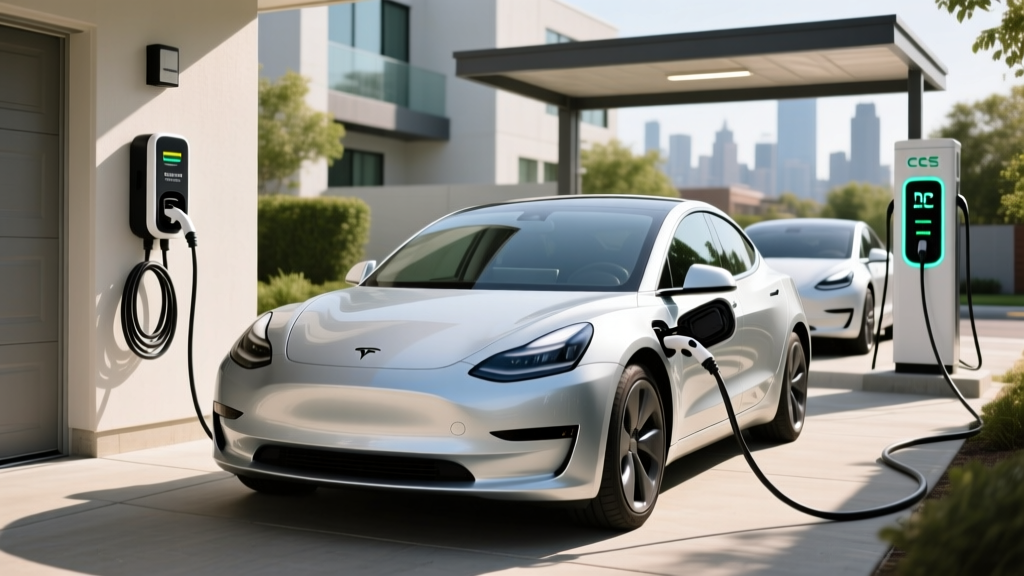
The 2020 Tesla Model 3 Long Range remains one of the most popular used EVs on the market in 2026, thanks to its 322-mile EPA range and access to the Supercharger network. But whether you just bought one or are shopping for one, understanding how to charge it efficiently — at home, on the road, and at what cost — is essential to maximizing ownership value. This guide covers every charging scenario with exact numbers, equipment picks, and installation realities.
2020 Model 3 Long Range: Battery and Charging Specs at a Glance
Before diving into charging logistics, here are the critical numbers for the 2020 Model 3 Long Range AWD. Tesla used an NMC (nickel-manganese-cobalt) lithium-ion battery pack in this model year, with approximately 75 kWh of usable capacity.
| Spec | Value |
|---|---|
| EPA Range | 322 miles |
| Real-World Highway Range | ~270–290 miles (75 mph, moderate temps) |
| Real-World Cold-Weather Range | ~240–260 miles (below freezing) |
| Battery Usable Capacity | ~75 kWh (NMC) |
| Max DC Fast Charge Rate | 250 kW (peak) |
| 10–80% DC Fast Charge Time | ~25–30 minutes (V3 Supercharger) |
| Max Level 2 AC Charge Rate | 11.5 kW (48A onboard charger) |
| Connector | NACS (Tesla proprietary) |
| EPA Efficiency | 141 MPGe combined (24 kWh/100mi) |
Charging Levels Explained: How Fast Will Each Add Range?
EV charging operates at three distinct levels. The key distinction every owner must understand: kW (kilowatts) measures power — how fast energy flows into the battery. kWh (kilowatt-hours) measures energy — the total capacity stored. Think of kW as the flow rate of a hose and kWh as the size of the bucket.
| Level | Voltage / Power | Charge Rate (kW) | Miles Added per Hour | Best For |
|---|---|---|---|---|
| Level 1 | 120V / 12A | ~1.4 kW | ~4–5 miles | Overnight top-ups, emergencies |
| Level 2 (Home) | 240V / 40–48A | 9.6–11.5 kW | ~35–44 miles | Daily home charging |
| DC Fast Charging | 400V+ / up to 250 kW | Up to 250 kW | ~170+ miles in 15 min | Road trips, rapid replenishment |
For the 2020 Model 3 Long Range's 75 kWh battery, a full Level 1 charge from empty would take over 50 hours — impractical for daily use. Level 2 at 11.5 kW replenishes the full pack in roughly 7 hours, making overnight charging effortless. DC fast charging from 10% to 80% takes approximately 25–30 minutes on a V3 Supercharger (250 kW capable), though the charge curve tapers significantly above 80% to protect battery health.
Home Level 2 Installation: Electrical Requirements and Costs
Installing a Level 2 home charger is the single best upgrade for any 2020 Model 3 Long Range owner. Here is what the installation actually involves.
Electrical Requirements
The Model 3 Long Range's onboard charger accepts up to 48 amps, meaning you need a 240V circuit rated at 60 amps (EVSE must be derated to 80% of breaker capacity, so a 60A breaker supports 48A continuous draw). If you opt for a 40A charger, a 50A breaker suffices.
- Voltage: 240V (split-phase, standard US residential)
- Circuit breaker: 50A (for 40A charger) or 60A (for 48A charger)
- Wire gauge: 6 AWG copper (50A) or 4 AWG copper (60A)
- Dedicated circuit: Required — no sharing with other appliances
- GFCI protection: Required by NEC 2020+ for EV outlets (or built into hardwired EVSE)
Panel Capacity and Upgrade Considerations
Before installation, a licensed electrician must evaluate your electrical panel's available capacity. A typical 200-amp panel in a modern home usually has enough headroom for a 50–60A EV circuit. However, older homes with 100-amp or 150-amp service may require a panel upgrade, which is a significant added cost.
A qualified electrician will perform a load calculation per NEC Article 220 to determine whether your panel can support the additional draw. If an upgrade is needed, expect the following:
| Cost Component | Typical Range |
|---|---|
| Level 2 EVSE Equipment (40A–48A smart charger) | $400–$700 |
| Electrician Labor (standard install, panel to garage ~30ft) | $600–$1,500 |
| Electrical Permit | $50–$200 |
| Conduit, Wiring, Breaker (materials) | $150–$400 |
| Standard Install Total (no panel upgrade) | $1,200–$2,800 |
| Panel Upgrade to 200A (if needed) | $2,000–$4,500 |
| Total with Panel Upgrade | $3,200–$7,300 |
Some utilities offer rebates of $250–$500 for Level 2 installations, and certain states provide additional incentives. Check your local utility's EV program before scheduling work.
Connector Compatibility: NACS, CCS, and Adapters
The 2020 Model 3 Long Range was built with Tesla's proprietary connector, now formally designated as NACS (North American Charging Standard). In 2026, NACS has become the dominant connector in North America, adopted by Ford, GM, Rivian, Volvo, Hyundai, and most other manufacturers.
| Connector | 2020 Model 3 Compatibility | Notes |
|---|---|---|
| NACS (Tesla) | Native — direct plug | Works with all Tesla Superchargers and Destination Chargers |
| CCS1 | Requires adapter | Tesla sells a CCS adapter (~$250); opens Electrify America, EVgo networks |
| CHAdeMO | Not supported | No adapter available; legacy standard, declining availability |
| J1772 (Level 2 public) | Requires J1772-to-NACS adapter | Adapter included with Tesla vehicles; used for non-Tesla Level 2 stations |
Practical advice: The J1772 adapter comes with the car (check the trunk). For DC fast charging on non-Tesla networks, the Tesla CCS adapter is worth purchasing if you frequently travel in areas where Supercharger coverage is sparse. However, with Tesla's Supercharger network now exceeding 6,000 US stations, most Model 3 owners rarely need CCS.
Equipment Recommendations: Best Home Chargers for the Model 3 Long Range
Since the Model 3 Long Range can accept up to 48A (11.5 kW), pairing it with a capable charger ensures you get the fastest possible home charging. Here are three proven options in 2026:
Tesla Wall Connector (Gen 4)
- Power Output: Up to 48A / 11.5 kW (240V)
- Connector: NACS (native, no adapter needed)
- Cable Length: 24 feet
- Smart Features: Wi-Fi, OTA updates, Tesla app integration, load sharing between units
- Price: ~$475
- Verdict: Best overall for Tesla owners — seamless integration, fastest home charge
ChargePoint Home Flex
- Power Output: Configurable 16A–50A / up to 12 kW (240V)
- Connector: NACS or J1772 (select at purchase)
- Cable Length: 23 feet
- Smart Features: Wi-Fi, ChargePoint app, Alexa, scheduling, energy tracking
- Price: ~$550–$650
- Verdict: Excellent for multi-EV households or those wanting detailed energy data
Emporia Level 2 EV Charger
- Power Output: Up to 48A / 11.5 kW (240V)
- Connector: NACS or J1772
- Cable Length: 24 feet
- Smart Features: Wi-Fi, Emporia app, solar integration, real-time energy monitoring
- Price: ~$400–$450
- Verdict: Best budget smart charger; ideal for solar-panel owners
All three chargers are NEMA 4-rated for outdoor installation and support hardwired or plug-in (NEMA 14-50) configurations. Hardwiring is preferred for 48A units, as NEMA 14-50 outlets are limited to 50A breakers (40A continuous).
Charging Cost: Home vs. Public vs. Gas
One of the strongest ownership arguments for the 2020 Model 3 Long Range is its low per-mile energy cost. Here is how charging scenarios compare to gasoline.
| Scenario | Rate | Cost to Add 200 Miles | Cost per Mile |
|---|---|---|---|
| Home Charging (off-peak utility rate) | $0.10/kWh | $9.60 | $0.048 |
| Home Charging (national avg. residential) | $0.17/kWh | $16.32 | $0.082 |
| Supercharger (avg. 2026 rate) | $0.32/kWh | $30.72 | $0.154 |
| Public DC Fast (Electrify America, EVgo) | $0.40/kWh | $38.40 | $0.192 |
| Gasoline Car (30 MPG, $3.40/gallon) | — | $22.67 | $0.113 |
At the Model 3 Long Range's real-world efficiency of roughly 24 kWh/100 miles (per fueleconomy.gov), home charging on an off-peak rate is dramatically cheaper than gasoline. Even at public DC fast charger rates, the cost is competitive with a 30-MPG gas car — and most Model 3 owners do 80%+ of their charging at home.
Pro tip: Many utilities offer time-of-use (TOU) plans with off-peak rates as low as $0.06–$0.10/kWh between midnight and 6 AM. Schedule your Model 3 to charge during these windows via the Tesla app for maximum savings.
Public Charging and Supercharger Network Realities
The 2020 Model 3 Long Range's access to the Tesla Supercharger network remains a significant advantage. As of 2026, Tesla operates over 6,000 Supercharger stations with more than 65,000 stalls in the US alone.
Supercharger Speeds for the Model 3 Long Range
- V3 Supercharger (250 kW): 10–80% in ~25–30 minutes; peak rate of 250 kW sustained briefly, tapering to ~100 kW by 60% SoC
- V2 Supercharger (150 kW): 10–80% in ~35–40 minutes; shared stalls may split power
- V4 Supercharger (newer stations): Compatible; Model 3 Long Rate peaks at its 250 kW limit
Preconditioning for Faster Charging
Navigate to a Supercharger using the Model 3's built-in navigation, and the car will automatically precondition the battery — warming or cooling it to the optimal temperature for fast charging. This can reduce 10–80% charge time by 5–10 minutes, especially in cold weather. Always use nav-to-charger rather than arriving cold.
Safety and Code Considerations
EV charging installation must comply with the National Electrical Code (NEC) and local building codes. Key requirements include:
- Dedicated circuit: Your EV charger must be on its own breaker — no shared circuits with dryers, ovens, or HVAC
- GFCI protection: NEC 2020 and later requires ground-fault protection for EV outlets; hardwired EVSE units have built-in GFCI
- Outdoor rating: If installing outside, the EVSE must be NEMA 4-rated (weatherproof). All recommended chargers above meet this standard
- Permit and inspection: Most jurisdictions require an electrical permit and post-installation inspection. Budget $50–$200 and factor in 1–2 weeks for scheduling
- Cable management: Use a wall-mounted cable organizer to prevent tripping hazards and connector damage
Always hire a licensed electrician — DIY EV charger installation risks fire, code violations, and voided home insurance coverage.
Frequently Asked Questions
How much does it cost to install a home EV charger for the 2020 Model 3 Long Range?
A standard Level 2 installation with a 50–60A circuit typically costs $1,200–$2,800 including equipment, labor, permit, and materials. If your home requires a panel upgrade (common in homes with 100A service), add $2,000–$4,500. The Tesla Wall Connector at $475 is one of the most affordable premium chargers available.
How fast will each charging level add range to the Model 3 Long Range?
Level 1 (120V) adds roughly 4–5 miles per hour — about 50 miles overnight. Level 2 at 48A (11.5 kW) adds approximately 44 miles per hour, fully recharging the 75 kWh battery in about 7 hours. DC fast charging at a V3 Supercharger adds up to 170 miles in 15 minutes at peak rate, though the curve tapers significantly above 60% SoC.
Which charger connector is compatible with my 2020 Model 3 Long Range?
Your Model 3 uses the NACS (Tesla) connector natively. It plugs directly into all Tesla Superchargers, Destination Chargers, and Tesla Wall Connectors. For J1772 Level 2 public stations, use the included J1772-to-NACS adapter. For non-Tesla DC fast chargers (Electrify America, EVgo), you need the optional Tesla CCS adapter (~$250).
How much does charging cost per mile vs. gasoline?
At a national average residential electricity rate of $0.17/kWh, the Model 3 Long Range costs approximately $0.082 per mile to charge at home. A comparable 30-MPG gas car at $3.40 per gallon costs $0.113 per mile. On off-peak utility rates ($0.10/kWh), the Model 3 drops to $0.048 per mile — less than half the cost of gasoline. Public DC fast charging at $0.32–$0.40/kWh is more expensive but still competitive with gas for road trips.
What electrical upgrades might I need for a Level 2 charger?
Most homes with 200-amp electrical panels can accommodate a 50–60A EV circuit without upgrades. Homes with 100A or 150A service may need a panel upgrade ($2,000–$4,500). An electrician will perform an NEC Article 220 load calculation to determine available capacity. Additional considerations include the distance from the panel to the charging location (longer runs increase wire cost) and whether a sub-panel is needed for a detached garage.
Should I charge to 100% every night?
No. The 2020 Model 3 Long Range uses an NMC battery, which degrades faster when held at 100% state-of-charge for extended periods. Tesla recommends setting the daily charge limit to 80–90% and only charging to 100% before long road trips. This practice significantly extends long-term battery health. For reference, Tesla's battery warranty covers 8 years or 120,000 miles, whichever comes first, with a minimum 70% capacity retention threshold (Tesla warranty details).
Can I use a NEMA 14-50 outlet instead of hardwiring?
Yes, but with a limitation. A NEMA 14-50 outlet is on a 50A breaker, which supports 40A continuous charging (9.6 kW). To use the Model 3's full 48A (11.5 kW) capability, you need a hardwired connection on a 60A breaker. If 9.6 kW is sufficient (it adds ~37 miles per hour — plenty for most overnight charging), a 14-50 outlet offers flexibility to take the charger with you if you move.
For the latest IRS rules on the §30D clean vehicle credit (applicable if purchasing a used Model 3 through a dealer — the used-EV credit offers up to $4,000 for qualifying vehicles under $25,000), consult a tax professional as income caps and sourcing requirements apply.