The Genesis and Scale of Electrify America
Electrify America (EA) was born out of the Volkswagen Group's 2016 Dieselgate emissions settlement, tasked with investing $2 billion over ten years to build a nationwide zero-emission vehicle (ZEV) infrastructure. What started as a compliance mandate has evolved into the largest open DC fast-charging network in the United States. According to data tracked by the U.S. Department of Energy's Alternative Fuels Data Center, Electrify America now operates nearly 1,000 stations and over 4,500 individual DC fast chargers across the country. This massive footprint makes it a critical pillar for non-Tesla EV owners attempting cross-country road trips.
However, scale does not always equate to seamlessness. As the network has expanded, so too has the volume of user feedback regarding station reliability, hardware quirks, and software integration. For EV drivers, understanding the data behind Electrify America's performance is essential for efficient route planning and minimizing roadside frustration.
Defining Reliability: Uptime vs. Charge Success Rate
When analyzing charging network reliability, industry experts separate metrics into two distinct categories: Station Uptime and Charge Success Rate. Electrify America historically reports an uptime of 90% to 95% across its network. Uptime simply means the station is powered on, connected to the cellular network, and not displaying a critical hardware fault. However, uptime is a flawed metric for the end user.
The more critical metric is the Charge Success Rate, which measures how often a driver successfully initiates a charging session and receives electrons into their battery on the first attempt. This is where Electrify America has historically faced challenges. Issues such as payment processing errors, screen glare, reader malfunctions, and the infamous ISO 15118 'handshake' failure between the vehicle and the charger have dragged success rates down. While Tesla Superchargers routinely boast a first-plug success rate of over 95%, independent data and user surveys have frequently placed Electrify America's first-plug success rate in the 75% to 85% range, though recent software updates and the rollout of Plug & Charge have significantly improved these numbers in 2023 and 2024.
Data-Driven Network Comparison
To understand where Electrify America stands in the broader market, we must compare its core metrics against its primary competitors: the Tesla Supercharger network (now opening to non-Tesla EVs via NACS adapters), EVgo, and ChargePoint. The following table highlights the structural and experiential differences between these major networks.
| Metric | Electrify America | Tesla Supercharger | EVgo | ChargePoint (DC Fast) |
|---|---|---|---|---|
| Primary Plug Types | CCS, CHAdeMO, NACS (rolling out) | NACS, CCS (via Magic Dock) | CCS, CHAdeMO, NACS | CCS, CHAdeMO |
| Max Charging Speed | 350 kW | 250 kW (V3) / 325 kW (V4) | 350 kW | 350 kW (varies heavily) |
| First-Plug Success Rate | ~80% - 88% | >95% | ~75% - 82% | ~70% - 80% |
| Payment System | App, RFID, Plug & Charge, Credit Card | Vehicle-integrated, App | App, RFID, Credit Card | App, RFID, Credit Card |
| Idle Fees | $0.40/min (after 10 min grace) | $0.50 - $1.00/min | $0.15 - $0.30/min | Varies by host location |
Note: Success rates are aggregated estimates based on industry benchmarks tracked by J.D. Power's EV Experience Index and independent EV advocacy surveys, reflecting the transition period between legacy CCS and emerging NACS standards.
The User Experience: Hardware, Software, and the Handshake
Hardware and Cable Management
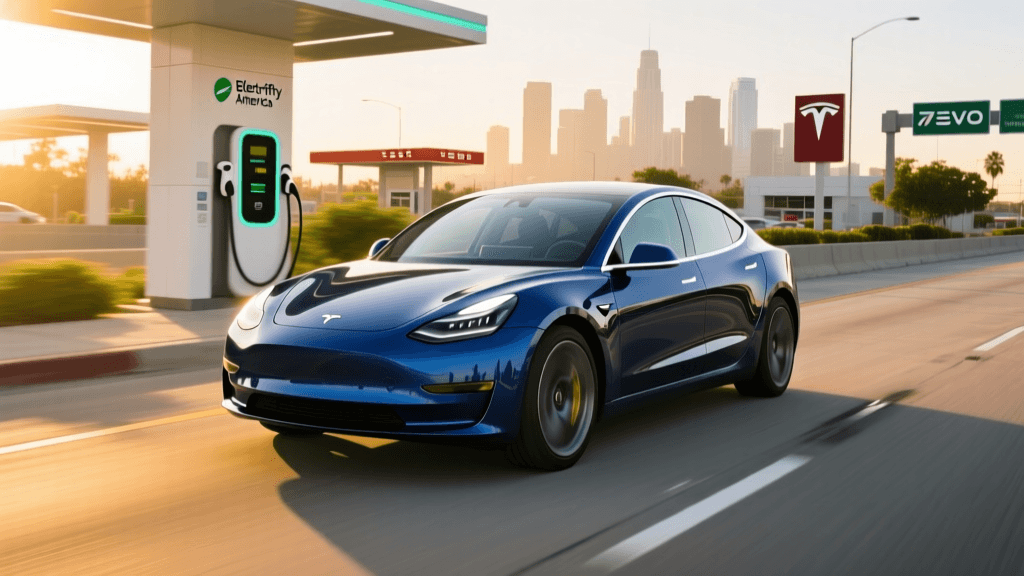
Electrify America stations are visually distinct, featuring bright green and white branding, solar canopies, and robust hardware. The network utilizes both 150 kW and 350 kW dispensers. The 350 kW stalls feature liquid-cooled cables, which are necessary to prevent overheating at high amperages. However, these liquid-cooled cables are notoriously thick, heavy, and stiff, making them difficult to maneuver for some users, especially in cold weather when the internal coolant fluid becomes more viscous.
Furthermore, cable length has been a point of contention. Early EA installations featured cables that were too short to reach the charging ports of vehicles like the Audi e-tron or the Ford F-150 Lightning if parked slightly off-center. While newer station layouts have improved cable reach, drivers of large electric trucks still need to be mindful of their parking alignment.
Software and the ISO 15118 Handshake
The most common cause of charge failure at EA stations is the digital 'handshake' between the car's Battery Management System (BMS) and the charger's controller. When a driver plugs in, the systems must negotiate voltage, current limits, and battery temperature. If this ISO 15118 communication times out or encounters a packet loss, the screen will display an error code (often an 'Isolation Fault' or 'Communication Error'), and the session will abort.
To combat this, Electrify America has heavily invested in Plug & Charge technology. By linking your vehicle's VIN to your EA account, the charger automatically identifies the car upon physical connection, bypassing the need to use the app or swipe a credit card. This not only streamlines the user experience but also drastically reduces handshake errors related to payment authorization timeouts.
Cost Analysis and Membership Tiers
Pricing on the Electrify America network is dynamic and varies by region, time of day, and membership status. As detailed on the official Electrify America pricing page, the network operates on a per-kilowatt-hour (kWh) billing model in most states, which is the most equitable way to charge for electricity. In states where utility regulations prohibit third-party per-kWh billing (such as older regulations in certain midwestern states), per-minute billing is applied based on the vehicle's maximum charging capability.
- Guest Pricing: Typically ranges from $0.48 to $0.65 per kWh depending on the local utility and demand.
- Pass+ Membership: For a monthly subscription (usually around $7), members receive a discounted rate, often dropping the cost to between $0.32 and $0.45 per kWh. For frequent road trippers, this membership pays for itself within a single charging session.
- Idle Fees: To prevent station hogging, EA enforces a strict idle fee of $0.40 per minute if a vehicle remains plugged in for more than 10 minutes after reaching its charge limit or completing its session.
Actionable Advice for Maximizing EA Success
Based on network data and veteran EV road-tripper experiences, here are the most effective strategies to ensure a flawless Electrify America charging session:
- Set Up Plug & Charge Before Your Trip: Do not wait until you are at the station to figure out payment. Download the EA app, create an account, add your payment method, and enable Plug & Charge by entering your vehicle's exact VIN. This eliminates 90% of software-related initiation failures.
- Pre-Condition Your Battery: If your EV supports it (e.g., Porsche Taycan, Hyundai Ioniq 5, Ford Mustang Mach-E), navigate to the EA station using the car's native infotainment system. This warms the battery to the optimal temperature, ensuring you actually pull the 150kW+ speeds the station advertises, rather than being bottlenecked by a cold battery.
- The 'Unplug and Replug' Trick: If you encounter a handshake error or an isolation fault on the screen, do not immediately move to another stall. Unplug the cable, wait 15 seconds for the car's BMS to reset its contactors, and plug it back in firmly. Ensure you hear the physical 'click' of the CCS latch. This simple step resolves the majority of communication errors.
- Check Real-Time Stall Status: Before pulling off the highway, open the EA app and check the specific station. Look for the individual stall status. If a 350 kW stall is marked 'Out of Order' or 'Unavailable,' plan accordingly. If all 350 kW stalls are down, you will be limited to the 150 kW dispensers, which will alter your charging time calculations.
- Bring a Screen Cleaning Cloth: It sounds trivial, but EA's touchscreen kiosks are highly susceptible to sun glare and fingerprint smudges, making it difficult to read error codes or input payment info. Keeping a microfiber cloth in your glovebox can save you from a frustrating interaction with the kiosk interface.
Conclusion
Electrify America has made monumental strides since its inception, transforming from a settlement-mandated project into a cornerstone of the American EV infrastructure. While its first-plug success rate and hardware quirks still lag slightly behind the closed-loop perfection of the Tesla Supercharger network, the data shows a clear upward trend in reliability. By understanding the nuances of network uptime versus charge success, leveraging Plug & Charge technology, and utilizing strategic troubleshooting methods, EV drivers can confidently rely on Electrify America for seamless, high-speed cross-country travel.