The Multidimensional Calculus of Cross-Country EV Routing
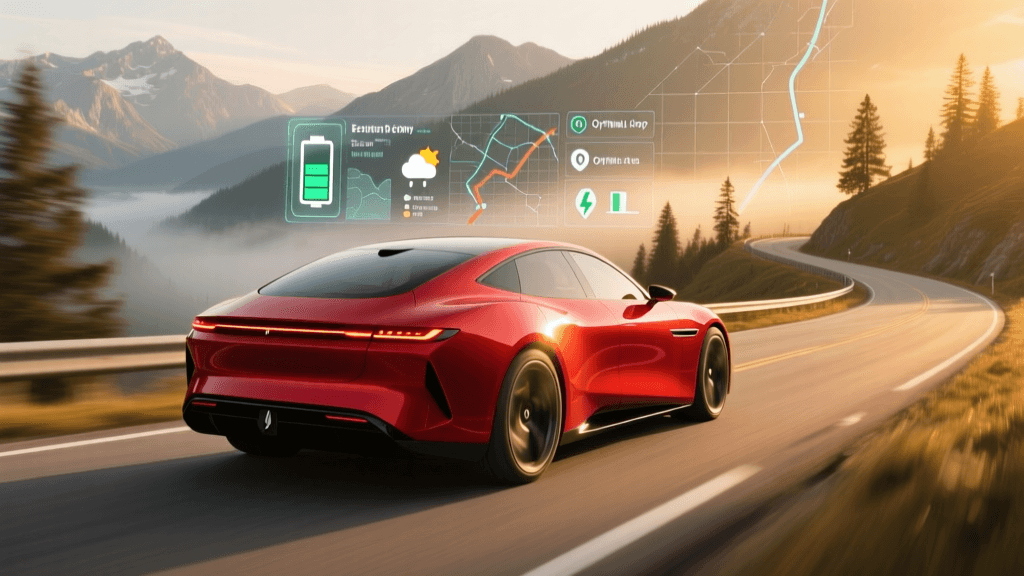
Planning a cross-country road trip in an internal combustion engine (ICE) vehicle is a trivial exercise. You follow the highway, and when the fuel gauge dips below a quarter tank, you pull into the nearest gas station. In the electric vehicle (EV) ecosystem, however, routing is a complex, multidimensional calculus problem. A reliable cross-country EV route planner must synthesize real-time telemetry, meteorological data, topographical maps, and non-linear battery charging curves to deliver a viable itinerary.
As the Alternative Fuels Data Center (AFDC) notes, the rapid expansion of the national charging network has made transcontinental travel possible, but the sheer variance in charger speeds, network reliability, and vehicle efficiency demands sophisticated algorithmic intervention. In this technology deep dive, we dissect the underlying mechanics of modern EV route planners, exploring how they calculate energy consumption and optimize charging stops for cross-country journeys.
The Physics of Energy Consumption Modeling
At the core of any advanced EV route planner is an energy consumption model. Unlike ICE vehicles, where fuel efficiency is relatively stable across different driving conditions, EV efficiency is highly sensitive to external variables. The algorithmic model calculates the total energy required ($E$) by integrating the sum of forces acting on the vehicle over the distance ($d$) of the trip:
Forces considered include:
- Rolling Resistance ($F_{roll}$): Dictated by vehicle weight, tire pressure, and road surface conditions.
- Aerodynamic Drag ($F_{aero}$): The most critical factor at highway speeds, calculated using the drag coefficient ($C_d$), frontal area ($A$), air density ($\rho$), and the square of the vehicle's velocity ($v^2$).
- Grade Resistance ($F_{grade}$): The energy required to overcome gravity during elevation changes.
- Accessory Load ($F_{accessory}$): Energy consumed by HVAC systems, infotainment, and battery thermal management.
Basic route planners simply divide the total distance by the EPA's official EV range database combined MPGe rating. However, advanced cross-country algorithms segment the route into micro-nodes (often every 100 to 500 meters) and calculate the specific energy draw for each node based on localized data.
Topography, Meteorology, and Aerodynamic Drag
Cross-country routes inevitably involve massive elevation changes and shifting weather patterns. Premium routing algorithms integrate USGS topographical data and NOAA meteorological APIs to adjust range predictions dynamically.
Elevation and Regenerative Braking
Climbing the Rocky Mountains requires immense energy, but descending offers an opportunity for regenerative braking. Advanced planners do not just subtract energy for the ascent; they calculate the exact recuperation potential on the descent, factoring in the battery's maximum charge acceptance rate and the vehicle's regen efficiency (typically between 60% and 75%). If the battery is too cold or too full to accept the regen current, the algorithm adjusts the expected recuperation downward.
Headwinds and Air Density
Aerodynamic drag increases with the square of speed, but a cross-country headwind effectively increases the vehicle's velocity relative to the air mass. A 15 mph headwind can reduce an EV's highway range by 10% to 15%. Furthermore, cold air is denser than warm air, increasing the drag coefficient. Route planners pull real-time wind vector data and ambient temperature forecasts to adjust the $F_{aero}$ variable for every segment of a cross-country trip.
State of Charge (SOC) Optimization and Non-Linear Charging Curves
The most crucial differentiator between a basic map app and a dedicated EV route planner is State of Charge (SOC) optimization. Lithium-ion batteries do not charge at a constant rate. They follow a non-linear charging curve, accepting maximum power (kW) only when the SOC is low and the battery is at an optimal temperature.
For example, a 350 kW capable charger might only deliver 250 kW between 10% and 40% SOC, tapering to 100 kW at 60%, and dropping to a trickle below 40 kW past 85%. A sophisticated cross-country routing algorithm utilizes a 'skip-and-leap' strategy. Instead of arriving at a charger with 25% SOC and charging to 80%, the algorithm might route you to arrive at 5% SOC and charge only to 55%. Because the battery spends more time in the peak charging zone, the total time spent plugged in is drastically reduced, minimizing total trip duration.
To execute this, the algorithm must cross-reference the vehicle's specific charging curve with the real-time availability and maximum output of chargers along the route, often querying the Open Charge Point Protocol (OCPP) networks to ensure the station is not offline or broken before dispatching the driver.
Real-Time Telemetry: The Role of OBD-II Dongles
While factory-integrated navigation systems (like Tesla's Trip Planner or Rivian's Adventure Network planner) have direct access to the vehicle's CAN bus, third-party apps like A Better Routeplanner (ABRP) rely on external telemetry. By pairing an OBD-II Bluetooth dongle to the route planner app, the algorithm receives live data streams, including:
- Exact cell-level voltage and temperature
- Real-time battery degradation metrics
- Live accessory power draw (HVAC and battery preconditioning)
- Instantaneous speed and elevation
This live telemetry allows the route planner to constantly recalculate the remaining range and dynamically adjust the next charging stop if headwinds or detours cause higher-than-expected energy consumption.
Comparing Cross-Country EV Route Planning Platforms
Not all routing engines are built equally. Below is a technical comparison of the primary platforms used for transcontinental EV travel.
| Platform | Algorithm Type | OBD-II Telemetry | Charger Status API | Best Use Case |
|---|---|---|---|---|
| A Better Routeplanner (ABRP) | Physics-based, user-calibrated | Yes (via third-party dongles) | Yes (Multi-network) | Non-Tesla EVs, hyper-milers, complex multi-stop routing |
| Tesla Native Trip Planner | Closed-loop CAN bus integration | Native (Built-in) | Yes (Supercharger only) | Tesla owners relying exclusively on the Supercharger network |
| PlugShare | Community-driven, static range | No | Limited | Locating niche or independent chargers in rural areas |
| EV Trip Planner | Heuristic, web-based estimation | No | Yes (Basic) | Quick desktop estimates for older EV models |
Actionable Guide: Calibrating A Better Routeplanner (ABRP)
For non-Tesla EV owners undertaking a cross-country trip, ABRP is the gold standard. However, its algorithm is only as good as the data fed into it. Follow these steps to calibrate the engine for maximum accuracy:
- Set the Battery Degradation Variable: If your EV is three years old, do not leave the degradation slider at 100%. Check your battery health via the dealership or OBD-II scanner and input the exact percentage (e.g., 92%).
- Input the Reference Energy Value: ABRP uses a Wh/km or Wh/mi reference value based on a standard speed (usually 110 km/h or 65 mph). Consult your vehicle's long-term trip computer and input your actual highway efficiency, not the EPA estimate.
- Adjust the Payload and Cargo: Adding 500 lbs of luggage and passengers to a 4,500 lb SUV increases rolling resistance and energy consumption by roughly 3-5%. Use the 'Extra Weight' parameter in the app settings.
- Enable Live Weather and Wind: Ensure the app has location permissions to pull live NOAA data. A tailwind can add 20 miles of range; a headwind can subtract it.
- Set Arrival and Departure SOC Limits: For cross-country efficiency, set your 'Arrival SOC' to 10% and your 'Departure SOC' to 65%. This forces the algorithm to keep you in the steepest, fastest part of the DC fast-charging curve, minimizing time spent at charging plazas.
The Future: V2G and Predictive Grid Load Routing
The next frontier in EV routing technology involves grid integration. As the Federal Highway Administration's NEVI program continues to fund high-capacity charging corridors, route planners are beginning to experiment with predictive grid load data. In the near future, algorithms will not only route you to the nearest available charger but will also factor in real-time utility pricing and grid congestion, potentially routing you to a slightly further station where electricity is cheaper and the charging speed is not throttled by local peak demand.
Furthermore, Vehicle-to-Grid (V2G) capabilities will allow route planners to calculate whether it is more cost-effective to charge at a destination or discharge energy back to the grid at a high-price node along the route. Until then, mastering the physics-based algorithms of today's route planners remains the key to seamless, anxiety-free cross-country electric travel.