2026 Tesla Semi: The Commercial Electric Truck Under the Microscope
When Tesla first unveiled the Semi in 2017, the commercial trucking industry was skeptical. Nearly a decade later, the 2026 Tesla Semi is in limited production at the Nevada Gigafactory, with PepsiCo, Walmart, and Schneider National among its earliest fleet operators. The question has shifted from "will it work?" to "does the math pencil out for my fleet?"
This review breaks down the 2026 Tesla Semi's real-world range, megawatt-class charging, operating economics, and federal incentive landscape. If you're evaluating a Tesla commercial vehicle for your operation, the data below will tell you whether it fits your routes, your depot infrastructure, and your bottom line.
| Spec | 300-Mile Variant | 500-Mile Variant |
|---|---|---|
| EPA Estimated Range | ~300 mi (loaded) | ~500 mi (loaded) |
| Battery Capacity (est.) | ~500 kWh (NMC) | ~900 kWh (NMC) |
| Max DC Fast Charge | ~1 MW (Megacharger) | ~1 MW (Megacharger) |
| 10–80% Charge Time | ~35 min (est.) | ~45–50 min (est.) |
| 0–60 mph (loaded, 80k lbs) | ~20 sec | ~20 sec |
| Drivetrain | Tri-Motor AWD | Tri-Motor AWD |
| Estimated Base MSRP | $250,000 | $290,000 |
| Efficiency | ~1.7 kWh/mi (loaded) | ~1.7 kWh/mi (loaded) |
| Warranty (battery/drive) | 8 yr / 500,000 mi (est.) | 8 yr / 500,000 mi (est.) |
Sources: Tesla Semi product page, EPA, fleet operator disclosures.
Range and Efficiency: Real-World Numbers for Fleet Planners
EPA Estimated Range (500-mi variant): ~500 miles at full load (82,000 lbs GVWR)
Real-World Expectation: Expect 380–430 miles on highway-dominant routes at 65–70 mph. In cold weather (below 32°F), range can drop to 320–370 miles due to battery thermal losses and cabin/climate demands. Stop-and-go urban delivery routes with regenerative braking can approach or slightly exceed the EPA figure.
Tesla's claimed efficiency of under 2 kWh per mile is a significant achievement for a Class 8 vehicle. For context, a diesel truck at 7 mpg burns roughly $0.70–$0.85 per mile in fuel (at $5.00/gal diesel), while the Semi at 1.7 kWh/mi costs roughly $0.17–$0.25 per mile at commercial depot electricity rates of $0.10–$0.15/kWh. That's a fuel-cost reduction of roughly 60–75%.
The critical variable for fleet planners is route predictability. If your routes are under 350 miles round-trip with depot charging, the 500-mile variant provides ample buffer. Routes exceeding 400 miles will require en-route Megacharger infrastructure, which remains sparse outside of Tesla's own corridor deployments in California and Nevada.
Charging: Megawatt-Class Speed and Depot Requirements
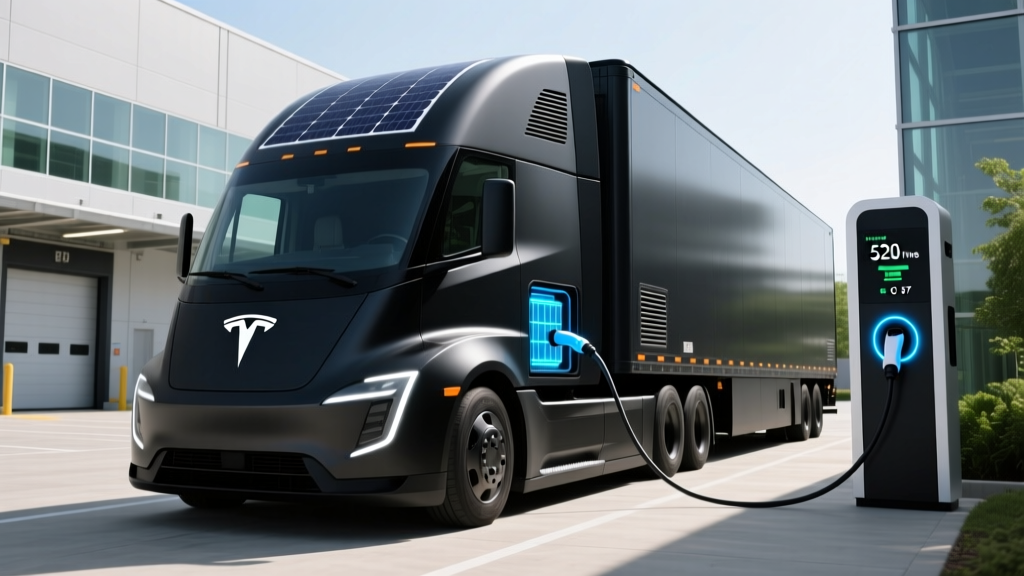
The Tesla Semi uses Tesla's proprietary Megacharger standard — capable of delivering up to 1 MW (1,000 kW) of DC power. This is fundamentally different from the NACS connector used on Tesla's consumer vehicles. The Semi cannot use standard Supercharger stalls.
| Charging Level | Power (kW) | Miles Added per Hour | Notes |
|---|---|---|---|
| Megacharger (DC) | Up to 1,000 kW peak | ~500–600 mi/hr (peak) | Proprietary connector; 10–80% in ~45–50 min |
| CCS2/MCS Adapter (est.) | Up to 500 kW | ~250–300 mi/hr | Future MCS standard compatibility expected |
| Depot Level 2 (AC, 480V) | ~40–80 kW | ~25–50 mi/hr | Overnight depot top-up; 10–12 hr full charge |
Depot infrastructure reality: Installing a single Megacharger requires dedicated medium-voltage utility service (typically 480V three-phase, with a dedicated transformer). Expect site preparation costs of $100,000–$250,000 per Megacharger unit, including utility upgrades, switchgear, conduit, and permitting. Fleet operators planning 5+ Semis should budget for a dedicated substation upgrade, which can push total site electrical work above $500,000.
The charging curve matters: the Semi will sustain peak 1 MW for roughly the first 20–30% of the charge session, then taper. A 10–80% session on the 500-mile variant takes approximately 45–50 minutes. This aligns with federal Hours of Service (HOS) 30-minute break requirements, making en-route charging feasible for compliant drivers — if the chargers exist along the route.
Performance and Drivetrain
The tri-motor all-wheel-drive system produces an estimated 1,000+ horsepower across the rear axle motors. Tesla claims a 0–60 mph time of 20 seconds at a full 80,000-lb gross combined weight — roughly twice as fast as a comparable diesel Class 8 tractor. Unloaded, Tesla has demonstrated 0–60 in approximately 5 seconds, though this is irrelevant for commercial duty cycles.
The three independent rear motors eliminate the need for a traditional transmission. Regenerative braking on all three motors recaptures significant energy on downhill grades and in stop-and-go urban delivery patterns. Fleet operators in hilly terrain (e.g., Southern California's Inland Empire to coastal routes) report regen contributing 15–25% energy recovery on descent-heavy routes.
Pricing, Tax Credits, and Fleet Economics
The 2026 Tesla Semi is offered in two range variants. Pricing has risen from Tesla's original 2017 estimates due to battery cost realities and low-volume production.
| Variant | Est. MSRP | Federal Commercial Clean Vehicle Credit (§45W) | Estimated Net Cost |
|---|---|---|---|
| 300-Mile Range | $250,000 | Up to $40,000 | ~$210,000 |
| 500-Mile Range | $290,000 | Up to $40,000 | ~$250,000 |
Tax credit note: The Tesla Semi, as a commercial vehicle over 14,000 lbs GVWR, does not qualify for the consumer §30D credit. Instead, it may qualify for the IRS §45W Commercial Clean Vehicle Credit, which provides up to $40,000 for qualified commercial electric vehicles. Eligibility depends on battery sourcing requirements, vehicle weight class, and the purchasing entity's tax liability. Consult a tax professional for your specific fleet structure.
Additional incentives vary by state and air district. California's Hybrid and Zero-Emission Truck and Bus Voucher Incentive Project (HVIP), for example, has offered vouchers of $60,000–$120,000 per Class 8 zero-emission truck, substantially reducing acquisition cost for in-state fleets. Check your state's clean-fleet programs for current availability.
5-Year Total Cost of Ownership: Semi vs. Diesel Class 8
| Cost Category | Tesla Semi (500-mi) | Diesel Class 8 |
|---|---|---|
| Acquisition (after incentives) | $190,000–$250,000 | $150,000–$180,000 |
| Fuel / Energy | $85,000–$125,000 | $350,000–$425,000 |
| Maintenance | $25,000–$40,000 | $60,000–$85,000 |
| Depot Charging Install (amortized) | $30,000–$50,000 | $0 |
| Estimated 5-Yr Total | $330,000–$465,000 | $560,000–$690,000 |
The fuel-cost advantage is decisive. At 500,000 miles over five years, the energy savings alone can offset the higher acquisition cost — provided the fleet's routes align with the Semi's range profile and depot charging is feasible.
Technology, Safety, and Driver Experience
The Semi's cab is centered around two 15-inch touchscreens flanking the steering column — one for vehicle telemetry and navigation, the other for media and fleet management integration. The driver sits in a centered position (similar to a McLaren F1), which improves forward visibility and mirror sightlines.
Driver assistance: The Semi includes Tesla's enhanced Autopilot suite adapted for Class 8 use. This is a SAE Level 2 system — it provides lane-keeping and adaptive cruise control, but the driver must remain fully engaged at all times. It is not autonomous trucking. Platooning features (electronically linking multiple trucks for drafting efficiency) have been demonstrated but are not yet approved for commercial use in most jurisdictions.
ADAS Limitation: Tesla's Autopilot on the Semi is SAE Level 2 driver assistance. The driver must maintain hands-on-wheel awareness, monitor surroundings, and be prepared to take over immediately. This is not a self-driving truck and does not reduce Hours of Service requirements.
Safety features include automatic emergency braking, jackknife prevention (via independent motor torque vectoring), and a low center of gravity from the underfloor battery pack that significantly reduces rollover risk compared to a diesel tractor with a high-mounted engine and fuel tanks.
Cargo, Dimensions, and Practical Considerations
The Semi is designed as a day-cab Class 8 tractor. It does not include a sleeper compartment, which limits it to regional and short-haul duty cycles. Key dimensions:
- Wheelbase: ~160 inches (varies by configuration)
- Cab storage: Limited behind-seat storage; no sleeper berth
- Turning radius: Comparable to conventional Class 8 day cabs
- 5th-wheel compatibility: Standard industry 5th-wheel coupling
- Trailer compatibility: Standard dry van, reefer, flatbed — no modifications required
The absence of a sleeper is both a limitation and a design choice. It keeps weight down and cost down, but it firmly positions the Semi as a regional-haul and drayage vehicle, not a long-haul cross-country truck. For operators running 800+ mile routes with team drivers, the Semi's current configuration is not a fit.
Warranty and Long-Term Battery Outlook
Tesla has indicated a battery and drive unit warranty of approximately 8 years or 500,000 miles (whichever comes first) for the Semi, though final commercial warranty terms should be confirmed with Tesla's commercial sales team at time of order.
The Semi uses NMC (nickel manganese cobalt) battery chemistry — chosen for its high energy density, which is critical for a Class 8 vehicle where battery weight directly reduces payload capacity. NMC cells typically exhibit 10–15% capacity loss over 3,000–4,000 full charge cycles. At 500 miles per cycle, that translates to roughly 1.5–2 million miles before significant degradation — well beyond a typical first-owner fleet lifecycle.
However, battery replacement cost remains a risk factor. At current NMC cell pricing (~$110–$130/kWh), a 900 kWh pack replacement could cost $100,000–$120,000 out of warranty. Fleet operators should model this as a tail-risk in their 7–10 year TCO projections.
Who Should Buy the Tesla Semi?
Choose the Tesla Semi if:
- Your routes are under 400 miles round-trip and depot-returnable
- You operate in a state with strong zero-emission truck incentives (CA, NY, NJ, WA)
- Your fleet faces zero-emission mandate compliance (e.g., CARB Advanced Clean Fleets rule)
- You have depot space and utility capacity for Megacharger installation
- Fuel cost per mile is a dominant line item in your P&L
Look elsewhere if:
- You run long-haul, multi-day routes exceeding 500 miles without reliable en-route charging
- Your utility service cannot support medium-voltage charging infrastructure
- You need a sleeper cab for team-driver operations
- Your fleet is fewer than 3 trucks (depot charging ROI is harder to justify at small scale)
Pros and Cons
Pros
- 60–75% lower energy cost per mile vs. diesel
- Dramatically lower maintenance (no oil, DPF, DEF, turbo, or transmission service)
- Strong regenerative braking extends brake life significantly
- Centered driving position and large screens improve ergonomics
- Zero tailpipe emissions — helps meet fleet sustainability mandates
- Up to $40,000 federal §45W credit plus state incentives
Cons
- $250,000–$290,000 base price — significant upfront premium over diesel
- Megacharger infrastructure requires $100K–$500K+ depot investment
- No sleeper cab — regional use only
- En-route public Megacharger network is extremely limited
- Production volume remains low — long lead times for new orders
- Battery replacement cost out of warranty is a six-figure risk
- Proprietary charging connector limits interoperability with MCS-standard chargers
Frequently Asked Questions
What is the real-world range of the Tesla Semi?
The 500-mile variant delivers approximately 380–430 miles in real-world highway operation at full load. Cold weather reduces this to 320–370 miles. Urban delivery routes with frequent regenerative braking can approach the EPA estimate. The 300-mile variant delivers roughly 230–270 miles in highway use.
How fast does the Tesla Semi charge?
On a Tesla Megacharger (up to 1 MW), the 500-mile variant charges from 10–80% in approximately 45–50 minutes, adding roughly 500–600 miles of range per hour at peak power. Depot Level 2 AC charging at 40–80 kW adds roughly 25–50 miles per hour, suitable for overnight top-ups.
Does the Tesla Semi qualify for the federal EV tax credit?
Not the consumer §30D credit. The Semi qualifies under the IRS §45W Commercial Clean Vehicle Credit, which provides up to $40,000 for qualifying commercial vehicles over 14,000 lbs GVWR. Eligibility depends on battery sourcing, tax liability, and other IRS rules. Consult a tax professional.
How much does the Tesla Semi cost after incentives?
After the $40,000 federal §45W credit, the 300-mile variant costs roughly $210,000 and the 500-mile variant roughly $250,000. In California, additional HVIP vouchers can reduce the net price by $60,000–$120,000, potentially bringing the 500-mile variant below $150,000 net — competitive with a diesel tractor.
Is the Tesla Semi worth buying vs. diesel or competitors?
For regional routes under 400 miles with depot charging, the TCO math strongly favors the Semi over diesel due to fuel and maintenance savings. Competitors like the Freightliner eCascadia and Volvo VNR Electric offer similar range profiles but at lower peak power and sometimes higher pricing. The Semi's advantages are range, charging speed, and Tesla's software ecosystem; its disadvantages are limited production volume and proprietary charging infrastructure.
Can the Tesla Semi use public charging networks?
Not currently. The Semi requires Tesla's proprietary Megacharger connector, and the public Megacharger network is extremely limited. The broader industry is moving toward the Megawatt Charging System (MCS) standard. Tesla has not confirmed MCS adapter availability for the Semi as of early 2026.