Quick Verdict: The Only Electric 7-Seater That Does It All
If you need three rows of seating, genuine long-range capability, and access to the largest fast-charging network in North America, the 2026 Tesla Model X 7-seat configuration remains the default choice. Its 335-mile EPA range, 250 kW peak DC fast-charging, and Supercharger ecosystem make it uniquely capable for family road trips that would strand rival electric SUVs. But at a base MSRP of $81,630, with third-row space that favors children over adults, and a federal tax credit situation complicated by battery-sourcing rules, the Model X demands careful evaluation before you sign.
This review covers the Long Range dual-motor AWD variant—the volume seller and the only trim offering the 7-seat layout (the Plaid trim comes exclusively with 5 or 6 seats). We'll break down the real-world range you can actually expect, the charging curve that Tesla doesn't publish, and whether this SUV earns its premium price in 2026.
Range, Battery & Real-World Efficiency
| Specification | Value |
|---|---|
| EPA Range | 335 miles |
| Battery Capacity (usable) | ~100 kWh (NMC) |
| Drivetrain | Dual-Motor AWD |
| Horsepower | 670 hp |
| 0–60 mph | 3.8 seconds |
| MPGe (combined) | 102 MPGe |
| Efficiency | 33 kWh / 100 mi |
| Top Speed | 155 mph |
| Towing Capacity | 5,000 lbs |
| Base MSRP | $81,630 |
| Battery Warranty | 8 years / 150,000 miles |
The EPA rates the 2026 Model X Long Range at 335 miles. In our experience, expect approximately 280–305 miles on mixed highway driving at 70–75 mph with climate control active. In cold weather (below 32°F), range drops to roughly 235–260 miles due to cabin heating demands and increased battery resistance. City driving with heavy regenerative braking use can push efficiency closer to the EPA sticker, sometimes reaching 320+ miles. The Model X's heat pump helps mitigate cold-weather losses compared to older EVs, but the physics of a 5,100-lb SUV with a large frontal area still dominate at highway speeds.
The Model X uses an NMC (nickel manganese cobalt) battery pack rather than the LFP chemistry found in some Standard Range Tesla models. NMC offers higher energy density—critical for fitting 100 kWh into a vehicle platform shared with the Model S—but requires more careful thermal management. Tesla's octovalve thermal system routes heat between the battery, motors, and cabin to maximize efficiency, and the heat pump is standard equipment.
For efficiency context, fueleconomy.gov lists the Model X Long Range AWD at 102 MPGe combined (33 kWh per 100 miles). That trails the smaller Model Y (around 122 MPGe) but beats heavier competitors like the Rivian R1S (roughly 69–76 MPGe depending on configuration).
Charging Speed: DC Fast, Level 2 & Home Setup
| Charging Method | Power / Rate | Practical Speed |
|---|---|---|
| DC Fast Charge (V4 Supercharger) | Peak 250 kW | 10–80% in ~30 minutes |
| DC Fast Charge (V3 Supercharger) | Peak 250 kW | 10–80% in ~32 minutes |
| Home Level 2 (Wall Connector, 48A) | 11.5 kW | ~34 miles of range per hour |
| Home Level 2 (Mobile Connector, 32A) | 7.7 kW | ~23 miles of range per hour |
| Level 1 (120V outlet) | ~1.4 kW | ~3–4 miles of range per hour |
The Model X charges via the NACS (North American Charging Standard) connector natively—no adapter needed at Tesla Superchargers. With the industry-wide shift to NACS in 2025–2026, the Model X can also access Electrify America, EVgo, and other networks using their NACS-equipped stalls as they come online.
At a V3 or V4 Supercharger, the Model X peaks at 250 kW, but that peak is not sustained. The charging curve holds near 250 kW from roughly 10% to 35% state of charge, then steps down to approximately 175 kW through 55%, and tapers further above 70%. This is why the 10–80% time is around 30 minutes rather than the ~24 minutes a sustained 250 kW rate would imply. Always precondition the battery by navigating to a Supercharger in the car's navigation system—this warms the pack to optimal temperature and can shave 5–8 minutes off your charge session, especially in cold weather.
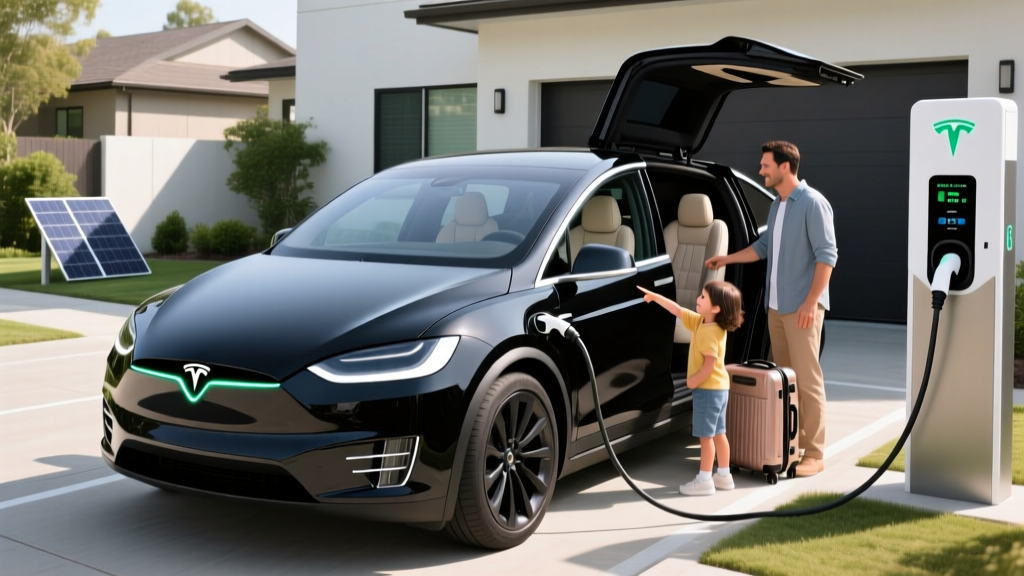
For home charging, the Tesla Wall Connector at 48 amps (requiring a 60-amp circuit) delivers 11.5 kW, replenishing a full 100 kWh pack in roughly 9–10 hours. Most owners who plug in nightly never need the full capacity anyway. A typical 50-mile daily commute uses about 16.5 kWh, which the Wall Connector replaces in under 90 minutes. Installation of a 60-amp circuit with a Wall Connector typically runs $800–$2,000 depending on panel proximity and local permitting, on top of the $475 Wall Connector hardware cost.
Performance & Driving Dynamics
The dual-motor AWD powertrain produces 670 horsepower and rockets the 5,100-pound Model X from 0–60 mph in 3.8 seconds. That's sports-sedan acceleration in a three-row family SUV, and it never fails to surprise passengers. The instant torque delivery means highway merging and passing require zero planning—just press the pedal.
The adaptive air suspension provides a comfortable ride with adjustable ride height. You can raise the vehicle for rough driveways or lower it at highway speeds for improved aerodynamics and efficiency. The air suspension also enables the "easy entry" feature, lowering the car when parked to make loading children into car seats marginally less of a back-straining exercise.
Handling is competent rather than engaging. The Model X carries its mass noticeably in corners, and the steering, while precise, lacks the feedback of a performance-oriented vehicle. For a family hauler, the ride quality and straight-line composure are excellent. For canyon carving, you'd want something lighter.
Interior Space, 7-Seat Layout & Cargo
The 7-seat configuration replaces the second-row captain's chairs with a three-across bench and adds a two-seat third row. Here's how the space breaks down:
- Front headroom: 41.7 inches
- Second-row legroom: 41.0 inches
- Third-row legroom: 32.7 inches
- Cargo behind 3rd row: 15.8 cu ft
- Cargo behind 2nd row (3rd row folded): 43.9 cu ft
- Max cargo (all rear seats folded): 81.4 cu ft
- Frunk (front trunk): 6.6 cu ft
The third row is best suited for children or short-trip adult passengers. At 32.7 inches of legroom, adults over 5'8" will find their knees pressed into the second-row seatback on longer journeys. This is a common limitation of mid-size SUV third rows—the Rivian R1S and Kia EV9 offer marginally more third-row space, though the EV9 sacrifices range.
The falcon-wing rear doors remain the Model X's most polarizing feature. They open upward and outward with articulated hinges, providing excellent overhead clearance for loading car seats and accessing the second and third rows in tight parking spaces. However, they require overhead clearance (they won't open fully in a low-ceiling garage without the obstacle-detection sensors limiting travel), and their motorized operation is slower than conventional doors. Maintenance and repair costs for the falcon-wing mechanisms have historically been higher than standard doors.
Pricing, Trims & Federal Tax Credit Eligibility
| Item | Amount |
|---|---|
| Model X Long Range AWD (7-seat) MSRP | $81,630 |
| Destination Fee | $1,995 |
| Typical As-Tested (with FSD, paint, wheels) | $93,000–$98,000 |
| Federal §30D Tax Credit | Not currently eligible* |
| Estimated Out-of-Pocket (before state incentives) | $83,625+ |
*Tax credit explanation: As of 2026, the Tesla Model X does not qualify for the $7,500 federal EV tax credit under IRS §30D. The vehicle's MSRP exceeds the $80,000 cap for SUVs (the base price of $81,630 is above the threshold before destination fees). Additionally, battery-critical-mineral and battery-component sourcing requirements under the Inflation Reduction Act further complicate eligibility for Tesla's supply chain. Always verify current eligibility at IRS.gov and consult a tax professional, as rules and manufacturer compliance statuses change.
The 7-seat option itself is a no-cost configuration choice on the Long Range trim—you select it instead of the standard 5-seat layout at no additional charge. The 6-seat layout (with second-row captain's chairs and a center console) is also available at no extra cost but eliminates the seventh seat.
Notable paid options include:
- Full Self-Driving (Supervised): $8,000 (or $99/month subscription)
- Premium paint colors: $1,500–$2,500 depending on color
- 22-inch turbine wheels: $5,500 (reduces range to ~311 miles EPA)
Driver Assistance, Tech & Standout Features
Tesla's Autopilot (standard) and Full Self-Driving Supervised ($8,000) are both SAE Level 2 driver-assistance systems. The driver must remain attentive, keep hands on the wheel (or demonstrate engagement via the cabin camera), and be prepared to take over at any moment. These systems are not self-driving. Only Level 4 services like Waymo operate without a human driver in designated areas.
The Model X's tech stack centers on a 17-inch center touchscreen running Tesla's proprietary infotainment OS. The system handles navigation, media, climate, vehicle settings, and a growing library of apps including Netflix, YouTube, and games (usable while parked). A secondary 8-inch screen in the rear seat provides climate controls and entertainment for second-row passengers.
Standard Autopilot includes adaptive cruise control, lane-centering, and automatic emergency braking. FSD Supervised adds automatic lane changes, traffic-light and stop-sign recognition, and navigation-guided on/off-ramp transitions. Real-world FSD performance has improved substantially through 2025–2026 neural-network updates, but it still requires active supervision and occasionally makes conservative or unexpected decisions in construction zones and complex intersections.
Other standout features:
- HEPA air filtration with "Bioweapon Defense Mode" (genuinely effective, not marketing fluff)
- Over-the-air updates that add features and improve performance post-purchase
- Sentry Mode dashcam surveillance while parked
- Dog Mode for climate-controlled pet safety
- 22-speaker audio system with immersive sound
- No Apple CarPlay or Android Auto—Tesla's closed ecosystem only
- Falcon-wing doors can be slow and require overhead clearance
- Panel gap quality remains inconsistent compared to German rivals
- No physical instrument cluster—all driving info is on the center screen
- Insurance premiums are typically 25–40% higher than comparable non-Tesla SUVs
How It Compares: Model X vs. Rival 7-Seat EVs
| Spec | Tesla Model X LR | Rivian R1S Dual-Motor | Kia EV9 GT-Line AWD |
|---|---|---|---|
| EPA Range | 335 mi | 321 mi (Max Pack: 410 mi) | 270 mi |
| Base MSRP | $81,630 | $79,900 | $73,900 |
| Peak DC Charge | 250 kW | 220 kW | 236 kW (800V) |
| 10–80% Time | ~30 min | ~34 min | ~24 min |
| 3rd-Row Legroom | 32.7 in | 34.5 in | 32.0 in |
| Max Cargo | 81.4 cu ft | 104.7 cu ft | 81.7 cu ft |
| 0–60 mph | 3.8 sec | 4.5 sec | 5.0 sec |
| Towing | 5,000 lbs | 7,700 lbs | 5,000 lbs |
| Fed. Tax Credit | No (MSRP cap) | Partial/No* | Yes (up to $7,500)* |
*Tax credit eligibility depends on battery sourcing, buyer income, and current IRS rules. Verify at IRS.gov.
The Rivian R1S offers more third-row space, vastly more cargo room, and superior off-road capability with a body-on-frame platform. Its Max Pack variant achieves 410 miles of range, but at a price well above $100,000. The R1S also tows significantly more (7,700 lbs). If you prioritize interior volume and adventure capability over charging-network convenience, the R1S is a strong alternative.
The Kia EV9 undercuts the Model X by nearly $8,000 at base and may qualify for the federal tax credit (depending on sourcing compliance and buyer income). However, its 270-mile EPA range is a meaningful gap for road trips, and its third-row legroom is slightly tighter. The EV9's 800V architecture enables faster 10–80% charging, but you'll need compatible chargers to exploit it.
- You road-trip frequently and value Supercharger network reliability
- You want 335 miles of range and sports-sedan acceleration
- You prioritize over-the-air updates and a mature software ecosystem
- Your third-row passengers are primarily children
- You need adult-friendly third-row space and maximum cargo → Rivian R1S
- You want a lower price and possible $7,500 tax credit → Kia EV9
- You tow heavy trailers (boats, campers) → Rivian R1S (7,700 lbs)
- You need Apple CarPlay → any non-Tesla competitor
Warranty & Long-Term Ownership
Tesla covers the Model X battery and drive unit for 8 years or 150,000 miles (whichever comes first), with a minimum 70% capacity retention guarantee. The basic vehicle limited warranty is 4 years or 50,000 miles. These terms are competitive with the industry—Rivian offers 8 years/175,000 miles on the battery, while Kia offers 10 years/100,000 miles.
NMC battery degradation data from long-term Tesla fleet studies suggests typical capacity loss of approximately 10–12% over 150,000 miles. Most owners report a steep initial degradation curve (roughly 3–5% in the first year) followed by a long, gradual decline. To maximize longevity, Tesla recommends daily charging to 80–90% for NMC packs and only charging to 100% when needed for long trips.
Insurance is a significant ownership cost. Model X premiums average $2,800–$3,600 annually depending on state, driving record, and coverage level—substantially higher than a comparably priced gas SUV. Tesla Insurance is available in some states and can be competitive, but availability and pricing vary widely.
For detailed safety ratings, check the NHTSA vehicle safety page and IIHS.org for crash-test results as they become available for the 2026 model year.
Pros, Cons & Final Assessment
- 335-mile EPA range leads the 7-seat EV segment
- Supercharger network remains the most reliable DC fast-charging option
- 3.8-second 0–60 in a 5,100-lb SUV
- Best-in-class software and OTA update cadence
- HEPA air filtration is genuinely superior
- Falcon-wing doors ease car-seat loading in tight spaces
- $81,630 base price; no federal tax credit due to MSRP cap
- Third row fits children, not adults comfortably
- No Apple CarPlay or Android Auto
- Insurance premiums 25–40% above segment average
- Falcon-wing doors are slow and mechanically complex
- Build quality still lags European and Korean rivals
Frequently Asked Questions
What is the real-world range of the 2026 Tesla Model X 7-seat?
The EPA rates it at 335 miles. In real-world highway driving at 70–75 mph, expect 280–305 miles. In freezing temperatures, plan for 235–260 miles. City driving with regenerative braking can approach the EPA figure.
How fast does the Model X charge at home and on the road?
At a Tesla Supercharger (250 kW peak), 10–80% takes approximately 30 minutes with battery preconditioning. At home with a Wall Connector (11.5 kW), you gain about 34 miles of range per hour, fully replenishing overnight.
Does the Tesla Model X qualify for the $7,500 federal EV tax credit?
No. The Model X Long Range base MSRP of $81,630 exceeds the $80,000 SUV cap under IRS §30D. Battery-sourcing requirements further limit eligibility. Always verify current rules at IRS.gov and consult a tax professional.
Is the Model X 7-seat worth it over the Rivian R1S or Kia EV9?
The Model X wins on range, charging-network access, and performance. The Rivian R1S wins on cargo space, third-row comfort, towing, and off-road capability. The Kia EV9 wins on price and potential tax-credit eligibility. Your priorities determine the right choice.
How much does it cost to own a Model X over 5 years?
Between the $83,625+ purchase price, ~$15,000 in insurance, ~$3,500 in electricity (at $0.15/kWh, 50,000 miles), and minimal maintenance, 5-year ownership costs approximately $102,000–$108,000 before depreciation. Depreciation on the Model X has historically been 40–50% over 5 years, making total cost of ownership substantial.
Can adults sit in the third row of the Model X?
Adults under 5'8" can manage short trips. The 32.7 inches of legroom and limited headroom make the third row best suited for children or very occasional adult use. For regular adult third-row passengers, the Rivian R1S (34.5 inches) is more accommodating.